LC-MS/MS-driven metabolomic profiling and antibacterial efficacy of Nigella sativa (black seed) phytoconstituents against food-spoilage pathogens: A comprehensive structured review for biopreservation
DOI:
https://doi.org/10.14295/bjs.v6i4.966Keywords:
Nigella sativa, thymoquinone, LC-MS/MS, antibacterial activity, food biopreservationAbstract
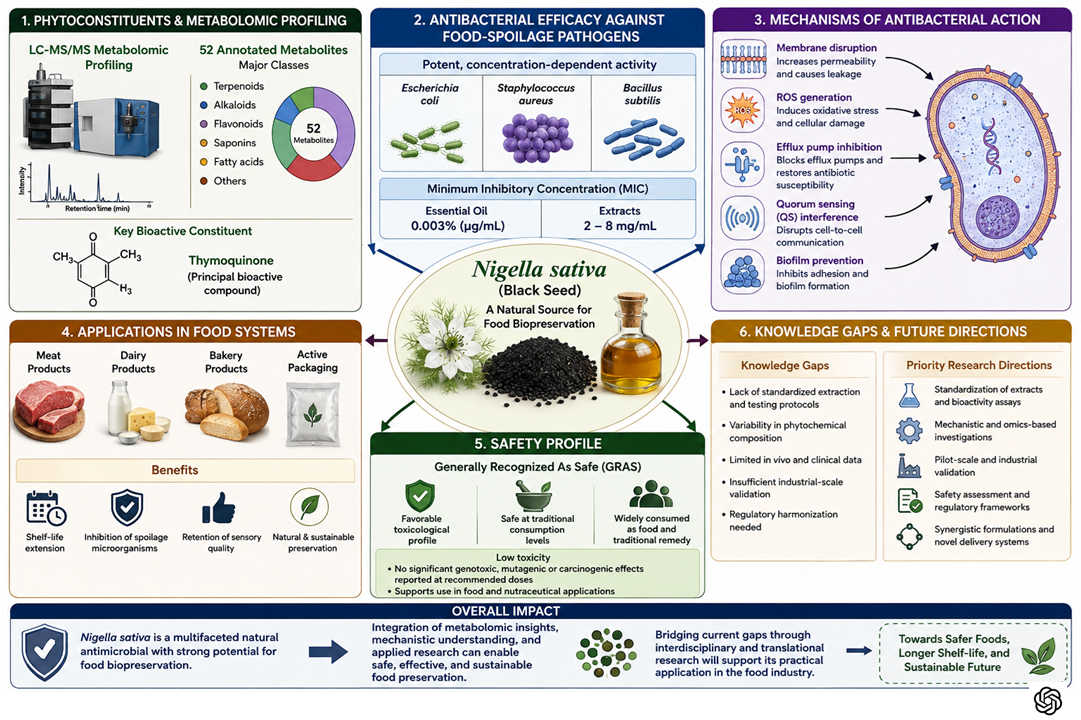
Nigella sativa (black seed) has emerged as a promising candidate for food biopreservation due to its rich phytochemical diversity and documented antimicrobial properties. This comprehensive review synthesizes current knowledge on the phytoconstituents, LC-MS/MS metabolomic profiling, antibacterial efficacy, mechanisms of action, food system applications, and safety of N. sativa. Metabolomic investigations have annotated 52 metabolites spanning terpenoids, alkaloids, flavonoids, saponins, and fatty acids, with thymoquinone as the principal bioactive constituent. Antibacterial studies demonstrate potent, concentration-dependent activity against major food-spoilage bacteria, including Escherichia coli, Staphylococcus aureus, and Bacillus subtilis, with MICs ranging from 0.003% (μg mL-1) for essential oil to 2-8 mg mL-1 for extracts. Mechanistic insights reveal multi-target actions including membrane disruption, ROS generation, efflux pump inhibition, QS interference, and biofilm prevention. Applications across meat, dairy, bakery, and active packaging systems demonstrate shelf-life extension with acceptable sensory properties. Nigella sativa enjoys GRAS status with favorable toxicological profiles at traditional consumption levels. This review identifies critical knowledge gaps, including lack of standardized protocols and industrial-scale validation, and recommends priority research directions for translational food safety applications.
References
Abbas, M., Gururani, M. A., Ali, A., Bajwa, S., Hassan, R., Batool, S. W., Imam, M., & Wei, D. (2024). Antimicrobial properties and therapeutic potential of bioactive compounds in Nigella sativa: A review. Molecules, 29(20), 4914. https://doi.org/10.3390/molecules29204914
Ahmad, A. A. M., Abdelgalil, S. Y., Khamis, T., Abdelwahab, A. M. O., Atwa, D. N., & Elmowalid, G. A. (2024). Thymoquinone's potent impairment of multidrug-resistant Staphylococcus aureus NorA efflux pump activity. Scientific Reports, 14, 16483. https://doi.org/10.1038/s41598-024-65991-5
Ahmad, A., Husain, A., Mujeeb, M., Khan, S. A., Najmi, A. K., Siddique, N. A., Damanhouri, Z. A., & Anwar, F. (2013). A review on therapeutic potential of Nigella sativa: A miracle herb. Asian Pacific Journal of Tropical Biomedicine, 3(5), 337-352. https://doi.org/10.1016/S2221-1691(13)60075-1
Alam, M. M., Yasmin, M., Nessa, J., & Ahsan, C. R. (2010). Antibacterial activity of chloroform and ethanol extracts of black cumin seeds (Nigella sativa) against multi-drug resistant human pathogens under laboratory conditions. Journal of Medicinal Plant Research, 4(18), 1901-1905. https://hero.epa.gov/reference/3697379/
Albakry, Z., Karrar, E., Ahmed, I. A. M., Oz, E., Proestos, C., Sheikha, A. F. E., Oz, F., Wu, G., & Wang, X. (2022). Nutritional composition and volatile compounds of black cumin (Nigella sativa L) seed, fatty acid composition and tocopherols, polyphenols, and antioxidant activity of its essential oil. Horticulturae, 8(7), 575. https://doi.org/10.3390/horticulturae8070575
Alu’datt, M. H., Rababah, T., Al-u’-datt, D. G. F., Gammoh, S., Alkandari, S., Allafi, A., Alrosan, M., Kubow, S., & Al-Rashdan, H. K. (2024). Designing novel industrial and functional foods using the bioactive compounds from Nigella sativa L. (black cumin): Biochemical and biological prospects toward health implications. Journal of Food Science, 89(4), 1865-1893. https://doi.org/10.1111/1750-3841.16981
Al-Kaabi, A. B., Davati, N., & Karami, M. (2024). Effect of Nigella sativa L. essential oil on oxidative stability and microbial growth of local white Feta cheese. International Food Research Journal, 31(3), 567-577. https://doi.org/10.47836/ifrj.31.3.03
Alhelli, A. M., Al-Ibady, Q. A. N. K., & Obaidi, H. (2024). Comparison the influence of two types of black cumin oil (Nigella sativa L.) on some physicochemical, microbiological and sensory evaluation of processed cheese. IOP Conference Series: Earth and Environmental Science, 1371(6), 062003. https://doi.org/10.1088/1755-1315/1371/6/062003
Al-Rabia, M. W., Asfour, H. Z., Alhakamy, N. A., Abdulaal, W. H., Ibrahim, T. S., Abbas, H. A., Salem, I. M., Hegazy, W. A. H., & Nazeih, S. I. (2024). Thymoquinone is a natural antibiofilm and pathogenicity attenuating agent in Pseudomonas aeruginosa. Frontiers in Cellular and Infection Microbiology, 14, 1382289. https://doi.org/10.3389/fcimb.2024.1382289
Al-Shabib, N. A., Husain, F. M., Ahmed, F., Khan, R. A., Ahmad, I., Alsharaeh, E., Khan, M. S., Hussain, A., Rehman, M. T., Yusuf, M., Hassan, I., Khan, J. M., Ashraf, G. M., Alsalme, A., Al-Ajmi, M. F., Tarasov, V. V., & Aliev, G. (2016). Biogenic synthesis of Zinc oxide nanostructures from Nigella sativa seed: Prospective role as food packaging material inhibiting broad-spectrum quorum sensing and biofilm. Scientific Reports, 6, 36761. https://doi.org/10.1038/srep36761
Arshad, M. T., Maqsood, S., Ikram, A., & Abdullahi, M. A. (2025). Functional, nutraceutical, and pharmacological properties of black seed (Nigella sativa). Food Science & Nutrition, 13(8), e70725. https://doi.org/10.1002/fsn3.70725
Ayache, N. E., Ayache, N. E., Jabbour, M., & Krayem, M. (2025). Development and evaluation of a multi-ingredient functional spread incorporating Olea europaea, Nigella sativa, and Sesamum indicum. Sciforum. The 6th International Electronic Conference on Foods. Available at: https://sciforum.net/paper/25101. Accessed on: July 12, 2026.
Bhatti, S. A., Hussain, M. H., Mohsin, M. Z., Mohsin, A., Zaman, W. Q., Huo, M., Iqbal, M. W., Siddiqui, S. A., & Korma, S. A. (2022). Evaluation of the antimicrobial effects of Capsicum, Nigella sativa, Musa paradisiaca L., and Citrus limetta: A review. Frontiers in Sustainable Food Systems, 6, 1052345. https://doi.org/10.3389/fsufs.2022.1043823
Burdock, G. A. (2021). Assessment of black cumin (Nigella sativa L.) as a food ingredient and putative therapeutic agent. Regulatory Toxicology and Pharmacology, 128, 105088. https://doi.org/10.1016/j.yrtph.2021.105088
Chaieb, K., Kouidhi, B., Jrah, H., Mahdouani, K., & Bakhrouf, A. (2011). Antibacterial activity of thymoquinone, an active principle of Nigella sativa and its potency to prevent bacterial biofilm formation. BMC Complementary and Alternative Medicine, 11, 29. https://doi.org/10.1186/1472-6882-11-29
Chen, H., Ji, P. C., Qi, Y. H., Chen, S. J., Wang, C. Y., Yang, Y. J., Zhao, X. Y., & Zhou, J. W. (2023). Inactivation of Pseudomonas aeruginosa biofilms by thymoquinone in combination with nisin. Frontiers in Microbiology, 13. https://doi.org/10.3389/fmicb.2022.1029412
Dey, S., Bhattacharya, S., & Chakraborty, S. (2025). Antibacterial mechanism of thymoquinone against Shigella flexneri: A multi-target approach. Journal of Applied Microbiology, 136(2), 1-12. https://doi.org/10.1093/jambio/lxae123
Fan, Q., Liu, C., Gao, Z., Hu, Z., Wang, Z., Xiao, J., Yuan, Y., & Yue, T. (2021). Inactivation effect of thymoquinone on Alicyclobacillus acidoterrestris vegetative cells, spores, and biofilms. Frontiers in Microbiology, 12, 679808. https://doi.org/10.3389/fmicb.2021.679808
Farag, M. A., Saad, H. H., & Hegazi, N. M. (2020). Rediscovering Nigella seeds bioactives chemical composition using metabolomics technologies. In: Black cumin (Nigella sativa) seeds: Chemistry, Technology, Functionality, and Applications. Chapter, 131-151. https://doi.org/10.1007/978-3-030-48798-0_10
Farag, M. A., Gad, H. A., Heiss, A. G., & Wessjohann, L. A. (2014). Metabolomics driven analysis of six Nigella species seeds via UPLC-qTOF-MS and GC–MS coupled to chemometrics. Food Chemistry, 151, 333-342. https://doi.org/10.1016/j.foodchem.2013.11.032
Ferizi, R., Ramadan, M. F., & Maxhuni, Q. (2023). Black seeds (Nigella sativa) medical application and pharmaceutical perspectives. Journal of Pharmacy & BioAllied Sciences, 15(2), 63-67. https://doi.org/10.4103/jpbs.jpbs_364_22
Gupta, I., & Peddha, M. S. (2024). Characterization of polyphenols profile, antioxidant, and in vitro activities of Nigella sativa L. (black cumin) seed oleoresin. Food Measure, 18, 2205-2215. https://doi.org/10.1007/s11694-023-02311-x
Gwiazdowski, R., Gwiazdowska, D., Juś, K., Marchwińska, K., Frąk, S., Popowski, D., Pawlak-Lemańska, K., Uwineza, P. A., & Padewska, D. (2025). The effect of the extraction method on the content of bioactive compounds and the biological activity of Nigella sativa extracts. Molecules, 30(24), 4736. https://doi.org/10.3390/molecules30244736
Habashy, A. H. A., El-Dien, W. M. A., Hussein, M. A. M., & Darwish, W. S. (2021). Prevalence of Staphylococcus aureus and Salmonella species in retailed chicken meat with a reduction trial using Nigella sativa and rosemary essential oils. Slovenian Veterinary Research, 58(24), 299-305. https://doi.org/10.26873/SVR-1449-2021
Halagarda, M., Tlałka, M., Juszczak, L., & Lorenzo, J. M. (2025). Functional fat substitution with black cumin (Nigella sativa) oil to improve the nutritional profile of traditional Polish wild boar sausages. Animal Science Journal, 96(1), e70125. https://doi.org/10.1111/asj.70125
Halamova, K., Kokoska, L., Flesar, J., Sklenickova, O., Svobodova, B., & Marsik, P. (2010). In vitro antifungal effect of black cumin seed quinones against dairy spoilage yeasts at different acidity levels. Journal of Food Protection, 73(12), 2291-2295. https://doi.org/10.4315/0362-028x-73.12.2291
Hammond, S. T., Brown, J. H., Burger, J. R., Flanagan, T. P., Fristoe, T. S., Mercad0-Silva, N., Nekola, J. C., & Okie, J. G. (2015). Food spoilage, storage, and transport: Implications for a sustainable future. BioScience, 65(8), 758-768. https://doi.org/10.1093/biosci/biv081
Hannan, M. A., Rahman, M. A., Sohag, A. A. M., Uddin, M. J., Dash, R., Sikder, M. H., Rahman, M. S., Timalsina, B., Munni, Y. A., Sarker, P. P., Alam, M., Mohibbullah, M., Haque, M. N., Jahan, I., Hossain, M. T., Afrin, T., Rahman, M. M., Tahjib-Ul-Arif, M., Mitra, S., & Kim, B. (2021). Black cumin (Nigella sativa L.): A comprehensive review on phytochemistry, health benefits, molecular pharmacology, and safety. Nutrients, 13(6), 1784. https://doi.org/10.3390/nu13061784
Hossain, M. S., Sharfaraz, A., Dutta, A., Ahsan, S., Masud, M. A., Ahmed, I. A., Goh, B. H., Urbi, Z., Moklesur, M., Sarker, R., & Ming, L. C. (2021). A review of ethnobotany, phytochemistry, antimicrobial pharmacology and toxicology of Nigella sativa L. Biomedicine & Pharmacotherapy, 143, 112192. https://doi.org/10.1016/j.biopha.2021.112192
Kadem, S., Al-Obaidi, J. R., & Al-Taie, L. H. (2017). The role of medicinal plants in primary healthcare: A WHO perspective. Journal of Herbal Medicine, 9, 45-52.
Khan, S., Ali, M., Albratty, M. M. A., Najmi, A. Y., Azeem, U., Khan, S. A., & Rather, M. A. (2022). Nigella sativa: From chemistry to medicine. Chapter 2, Black Seeds (Nigella sativa), 29-62. Elsevier. https://doi.org/10.1016/B978-0-12-824462-3.00014-7
Kolayli, S., Kazaz, G., Özkök, A., Keskin, M., Kara, Y., Kanbur, E. D., & Ertürk, Ö. (2023). The phenolic composition, aroma compounds, physicochemical and antimicrobial properties of Nigella sativa L. (black cumin) honey. European Food Research and Technology, 249, 653-664. https://doi.org/10.1007/s00217-022-04160-2
Kumari, V. P., & Fathima, S. (2025). The effect of Nigella sativa oil on physicochemical, antioxidant properties, and shelf life of savory cake. Research and Innovation in Food Science and Technology, 11(4), 367-382. https://doi.org/10.22101/JRIFST.2022.342704.1360
Madhumala, Y., & Soraganvi, V. S. (2024). Microbiology of food spoilage. In: Yaradoddi, J. S., Mati, B. S., Mudgulkar, S. B., & Agsar, D. (eds). Frotiers in Food Biotechnology, Chapter, 67-80 p. https://doi.org/10.1007/978-981-97-3261-6_5
Mashayekhi-Sardoo, H., Rezaee, R., & Karimi, G. (2020). Nigella sativa (black seed) safety: An overview. Asian Biomedicine, 14(4), 127-137. https://doi.org/10.1515/abm-2020-0020
Misiou, O., & Koutsoumanis, K. (2022). Climate change and its implications for food safety and spoilage. Trends in Food Science & Technology, 126, 142-152. https://doi.org/10.1016/j.tifs.2021.03.031
Mouwakeh, A., Radácsi, P., Pluhár, Z. S., Németh Zámboriné, É., Muránszky, G., Mohácsi-Farkas, C. S., & Kiskó, G. (2018). Chemical composition and antimicrobial activity of Nigella sativa crude and essential oil. Acta Alimentaria, 47(3), 379-386. https://doi.org/10.1556/066.2018.47.3.14
Mungurwade, N. P., Mujawar, S. S., & Kashte, S. B. (2026). Active multifunctional film loaded with Nigella sativa essential oil for food packaging. Journal of Applied Polymer Science, 143(14), e70415. https://doi.org/10.1002/app.70415
Ombarak, R. A., Elshamy, A. I., El Gendy, A. E-N. G., & Zakaria, A. (2025). Properties of cold pressed Egyptian and Ethiopian black seed oils and their impact on microbiological quality of commercially sold Kariesh cheese. (2025). Egyptian Journal of Veterinary Sciences. https://doi.org/10.21608/ejvs.2025.340653.2531
Pandey, R., Pandey, B., & Bhargava, A. (2025). An updated review on the phytochemistry and pharmacological activity of black cumin (Nigella sativa L.). Advanced Chinese Medicine, 2(1), 13-29. https://doi.org/10.1002/acm4.33
Pouris, J., Kolyva, F., Bratakou, S., Vogiatzi, C. A., Chaniotis, D., & Beloukas, A. (2024). The role of fungi in food production and processing. Applied Sciences, 14(12), 5046. https://doi.org/10.3390/app14125046
Rahman, A. U., Abdullah, A., Faisal, S., Mansour, B., & Yahya, G. (2024). Unlocking the therapeutic potential of Nigella sativa extract: Phytochemical analysis and revealing antimicrobial and antioxidant marvels. BMC Complementary Medicine and Therapies, 24, 266. https://doi.org/10.1186/s12906-024-04470-w
Rashwan, H. K., Mahgoub, S., Abuelezz, N. Z., & Amin, H. K. (2023). Black cumin seed (Nigella sativa) in inflammatory disorders: Therapeutic potential and promising molecular mechanisms. Drugs and Drug Candidates, 2(2), 516-537. https://doi.org/10.3390/ddc2020027
Roy, S., Saha, S. K., & Chakraborty, R. (2026). Efficacy of black cumin in edible film and edible coating formulation - a review. BIO Web of Conferences, 228, 05001. https://doi.org/10.1051/bioconf/202622805001
Ruqayyah, A. U., & Salihu, A. (2023). Phytochemical constituents, liquid chromatography-mass spectroscopy (LC-MS) profile and antibacterial activity of Nigella sativa (black seeds) against food spoilage organisms. UMYU Journal of Microbiology Research, 11(1), 124-134. https://doi.org/10.47430/ujmr.26111.013
Sadeghi, E., Imenhahidi, M., & Hosseinzadeh, H. (2023). Molecular mechanisms and signaling pathways of black cumin (Nigella sativa) and its active constituent, thymoquinone: a review. Molecular Biology Reports, 50, 5439-5454. https://doi.org/10.1007/s11033-023-08363-y
Sumara, A., Stachniuk, A., Trzpil, A., Bartoszek, A., Montowska, M., & Fornal, E. (2023). LC–MS metabolomic profiling of five types of unrefined, cold-pressed seed oils to identify markers to determine oil authenticity and to test for oil adulteration. Molecules, 28(12), 4754. https://doi.org/10.3390/molecules28124754
Shittu, A., Olorunsanya, A. O., Ofinni, O. O., Aliyu, Z. I., & Yaqoob, R. (2025). Organoleptic properties of minced broiler chicken meat preserved with black seed (Nigella sativa) powder. Nigerian Journal of Animal Production, 1709-1712. https://doi.org/10.51791/njap.vi.8737
Singh, S., Das, S. S., Singh, G., Schuff, C., de Lampasona, M. P., & Catalán, C. A. N. (2014). Composition, in vitro antioxidant and antimicrobial activities of essential oil and oleoresins obtained from black cumin seeds (Nigella sativa L.). BioMed Research International. https://doi.org/10.1155/2014/918209
Snyder, A. B., Martin, N., & Wiedmann, M. (2024). Microbial food spoilage: impact, causative agents and control strategies. Nature Reviews Microbiology, 22, 528-542. https://doi.org/10.1038/s41579-024-01037-x
Soliman, R. M., Salam, R. A. A., Eid, B. G., Khayyat, A., Neamatallah, T., Mesbah, M. K., & Hadd, G. M. (2020). Stability study of thymoquinone, carvacrol and thymol using HPLC-UV and LC-ESI-MS. Acta Pharmaceutica, 70(3). https://hrcak.srce.hr/226642
U. S. Food and Drug Administration. (2026). Substances Added to Food (formerly EAFUS): Caraway, black (Nigella sativa L.). Available at: https://hfpappexternal.fda.gov/scripts/fdcc/index.cfm?set=FoodSubstances&id=CARAWAYBLACK. Accessed on: July 11, 2026.
WHO. (2015). World Health Organization. WHO estimates of the global burden of foodborne diseases: Foodborne disease burden epidemiology reference group 2007–2015. World Health Organization. Available at: https://www.who.int/publications/i/item/9789241565165 Accessed on: 31 August, 2026.
WHO. (2019). World Health Organization. Ten threats to global health in 2019. World Health Organization. Available at: https://www.who.int/news-room/spotlight/ten-threats-to-global-health-in-2019. Accessed on: July 12, 2026.
Woldeamanuel, M. M., & Goshu, B. S. (2026). Chemical characterization and in vitro antioxidant and antimicrobial activities of Nigella sativa oil from Dire Dawa, Ethiopia. Romanian Journal of Biophysics, 36(1), 000-000. https://doi.org/10.59277/RJB.2026.1.04
Yang, H., Wang, S., Xhao, P., Yong, Q., Huang, Q., Al-Asmari, F., Sameeh, M. Y., Yang, B., Zhang, C., Wang, X., & Shi, C. (2025). Thymoquinone as a potent antimicrobial agent against Yersinia enterocolitica: Mechanisms of action and potential food safety applications. International Journal of Food Microbiology, 431, 111071. https://doi.org/10.1016/j.ijfoodmicro.2025.111071
Yasni, S., Syamsir, E., & Direja, E. H. (2009). Antimicrobial activity of black cumin extracts (Nigella sativa) against food pathogenic and spoilage bacteria. Microbiology Indonesia, 3(3), 146-150.
Yimer, E. M., Tuem, K. B., Karim, A., Ur-Rehman, N., & Anwar, F. (2019). Nigella sativa L. (black cumin): A promising natural remedy for wide range of illnesses. Evidence-Based Complementary and Alternative Medicine, 2019. https://doi.org/10.1155/2019/1528635
24ChemicalResearch. (2025). Cold pressed black seed oil market, global outlook and forecast 2025-2032. Available at: https://24chemicalresearch.com/reports/261197/global-cold-pressed-black-seed-oil-forecast-market-2024-2030-517. Accessed on: July 10, 2026.
360iResearch. (2026). Black seed oil market by form, application, distribution channel - Global forecast 2026-2032. Available at: https://www.giiresearch.com/report/ires2099598-black-seed-oil-market-global-forecast.html? Accessed on: July 31, 2026.
Downloads
Published
How to Cite
Issue
Section
License
Copyright (c) 2027 Belay Sitotaw Goshu

This work is licensed under a Creative Commons Attribution 4.0 International License.
Authors who publish with this journal agree to the following terms:
1) Authors retain copyright and grant the journal right of first publication with the work simultaneously licensed under a Creative Commons Attribution License that allows others to share the work with an acknowledgement of the work's authorship and initial publication in this journal.
2) Authors are able to enter into separate, additional contractual arrangements for the non-exclusive distribution of the journal's published version of the work (e.g., post it to an institutional repository or publish it in a book), with an acknowledgement of its initial publication in this journal.
3) Authors are permitted and encouraged to post their work online (e.g., in institutional repositories or on their website) prior to and during the submission process, as it can lead to productive exchanges, as well as earlier and greater citation of published work.