Comprehensive bioinformatic analysis identifies some indole derivatives for treating cTnT-associated hypertrophic cardiomyopathy
DOI:
https://doi.org/10.14295/bjs.v6i2.938Keywords:
hypertrophic cardiomyopathy, indole derivatives, docking serverAbstract
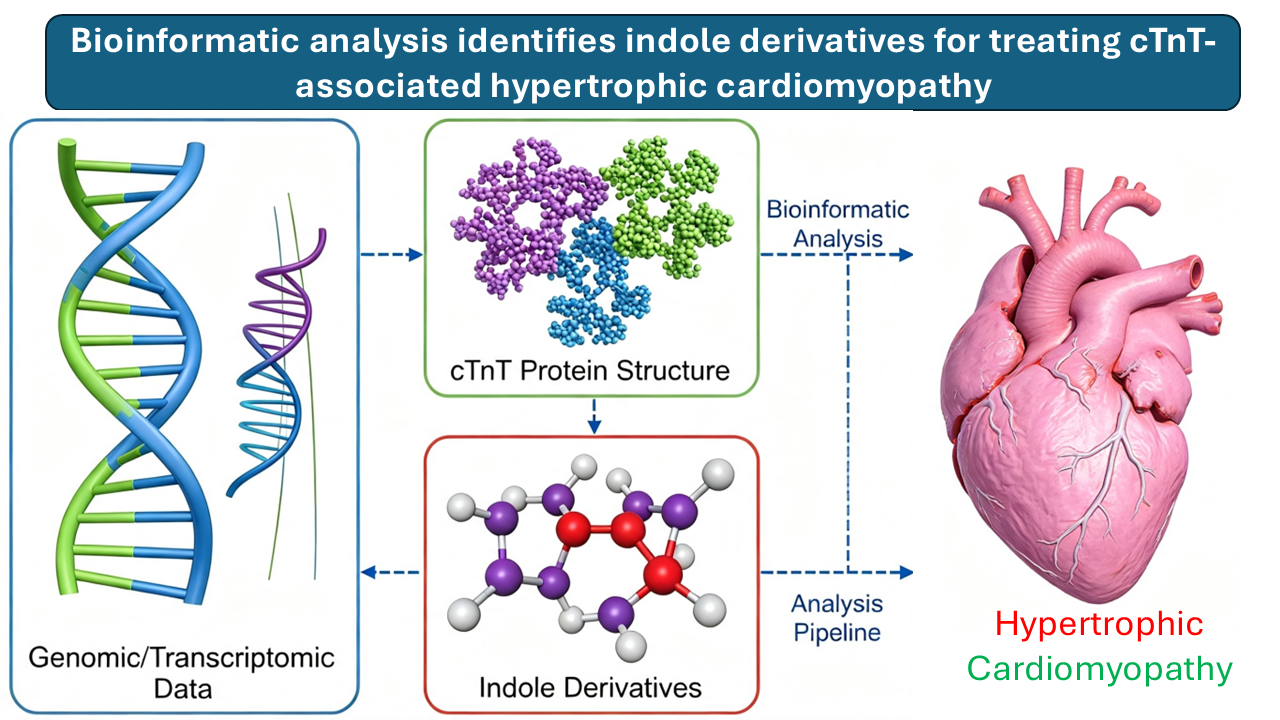
Alterations in cardiac troponin (cTnT) levels have been observed to be associated with the development of hypertrophic cardiomyopathy. It is worth noting that some drugs have been used to treat hypertrophic cardiomyopathy; however, these drugs act as myosin inhibitors. In the search for a therapeutic alternative for the treatment of this clinical pathology, this study aimed to determine the interaction of some indole derivatives (1-43) with cTnT using the 2n7l protein as a theoretical tool in the DockingServer program. Besides, the compounds indole, bepridil, levosimedam, and DPISTA were used as controls. The results showed differences in the number of amino acid residues involved in the docking of indole derivatives with the 2n7l protein surface compared to the controls. Other results indicate that the Ki values for indole derivatives 2, 4, 11, and 43 were lower compared with compounds 1, 3, 5-10, 12-42, beperidil, indole, and levosimedam. All these data suggest that compounds 2, 4, 11, and 43 may have good affinity for the 2n7l protein surface, which could lead to changes in the biological activity of cTnT. Therefore, these compounds could represent promising candidates for further experimental evaluation using a hypertrophic cardiomyopathy model.
References
Agrawal, M., Deval, V., & Gupta, A. (2020). Evaluation of conformational and spectral behavior and prediction of biological activity and chemical reactivity descriptors of Levosimendan. Journal of Molecular Structure, 1217, 128464. https://doi.org/10.1016/j.molstruc.2020.128464
Akbariqomi, M., Badri, T., Mohammadi, M., Sehri, S., & Farnoosh, G. (2024). Enhancement of the activity of organophosphorus hydrolase (OPH): An in silico approach using docking, molecular dynamics simulation, and MM-PBSA. Biointerface Research in Applied Chemistry, 14, 121. https://doi.org/10.33263/BRIAC145.121
Anan, R., Shono, H., Kisanuki, A., Arima, S., Nakao, S., & Tanaka, H. (1998). Patients with familial hypertrophic cardiomyopathy caused by a Phe110Ile missense mutation in the cardiac troponin T gene have variable cardiac morphologies and a favorable prognosis. Circulation, 98(5), 391-397. https://doi.org/10.1161/01.CIR.98.5.391
Anees, M. (2025). Molecular dynamic of protein-ligand interactions: Insights into drug design and development. Edutech Journal of Next-Gen Technologies and AI, 1(01), 31-36.
Aprahamian, M., Tikunova, S., Price, M., Cuesta, A., Davis, J., & Lindert, S. (2017). Successful identification of cardiac troponin calcium sensitizers using a combination of virtual screening and ROC analysis of known troponin C binders. Journal of chemical information and modeling, 57(12), 3056-3069. https://doi.org/10.1021/acs.jcim.7b00536
Askerova, U. (2023). Prediction of acute toxicity for (Z)-3-(2-phenylhydrazinylidene) benzofuran-2 (3H)-one and its derivatives for rats using GUSAR program. New Material Compounds & Applications, 7(1), 50-56.
Basciu, A., Athar, M., Kurt, H., Neville, C., Malloci, G., Muredda, F. C., & Vargiu, A. V. (2025). Toward the prediction of binding events in very flexible, allosteric, multidomain proteins. Journal of Chemical Information and Modeling, 65(4), 2052-2065. https://doi.org/10.1021/acs.jcim.4c01810
Baud, S., & de Azevedo, W. (2025). Protein-ligand docking simulations for drug discovery. Current Medicinal Chemistry, 32(28), 5879-5881. https://doi.org/10.2174/0109298673410629250520111827
Bazan, S., Oliveira, G., Silveira, C., Reis, F., Malagutte, K., Tinasi, L., & Okoshi, K. (2020). Hypertrophic cardiomyopathy: A review. Arquivos Brasileiros de Cardiologia, 115, 927-935. https://doi.org/10.36660/abc.20190802
Berendsen, H., Van Der Spoel, & Van Drunen, R. (1995). GROMACS: A message-passing parallel molecular dynamics implementation. Computer Physics Communications, 91(1-3), 43-56. https://doi.org/10.1016/0010-4655(95)00042-E
Borsi, J., Klepp, O., & Johan Moe, P. (1988). PharmCalc: Program for the calculation of clinical pharmacokinetic parameters of methotrexate. Cancer chemotherapy and pharmacology, 22(4), 339-343.
Bowman, J., Coldren, W., & Lindert, S. (2019). Mechanism of cardiac troponin C calcium sensitivity modulation by small molecules illuminated by umbrella sampling simulations. Journal of chemical information and modeling, 59(6), 2964-2972. https://doi.org/10.1021/acs.jcim.9b00256
Brieler, J., Breeden, M., & Tucker, J. (2017). Cardiomyopathy: an overview. American Family Physician, 96(10), 640-646.
Butzner, M., ElHabr, A. K., Farajkhah, K., Chhatwal, J., Ayer, T., Gebrehiwet, P., & Masri, A. (2026). Epidemiology of hypertrophic cardiomyopathy in the United States from 2016 to 2023. JACC: Advances, 5(2), 102552.
Cárdenas-Yong, E., Flores-Monroy, J., Arenaza-Corona, A., González-Sebastián, L., Flores-Alamo, M., Orjuela, A. L., & Morales-Morales, D. (2026). Synthesis, crystal structure, and bioactivity of two new levosimendan analogues. Journal of Molecular Structure, 146656. https://doi.org/10.1016/j.molstruc.2026.146656
Celej, M., Montich, G., & Fidelio, G. (2003). Protein stability induced by ligand binding correlates with changes in protein flexibility. Protein Science, 12(7), 1496-1506. https://doi.org/10.1110/ps.0240003
Coldren, W., Tikunova, S., Davis, J., & Lindert, S. (2020). Discovery of novel small-molecule calcium sensitizers for cardiac troponin C: A combined virtual and experimental screening approach. Journal of Chemical Information and Modeling, 60(7), 3648-3661. https://doi.org/10.1021/acs.jcim.0c00452
Daina, A., Michielin, O., & Zoete, V. (2017). SwissADME: a free web tool to evaluate pharmacokinetics, drug-likeness and medicinal chemistry friendliness of small molecules. Scientific Reports, 7(1), 42717.
Davis, B., Volk, H., Nguyen, O., Kamna, D., Chen, H., Barriales‐Villa, R., & Masri, A. (2025). Safety and efficacy of mavacamten and aficamten in patients with hypertrophic cardiomyopathy. Journal of the American Heart Association, 14(6), e038758. https://doi.org/10.1161/JAHA.124.038758
Dicorato, M., Citarelli, G., Mangini, F., Alemanni, R., Albanese, M., Cicco, S., & Dentamaro, I. (2025). Integrative approaches in the management of hypertrophic cardiomyopathy: A comprehensive review of current therapeutic modalities. Biomedicines, 13(5), 1256. https://www.mdpi.com/2227-9059/13/5/1256#
Fahed, A., Nemer, G., Bitar, F., Arnaout, S., Abchee, A., Batrawi, M., & Seidman, C. (2020). Founder mutation in N-terminus of cardiac troponin I causes malignant hypertrophic cardiomyopathy. Circulation: Genomic and Precision Medicine, 13(5), 444-452. https://doi.org/10.1161/CIRCGEN.120.002991
Falbo, E., Delre, P., & Lavecchia, A. (2025). From apo to ligand-bound: Unraveling PPARγ-LBD conformational shifts via advanced molecular dynamics. ACS Omega, 10(13), 13303-13318. https://doi.org/10.1021/acsomega.4c11128
Fu, L., Shi, S., Yi, J., Wang, N., He, Y., Wu, Z., & Cao, D. (2024). ADMETlab 3.0: an updated comprehensive online ADMET prediction platform enhanced with broader coverage, improved performance, API functionality and decision support. Nucleic Acids Research, 52(W1), W422-W431. https://doi.org/10.1093/nar/gkae236
Geske, J., Ommen, S., & Gersh, B. (2018). Hypertrophic cardiomyopathy: clinical update. JACC: Heart Failure, 6(5), 364-375.
Gil, V.; Guallar, V. (2013). pyRMSD: a Python package for efficient pairwise RMSD matrix calculation and handling. Bioinformatics, 29(18), 2363-2364. https://doi.org/10.1093/bioinformatics/btt402
Gomeni, R. (1984). PHARM-an interactive graphic program for individual and population pharmacokinetic parameter estimation. Computers in biology and medicine, 14(1), 25-34.
Grewal, S., Deswal, G., Grewal, A., & Guarve, K. (2025). Molecular dynamics simulations: Insights into protein and protein ligand interactions. Advances in Pharmacology, 103, 139-162. https://doi.org/10.1016/bs.apha.2025.01.007
Guazzelli, D., & Avila, M. (2025). Hypertrophic Cardiomyopathy in Brazil: Advances in Knowledge and Clinical Implications. Arquivos Brasileiros de Cardiologia, 122, e20250185. https://doi.org/10.36660/abc.20250185i
T. (1998). Merck molecular force field. I. Basis, form, scope, parametrization, and performance of MMFF94. Journal of Computational Chemistry, 17(5-6), 490-519. https://doi.org/10.1002/(SICI)1096-987X(199604)17:5/6%3C490::AID-JCC1%3E3.0.CO;2-P
Ho, C., Lever, H., DeSanctis, R., Farver, C., Seidman, J., & Seidman, C. (2000). Homozygous mutation in cardiac troponin T: implications for hypertrophic cardiomyopathy. Circulation, 102(16), 1950-1955.
Jia, F., Sun, J., Ren, J., Wang, M., Song, J., Hu, B., & Zhong, J. (2025). Levosimendan for myocardial protection in unstable angina patients undergoing elective percutaneous coronary intervention: A prospective randomized controlled trial. Eurasian Journal of Medicine and Oncology, 025260284. https://dx.doi.org/10.36922/EJMO025260284
Jin, Y., Che, W., Yang, J., Chang, S., Bao, W., Ren, X., & Hou, A. (2025). Classification, Diagnosis, and Prognosis of Cardiomyopathy: A Comprehensive Narrative Review. Reviews in Cardiovascular Medicine, 26(6), 36280. https://doi.org/10.31083/RCM36280
Kimura, A., Harada, H., Park, J., Nishi, H., Satoh, M., Takahashi, M., & Sasazuki, T. (1997). Mutations in the cardiac troponin I gene associated with hypertrophic cardiomyopathy. Nature Genetics, 16(4), 379-382.https://doi.org/10.1038/ng0897-379
Klein, B., Reiz, B., Robertson, I., Irving, M., Li, L., Sun, Y., & Sykes, B. (2018). Reversible covalent reaction of levosimendan with cardiac troponin C in vitro and in situ. Biochemistry, 57(15), 2256-2265. https://doi.org/10.1021/acs.biochem.8b00109
Klopman, G., & Rosenkranz, H. S. (1995). Toxicity estimation by chemical structure analysis: the TOX II program. Toxicology Letters, 79(1-3), 145-155. https://doi.org/10.1016/0378-4274(95)03366-S
Kokado, H., Shimizu, M., Yoshio, H., Ino, H., Okeie, K., Emoto, Y., & Mabuchi, H. (2000). Clinical features of hypertrophic cardiomyopathy caused by a Lys183 deletion mutation in the cardiac troponin I gene. Circulation, 102(6), 663-669. https://doi.org/10.1161/01.CIR.102.6.663
Lang, S., Braz, N., Slater, M., & Kidley, N. (2025). In silico methods for ranking Ligand–Protein interactions and predicting binding affinities: which method is right for you?. Journal of Medicinal Chemistry, 68(19), 19795-19799.https://doi.org/10.1021/acs.jmedchem.5c02582
Liu, W., Yang, L., Chen, Z., Wu, Y., & Lai, H. (2026). Efficacy and safety of levosimendan in acute heart failure patients with different body mass index: a multicenter, retrospective, observational real-world study. Frontiers in Cardiovascular Medicine, 13, 1790085.
Lopez-Ramos, M., Figueroa-Valverde, L., Rosas-Nexicapa, M., Cervantes-Ortega, C., Alvarez-Ramirez, M., & Diaz-Cedillo, F. (2024). Interaction of benzenesulfonamide derivatives with Smyd3 using a theoretical model. Brazilian Journal of Sciences, 3(1), 115-129. https://doi.org/10.14295/bjs.v3i1.455
Lorenzini, M., Norrish, G., Field, E., Ochoa, J., Cicerchia, M., Akhtar, M., & Elliott, P. (2020). Penetrance of hypertrophic cardiomyopathy in sarcomere protein mutation carriers. Journal of the American College of Cardiology, 76(5), 550-559.
Maron, B., Desai, M., Nishimura, R., Spirito, P., Rakowski, H., Towbin, J., & Sherrid, M. (2022). Diagnosis and evaluation of hypertrophic cardiomyopathy: JACC state-of-the-art review. Journal of the American College of Cardiology, 79(4), 372-389.
Maron, B., Ommen, S., Nishimura, R., McKenna, W., Rakowski, H., Sherrid, M., & Maron, M. (2026). Evolution and transformation of hypertrophic cardiomyopathy from a high risk to a treatable low mortality disease with contemporary clinical research strategies. Journal of the American Heart Association, 15(12), e047462. https://doi.org/10.1161/JAHA.125.047462
Möbius-Winkler, M., Laufs, U., & Lenk, K. (2024). The diagnosis and treatment of hypertrophic cardiomyopathy. Deutsches Ärzteblatt International, 121(24), 805. https://doi.org/10.3238/arztebl.m2024.0196
Morris, G., & Goodsell, D. (1998). Automated docking using a Lamarckian genetic algorithm and an empirical binding free energy function. Journal of Computational Chemistry, 19(14), 1639-1662. https://doi.org/10.1002/(SICI)1096-987X(19981115)19: 14%3C1639::AID-JCC10%3E3.0.CO;2-B
Mouton, J., Kinnear, C., Moolman-Smook, J., Herbst, P., Pellizzon, A., Goosen, A., & Brink, P. (2015). Diagnostic disparity and identification of two TNNI3 gene mutations, one novel and one arising de novo, in South African patients with restrictive cardiomyopathy and focal ventricular hypertrophy. Cardiovascular Journal of Africa, 26(2), 63. https://doi.org/10.5830/CVJA-2015-019
Nhlapho, S., Nyathi, M., Ngwenya, B., Dube, T., Telukdarie, A., Munien, I., & Chude-Okonkwo, U. (2024). Druggability of pharmaceutical compounds using Lipinski rules with machine learning. Scientia Pharmaceutica, 3(4), 177-192.
Ostman-Smith, I. (2014). Beta-blockers in pediatric hypertrophic cardiomyopathies. Reviews on Recent Clinical Trials, 9(2), 82-85. https://doi.org/10.2174/1574887109666140908125158
Ovaska, M., & Taskinen, J. (1991). A model for human cardiac troponin C and for modulation of its Ca2+ affinity by drugs. Proteins: Structure, Function, and Bioinformatics, 11(2), 79-94. https://doi.org/10.1002/prot.340110202
Papp, Z., Édes, I., Fruhwald, S., De Hert, S. G., Salmenperä, M., Leppikangas, H., & Follath, F. (2012). Levosimendan: molecular mechanisms and clinical implications: consensus of experts on the mechanisms of action of levosimendan. International journal of cardiology, 159(2), 82-87. https://doi.org/10.1016/j.ijcard.2011.07.022
Perez-Asensio, A., Llamas-Gomez, H., Lara-Palomo, A., Villar-Ruiz, A., Jimenez-Mendez, C., & Palomino-Doza, J. (2025). A New Era in the Management of Hypertrophic Cardiomyopathy. Reviews in Cardiovascular Medicine, 26(10), 44503. https://doi.org/10.31083/RCM44503
Pineda-Sanabria, S., Robertson, I., & Sykes, B. (2011). Estructura del trans-resveratrol en complejo con la proteína reguladora cardíaca troponina C. Bioquímica, 50(8), 1309-1320. https://doi.org/10.1021/bi101985j
Pinto, G., Chiarito, M., Puscas, T., Bacher, A., Donal, E., Reant, P., & Working Group of the French, R. E. M. Y. (2025). Comparative influences of beta blockers and verapamil on cardiac outcomes in hypertrophic cardiomyopathy. The American Journal of Cardiology, 235, 9-15. https://doi.org/10.1016/j.amjcard.2024.10.029
Prasanna, S.; Doerksen, R. Topological polar surface area: a useful descriptor in 2D-QSAR. Current Medicinal Chemistry 2009, 16(1), 21-41. https://doi.org/10.2174/092986709787002817
Roomi, M., Culletta, G., Longo, L., de Azevedo, W., Perricone, U., & Tutone, M. (2025). Docking in the Dark: Insights into Protein–Protein and Protein–Ligand Blind Docking. Pharmaceuticals, 18(12), 1777. https://doi.org/10.3390/ph18121777
Rosevear, P., & Finley, N. (2003). Molecular mechanism of levosimendan action: an update. Journal of molecular and cellular cardiology, 35(9), 1011-1015. https://doi.org/ 10.1016/S0022-2828(03)00202-5
Rutwick-Surya, U., & Praveen, N. (2021). A molecular docking study of SARS-CoV-2 main protease against phytochemicals of Boerhavia diffusa Linn. for novel COVID-19 drug discovery. Virus Disease, 32(1), 46-54.
Sardar, H. (2023). Drug like potential of Daidzein using SwissADME prediction: In silico Approaches. Phytonutrients, 02-08.
Savsin, H., & Tokarek, T. (2025). Comprehensive review: mavacamten and aficamten in hypertrophic cardiomyopathy. Biomedicines, 13(7), 1619. https://www.mdpi.com/2227-9059/13/7/1619#
Sedov, I., & Zuev, Y. (2025). Protein–ligand interactions: Recent advances in biophysics, biochemistry, and bioinformatics. International Journal of Molecular Sciences, 26(19), 9576. https://www.mdpi.com/1422-0067/26/19/9576#
Seghir, A., Mokhtar, M., Azzam, K., Nadia, B., Aytar, E., Saad, A., & Boumediene, T. (2025). Comprehensive chemical profiling of Moringa oleifera leaves extracts by LC–MS/MS followed by in silico ADMET prediction using swissADME. Biomeedical Chromatography, 39(6), e70110. https://doi.org/10.1002/ bmc.70110
Semsarian, C., Ingles, J., Maron, M., & Maron, B. (2015). New perspectives on the prevalence of hypertrophic cardiomyopathy. Journal of the American College of Cardiology, 65(12), 1249-1254.
Sikand, N., Stendahl, J., Sen, S., Lampert, R., & Day, S. (2025). Current management of hypertrophic cardiomyopathy. BMJ, 389. http://dx.doi.org/10.1136/bmj-2023-077274
Silverdal, J., Delavaran, T., Smith, J. G., Braun, O., Basic, C., & Thunström, E. (2026). Epidemiological trends in hypertrophic cardiomyopathy in adults—a Swedish nationwide registry study. European Journal of Heart Failure, 132. https://doi.org/10.1093/ejhf/xuag132
Sim, J., Kim, D., Kim, B., Choi, J., & Lee, J. (2025). Recent advances in AI-driven protein-ligand interaction predictions. Current Opinion in Structural Biology, 92, 103020. https://doi.org/10.1016/j.sbi.2025.103020
Solis, F., Wets, R. (1981). Minimization by Random Search Techniques. Mathematics and Operations Research, 6(1), 19-30. https://doi.org/10.1287/moor.6.1.19
Surya-Ulhas, R., & Malaviya, A. (2023). In silico validation of novel therapeutic activities of withaferin a using molecular docking and dynamics studies. Journal of Biomolecular Structure and Dynamic, 41(11), 5045-5056. https://doi.org/10.1080/07391102.2022.2078410
Urios, A., Largeron, M., Fleury, M. B., & Blanco, M. (2006). A convenient approach for evaluating the toxicity profiles of in vitro neuroprotective alkylaminophenol derivatives. Free Radical Biology and Medicine, 40(5), 791-800. https://doi.org/10.1016/j.freeradbiomed.2005.10.001
Valdés-Albuernes, J., Díaz-Pico, E., Alfaro, S., & Caballero, J. (2025). Advanced modeling of salt-inducible kinase (SIK) inhibitors incorporating protein flexibility through molecular dynamics and cross-docking. Scientific Reports, 15(1), 18868. https://doi.org/10.1038/s41598-025-03699-w
Valdés-Albuernes, J., Díaz-Pico, E., Alfaro, S., Caballero, J. (2024). Modeling of noncovalent inhibitors of the papain-like protease (PLpro) from SARS-CoV-2 considering the protein flexibility by using molecular dynamics and cross-docking. Frontiers in Molecular Biosciences, 11, 1374364. https://doi.org/10.3389/ fmolb.2024.1374364
Vanden Wijngaard, A., Volders, P., Van Tintelen, J., Jongbloed, J., Van Den Berg, M., Lekanne Deprez, R., & Smeets, B. (2011). Recurrent and founder mutations in the Netherlands: cardiac Troponin I (TNNI3) gene mutations as a cause of severe forms of hypertrophic and restrictive cardiomyopathy. Netherlands Heart Journal, 19(7), 344-351.
Varughese, J., Baxley, T., Chalovich, J., & Li, Y. (2011). A computational and experimental approach to investigate bepridil binding with cardiac troponin. The Journal of Physical Chemistry B, 115(10), 2392-2400. https://doi.org/10.1021/jp1094504
Velázquez-Libera, J., Durán-Verdugo, F., Valdés-Jiménez, A., Núñez-Vivanco, G., & Caballero, J. (2020). LigRMSD: A web server for automatic structure matching and RMSD calculations among identical and similar compounds in protein-ligand docking. Bioinformatics, 36(9), 2912-2914.
Venkatapathy, R., Moudgal, C. J., & Bruce, R. M. (2004). Assessment of the oral rat chronic lowest observed adverse effect level model in TOPKAT, a QSAR software package for toxicity prediction. Journal of Chemical Information and Computer Sciences, 44(5), 1623-1629.
Wexler, R., Elton, T., Pleister, A., & Feldman, D. (2009). Cardiomyopathy: an overview. American Family Physician, 79(9), 778.
Zhao, F., Wei, H., Lin, L., Wang, H., Zhang, Z., & Guo, L. (2025). Levosimendan versus dobutamine in septic cardiomyopathy: a randomized clinical trial on cardiac function and safety. Frontiers in Cardiovascular Medicine, 12, 1641604.https://doi.org/10.3389/fcvm.2025.1641604
Downloads
Published
How to Cite
Issue
Section
License
Copyright (c) 2027 Marcela Rosas-Nexticapa, Magdalena Álvarez-Ramírez, Enrique Bonilla-Zavaleta, Montserrat Alheli Melgarejo-Gutiérrez, Martha Paola Rascón-Díaz, Abril Ramírez-Higuera

This work is licensed under a Creative Commons Attribution 4.0 International License.
Authors who publish with this journal agree to the following terms:
1) Authors retain copyright and grant the journal right of first publication with the work simultaneously licensed under a Creative Commons Attribution License that allows others to share the work with an acknowledgement of the work's authorship and initial publication in this journal.
2) Authors are able to enter into separate, additional contractual arrangements for the non-exclusive distribution of the journal's published version of the work (e.g., post it to an institutional repository or publish it in a book), with an acknowledgement of its initial publication in this journal.
3) Authors are permitted and encouraged to post their work online (e.g., in institutional repositories or on their website) prior to and during the submission process, as it can lead to productive exchanges, as well as earlier and greater citation of published work.