Integrated ethnomedicine and ethnobotany of the Somali pastoralist people, Eastern Ethiopia: A qualitative-quantitative synthesis
DOI:
https://doi.org/10.14295/bjs.v5i12.920Keywords:
Somali pastoralists, ethnomedicine, indigenous knowledge, healthcare pluralism, ethnobotanyAbstract
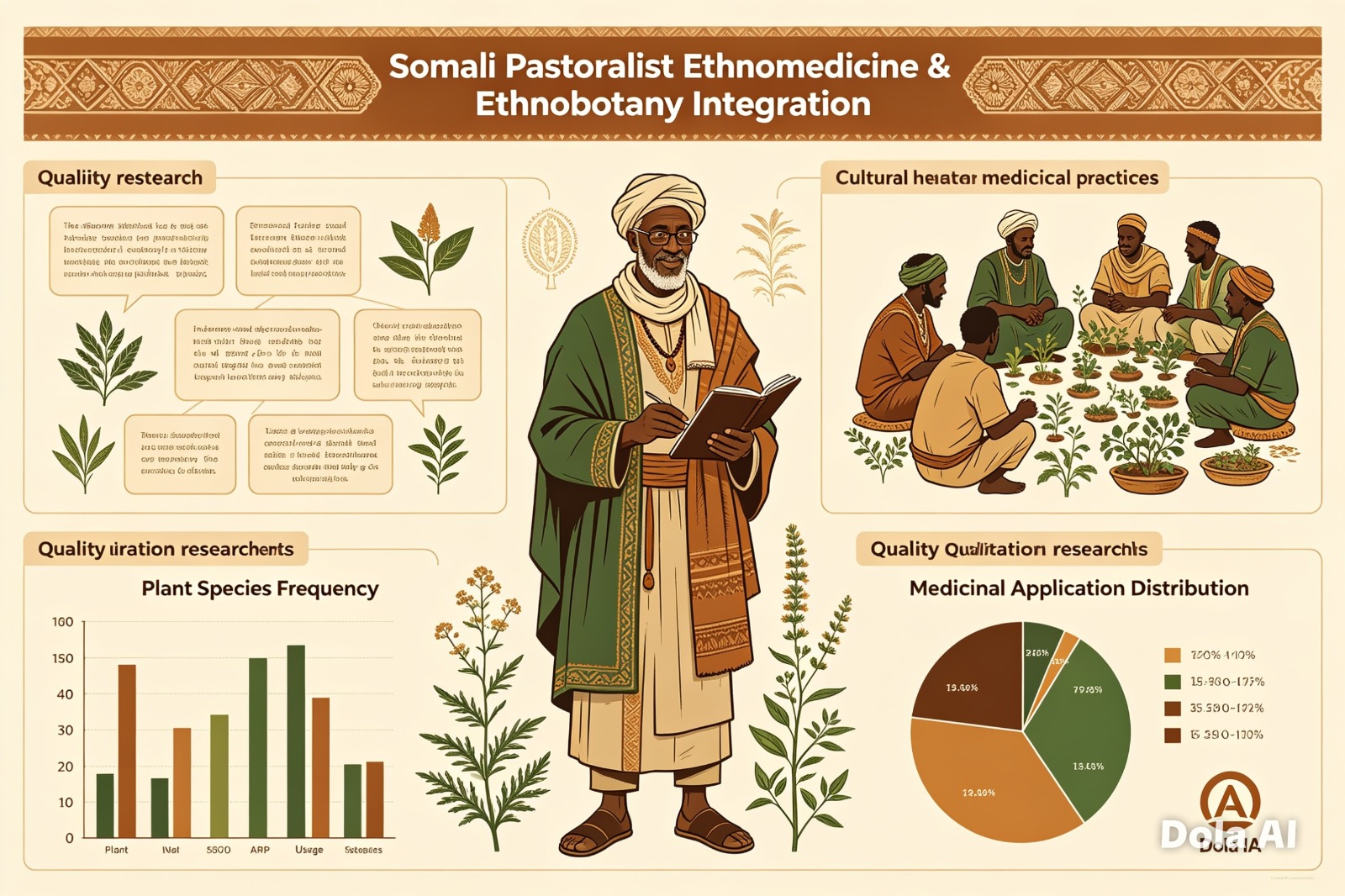
The Somali pastoralist communities of eastern Ethiopia, numbering approximately 11 million, maintain a rich ethnomedical system rooted in spiritual beliefs, arid-land lifestyles, and an Islamic worldview. This study integrates qualitative and quantitative approaches to document their disease classification, healing practices, and medicinal plant knowledge in the Jigjiga, Kebridehar, Shekosh, and Karamara districts. Data were collected from 55 key informants (20 men, 35 women) and six focus group discussions, supplemented by previous ethnobotanical inventories. Somalis classify diseases into natural (42%), human (28%), and spiritual (30%) origins. Knowledge transmission is primarily patrilineal (64%), with 21% acquired through apprenticeship and 15% via divine calling. Women healers (24% of practitioners) specialize in reproductive health, while male healers manage ruqya, xirsi, snakebites, and livestock care. Healthcare pluralism is pronounced, with 82% of the population utilizing both traditional and modern systems. Modern medicine is preferred for emergencies (84%) and immunization (81%), while traditional care is sought for mental and spiritual ailments (62%) due to better affordability and accessibility. A total of 213 medicinal plant species from 64 families were documented, with Fabaceae dominating (16%). Leaves (34.5%) and shrubs (45.1%) are most frequently used. Gastrointestinal disorders showed the highest Informant Consensus Factor (ICF = 0.88), followed by livestock ailments (ICF = 0.84). Notable species include Tamarindus indica (81.09% anti-malarial suppression) and endemic Halothamnus somalensis. This study underscores the resilience of Somali ethnomedicine and its complementary role to biomedicine, calling for integration of traditional practitioners, cross-training, community documentation, and conservation of key medicinal flora.
References
Altieri, M., & Nicholls, C. (2018). Biodiversity and pest management in agroecosystems. Boca Raton: CRC Press.
Alebie, G., & Mehamed, A. (2016). An ethno-botanical study of medicinal plants in Jigjiga town, capital city of Somali regional state of Ethiopia. International Journal of Herbal Medicine, 4(6), 168-175.
Al-Adawi, S., Al-Salmi, A., & Dorvlo, A. S. (2017). The role of culture in mental health: Perspectives from the Arabian Gulf. Transcultural Psychiatry, 54(2), 254-271. https://doi.org/10.1177/1363461517693159
Ayalew, S., Kebede, A., Mesfin, A., & Mulualem, G. M. (2017). Ethnobotanical study of medicinal plants used by agro pastoralist Somali people for the management of human ailments in Jeldesa Cluster, Dire Dawa Administration, Eastern Ethiopia. Journal of Medicinal Plants Research, 11(9), 171-187. https://doi.org/10.5897/JMPR2016.6292
Baum, E., Abdi, S., van Eeuwijk, P., Probst-Hensch, N., Zinsstag, J., Tschopp, R., & Vosseler, B. (2023). It is difficult for us to treat their pain': Health professionals' perceptions of Somali pastoralists in the context of pain management—A conceptual model. Medical Humanities, 49(4), 700-712. https://doi.org/10.1136/medhum-2022-012570
Bilal, A. I., Fenta, T. G., Gebre-Mariam, T., & Asres, K. (2017). Ethnomedicinal uses of plants among the Somali ethnic group in Jigjiga Woreda, Somali Regional State, Ethiopia. Ethiopian Journal of Health Development, 31(3), 1-10.
Degu, S., Berhe, T., & Gebremedhin, G. (2024). Ethnobotanical knowledge and practices of pastoralist communities on plants used as repellents and/or insecticides against insect vectors in the Korahaye zone of the Somali Regional State, Eastern Ethiopia. Journal of Ethnobiology and Ethnomedicine, 20(1). https://doi.org/10.1186/s13002-024-00696-4
Dube, F. F., Tadesse, K. B., & Tekie, H. (2011). Fresh, dried or smoked? Repellent properties of volatiles emitted from ethnomedicinal plant leaves against malaria and yellow fever vectors in Ethiopia. Malaria Journal, 10. https://doi.org/10.1186/1475-2875-10-375
Duguma, M., Awoke, A., & Kassa, Z. (2026). Ethnobotanical documentation and conservation assessment of medicinal plants used by the Somali community in Karamara forest patches, Eastern Ethiopia. Journal of Ethnobiology and Ethnomedicine, 22. https://doi.org/10.1186/s13002-026-00870-z
Gebrezgabiher, G., Gudesho, G., Chane, K., Siyum, Y., Tilahun, W., Gebremedhin, H., & Tadesse, A. (2025). Traditionally used phytomedicines and their associated threats in Bita district, southwestern Ethiopia. Journal of Ethnobiology and Ethnomedicine, 21(8). https://doi.org/10.1186/s13002-025-00768-2
Gwayisa, M. M. (2024). The exploration of indigenous knowledge systems of the Barolong boo Ratshidi with a special focus on traditional healing [Master's thesis, University of South Africa]. Institutional Repository. https://hdl.handle.net/10500/31853
Heinrich, M., Ankli, A., Frei, B., Weimann, C., & Sticher, O. (1998). Medicinal plants in Mexico: Healers' consensus and cultural importance. Social Science & Medicine, 47, 1863-1875.
Heinrich, M., Appendino, G., Efferth, T., Fürst, R., Izzo, A. A., Kayser, O., Pezzuto, J. M., & Viljoen, A. (2020). Best practice in research overcoming common challenges in phytopharmacological research. Journal of Ethnopharmacology, 246, 112230. https://doi.org/10.1016/j.jep.2019.112230
Janzen, J. M. (1978). The quest for therapy in lower Zaire. University of California Press. https://doi.org/10.1525/9780520316523
Lincoln, Y. S., & Guba, E. G. (1985). Naturalistic inquiry. Sage Publications.
Mesfin, A., Giday, M., Animut, A., & Teklehaymanot, T. (2012). Ethnobotanical study of antimalarial plants in Shinile District, Somali Region, Ethiopia, and in vivo evaluation of selected ones against Plasmodium berghei. Journal of Ethnopharmacology, 139(1), 221-227. https://doi.org/10.1016/j.jep.2011.11.006
Muluye, A. B., & Ayicheh, M. W. (2020). Medicinal plants utilized for hepatic disorders in Ethiopian traditional medical practices: A review. Clinical Phytoscience, 6(1), 1-12. https://doi.org/10.1186/s40816-020-00195-8
Olani, G. (2026). Ethnobotanical documentation and conservation assessment of medicinal plants used by the Somali community in Karamara forest patches, Eastern Ethiopia. Journal of Ethnobiology and Ethnomedicine, 22.
Phillips, O., Gentry, A. H., Reynel, C., Wilkin, P., & Gálvez-Durand, B. C. (1994). Quantitative ethnobotany and Amazonian conservation. Conservation Biology, 8, 225-248.
World Health Organization (WHO). (2013). WHO traditional medicine strategy 2014-2023 p. https://doi.org/10.1016/S0140-6736(13)61790-7
Wubu, K. A., Ngatie, A. H., Haylie, T. A., & Osman, A. D. (2023). Ethnobotanical study of traditional medicinal plants in Kebridehar and Shekosh districts, Korahi zone, Somali Region, Ethiopia. Heliyon, 9(12), e22152. https://doi.org/10.1016/j.heliyon.2023.e22152
Downloads
Published
How to Cite
Issue
Section
License
Copyright (c) 2026 Melaku Msresha Woldeamanueal, Belay Sitotaw Goshu, Beyene Dereje Degefa, Feven Tigistu Ayele, Dawit Daniel Dando

This work is licensed under a Creative Commons Attribution 4.0 International License.
Authors who publish with this journal agree to the following terms:
1) Authors retain copyright and grant the journal right of first publication with the work simultaneously licensed under a Creative Commons Attribution License that allows others to share the work with an acknowledgement of the work's authorship and initial publication in this journal.
2) Authors are able to enter into separate, additional contractual arrangements for the non-exclusive distribution of the journal's published version of the work (e.g., post it to an institutional repository or publish it in a book), with an acknowledgement of its initial publication in this journal.
3) Authors are permitted and encouraged to post their work online (e.g., in institutional repositories or on their website) prior to and during the submission process, as it can lead to productive exchanges, as well as earlier and greater citation of published work.