Public higher education as the knowledge industry: An activity-theoretical proposal for veterinary, animal, and health sciences
DOI:
https://doi.org/10.14295/bjs.v5i5.850Keywords:
activity theory, higher education, veterinary education, knowledge production, instrumental genesisAbstract
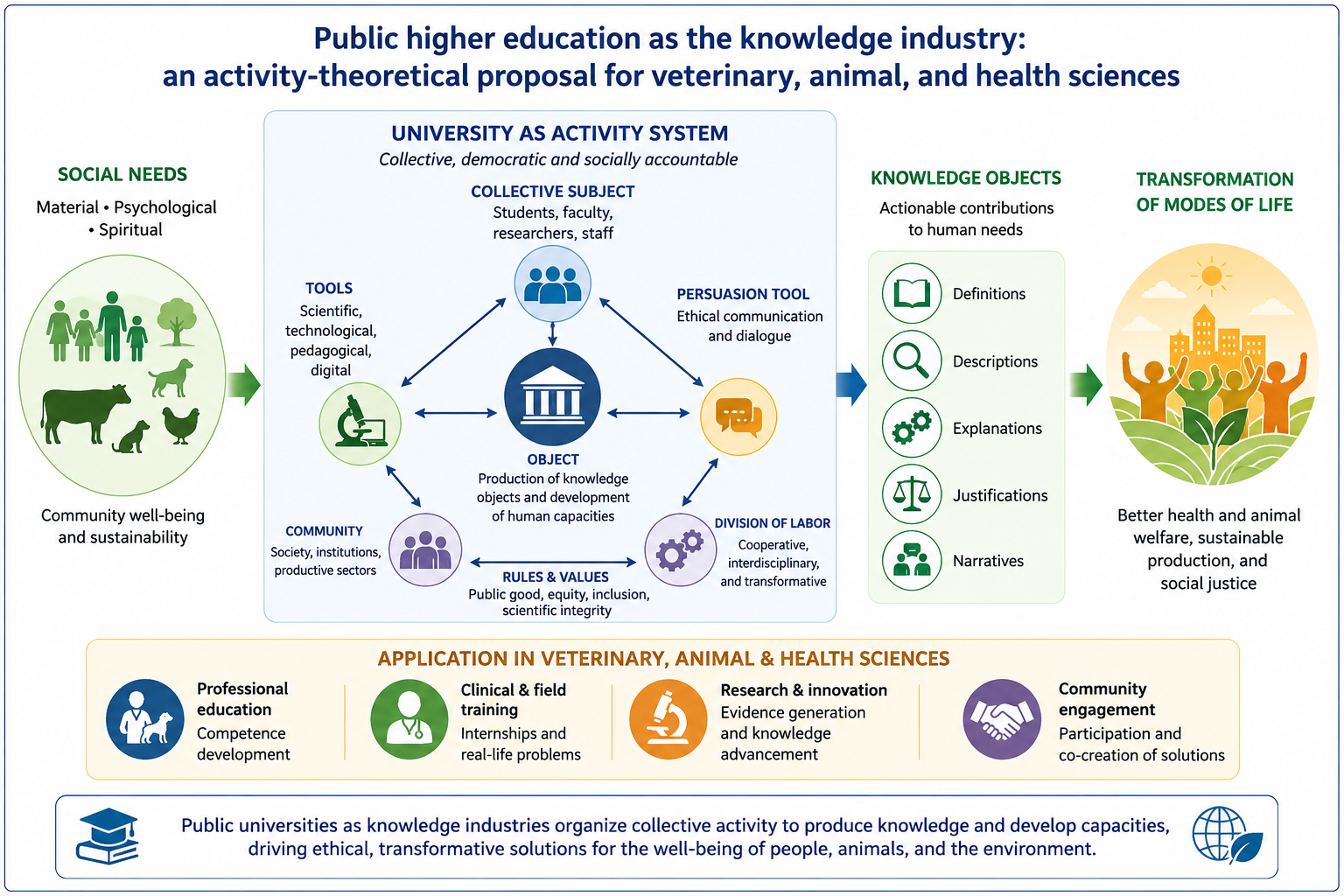
This article proposes public higher education as an “industry of knowledge” understood not as a market analogue but as a socially organized, democratically accountable form of collective work that produces knowledge objects and develops the human capacities required to satisfy shared needs. Using cultural-historical activity theory, the university is modeled as an activity system oriented to transforming modes of life through the satisfaction chain of mode of life, need, object, want, motive, and activity. The proposal emphasizes the development of activity-system elements rather than the exclusive optimization of products: the collective subject, the object, and the community, mediated by tools, a persuasion tool, and a cooperative division of labor. In veterinary medicine, animal husbandry, and health sciences, this model reframes professional and research formation as a developmental project that strengthens communicative, transformative, and evaluative competence while cultivating socialization, individuation, and personhood. The paper articulates ethical constraints on persuasion, foregrounds instrumental genesis and catachresis in tool development, and specifies how knowledge objects such as definitions, descriptions, explanations, justifications, and narratives become actionable contributions to material, psychological, and spiritual dimensions of need. Implications are offered for curriculum design, internships, research training, and community-engaged knowledge governance.
References
American Association of Veterinary Medical Colleges. (2025). AAVMC CBVE 2.0. https://www.aavmc.org/wp-content/uploads/2025/09/AAVMC-CBVE-2.0-2025-02.pdf
American Association of Veterinary Medical Colleges. (2026). Competency-based veterinary education. https://www.aavmc.org/resources/competency-based-veterinary-education/
Aristotle. (2007). On rhetoric: A theory of civic discourse (G. A. Kennedy, Trans.). Oxford University Press.
Béguin, P. (2007). Taking activity into account during the design process. Activités, 4(2). https://journals.openedition.org/activites/1727 DOI: https://doi.org/10.4000/activites.1727
Bruner, J. (1991). The narrative construction of reality. Critical Inquiry, 18(1), 1-21. https://doi.org/10.1086/448619 DOI: https://doi.org/10.1086/448619
Canale, M., & Swain, M. (1980). Theoretical bases of communicative approaches to second language teaching and testing. Applied Linguistics, 1(1), 1-47. https://doi.org/10.1093/applin/1.1.1 DOI: https://doi.org/10.1093/applin/1.1.1
Engeström, Y. (2001). Expansive learning at work: Toward an activity theoretical reconceptualization. Journal of Education and Work, 14(1), 133-156. https://doi.org/10.1080/13639080020028747 DOI: https://doi.org/10.1080/13639080020028747
Gibbons, M., Limoges, C., Nowotny, H., Schwartzman, S., Scott, P., & Trow, M. (1994). The new production of knowledge: The dynamics of science and research in contemporary societies. SAGE.
Habermas, J. (1984). The theory of communicative action, volume 1: Reason and the rationalization of society (T. McCarthy, Trans.). Beacon Press.
Hymes, D. (1972). On communicative competence. In: Pride, J. B., & Holmes, J. (Eds.), Sociolinguistics: Selected readings, 269-293 p, Penguin.
Maravita, A., & Iriki, A. (2004). Tools for the body (schema). Trends in Cognitive Sciences, 8(2), 79-86. DOI: https://doi.org/10.1016/j.tics.2003.12.008
Nowotny, H., Scott, P., & Gibbons, M. (2001). Re-thinking science: Knowledge and the public in an age of uncertainty. Polity Press.
Perelman, C., & Olbrechts-Tyteca, L. (1969). The new rhetoric: A treatise on argumentation. University of Notre Dame Press.
Petty, R. E., & Cacioppo, J. T. (1986). The elaboration likelihood model of persuasion. In: Communication and persuasion: Central and peripheral routes to attitude change, 1-24 p, Springer. https://doi.org/10.1007/978-1-4612-4964-1_1 DOI: https://doi.org/10.1007/978-1-4612-4964-1_1
Postholm, MB (2020). Premises and promises for expansive learning in teacher education. Frontiers in Education (5)41. https://doi.org/10.3389/feduc2020.00041 DOI: https://doi.org/10.3389/feduc.2020.00041
Pun, J. K. H. et al. (2020). An integrated review of the role of communication in veterinary clinical practice. BMC Veterinary Research, 16, 394. https://doi.org/10.1186/s12917-020-02558-2 DOI: https://doi.org/10.1186/s12917-020-02558-2
Rabardel, P., & Béguin, P. (2005). Instrument mediated activity: From subject development to anthropocentric design. Theoretical Issues in Ergonomics Science, 6(5), 429-461. https://doi.org/10.1080/14639220500078179 DOI: https://doi.org/10.1080/14639220500078179
Shaw, J. R., Adams, C. L., & Bonnett, B. N. (2004). What can veterinarians learn from studies of physician-patient communication about veterinarian-client-patient communication? Journal of the American Veterinary Medical Association, 224(5), 676-684. https://doi.org/10.2460/javma.2004.224.676 DOI: https://doi.org/10.2460/javma.2004.224.676
Stetsenko, A. (2017). The transformative mind: Expanding Vygotsky’s approach to development and education. Cambridge University Press. DOI: https://doi.org/10.1017/9780511843044
Stiggelbout, A. M., Van der Weijden, T., De Wit, M. P. T., Frosch, D., Legare, F., Montori, V. M., Trevena, L., & Elwyn, G. (2012). Shared decision making: Really putting patients at the centre of healthcare. BMJ, 344, e256. https://doi.org/10.1136/bmj.e256 DOI: https://doi.org/10.1136/bmj.e256
Toulmin, S. (1958). The uses of argument. Cambridge University Press.
UNESCO. (1998). World declaration on higher education for the twenty-first century: Vision and action. World Conference on Higher Education, Paris. https://unesdoc.unesco.org/ark:/48223/pf0000141952
Wenger, E. (1998). Communities of practice: Learning, meaning, and identity. Cambridge University Press. DOI: https://doi.org/10.1017/CBO9780511803932
Woolley, A. W., Chabris, C. F., Pentland, A., Hashmi, N., & Malone, T. W. (2010). Evidence for a collective intelligence factor in the performance of human groups. Science, 330(6004), 686-688. https://doi.org/10.1126/science.1193147 DOI: https://doi.org/10.1126/science.1193147
Downloads
Published
How to Cite
Issue
Section
License
Copyright (c) 2026 Federico de la Colina Flores, Heriberto Rodríguez Frausto, Paul Alexis de la Colina García, Tzitzi de la Colina García

This work is licensed under a Creative Commons Attribution 4.0 International License.
Authors who publish with this journal agree to the following terms:
1) Authors retain copyright and grant the journal right of first publication with the work simultaneously licensed under a Creative Commons Attribution License that allows others to share the work with an acknowledgement of the work's authorship and initial publication in this journal.
2) Authors are able to enter into separate, additional contractual arrangements for the non-exclusive distribution of the journal's published version of the work (e.g., post it to an institutional repository or publish it in a book), with an acknowledgement of its initial publication in this journal.
3) Authors are permitted and encouraged to post their work online (e.g., in institutional repositories or on their website) prior to and during the submission process, as it can lead to productive exchanges, as well as earlier and greater citation of published work.