Integrating qualitative and quantitative ethnomedicinal knowledge: A comprehensive assessment of traditional medicine in West Hararghe Zone, Oromia, Ethiopia
DOI:
https://doi.org/10.14295/bjs.v6i1.924Keywords:
ethnobotany, medicinal plants, ethnoveterinary medicine, traditional medicine, disease etiologyAbstract
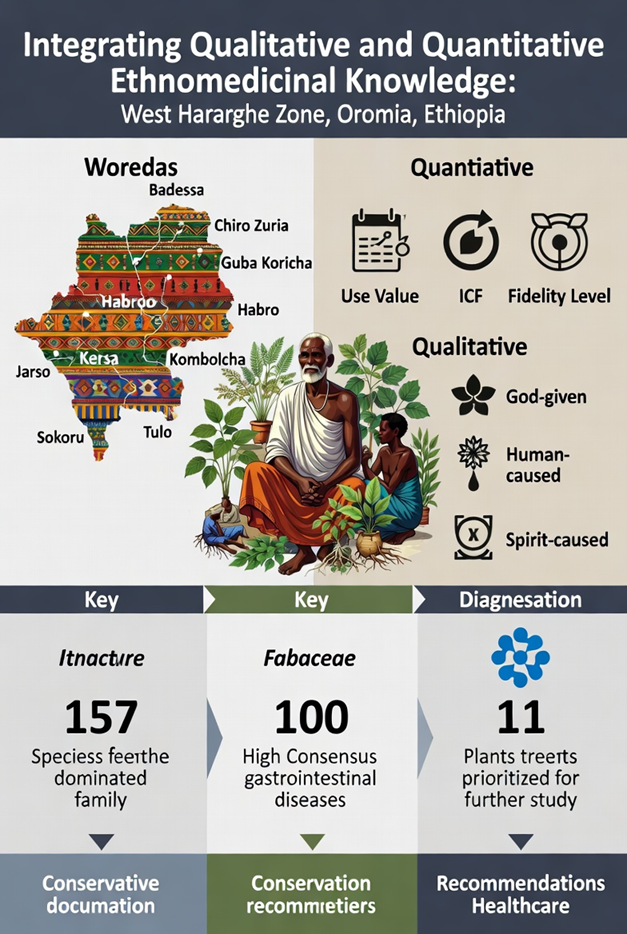
Traditional medicine remains the primary healthcare system for 80–90% of the Ethiopian population, particularly in rural areas, yet comprehensive ethnobotanical studies integrating quantitative indices with qualitative healers’ perspectives remain limited in the West Hararghe Zone. This mixed-methods study documented medicinal plants used for human and veterinary healthcare across eight woredas and explored traditional diagnostic practices, disease aetiologies, and knowledge transmission. Data were collected from 120 informants through semi-structured interviews, focus group discussions, participant observation, guided field walks, and case narratives. Ethnobotanical indices, including Use Value (UV), Relative Frequency of Citation (RFC), Informant Consensus Factor (ICF), Fidelity Level (FL), and a 40-point Drug Lead Priority matrix, were combined with thematic analysis. A total of 157 medicinal plant species representing 64 families and 123 genera were recorded, with Fabaceae being the dominant family (9.6%). Herbs (41.2%) collected mainly from wild habitats (68.4%) predominated, while leaves (38.5%) were the most frequently used plant part. Decoction (44.9%) and oral administration (61.2%) were the principal preparation and application methods. Gastrointestinal disorders showed the highest informant consensus (ICF = 0.92), whereas Croton macrostachyus exhibited the highest fidelity level for wound treatment (FL = 96.7%). Eleven species achieved high drug-lead priority scores (≥ 28/40), including three promising candidates (Maerua angolensis, Laggera crispata, and Cadaba farinosa). Traditional healers recognized three major disease aetiologies and employed five complementary diagnostic approaches, with 82% integrating traditional and biomedical healthcare. Notably, 28% of the documented medicinal plants were classified as endangered. These findings highlight the rich ethnomedicinal knowledge of West Hararghe, identify promising species for future pharmacological investigation, and emphasize the urgent need for conservation and preservation of traditional knowledge.
References
Akanaw, H. (2018). Analysis of traditional herbal medicine ingredients, preparations, disease identification methods and delivery in Gondar city and its surrounding. Ethiopian Renaissance Journal of Social Sciences and the Humanities, 5(2). https://erjssh.uog.edu.et/index.php/ERJSSH/article/view/103
Anbessa, B., Lulekal, E., Debella, A., & Hymete, A. (2024). Ethnobotanical study of medicinal plants in Dibatie district, Metekel zone, Benishangul Gumuz Regional State, western Ethiopia. Journal of Ethnobiology and Ethnomedicine, 20(1). https://doi.org/10.1186/s13002-024-00721-9 DOI: https://doi.org/10.1186/s13002-024-00723-7
Belayneh, A., Asfaw, Z., Demissew, S., & Bussa, N. F. (2021). Medicinal plants potential and use by pastoral and agro-pastoral communities in Erer Valley of Babile Wereda, Eastern Ethiopia. Journal of Ethnobiology and Ethnomedicine, 17(1), 19. https://doi.org/10.1186/s13002-021-00446-z DOI: https://doi.org/10.1186/s13002-021-00446-z
Berlowtiz, I., Pesantes, M. A., Palacios, C. C., Martin-Soelch, C., Wolf, U., & Maake, C. (2025). Towards culturally inclusive healthcare in Peru: Mapping epistemic concepts in contemporary indigenous Amazonian medicine – Traditional healers’ perspectives. PLOS Global Public Health. https://doi.org/10.1371/journal.pgph.0003912 DOI: https://doi.org/10.1371/journal.pgph.0003912
Bernard, H. R. (2018). Research methods in anthropology: Qualitative and quantitative approaches. 6th ed., Rowman & Littlefield. https://doi.org/10.4324/9781315176945
Bogale, M., Sasikumar, J. M., & Egigu, M. C. (2023). An ethnomedicinal study in Tulo district, west Hararghe zone, Oromia region, Ethiopia. Heliyon, 9(4), e15072. https://doi.org/10.1016/j.heliyon.2023.e15072 DOI: https://doi.org/10.1016/j.heliyon.2023.e15361
Braun, V., & Clarke, V. (2006). Using thematic analysis in psychology. Qualitative Research in Psychology, 3(2), 77-101. https://doi.org/10.1191/1478088706qp063oa DOI: https://doi.org/10.1191/1478088706qp063oa
Carruth, L. (2014). Camel milk, amoxicillin, and a prayer: Medical pluralism and medical humanitarian aid in the Somali Region of Ethiopia. Social Science & Medicine, 120, 405-412. https://doi.org/10.1016/j.socscimed.2014.03.005 DOI: https://doi.org/10.1016/j.socscimed.2014.03.007
Central Statistical Agency (CSA). (2007). Population and housing census of Ethiopia. https://doi.org/10.13140/RG.2.2.21688.52487
Chen, Z. (2024). Syncretism in Miao healing: Bridging shamanic practices and scientific treatments with religion, ritual, and local knowledge. Religions, 15(3), 320. https://doi.org/10.3390/rel15030320 DOI: https://doi.org/10.3390/rel15030320
Cochran, W. G. (1977). Sampling techniques. 3rd ed., John Wiley & Sons.
Cole, A. M., & Gallo, R. L. (2017). Antimicrobial peptides in human saliva. Journal of Oral Microbiology, 9(1), 132-145.
Creswell, J. W., & Poth, C. N. (2018). Qualitative inquiry and research design: Choosing among five approaches. 4th ed., Sage Publications. https://doi.org/10.4135/9781506330203
Cunningham, A. B., & Mbenkum, F. T. (1993). Sustainability of harvesting Prunus africana bark in Cameroon: A medicinal plant in international trade. UNESCO.
Egigu, M. C., & Mogesse, S. (2024). Ethnobotanical study of medicinal plants used to treat human ailments in Oda-Bultum district, West Hararghe zone of Oromia region, Ethiopia. Ethnobotany Research and Applications, 29, 1-35. https://ethnobotanyjournal.org/index.php/era/article/view/6244 DOI: https://doi.org/10.32859/era.29.56.1-35
Etkin, N. L. (2016). Ethnopharmacology: The conjunction of medical ethnography and the biology of therapeutic action. In: H. R. Bernard, H. R., & Gravlee, C. C., Eds., Handbook of methods in cultural anthropology, 521-546 p, Rowman & Littlefield.
Fassil, A., & Gashaw, G. (2019). An ethnobotanical study of medicinal plants in Chiro district, West Hararghe, Ethiopia. African Journal of Plant Science, 13(11), 309-323. https://doi.org/10.5897/AJPS2019.1915 DOI: https://doi.org/10.5897/AJPS2019.1911
Fetters, M. D., Curry, L. A., & Creswell, J. W. (2013). Achieving integration in mixed methods designs—Principles and practices. Health Services Research, 48(6pt2), 2134-2156. https://doi.org/10.1111/1475-6773.12117 DOI: https://doi.org/10.1111/1475-6773.12117
Foster, G. M. (1994). Hippocrates' Latin American legacy: Humoral medicine in the New World. Gordon & Breach.
Friedman, J., Yaniv, Z., Dafni, A., & Palewitch, D. (1986). A preliminary classification of the healing potential of medicinal plants, based on a rational analysis of an ethnopharmacological field survey among Bedouins in the Negev Desert, Israel. Journal of Ethnopharmacology, 16(2-3), 275-287. https://doi.org/10.1016/0378-8741(86)90094-2 DOI: https://doi.org/10.1016/0378-8741(86)90094-2
Gebissa, N., Tolossa, K., Gebresilassie, A., Aklilu, E., Bisrat, D., Kumsa, B., & Dugassa, S. (2025). Larvicidal effects os selected medicinal plant extracts against Anopheles arabiensis, Anopheles stephensi, and Aedes aegypti. Tropical Medicine and Health, 53. https://doi.org/10.1186/s41182-025-00879-2 DOI: https://doi.org/10.1186/s41182-025-00879-2
Gedlu, M. (2024). A comprehensive review on traditional medicinal plants in Ethiopia and their application for treatment of different diseases. Advances in Public Health, 2024. https://doi.org/10.1155/2024/5542990 DOI: https://doi.org/10.1155/2024/5542990
Giday, M., & Teklehaymanot, T. (2013). Ethnobotanical study of plants used in management of livestock health problems by Afar people of Ada'ar District, Afar Regional State, Ethiopia. Journal of Ethnobiology and Ethnomedicine, 9(1), 8. https://doi.org/10.1186/1746-4269-9-8 DOI: https://doi.org/10.1186/1746-4269-9-8
Giday, M., Asfaw, Z., Elmqvist, T., & Woldu, Z. (2003). An ethnobotanical study of medicinal plants used by the Zay people in Ethiopia. Journal of Ethnopharmacology, 85(1), 43-52. https://doi.org/10.1016/S0378-8741(02)00359-8 DOI: https://doi.org/10.1016/S0378-8741(02)00359-8
Giday, M., Teklehaymanot, T., Animut, A., & Mekonnen, Y. (2007). Medicinal plants of the Shinasha, Agew-awi and Amhara peoples in northwest Ethiopia. Journal of Ethnopharmacology, 110(3), 516-525. https://doi.org/10.1016/j.jep.2006.10.011 DOI: https://doi.org/10.1016/j.jep.2006.10.011
Gobbo-Neto, L., & Lopes, N. P. (2007). Medicinal plants: Factors of influence on the content of secondary metabolites. Química Nova, 30(2), 374-381. https://doi.org/10.1590/S0100-40422007000200026 DOI: https://doi.org/10.1590/S0100-40422007000200026
Goshu, B. S., & Ridwan, M. (2026), Spiritual health and healing in Ethiopia: A scoping review and thematic analysis of beliefs, practices, and gaps in healthcare integration. SIASAT Journal of Social, Cultural and Political Studies, 11 (3), 162-186
Green, E. C. (1999). Indigenous theories of contagious disease. Altamira Press. https://doi.org/10.4324/9781315804287
Guest, G., MacQueen, K. M., & Namey, E. E. (2012). Applied thematic analysis. Sage Publications. https://doi.org/10.4135/9781483384436 DOI: https://doi.org/10.4135/9781483384436
Gutema, B. T., & Mengstie, M. M. (2023). Perceived causes, diagnosis methods and treatment practices of mental illness among traditional healers of the Berta community in Assosa, Ethiopia. International Journal of Social Psychiatry, 69(3), 639-645. https://doi.org/10.1177/00207640221128163 DOI: https://doi.org/10.1177/00207640221128163
Halilu, E. M., Abdurrahman, A. M., Mathias, S. N., Ugwah-Oguejiofor, C. J., Abdulrahamn, M., & Abubakar, S. (2021). Phytochemical and antioxidant activity of Cadaba farinosa Forssk stem bark extracts. Physical Sciences Reviews, 8(5). https://doi.org/10.1515/psr-2020-0088 DOI: https://doi.org/10.1515/psr-2020-0088
Hambisa, M. (2015). Knowledge management approach for indigenous knowledge of traditional healthcare practices: The case of Horro Guduru Wollega Zone, Ethiopia (Master's thesis), Jimma University.
Hamilton, A. C. (2004). Medicinal plants, conservation and livelihoods. Biodiversity and Conservation, 13(8), 1477-1517. https://doi.org/10.1023/B:BIOC.0000021333.23413.42 DOI: https://doi.org/10.1023/B:BIOC.0000021333.23413.42
Heinrich, M., Appendino, G., Efferth, T., Fürst, R., Izzo, A. A., Kayser, O., Pezzuto, J. M., & Viljoen, A. (2020). Best practice in research – Overcoming common challenges in phytopharmacological research. Journal of Ethnopharmacology, 246, 112230. https://doi.org/10.1016/j.jep.2019.112230 DOI: https://doi.org/10.1016/j.jep.2019.112230
International Society of Ethnobiology. (2008). ISE Code of Ethics. Available in: https://www.ethnobiology.net/code-of-ethics/ Accessed on: March 12, 2026.
Jaccard, P. (1912). The distribution of the flora in the alpine zone. New Phytologist, 11(2), 37-50. https://doi.org/10.1111/j.1469-8137.1912.tb05611.x DOI: https://doi.org/10.1111/j.1469-8137.1912.tb05611.x
Janzen, J. M. (1978). The quest for therapy in lower Zaire. University of California Press. https://doi.org/10.1525/9780520316523 DOI: https://doi.org/10.1525/9780520340534
Jacobsson, L., Merdasa, F., & Mussie, E. (1991). Traditional perceptions and treatment of mental disorders in western Ethiopia before the 1974 revolution. Acta Psychiatrica Scandinavica, 84(5), 475-481. https://doi.org/10.1111/j.1600-0447.1991.tb03180.x DOI: https://doi.org/10.1111/j.1600-0447.1991.tb03180.x
Kaba, M. (2017). Utilization of plant medicine for the treatment of health problems: The case of the Oromo of Chora District, Illubabor Zone, Western Ethiopia. The Ethiopian Journal of Health Development, 31(2), 84-91. https://doi.org/10.4314/ejhd.v31i2.5
Kaba, M. (1996). Utilization of plant medicine for the treatment of health problems: The case of the Oromo of Chora District, Illubabor Zone, Western Ethiopia. Ethiopian Journal of Health Development, 10(3), 161-166. https://doi.org/10.4314/ejhd.v10i3.215581
Kassaye, K. D., Amberbir, A., Getachew, B., & Mussema, Y. (2020). A historical overview of traditional medicine in Ethiopia. Ethiopian Journal of Health Development, 34, 45-58.
Kleinman, A. (1980). Patients and healers in the context of culture: An exploration of the borderland between anthropology, medicine, and psychiatry. University of California Press. https://doi.org/10.1525/9780520340848 DOI: https://doi.org/10.1525/9780520340848
Krippendorff, K. (2018). Content analysis: An introduction to its methodology. 4th ed., Sage Publications. DOI: https://doi.org/10.4135/9781071878781
Krueger, R. A., & Casey, M. A. (2015). Focus groups: A practical guide for applied research. 5th ed., Sage Publications. https://doi.org/10.4135/9781483329900
Legesse, F. M., & Babanto, A. M. (2023). Factors associated with the use of traditional medicine in Wolaita Zone, Southern Ethiopia. SAGE Open, 13(1), 1-10. https://doi.org/10.1177/21582440231153038 DOI: https://doi.org/10.1177/21582440231153038
Lincoln, Y. S., & Guba, E. G. (1985). Naturalistic inquiry. Sage Publications. DOI: https://doi.org/10.1016/0147-1767(85)90062-8
Lulekal, E., Rondevaldova, J., Bernaskova, E., Cepkova, J., Asfaw, Z., Kelbessa, E., & Van Damme, P. (2014). Antimicrobial activity of traditional medicinal plants from Ankober District, North Shewa Zone, Amhara Region, Ethiopia. Pharmaceutical Biology, 52(5), 614-620. https://doi.org/10.3109/13880209.2013.858365 DOI: https://doi.org/10.3109/13880209.2013.858362
Maroyi, A. (2023). Medicinal uses of the Fabaceae family in Zimbabwe: A review. Plants, 12(6), 1255. https://doi.org/10.3390/plants12061255 DOI: https://doi.org/10.3390/plants12061255
Martin, G. J. (1995). Ethnobotany: A methods manual. Chapman & Hall. https://doi.org/10.1007/978-1-4615-2496-0 DOI: https://doi.org/10.1007/978-1-4615-2496-0
Misganaw, W., Masresha, G., Alemu, A., & Lulekal, E. (2025). Ethnobotanical study of medicinal plants used to treat human and livestock ailments in Addi Arkay district, northwest Ethiopia. Journal of Ethnobiology and Ethnomedicine, 21. https://doi.org/10.1186/s13002-025-00775-3 DOI: https://doi.org/10.1186/s13002-025-00775-3
Moerman, D. E. (2002). Meaning, medicine and the 'placebo effect'. Cambridge University Press. DOI: https://doi.org/10.1017/CBO9780511810855
Nuro, G. G., Tolossa, K., Arage, M., & Giday, M. (2024). Medicinal plants diversity among the Oromo community in Heban-Arsi district of Ethiopia used to manage human and livestock ailments. Frontiers in Pharmacology, 15, 1455126. https://doi.org/10.3389/fphar.2024.1455126 DOI: https://doi.org/10.3389/fphar.2024.1455126
Olanlokun, J. O., Owoeye, A. A., & Olorunsogo, O. O. (2021). Cadabacins – A review of the chemistry and pharmacology of glucosinolates from Cadaba species. Natural Product Communications, 16(2), 1-12. https://doi.org/10.1177/1934578X21991677
Phillips, O., & Gentry, A. H. (1993). The useful plants of Tambopata, Peru: I. Statistical hypotheses tests with a new quantitative technique. Economic Botany, 47(1), 15-32. https://doi.org/10.1007/BF02862203 DOI: https://doi.org/10.1007/BF02862203
Schmidt, T. J., Akerele, O., & Tëmkin, I. (2020). Humoral medicine in Ethiopian Orthodox Christian tradition. Journal of Ethnopharmacology, 258, 112889.
Smith, J. A., Flowers, P., & Larkin, M. (2009). Interpretative phenomenological analysis: Theory, method and research. Sage Publications.
Tardío, J., & Pardo-de-Santayana, M. (2008). Cultural importance indices: A comparative analysis based on the useful wild plants of Southern Cantabria (Northern Spain). Economic Botany, 62(1), 24-39. https://doi.org/10.1007/s12231-007-9004-5 DOI: https://doi.org/10.1007/s12231-007-9004-5
Teklehaymanot, T. (2009). Ethnobotanical study of knowledge and medicinal plants use by the people in Dek Island in Ethiopia. Journal of Ethnopharmacology, 124(1), 69-78. https://doi.org/10.1016/j.jep.2009.04.005 DOI: https://doi.org/10.1016/j.jep.2009.04.005
Teklehaymanot, T., & Giday, M. (2007). Ethnobotanical study of medicinal plants used by people in Zegie Peninsula, northwestern Ethiopia. Journal of Ethnobiology and Ethnomedicine, 3, 12. https://doi.org/10.1186/1746-4269-3-12 DOI: https://doi.org/10.1186/1746-4269-3-12
Terefe, A., Muthuswamy, M., & Chimdessa, M. (2021). Ethnobotanical study of medicinal plants in Chiro Woreda, West Hararghe zone of Oromia Regional State, Ethiopia [Unpublished master's thesis]. Haramaya University.
Teshome-Bahire, W. (2000). Initiation of healers in Ethiopia: A case study. Collegium Antropologicum, 24(2), 555-563.
Tewodros, A., Desta, A., & Gebremeskel, K. (2026). Ethnobotanical study of medicinal plants in Hades Forest, Doba Wereda, West Hararghe, Ethiopia, and their associated indigenous knowledge. Research Square. https://doi.org/10.21203/rs.3.rs-8569382/v1 DOI: https://doi.org/10.21203/rs.3.rs-8569382/v1
Tlhapi, D., Malebo, N., Manduna, I. T., Lautenschläger, T., & Mawunu, M. (2024). A review of medicinal plants used in the management of microbial infections in Angola. Plants, 13(21), 2991. https://doi.org/10.3390/plants13212991 DOI: https://doi.org/10.3390/plants13212991
Tolasa, M., Abebe, T., & Gadisa, E. (2019). Cultural conceptualizations of illness among Oromo communities. Ethiopian Journal of Social Sciences, 15, 78-102.
Tongco, M. D. C. (2007). Purposive sampling as a tool for informant selection. Ethnobotany Research & Applications, 5, 147-158. https://doi.org/10.17348/era.5.0.147-158 DOI: https://doi.org/10.17348/era.5.0.147-158
Trotter, R. T., & Logan, M. H. (1986). Informant consensus: A new approach for identifying potentially effective medicinal plants. In: Etkin, N. L., (Ed.), Plants in indigenous medicine and diet: Biobehavioral approaches, 91–112 p, Redgrave Publishing Company. DOI: https://doi.org/10.4324/9781315060385-6
Tufa, M. E., & Gebremariam, F. M. (2017). The role of indigenous healing practices in environmental protection among the Maccaa Oromo of Ilu Abbur.
Usman, M., Khan, W. R., Yousaf, N., Akram, S., Murtaza, G., Kudus, K. A., Ditta, A., Rosli, Z., Rajpar, M. N., & Nazre, M. (2022). Exploring the phytochemicals ans anti-cancer potential of the members of Fabaceae family: A comprehensive review. Molecules, 27(12), 3863. https://doi.org/10.3390/molecules27123863 DOI: https://doi.org/10.3390/molecules27123863
Workneh, T. C., King, E. J., & Kloos, H. (2020). Exploring the contribution of indigenous medicine to primary healthcare in West Belesa District in northwestern Ethiopia: A qualitative analysis. The Ethiopian Journal of Health Development, 34(3), 191-204.
Woldeamanueal, M. M., Goshu, B.S. (2026), Ethiopian mothers' indigenous remedies: Scientific and cultural insights. Brazilian Journal of Science, 5(7), 45-76, 2026. DOI: https://doi.org/10.14295/bjs.v5i7.868
Downloads
Published
How to Cite
Issue
Section
License
Copyright (c) 2027 Melaku Masresha Woldeamanueal, Belay Sitotaw Goshu, Geltu Nuredin Mushike, Sitna Dawude Ahmed, Molla Fente Tasew

This work is licensed under a Creative Commons Attribution 4.0 International License.
Authors who publish with this journal agree to the following terms:
1) Authors retain copyright and grant the journal right of first publication with the work simultaneously licensed under a Creative Commons Attribution License that allows others to share the work with an acknowledgement of the work's authorship and initial publication in this journal.
2) Authors are able to enter into separate, additional contractual arrangements for the non-exclusive distribution of the journal's published version of the work (e.g., post it to an institutional repository or publish it in a book), with an acknowledgement of its initial publication in this journal.
3) Authors are permitted and encouraged to post their work online (e.g., in institutional repositories or on their website) prior to and during the submission process, as it can lead to productive exchanges, as well as earlier and greater citation of published work.