Integrated management strategies for Septoria leaf spot in fresh tomatoes, focusing on low pesticide contamination risk
DOI:
https://doi.org/10.14295/bjs.v5i10.910Keywords:
Solanum lycopersicum L., pesticide residues, biological control, Septoria leaf spot, fungicidesAbstract
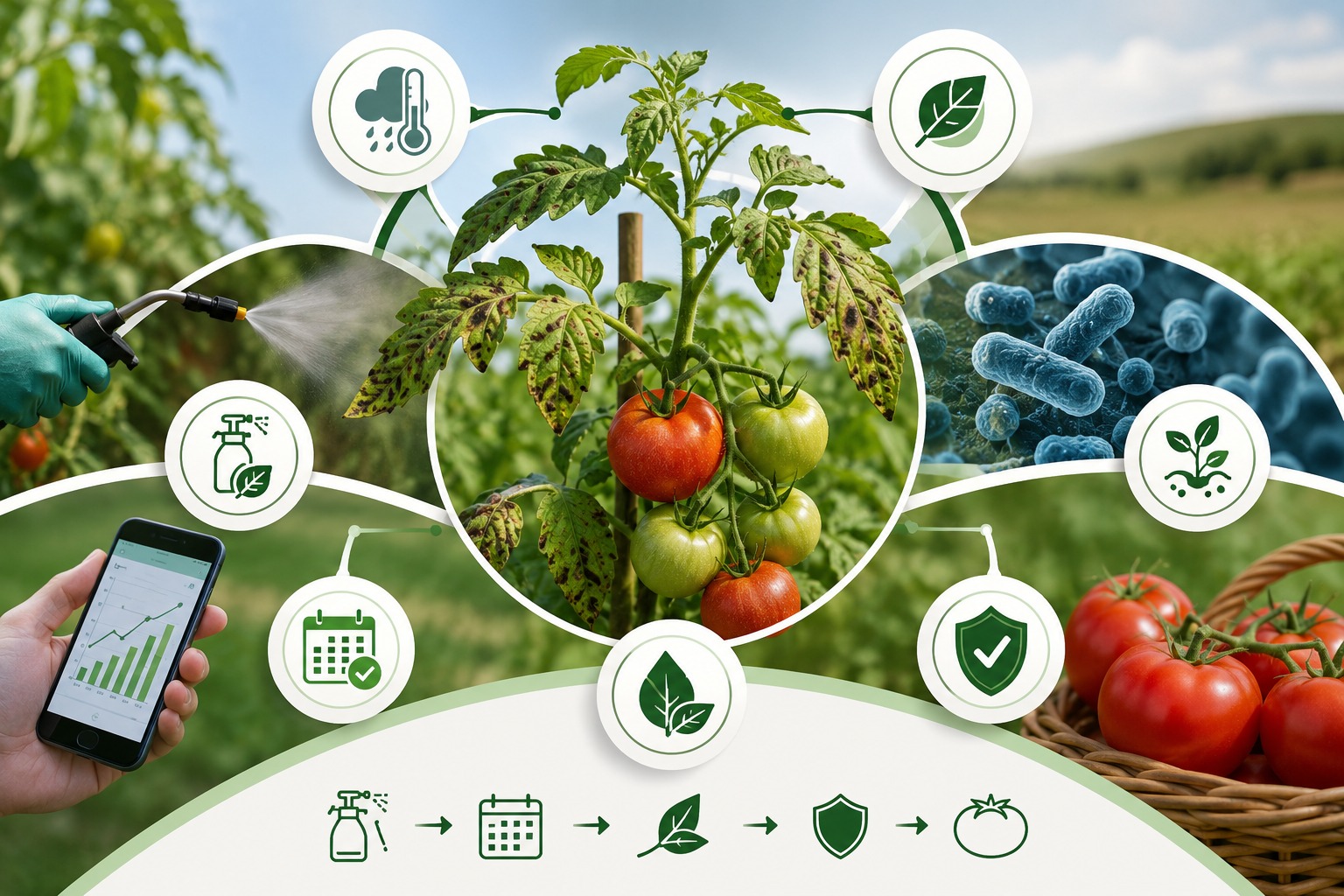
Studies on fresh-market tomato crops in the state of Goiás, Brazil, are still scarce, especially regarding the validation of production technologies. This study aimed to evaluate strategies for the application of plant protection products to control Septoria leaf spot in tomato plants with a low risk of pesticide contamination in fruits. Two field trials were conducted under natural infection conditions. Apical meristem pruning was performed, and nine treatments were evaluated: untreated control; weekly application of chemical fungicides; weekly application of chemical fungicides with a switch to biological fungicides at the beginning of harvest; application of chemical fungicides based on a disease forecasting system; application of chemical fungicides based on a forecasting system with a switch to biological fungicides at the beginning of harvest; application of biological fungicide at the recommended rate; application of biological fungicide at double the recommended rate; weekly application of copper hydroxide; and weekly application of copper hydroxide with a switch to biological fungicides at the beginning of harvest. Septoria leaf spot severity was evaluated based on natural infection, and total yield was estimated by fruit class. Data were subjected to analysis of variance, and means were compared using Tukey’s test at the 5% probability level. The weekly application of chemical fungicides showed the highest efficiency compared to applications based on the forecasting system and the use of biological products.
References
Abbasi, P. A., & Weselowski, B. (2015). Efficacy of Bacillus subtilis QST 713 formulations, copper hydroxide, and their tank mixes on bacterial spot of tomato. Crop Protection, 74, 70-76. https://doi.org/10.1016/j.cropro.2015.04.009 DOI: https://doi.org/10.1016/j.cropro.2015.04.009
Abdel-Rahman, M. A., Abdel-Shakour, E. H., Nour El-Din, M., Refaat, B. M., Ewais, E. E-D., & Alrefaey, H. M. A. (2015). A novel promising thermotolerant cellulase-producing Bacillus licheniformis 1-1v strain suitable for composting of rice straw. International Journal of Advanced Research, 3(12), 413-423.
Ali, D. F. I., El-Nahrawy, S., El-Zawawy, H. A. H., & Omar, A. E-D. (2025). Effective applications of Bacillus subtilis and B. amyloliquefaciens as biocontrol agents of damping-off and biostimulation of tomato plants. Stresses, 5(1), 9. https://doi.org/10.3390/stresses5010009 DOI: https://doi.org/10.3390/stresses5010009
Alizadeh-Moghaddam, G., Nasr-Esfahani, M., Nars-Esfahani, A., & Mohammadbagheri, L. (2024). A suitable alternative to antifungal agents for the control of early blight disease-Alternaria alternata of tomato. Australasian Plant Pathology, 53, 129-140. https://doi.org/10.1007/s13313-024-00968-6 DOI: https://doi.org/10.1007/s13313-024-00968-6
Andrade, J. C., Galvan, D., Kato, L. S., & Conte-Júnior, C. A. (2023). Consumption of fruits and vegetables contaminated with pesticide residues in Brazil: A systematic review with health risk assessment. Chemosphere, 322, 138244. https://doi.org/10.1016/j.chemosphere.2023.138244 DOI: https://doi.org/10.1016/j.chemosphere.2023.138244
Ávila, M. C. R., Júnior, V. L., Quezado-Duval, A. M., Becker, W. F., Abreu-Tarazi, M. F., Borges, L. C., & Nascimento, A. R. (2020). Field validation of TOMCAST modified to manage septoria leaf spot on tomato in the central-west region of Brazil. Crop Protection, 138, 105333. https://doi.org/10.1016/j.cropro.2020.105333 DOI: https://doi.org/10.1016/j.cropro.2020.105333
Baldicera, A. K., Bogo, A., Nerbass, F. R., Becker, W. F., Casa, R. T., & Silva, F. N. (2020). Sensitivity of Septoria lycopersici isolates and effectiveness of fungicides for the control of Septoria leaf spot in tomato. Revista de Ciências Agroveterinárias, 19(2), 159-170. https://doi.org/10.5965/223811711922020159 DOI: https://doi.org/10.5965/223811711922020159
Bayiyana, I., Bua, A., Ozimati, A., Mugisha, J., Colvin, J., & Omongo, C. A. (2023). Insecticide use by small-scale Ugandan cassava growers: An economic analysis. Agriculture13(5), 1043. https://doi.org/10.3390/agriculture13051043 DOI: https://doi.org/10.3390/agriculture13051043
Beyer, M., Marozska, B., Dam, D., Parisot, O., Pallez-Barthel, M., & Hoffmann, L. (2022). Enhancing septoria leaf blotch forecasts in winter wheat II: model architecture and validation results. Journal of Plant Diseases and Protection, 129, 45-51. https://doi.org/10.1007/s41348-021-00554-8 DOI: https://doi.org/10.1007/s41348-021-00554-8
Borba, M. E. A., Maciel, G. M., Fraga Júnior, E. F., Machado Júnior, C. S., Marquez, G. R., Silva, I. G., & End, R. S. A. (2017). Gas exchanges and water use efficiency in the selection of tomato genotypes tolerant to water stress. Genetics and Molecular Research, 16(2), 1-9. DOI: https://doi.org/10.4238/gmr16029685
Costa, C. A., Reis, A., Mizubuti, E. S. G., & Lourenço Jr, V. (2025). Sensitivity of Septoria lycopersici Speg. isolates to fungicides in Brazil. Crop Protection, 190, 107059. https://doi.org/10.1016/j.cropro.2024.107059 DOI: https://doi.org/10.1016/j.cropro.2024.107059
Derbe, S. Y., Kifle, S. W., Yimenu, S. M., Geleta, D. S., & Woldegiorgies, B. S. (2024). Market orientation and performance of smallholder tomato producers. Agricultural and Resource Economics: International Scientific E-Journal, 10(1), 184-202. https://doi.org/10.22004/ag.econ.341564 DOI: https://doi.org/10.51599/are.2024.10.01.08
Feng, R., Wang, H., Liu, T., Wang, F., Cai, L., Chen, X., & Zhang, S. (2023). Response of microbial communities in the phyllosphere ecosystem of tobacco exposed to the broad-spectrum copper hydroxide. Frontiers in Microbiology, 14. https://doi.org/10.3389/fmicb.2023.1229294 DOI: https://doi.org/10.3389/fmicb.2023.1229294
Grzanka, M., Sobiech, Ł., Filipczak, A., Danielewicz, J., Jajor, E., Horoszkiewicz, J., & Korbas, M. (2024). The efficacy of plant pathogens control by complexed froms of copper. Agriculture, 14(1), 139. https://doi.org/10.3390/agriculture14010139 DOI: https://doi.org/10.3390/agriculture14010139
Gu, H., Javidan, S. M., Ampatzidis, Y., & Zhang, Z. (2025). Explainable AI for predicting latent period and infection stage progression in tomato fungal diseases. Horticulturae, 11(11), 1376. https://doi.org/10.3390/horticulturae11111376 DOI: https://doi.org/10.3390/horticulturae11111376
Hasanaliyeva, G., Ammour, M. S., Yaseen, T., Rossi, V., & Caffi, T. (2022). Innovations in disease detection and forecasting: A digital roadmap for sustainable management of fruit and foliar disease. Agronomy, 12(7), 1707. https://doi.org/10.3390/agronomy12071707 DOI: https://doi.org/10.3390/agronomy12071707
Ishaq, M., Sultana, N., Ikram, M., Iqbal, A., Shah, F., Hamayun, M., & Hussain, A. (2020). Occurrence of heavy metals and pesticide residues in tomato crop: a threat to public health. Arabian Journal of Geosciences, 13. https://doi.org/10.1007/s12517-020-05578-2 DOI: https://doi.org/10.1007/s12517-020-05578-2
Jardim, A. N. O., & Caldas, E. D. (2024). Pesticide residues in food of plant origin commercialized in Brazil from 2010 to 2020 – An update from the two national monitoring programs. Food Control, 165, 110674. https://doi.org/10.1016/j.foodcont.2024.110674 DOI: https://doi.org/10.1016/j.foodcont.2024.110674
Karačić, V., Miljaković, D., Marinković, J., Ignjatov, M., Milošević, D., Tamindžić, G., & Ivanović, M. (2024). Bacillus species: Excellent biocontrol agents against tomato diseases. Microorganisms, 12(3), 457. https://doi.org/10.3390/microorganisms12030457 DOI: https://doi.org/10.3390/microorganisms12030457
Kumari, N., & Nagar, N. (2026). Chapter 2 – Plant disease diagnosis and forecasting in the era of artificial intelligence, machine learning, and deep learning. In: From Conventional to Artificial Intelligence-Based Agroculture, 17-31. https://doi.org/10.1016/B978-0-443-27465-7.00006-6 DOI: https://doi.org/10.1016/B978-0-443-27465-7.00006-6
Lamichhane, J. R., Osdaghi, E., Behlau, F., Köhol, J., Jones, J. B., & Aubertot, J-N. (2018). Thirteen decades of antimicrobial copper compounds applied in agriculture. A review. Agronomy for Sustainable Development, 38. https://doi.org/10.1007/s13593-018-0503-9 DOI: https://doi.org/10.1007/s13593-018-0503-9
Lopez, A. C., McCaslin, M., & Dawson, J. C. (2025). The sls-1 and sls-2 genes confer significant resistance to septoria leaf spot (Septoria lycopersici L.) in organic field-grown tomatoes (Solanum lycopersicum). Plant Breeding, 144(5), 705-714. https://doi.org/10.1111/pbr.13285 DOI: https://doi.org/10.1111/pbr.13285
Meno, L., Abuley, I., Seijo, M. C., & Escuredo, O. (2025). Management strategies for early blight in potatoes: Assessment of the TOMCAST model, including the aerobiological risk level and critical phenological period. Agriculture, 14(8), 1414. https://doi.org/10.3390/agriculture14081414 DOI: https://doi.org/10.3390/agriculture14081414
Pandey, A., Paudel, R., Adhikari, T. B., Panthrr, D. R., & Louws, F. J. (2024). Septoria leaf spot os tomatoes: Historical insights, present challenges, and future prospects. Horticulturae, 10(12), 1299. https://doi.org/10.3390/horticulturae10121299 DOI: https://doi.org/10.3390/horticulturae10121299
Panthee, D. R., Pandey, A., & Paudel, R. (2024). Multiple foliar fungal disease management in tomatoes: A comprehensive approach. International Journal of Plant Biology, 15(1), 69-93. https://doi.org/10.3390/ijpb15010007 DOI: https://doi.org/10.3390/ijpb15010007
Raghuvanshi, R. S., Milan, A., Sharma, B., Raghuwaanshi, S., Bag, D., Nigam, R., Babu, S., & Dhiman, S. (2025). A review on sustainable plant disease management through integrated approaches. Journal of Experimental Agriculture International, 47(12), 719-739. https://doi.org/10.9734/jeai/2025/v47i123972 DOI: https://doi.org/10.9734/jeai/2025/v47i123972
Reis, A., Boiteux, L. S., & Lopes, C. A. (2006). Mancha-de-septória: doença limitante do tomateiro no período de chuvas. Comunicado Técnico 37, Brasília, DF.
Santos, F. M., Vieira, L. S., Camargo, D. P., Muniz, M. F. B., Costa, I F. D., Guedes, J. V. C., Santos, J. R. P., & Silva, J. C. P. (2022). Integrating a Bacillus-based product with fungicides by foliar application to protect soybean: a sustainable approach to avoid exclusive use of chemicals. Pest Management Science, 78(11), 4832-4840. https://doi.org/10.1002/ps.7104 DOI: https://doi.org/10.1002/ps.7104
Shanmungam, S. P., Murugan, M., Shanthi, M., Elaiyabharathi, T., Angappan, K., Karthikeyan, G., Arulkumar, G., Manjari, P., Ravishankar, M., Sotelo-Cardona, P., Oliva, R., & Srinivasan, R. (2024). Evaluation of integrated pest and disease management combinations against major insect pests and diseases of tomato in Tamil Nadu, India. Horticulturae, 10(7), 766. https://doi.org/10.3390/horticulturae10070766 DOI: https://doi.org/10.3390/horticulturae10070766
Singh, R., Sharma, S. K., Kangjam, V., Touthang, L., & Kalita, H. (2025). Management of tomato late blight disease in high rainfall area of Northeast India. Indian Phytopathology, 78, 117-121. https://doi.org/10.1007/s42360-025-00836-3 DOI: https://doi.org/10.1007/s42360-025-00836-3
Wang, Y., Wen, T., Mao, F., Yang, S., Zhang, Q., Fu, X., Zhai, C., & Zhang, H. (2025). Engineering copper and copper-based materials for a post-antibiotic era. Frontiers in Bioengineering and Biotechnology, 13. https://doi.org/10.3389/fbioe.2025.1644362 DOI: https://doi.org/10.3389/fbioe.2025.1644362
Wu, W., & Liang, K. (2026). Disease-resistant tomato cultivars of high-quality production. Biological Evidence, 16(2).
Downloads
Published
How to Cite
Issue
Section
License
Copyright (c) 2026 Francisco Rafael Santos Conceição, Abadia dos Reis Nascimento, Miriam Fumiko Fujinawa, Nadson de Carvalho Pontes

This work is licensed under a Creative Commons Attribution 4.0 International License.
Authors who publish with this journal agree to the following terms:
1) Authors retain copyright and grant the journal right of first publication with the work simultaneously licensed under a Creative Commons Attribution License that allows others to share the work with an acknowledgement of the work's authorship and initial publication in this journal.
2) Authors are able to enter into separate, additional contractual arrangements for the non-exclusive distribution of the journal's published version of the work (e.g., post it to an institutional repository or publish it in a book), with an acknowledgement of its initial publication in this journal.
3) Authors are permitted and encouraged to post their work online (e.g., in institutional repositories or on their website) prior to and during the submission process, as it can lead to productive exchanges, as well as earlier and greater citation of published work.