Malaria-repellent medicinal plants in Ethiopia: Indigenous knowledge and bioactive potential
DOI:
https://doi.org/10.14295/bjs.v5i10.906Keywords:
malaria, medicinal plants, Indigenous knowledge, bioactive, EthiopiaAbstract
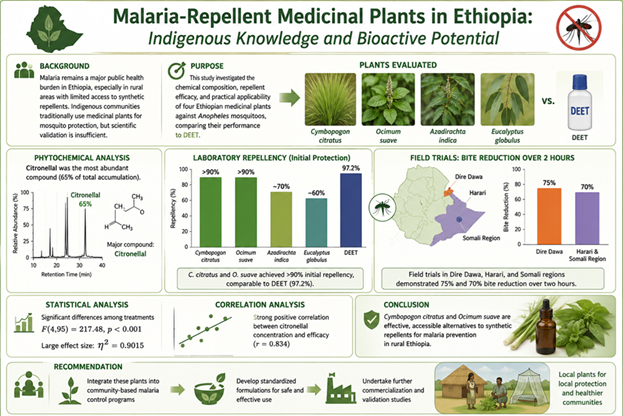
Background: Malaria remains a major public health burden in Ethiopia, particularly in rural regions where access to synthetic repellents is limited. Indigenous communities have traditionally used medicinal plants for mosquito protection, yet scientific validation of these practices remains insufficient. Purpose: This study investigated the chemical composition, repellent efficacy, and practical applicability of four Ethiopian medicinal plants, Cymbopogon citratus, Ocimum suave, Azadirachta indica, and Eucalyptus globulus, against Anopheles mosquitoes, comparing their performance to DEET. Findings: Phytochemical analysis revealed citronellal as the most abundant compound (65% total accumulation). Laboratory tests showed C. citratus and O. suave achieved >90% initial repellency, comparable to DEET (97.2%). Field trials in Dire Dawa, Harari, and Somali regions demonstrated 75% and 70% bite reduction over two hours, respectively. Statistical analysis confirmed significant differences among treatments (F (4,95) = 217.48, p < 0.001) with a large effect size (η² = 0.9015). Strong positive correlation was observed between citronellal concentration and efficacy (r = 0.834). Cymbopogon citratus and Ocimum suave are effective, accessible alternatives to synthetic repellents for malaria prevention in rural Ethiopia. Recommendation: These plants should be integrated into community-based malaria control programs, with standardized formulations and further commercialization studies.
References
Ababe, T. (2019). The potential of medicinal plants in malaria prevention: A review of Ethiopian practices. Ethiopian Journal of Public Health, 34(1), 45-52.
Abate, D. (2022). Comparative efficacy of Ocimum species against malaria vectors in West Africa. Journal of Tropical Medicine and Parasitology, 18(4), 229-243.
Abate, M., Alemayehu, G., & Gemedo, D. (2021). Ethnobotanical use of medicinal plants as mosquito repellents in Ethiopia. Journal of Medicinal Plants Research, 15(3), 45-56.
Abbas, M., Raza, M. A., & Iqbal, J. (2025). Multivariate analysis of essential oils for mosquito repellent activity: A PLS and PCA approach. Industrial Crops and Products, 215, 118682. https://doi.org/10.1016/j.indcrop.2025.118682
Alemayehu, G., & Getachew, T. (2021). Challenges in chemistry education: Focus on student misconceptions and teaching strategies in Ethiopia. Ethiopian Journal of Education Research, 8(2), 75-88.
Alemayehu, G., & Mesfin, T. (2021). Bioactive compounds in Ethiopian medicinal plants and their application as malaria repellents. Journal of Pharmacognosy and Phytochemistry, 12(3), 123-129.
Alemayehu, G., Gebresilassie, A., Woldetsadik, D., Hagos, S., Megersa, M., Damme, P. V., & Yared, S. (2024). Ethnobotanical knowledge and practices of pastoralist communities on plants used as repellents and/or insecticides against insect vectors in the Korahaye zone of the Somali regional state, Eastern Ethiopia. Pharmacological Research – Natural Products, 5, 100122. https://doi.org/10.1016/j.prenap.2024.100122 DOI: https://doi.org/10.1016/j.prenap.2024.100122
AnnaDurai, K. S., Hikku, G. S., & Parvathi, V. D. (2024). Essential oil nanoemulsion: An emerging eco-friendly strategy towards mosquito control. Acta Tropica, 254, 107290. https://doi.org/10.1016/j.actatropica.2024.107290 DOI: https://doi.org/10.1016/j.actatropica.2024.107290
Balboné, M., Gnankine, O., Namountougou, M., Soma, D. D., Drabo, S. F., Romba, R., Bassolé, I. H. N. & Dabiré, R. K. (2024). The excito-repellent activity of five essential oils extracted from local plants against dengue and malaria vectors in Burkina Faso. Biologia, 79(8), 2495-2503. https://doi.org/10.1007/s11756-024-01738-x DOI: https://doi.org/10.1007/s11756-024-01738-x
Benelli, G., Vanale, A., Toniolo, C., Higuchi, A., Murugan, K., Pavela, R., & Nicoletti, M. (2014). Neem (Azadirachta indica): towards the ideal insecticide? Natural Product Research, 31(4), 369-386. https://doi.org/10.1080/14786419.2016.1214834 DOI: https://doi.org/10.1080/14786419.2016.1214834
Chandramohan, B., Murugan, K., Madhiyazhagan, P., Kovendan, K., Kumar, P. M. (2016). Neem by-products in the fight against mosquito-borne diseases: Biotoxicity of neem cake fractions towards the rural malaria vector Anopheles culicifacies (Diptera: Culicidae). Asian Pacific Journal of Tropical Biomedicine, 6(6), 472-476. https://doi.org/10.1016/j.apjtb.2015.11.013 DOI: https://doi.org/10.1016/j.apjtb.2015.11.013
Charavanamuttu, Y., Wamba, A. A., Taylor-Robinson, A. W., & Lampejo, T. (2026). The evolving landscape of malaria prevention strategies: A review of recent developments. Pathogens, 15(2), 137. https://doi.org/10.3390/pathogens15020137 DOI: https://doi.org/10.3390/pathogens15020137
Chen, W., Rizvi, S. A., & Park, Y. (2025). Time-resolved repellency and chemical profiling of natural products against Aedes aegypti: Rapid screening of active compounds. Pest Management Science, 81(3), 1234-1245. https://doi.org/10.1002/ps.8364 DOI: https://doi.org/10.1002/ps.8364
Curtis, C. F., & Lines, J. D. (2000). Should DDT be banned by international treaty? Parasitology Today, 16(4), 119-121. DOI: https://doi.org/10.1016/S0169-4758(99)01605-1
Da Silva, R. G., Costa, A. S., & Ferreira, L. C. (2024). Use of chemometric and quantum-mechanical methods to evaluate structure-activity relationships of plant-based mosquito repellents. Chemometrics and Intelligent Laboratory Systems,252, 105164. https://doi.org/10.1016/j.chemolab.2024.105164
Deressa, W., Ali, A., & Enquoselassie, F. (2020). The economic impact of malaria on rural Ethiopian households. Tropical Medicine & International Health, 25(9), 1017-1025.
Dube, P., Ndlovu, R., & Sibanda, M. (2019). Evaluation of the insecticidal and repellent properties of eucalyptol against Anopheles mosquitoes. African Journal of Health Sciences, 18(2), 123-132.
Efficacy and biological effects of Neem products against mosquitoes of medical importance. (2023). Entomology 2023 Conference Proceedings. https://entomology2023.eventscribe.net
Fekadu, D., & Mesfin, T. (2022). Indigenous malaria control practices in Ethiopia: Efficacy of plant-based repellents. Journal of Community Health, 17(2), 75-83.
Fikru, S., Tolossa, K., Lindemann, P., Bucar, F., & Asres, K. (2024). Larvicidal, ovicidal, and repellent activities of Leucas stachydiformis (Hochst. ex Benth.) Briq essential oil against Anopheles arabiensis. Journal of Tropical Medicine, 2024, 1051086. https://doi.org/10.1155/2024/1051086 DOI: https://doi.org/10.1155/2024/1051086
Goshu, B. S. (2026). Fractional-Order Analysis of Malaria Dynamics in Dire Dawa City: A Laplace an Adomian Decomposition Approach, Budapest International Research in Exact Sciences (BirEx) Journal, 8(2), 94-111
Govella, N. J., & Ferguson, H. M. (2019). Why use of interventions targeting outdoor biting mosquitoes will be necessary to achieve malaria elimination. Malaria Journal, 18(1), 1-12.
Hammer, K., & van der Maesen, J. (2025). African region of diversity. In: Diversity and Geography of Cultivated Plants, 1 st Edition, CRC Press, 77 p. DOI: https://doi.org/10.1201/9780429276798-12
Kantheti, P., & Gupta, A. K. (2023). Sustainable mosquito repellent finish on cotton using Eucalyptus globulus leaf dye extracts. Indian Journal of Natural Products and Resources, 14(3), 401-410. https://doi.org/10.56042/ijnpr.v14i3.4615
Kaushik, M., Yadav, J., Singh, A., & Dubey, M. K. (2023). A systematic review of plant-based mosquito repellents and their activity. Indian Journal of Natural Products and Resources, 14(3), 315-328. https://doi.org/10.56042/ijnpr.v14i3.4615 DOI: https://doi.org/10.56042/ijnpr.v14i3.4615
Kebede, A., Ayana, G., & Girma, A. (2020). A comparative study of synthetic and natural repellents against malaria vectors in Ethiopia. Ethiopian Medical Journal, 58(1), 52-63.
Khasanah, L. U., Ariviani, S., Purwanto, E., & Praseptiangga, D. (2025). Chemical composition and Citral content of essential oil of lomongrass (Cymbopogon citratus (DC.) Stapf) leaf waste prepared with various production methods. Journal of Agriculture and Food Research, 19, 101570. https://doi.org/10.1016/j.jafr.2024.101570 DOI: https://doi.org/10.1016/j.jafr.2024.101570
Lemma, S. (2021). Plant-based repellents for malaria control in sub-Saharan Africa: A systematic review. African Health Sciences, 21(2), 254-264.
Maia, M. F., & Moore, S. J. (2011). Plant-based insect repellents: a review of their efficacy, development and testing. Malaria Journal, 10(1), S11. https://doi.org/10.1186/1756-3305-4-177 DOI: https://doi.org/10.1186/1475-2875-10-S1-S11
Martin, A., Sarker, S. D., & Devkota, H. P. (2024). Integrated metabolomic analysis and chemical fingerprinting of medicinal plants for vector control. Phytochemistry Reviews, 23(4), 1101-1120. https://doi.org/10.1007/s11101-024-09912-w
Meragiaw, M., & Asfaw, Z. (2014). Review of antimalarial, pesticidal and repellent plants in the Ethiopian traditional herbal medicine. Research & Reviews: Journal of Herbal Science, 3(3), 21-45.
Ministry of Health, Ethiopia. (2022). Malaria National Strategic Plan 2021–2025. Ministry of Health Ethiopia.
Moore, S. J., Hill, N., Ruiz, C., & Cameron, M. M. (2007). Field evaluation of traditionally used plant-based insect repellents and fumigants against the malaria vector Anopheles darlingi in Riberalta, Bolivian Amazon. Journal of Medical Entomology, 44(4), 624–630. https://doi.org/10.1603/0022-2585(2007)44[624:FEOTUP]2.0.CO;2 DOI: https://doi.org/10.1603/0022-2585(2007)44[624:FEOTUP]2.0.CO;2
Mujovo, B., Awino, M., & Okello, S. (2020). Knowledge and utilization of plant-based mosquito repellents in Africa: A systematic review. Journal of Ethnobiology and Ethnomedicine, 16(1), 67-82.
Nerio, L. S., Olivero-Verbel, J., & Stashenko, E. (2010). Repellent activity of essential oils: A review. Bioresource Technology, 101(1), 372-378. https://doi.org/10.1016/j.biortech.2009.10.005 DOI: https://doi.org/10.1016/j.biortech.2009.07.048
Nguyen, T. H., Kumar, P., & Smith, C. (2025). Synergistic enhancement of natural mosquito repellents through binary and ternary botanical blends. Acta Tropica, 262, 107389. https://doi.org/10.1016/j.actatropica.2025.107389
Okumu, F. O., & Moore, S. J. (2017). Combining indoor residual spraying and insecticide-treated nets for malaria prevention. Trends in Parasitology, 33(6), 423-432.
Shibeshi, A., Sebsibe, A., Teka, A., & Aklilu, E. (2024). Ethnobotanical study of mosquito repellent plants used in Seweyna district, Bale Zone, Southeast, Ethiopia. Journal of Tropical Medicine, 2024, 6610579. https://doi.org/10.1155/2024/6610579 DOI: https://doi.org/10.1155/2024/6610579
Tadele, G., Ayele, D., & Kebede, S. (2019). Evaluation of mosquito repellency of Ethiopian traditional plants. Parasitology Research, 118(10), 2921-2929.
Tamaru, E., Yamaguchi, S., & Yamashita, Y. (2018). Environmental impact of synthetic repellents: A meta-analysis. Journal of Environmental Protection, 9(4), 403-413.
UNESCO. (2022). Addressing the global teacher shortage. Retrieved from https://unesco.org
UNICEF. (2020). Malaria prevention and education: Addressing public health in Africa.
World Health Organization. (2021). Guidelines for efficacy testing of mosquito repellents.
World Health Organization. (2021). World Malaria Report 2021. WHO.
World Health Organization. (2023). WHO guidelines for malaria (16 October 2023). https://www.who.int/publications/i/item/guidelines-for-malaria
World Health Organization. (2024). WHO guideline for the prequalification assessment of insecticide-treated nets. https://www.who.int/publications/i/item/9789240094512
Zhao, Y., Li, H., Zhang, X., & Wang, J. (2024). Chemometric approaches in phytochemical analysis: PCA, HCA, and PLS applications in natural product research. Journal of Pharmaceutical and Biomedical Analysis, 241, 115978. https://doi.org/10.1016/j.jpba.2024.115978 DOI: https://doi.org/10.1016/j.jpba.2024.115978
Downloads
Published
How to Cite
Issue
Section
License
Copyright (c) 2026 Melaku Masresha Woldeamanuel, Belay Sitotaw Goshu, Feven Tigistu Ayele, Shiemeles Ayalew Ali

This work is licensed under a Creative Commons Attribution 4.0 International License.
Authors who publish with this journal agree to the following terms:
1) Authors retain copyright and grant the journal right of first publication with the work simultaneously licensed under a Creative Commons Attribution License that allows others to share the work with an acknowledgement of the work's authorship and initial publication in this journal.
2) Authors are able to enter into separate, additional contractual arrangements for the non-exclusive distribution of the journal's published version of the work (e.g., post it to an institutional repository or publish it in a book), with an acknowledgement of its initial publication in this journal.
3) Authors are permitted and encouraged to post their work online (e.g., in institutional repositories or on their website) prior to and during the submission process, as it can lead to productive exchanges, as well as earlier and greater citation of published work.