Cardioprotective and immunomodulatory mechanisms of Moringa oleifera: A critical review of phytochemical evidence, clinical gaps, and future research priorities
DOI:
https://doi.org/10.14295/bjs.v6i4.961Keywords:
Moringa oleifera, cardioprotective, immunomodulatory, phytochemicals, clinical translationAbstract
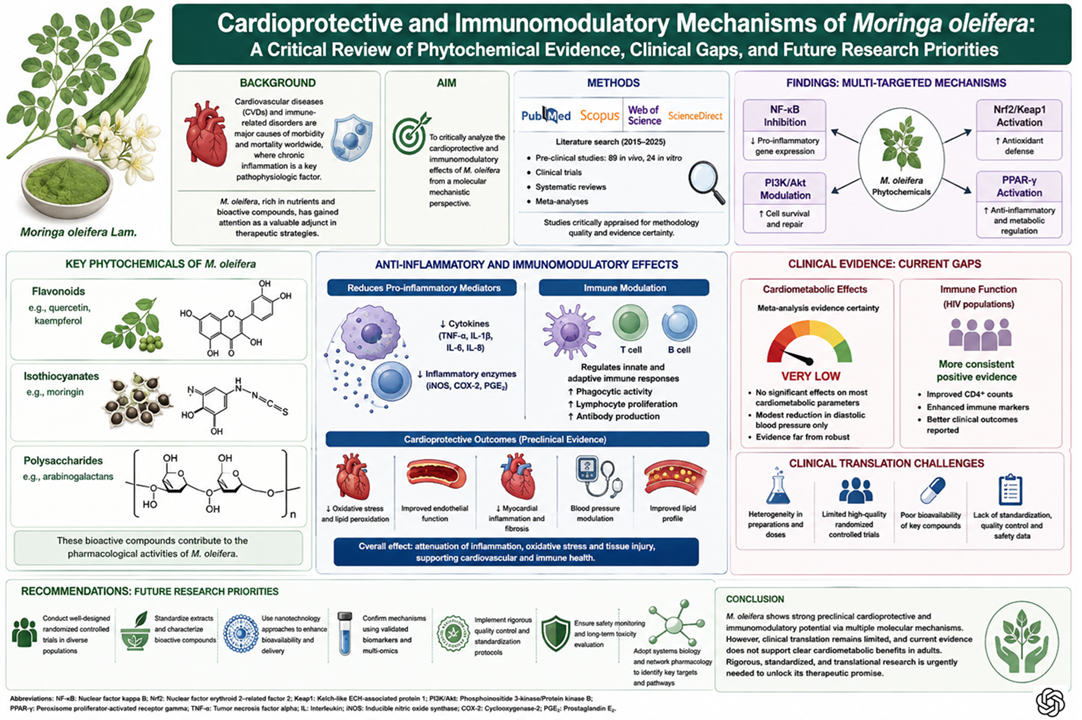
Cardiovascular diseases (CVDs) and immune-related disorders are major sources of morbidity and mortality worldwide, with chronic inflammation as a predominant pathophysiologic factor. Moringa oleifera Lam., rich in nutrients and possessing numerous pharmacological properties, has attracted attention as a potential adjunct to treatment strategies. This critical review evaluates the cardioprotective and immunomodulatory mechanisms of M. oleifera, moving beyond nutritional composition to examine the molecular pathways involved, identify gaps in clinical evidence, and propose future research priorities. A literature search was conducted in PubMed, Scopus, Web of Science, and ScienceDirect, focusing on publications from 2015 to 2025, and included preclinical studies, clinical trials, systematic reviews, and meta-analyses, which were critically appraised for methodological rigor and evidence certainty. Preclinical evidence indicates that M. oleifera exerts cardioprotective and immunomodulatory activities through mechanisms including NF-κB inhibition, Nrf2/Keap1 activation, PI3K/Akt modulation, and PPAR-γ activation. Bioactive compounds, particularly flavonoids (quercetin, kaempferol), isothiocyanates (moringin), and polysaccharides (arabinogalactans), suppress pro-inflammatory cytokines (TNF-α, IL-1β), inhibit pro-inflammatory enzymes (iNOS, COX-2), reduce the prostaglandin PGE₂, promote anti-inflammatory cytokines (IL-10), and enhance immune cell function, including CD4⁺/CD8⁺ T-lymphocyte proliferation and NK-cell cytotoxicity. However, clinical translation remains limited. Meta-analyses demonstrate very low certainty of evidence for cardiometabolic outcomes, with no significant effects on most parameters and only a modest, non-robust reduction in diastolic blood pressure. In contrast, more consistent positive evidence exists for immune function, particularly in populations living with HIV. Although preclinical potential is substantial, clinical translation has not kept pace. Current evidence does not support consistent cardiometabolic benefits of M. oleifera supplementation in adults. Future research should prioritize high-quality randomized controlled trials with standardized preparations, nanotechnology-enabled bioavailability enhancement, biomarker-driven mechanistic validation, robust quality control, long-term safety monitoring, and systems biology approaches to bridge the gap between preclinical evidence and clinical application.
References
Abdelazim, A. M., Afifi, M., Abu-Alghayth, M. H., & Alkadri, D. H. (2024). Moringa oleifera Lam.: Recent insights for its biochemical and medicinal applications. Journal of Food Biochemistry. https://doi.org/10.1155/2024/1270903
Aekthammarat, D., Pannangpetch, P., & Tangsucharit, P. (2019). Moringa oleifera leaf extract lowers high blood pressure by alleviating vascular dysfunction and decreasing oxidative stress in L-NAME hyper-tensive rats. Phytomedicine, 54, 9-16. https://doi.org/10.1016/j.phymed.2018.10.023
Afiaenyi, I. C., Ngwu, E. K., Okafor, A. M., & Ayogu, R. N. B. (2025). Effects of Moringa oleifera leaves on the blood glucose, blood pressure, and lipid profile of type 2 diabetic subjects: A parallel group ran-domized clinical trial of efficacy. Nutrition and Health, 31(1), 281-291. https://doi.org/10.1177/02601060231176873
Alidadi, M., Alidadi, H., & Sadeghi, A. (2023). Bioactive compounds in Moringa oleifera: Mechanisms of action, focus on their anti-inflammatory properties. Plants, 13(1), 20. https://doi.org/10.3390/plants13010020
Attakpa, E. S., Bertin, G. A., Chabi, N. W., Atègbo, J. -M., Seri, B., & Khan, N. A. (2017). Moringa oleifera-rich diet and T cell calcium signaling in spontaneously hypertensive rats. Physiological Research, 66(5), 753-767. https://doi.org/10.33549/physiolres.933397
Bennett, R. N., Mellon, F. A., Foidl, N., Pratt, J. H., Dupont, M. S., Perkins, L., & Kroon, P. A. (2003). Profil-ing glucosinolates and phenolics in vegetative and reproductive tissues of the multi-purpose trees Moringa oleifera L. (Horseradish tree) and Moringa stenopetala L. Journal of Agricultural and Food Chemistry, 51(12), 3546-3553. https://doi.org/10.1021/jf0211480
Berjawi, H. (2025). The effects of Moringa oleifera, quercetin and myricetin on cholesterol levels in HepG2 cells in vitro as well as on enzymes regulating cholesterol homeostasis in silico. Master’s the-sis, American University of Beirut. AUB ScholarWorks. http://hdl.handle.net/10938/34763
Brunelli, D., Tavecchio, M., Falcioni, C., Frapolli, R., Erba, E., Iori, R., Rollin, P., Barillari, J., Manzotti, C., Morazzoni, P., & D'Incalci, M. (2010). The isothiocyanate produced from glucomoringin inhibits NF-kB and reduces myeloma growth in nude mice in vivo. Biochemical Pharmacology, 79(8), 1141-1148. https://doi.org/10.1016/j.bcp.2009.12.008
Canett-Romero, R., Arvayo-Mata, K. L., & Ruvalcaba-Garfias, N. V. (2014). Aspectos tóxicos más rele-vantes de Moringa oleifera y sus posibles daños. Biotecnia, 16(2), 36-43. https://doi.org/10.18633/bt.v16i2.45
Chiș, A., Noubissi, P. A., Pop, O-L., Mureșan, C. I., Tagne, M. A. F., Cozma, A., Vulturar, R., & Suharoschi, R. (2024). Bioactive compounds in Moringa oleifera: Mechanisms of action, focus on their anti-inflammatory properties. Plants, 13(1), 20. https://doi.org/10.3390/plants13010020
Chodur, G. M., Olson, M. E., Wade, K. L., Stephenson, K. K., Nouman, W., Garima, & Fahey, J. W. (2018). Wild and domesticated Moringa oleifera differ in taste, glucosinolate composition, and antioxidant potential, but not myrosinase activity or protein content. Scientific Reports, 8, 7995. https://doi.org/10.1038/s41598-018-26059-3
Crișan, D., Gavrilas, L., Paltinean, R., Frumuzachi, O., Mocan, A., & Crisan, G. (2025). Effects of Moringa oleifera Lam. supplementation on cardiometabolic outcomes: A meta-analysis of randomized con-trolled trials with GRADE assessment. Nutrients, 17(22), 3501. https://doi.org/10.3390/nu17223501
Darwish, M. M., Ibrahim, R. S., Metwally, A. M., & Mahrous, R. S. R. (2024). In-depth in silico and in vitro screening of selected edible plants for identification of selective C-domain ACE-1 inhibitor and its synergistic effect with captopril. Food Bioscience, 59, 104019. https://doi.org/10.1016/j.fbio.2024.104019
David, S., Dapar, M. P., & Jimam, N. S. (2025). Clinical antihypertensive efficacy and safety of Moringa oleifera Lam. (Moringaceae) leaf: A systematic review. (2025). Journal of Pharmacy & Bioresources, 22(1), 1-12. https://dx.doi.org/10.4314/jpb.v22i1.1
da Silva Parente, R. L., Sarandy, M. M., de Araújo, C. M., Gonçalves, R. V., & Zucolotto, S. M. (2025). Effect of Moringa oleifera on inflammatory diseases: An umbrella review of 26 systematic reviews. Frontiers in Pharmacology, 16, 1575635. https://doi.org/10.3389/fphar.2025.1575635
Dewadas, H. D., Mahindran, M., Yi, T. X., Sugumaran, S., Pandit, T. V. S., Kumaresan, S., Munisamy, S., & Sadikan, M. Z. (2026). Moringa oleifera for blood pressure regulation and endothelial dysfunction – Mechanisms and therapeutic potential in cardiovascular disease: A review. Biomolecules and Biomedicine. https://doi.org/10.17305/bb.2026.13950
Gao, Q., Liu, X., Shi, J., Li, L., & Sun, B. (2025). Polyphenols in different parts of Moringa oleifera Lam.: Composition, antioxidant and neuroprotective potential. Food Chemistry, 475, 143207. https://doi.org/10.1016/j.foodchem.2025.143207
Gharsallah, K., Rezig, L., Rajoka, M. S., Mehwish, H. M., Ali, S. C., & Chew, S. C. (2023). Moringa oleifera: Processing, phytochemical composition, and industrial applications. South African Journal of Botany, 160, 180-193. https://doi.org/10.1016/j.sajb.2023.07.008
Gheorghe, A., Griffiths, U., Murphy, A., Legood, R., Lamptey, P., & Sobel, H. (2018). The economic burden of cardiovascular disease and hypertension in low- and middle-income countries: A systematic re-view. BMC Public Health, 18. https://doi.org/10.1186/s12889-018-5806-x
Global Burden of Cardiovascular Diseases and Risks. (2023). Global, regional, and national burden of cardiovascular diseases and risk factors in 204 countries and territories, 1990–2023. Journal of the American College of Cardiology, 86(22). https://doi.org/10.1016/j.jacc.2025.08.015
Gouda, R. A. M., Hassan, A. G. A., Mahmoud, Y. K., & Ibrahim, I. A. (2023). Moringa oleifera ameliorates cardiotoxicity and improves antioxidants in breast cancer-induced rats treated with doxorubicin: A preliminary study. Journal of Advanced Veterinary Research, 13(10), 19821990. https://www.advetresearch.com/index.php/AVR/article/view/1605
Gouvea, D. R., Buqui, G. A., Lopes, J. L. S., Diniz, A., & Lopez, N. P. (2017). An UPLC-MS/MS method for determination of vicenin-2 and lychnopholic acid in rat plasma and its application to a pharmacoki-netic study. Journal of the Brazilian Chemical Society, 28(3), 431-438. https://doi.org/10.21577/0103-5053.20160249
Jaja-Chimedza, A., Graf, B. L., Simmler, C., Kim, Y., Kuhn, P., Pauli, G. F., & Raskin, I. (2022). Moringa isothiocyanate-1 inhibits LPS-induced inflammation in mouse myoblasts and skeletal muscle. PLoS ONE, 17(12), e0279370. https://doi.org/10.1371/journal.pone.0279370
Liu, Y., Zhang, H., Zhao, Z., Wang, X., Kai, Y., Huang, D., Liu, S-Q., & Lu, Y. (2024a). Germination in-creases the glucomoringin content in moringa sprouts via transforming tyrosine. Journal of Agricul-tural and Food Chemistry, 72(18), 10234-10243. https://doi.org/10.1021/acs.jafc.4c01027
Liu, Y., Chin, F. W. L., Huang, D., Liu, S-Q., & Lu, Y. (2024b). The thermal degradation of glucomoringin and changes of phenolic compounds in moringa seed kernels during different degrees of roasting. Food Chemistry, 454, 139782. https://doi.org/10.1016/j.foodchem.2024.139782
Luo, H. (2024). Global burden and cross-country inequalities in six major immune-mediated inflammatory diseases from 1990 to 2021: A systematic analysis of the Global Burden of Disease Study 2021. Autoimmunity Reviews, 23(10), 103639. https://doi.org/10.1016/j.autrev.2024.103639
Louisa, M., Patintingan, C. G. H., & Wardhani, B. W. K. (2022). Moringa oleifera Lam. in cardiometabolic disorders: A systematic review of recent studies and possible mechanisms of action. Frontiers in Pharmacology, 13, 792794. https://doi.org/10.3389/fphar.2022.792794
Martin, S. S., Aday, A. W., Allen, N. B., Almarzooqi, Z. I., Anderson, C. A. M., Arora, P., & Palaniappan, L. P. (2025). 2025 heart disease and stroke statistics: A report of US and global data from the American Heart Association. Circulation, 151(8), e841. https://doi.org/10.1161/CIR.0000000000001303
Menichetti, F., Berteotti, C., Schirinzi, V., Poli, C., Arrighi, R., & Leone, A. (2025). Moringa oleifera and blood pressure: Evidence and potential mechanisms. Nutrients, 17(7), 1258. https://doi.org/10.3390/nu17071258
Mohamad, E. A., Ahmed, S. M., Masoud, M. A., Mohamed, F. A., & Mohammed, H. S. (2025). Cardiopro-tective potential of Moringa oleifera leaf extract loaded niosomes nanoparticles against doxorubicin toxicity in rats. Current Pharmaceutical Biotechnology, 26(2), 289-301. https://doi.org/10.2174/0113892010303097240605105013
Mohai Ud Din, R., Salwa, E., Zafar, M. H., Zhang, C., Saleh, A. A., Husien, H. M., & Wang, M. (2025). Moringa oleifera as a multifunctional feed additive: Synergistic nutritional and immunomodulatory mechanisms in livestock production. Frontiers in Nutrition, 12, 1615349. https://doi.org/10.3389/fnut.2025.1615349
Mozo, R. N., & Caoile-Ang, I. (2015). The effects of malunggay (Moringa oleifera) leaves capsule supple-ments on high specificity C-reactive protein and hemoglobin A1c levels of diabetic patients in Ospital ng Maynila Medical Center: A prospective cohort study. Philippine Journal of Internal Medicine, 53(4), 1-10.
Oduro, I., Ellis, W. O., & Owusu, D. (2008). Nutritional potential of two leafy vegetables: Moringa oleifera and Ipomoea batatas leaves. Scientific Research and Essays, 3(2), 57-60.
Quagliariello, V., Basilicata, M. G., Pepe, G., De Anseris, R., Di Mauro, A., Scognamiglio, G., Palma, G., Vestuto, V., Buccolo, S., Luciano, A., Barbieri, M., Bruzzese, F., Maurea, C., Pumpo, R., Ostacolo, C., Campiglia, P., Berretta, M., & Maurea, N. (2022). Combination of Spirulina platensis, Ganoderma lu-cidum and Moringa oleifera improves cardiac functions and reduces pro-inflammatory biomarkers in preclinical models of short-term doxorubicin-mediated cardiotoxicity: New frontiers in cardioncolo-gy? Journal of Cardiovascular Development and Disease, 9(12), 423. https://doi.org/10.3390/jcdd9120423
Pareek, A., Pant, M., Gupta, M. M., Kashania, P., Ratan, Y., Jain, V., Pareek, A., & Chuturgoon, A. A. (2024). A comprehensive review of the phytochemicals, health benefits, pharmacological safety and medicinal prospects of Moringa oleifera. Heliyon, 10(6), e27807. https://doi.org/10.1016/j.heliyon.2024.e27807
Patintingan, C. G. H., Louisa, M., Juniantito, V., Arozal, W., Hanifah, S., Wanandi, S. I., & Thandavarayan, R. (2023). Moringa oleifera leaves extract ameliorates doxorubicin-induced cardiotoxicity via its mi-tochondrial biogenesis modulatory activity in rats. Journal of Experimental Pharmacology, 15, 307-319. https://doi.org/10.2147/JEP.S413256
Peng, W., Wang, X., Wang, W., Wang, Y., Huang, J., Zhou, R., Bo, R., Liu, M., Yin, S., & Li, J. (2024). Com-parison, optimization and antioxidant of ultrasound-assisted natural deep eutectic solvents extraction and traditional method: A greener route for extraction of flavonoid from Moringa oleifera Lam. leaves. Ultrasonics Sonochemistry, 109, 107003. https://doi.org/10.1016/j.ultsonch.2024.107003
Sailaja, B. S., Aita, R., Maledatu, S., Ribnicky, D., Verzi, M. P., & Raskin, I. (2021). Moringa isothiocya-nate-1 regulates Nrf2 and NF-κB pathway in response to LPS-driven sepsis and inflammation. PLoS ONE, 16(4), e0248691. https://doi.org/10.1371/journal.pone.0248691
Sailaja, B. S., Aita, R., Maledatu, S., Ribnicky, D., Verzi, M. P., & Raskin, I. (2022). Moringa isothiocya-nate-1 inhibits LPS-induced inflammation in mouse myoblasts and skeletal muscle. PLoS ONE, 17(12), e0279370. https://doi.org/10.1371/journal.pone.0279370
Sánchez-Machado, D. I., Núñez-Gastélum, J. A., Reyes-Moreno, C., Ramírez-Wong, B., & López-Cervantes, J. (2010). Nutritional quality of edible parts of Moringa oleifera. Food Analytical Meth-ods, 3(3), 175-180. https://doi.org/10.1007/s12161-009-9106-z
Sianipar, E. A., Sumiwi, S. A., Susilawati, Y., & Levita, J. (2026). Moringa oleifera Lamk. as a promising adjunct therapeutic candidate: A narrative review of human studies and published case reports. Drug Design, Development and Therapy, 20, 586556. https://doi.org/10.2147/DDDT.S586556
Tabboon, P., Bungorn, S., & Kittisak, S. (2016). Effects of Moringa oleifera leaf extract on cholesterol levels and HMG-CoA reductase expression in HepG2 cells. Songklanakarin Journal of Science and Technology, 38(2), 155-161.
Villegas-Vazquez, E. Y., Gómez-Cansino, R., Marcelino-Pérez, G., Jiménez-López, D., & Quintas-Granados, L. I. (2025). Unveiling the miracle tree: Therapeutic potential of Moringa oleifera in chronic disease management and beyond. Biomedicines, 13(3), 634. https://doi.org/10.3390/biomedicines13030634
Wang, J., Li, Y., Zhang, H., & Chen, X. (2024). LC-MS/MS-based chemical profiling of water extracts of Moringa oleifera leaves and pharmacokinetics of their major constituents in rat plasma. Food Chem-istry: X, 23, 101585. https://doi.org/10.1016/j.fochx.2024.101585
Wang, X., Jiang, X., Yang, J., Adu-Frimpong, M., Gong, M., Hua, Q., Li, T., Li, J., Pan, P., Toreniyazov, E., Cao, X., Yu, J., Wang, Q., & Xu, X. (2025). Preparation of chitosan-modified Moringa A liposomes and its protective effect on acute alcoholic liver injury. Journal of Liposome Research, 35(4), 406-418. https://doi.org/10.1080/08982104.2025.2516033
Waruguru, P., Mulwa, D. W., Okoth, M., & Bor, W. (2022). Moringa oleifera regulates the health of people living with HIV in developing countries: a systematic review. African Journal of AIDS Research, 22(3), 247-252. https://doi.org/10.2989/16085906.2023.2277894
WHO. (2012). World Health Organization. Guideline: Potassium intake for adults and children. World Health Organization. Available at: https://www.who.int/publications/i/item/9789241504829. Ac-cessed on: April 16, 2026.
WHO. (2022a). World Health Organization. WHO establishes the Global Centre for Traditional Medicine. Available at: https://www.who.int/news/item/25-03-2022-who-establishes-the-global-centre-for-traditional-medicine-in-india. Accessed on: March 09, 2026.
WHO. (2022b). World Health Organization. Global report on hypertension: The race against a silent killer. Available at: https://www.who.int/publications/i/item/9789240081062. Accessed in: March 04, 2026.
WHO. (2025). World Health Organization. Global report on hypertension 2025: High stakes: Turning evidence into action. Available at: https://www.who.int/publications/i/item/9789240115569. Accessed on: April 14, 2026.
Xie, R., Ahmadi, F., Islam, M. A., Dushea, F. R., Suleria, H. A. R., & Ponnampalam, E. N. (2025). A system-atic review using the PRISMA methodology on nutrients and antioxidant capacity in Moringa (Moringa oleifera Lam.) and its applications in the food industry. Food Reviews International, 41(8). https://doi.org/10.1080/87559129.2025.2473673
Yu Oh, C. R., & Comia, A. T. (2024). Effects of processing techniques on the glucosinolate and isothiocy-anate content of malunggay (Moringa oleifera) and determination of its antioxidant activity. Under-graduate thesis, De La Salle University. Animo Repository. https://animorepository.dlsu.edu.ph/etdb_chem/40
Zunica, E. R. M., Yang, S., Coulter, A., White, C., Frazier, K., Kirwan, J. P., & Gilmore, L. A. (2021). Moringa oleifera seed extract concomitantly supplemented with chemotherapy worsens tumor pro-gression in mice with triple negative breast cancer and obesity. Nutrients, 13(9), 2923. https://doi.org/10.3390/nu13092923
Downloads
Published
How to Cite
Issue
Section
License
Copyright (c) 2027 Belay Sitotaw Goshu, Melaku Masresha Woldeamanueal

This work is licensed under a Creative Commons Attribution 4.0 International License.
Authors who publish with this journal agree to the following terms:
1) Authors retain copyright and grant the journal right of first publication with the work simultaneously licensed under a Creative Commons Attribution License that allows others to share the work with an acknowledgement of the work's authorship and initial publication in this journal.
2) Authors are able to enter into separate, additional contractual arrangements for the non-exclusive distribution of the journal's published version of the work (e.g., post it to an institutional repository or publish it in a book), with an acknowledgement of its initial publication in this journal.
3) Authors are permitted and encouraged to post their work online (e.g., in institutional repositories or on their website) prior to and during the submission process, as it can lead to productive exchanges, as well as earlier and greater citation of published work.