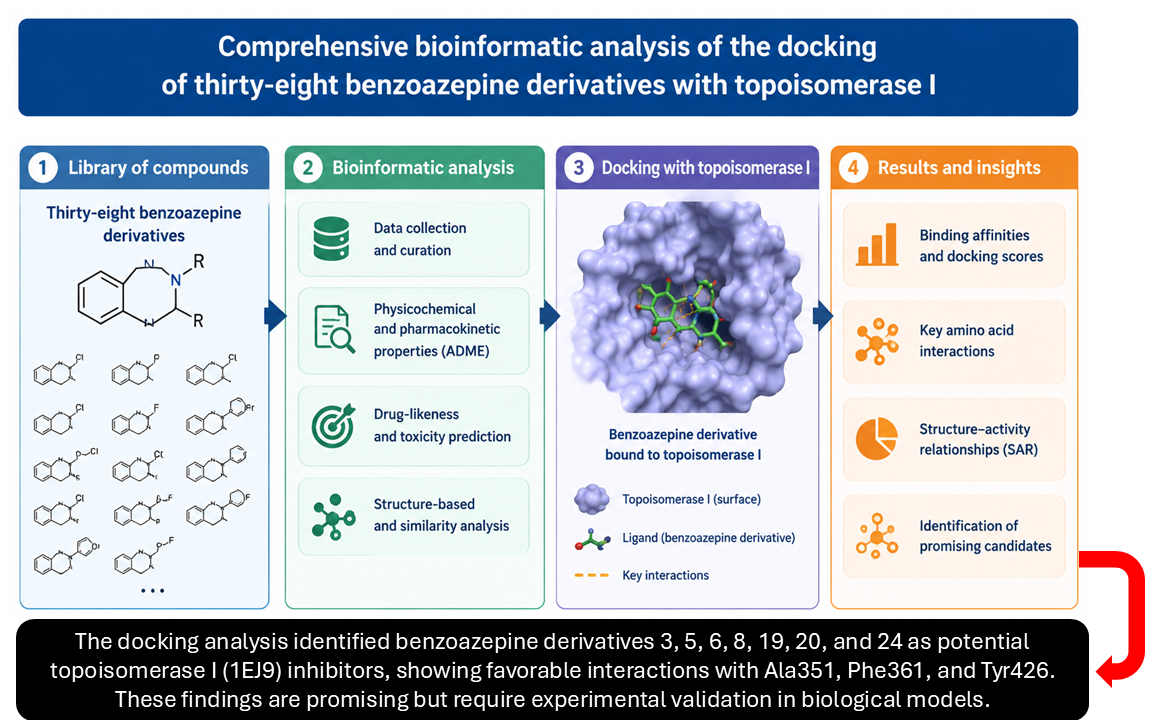
Comprehensive bioinformatic analysis of the docking of thirty-eight benzoazepine derivatives with topoisomerase I
DOI:
https://doi.org/10.14295/bjs.v6i4.969Keywords:
topoisomerase I, cancer, benzazepine derivatives, docking serverAbstract
Alterations in the topoisomerase I concentration have been associated with cancer development. It is important to mention that several drugs have been used as topoisomerase I inhibitors to treat cancer; however, some of these drugs can produce some secondary effects. Besides, their interaction is not clear; for this reason, the aim of this study was to determine the docking of thirty-eight benzazepine derivatives with topoisomerase I using the 1ej9 protein as a theoretical tool in the DockingServer program. In addition, compounds such as amantrone, belotecan, camptothecin, diflomotecan, exatecan, lurtetecan, and topotecan were used as controls. The results suggest that benzazepine derivatives 3, 5, 6, 8, 19, 20, and 24 have a good affinity for the 1ej9 protein surface, involving some amino acid residues such as Ala351, Phe361, and Tyr426. Besides, the Ki for compounds 3, 5, 6, 8, 19, 20, and 24 was different compared with the controls; this data suggests that benzazepine derivatives 3, 5, 6, 8, 19, 20, and 24 could act as 1ej9 protein inhibitors. This phenomenon could translate into changes in the biological activity of topoisomerase I. However, it is important to mention that alternative experiments are needed to evaluate the activity of these compounds in a biological model.
References
Acar Çevik, U., Sağlık, B., Osmaniye, D., Levent, S., Kaya Çavuşoğlu, B., Karaduman, A., & Kaplancıklı, Z. (2020). Synthesis, anticancer evaluation and molecular docking studies of new benzimidazole-1, 3, 4-oxadiazole derivatives as human topoisomerase types I poison. Journal of Enzyme Inhibition and Medicinal Chemistry, 35(1), 1657-1673.https://doi.org/10.1080/14756366.2020.1806831
Alavi, A., & Sharma, V. (2023). Role of docking in anticancer drug discovery. Letters in Drug Design & Discovery, 20(10), 1490-1511. https://doi.org/10.2174/1570180820666221111151104
Alsner, J., Svejstrup, J., Kjeldsen, E., Sørensen, B., & Westergaard, O. (1992). Identification of an N-terminal domain of eukaryotic DNA topoisomerase I dispensable for catalytic activity but essential for in vivo function. Journal of Biological Chemistry, 267(18), 12408-12411. https://doi.org/10.1016/S0021-9258(18)42288-0
Anjaneyulu Yakkala, P., Shaik, R., Seelam, B., Vohora, D., Manga, V., & Kamal, A. (2026). The design and discovery of topoisomerase-II inhibitors as new cancer drugs: current strategies and future perspectives. Expert Opinion on Drug Discovery, 21(6), 623-653. https://doi.org/10.1080/17460441.2026.2672645
Arthur, D., & Uzairu, A. (2018). Molecular docking study and structure‐based design of novel camptothecin analogues used as topoisomerase I inhibitor. Journal of the Chinese Chemical Society, 65(10), 1160-1178.https://doi.org/10.1002/jccs.201700314
Askerova, U. (2023). Prediction of acute toxicity for (Z)-3-(2-phenylhydrazinylidene) benzofuran-2 (3H)-one and its derivatives for rats using GUSAR program. New Materials, Compounds and Applications, 7(1), 50-56.
Avemann, K., Knippers, R., Koller, T., & Sogo, J. (1988). Camptothecin, a specific inhibitor of type I DNA topoisomerase, induces DNA breakage at replication forks. Molecular and Cellular Biology, 8(8), 3026-3034. https://doi.org/10.1128/mcb.8.8.3026-3034.1988
Bai, X., Smith, Z., Wang, Y., Butterworth, S., & Tirella, A. (2022). Sustained drug release from smart nanoparticles in cancer therapy: a comprehensive review. Micromachines, 13(10), 1623.
Bailly, C. (2012). Contemporary challenges in the design of topoisomerase II inhibitors for cancer chemotherapy. Chemical Reviews, 112(7), 3611-3640. https://doi.org/10.1021/ cr200325f
Baud, S., & De Azevedo, W. (2025). Protein-Ligand Docking Simulations for Drug Discovery. Current Medicinal Chemistry, 32(28), 5879-5881. https://doi.org/10.2174/0109298673410629250520111827
Bitencourt-Ferreira, G., Veit-Acosta, M., & de Azevedo, W. (2019). Hydrogen bonds in protein-ligand complexes. In: Docking screens for drug discovery, 93-107 p., New York, NY: Springer New York.
Boos, G., & Stopper, H. (2000). Genotoxicity of several clinically used topoisomerase II inhibitors. Toxicology Letters, 116(1-2), 7-16.https://doi.org/10.1016/S0378-4274(00)00192-2
Borsi, J., Klepp, O., & Johan Moe, P. (1988). PharmCalc: Program for the calculation of clinical pharmacokinetic parameters of methotrexate. Cancer Chemotherapy and Pharmacology, 22(4), 339-343.
Brylinski, M. (2018). Aromatic interactions at the ligand–protein interface: Implications for the development of docking scoring functions. Chemical Biology & Drug Design, 91(2), 380-390. https://doi.org/10.1111/cbdd.13084
Can, Ö., & Bedir, E. (2026). Actinomycin Derivatives: Structural Diversification and Biological Activities. Chemmedchem, 21(15), e70389. https://doi.org/10.1002/cmdc.70389
Celej, M., Montich, G., & Fidelio, G. (2003). Protein stability induced by ligand binding correlates with changes in protein flexibility. Protein Science, 12(7), 1496-1506. https://doi.org/10.1110/ps.0240003
Cheohen, C., Esteves, M., Gomes, V., Allonso, D., & Silva, M. (2024). In silico analysis of natural products from brazilian biodiversity in COVID-19 treatment: NuBBE database against SARS-CoV-2 Papain-Like protease. Journal of the Brazilian Chemical Society, 35(5), e-20230173. https://doi.org/10.21577/0103-5053.20230173
Daina, A., & Zoete, V. (2016). A boiled‐egg to predict gastrointestinal absorption and brain penetration of small molecules. ChemMedChem, 11(11), 1117-1121. https://doi.org/10.1002/cmdc.201600182
Depowski, P., Rosenthal, S., Brien, T., Stylos, S., Johnson, R., & Ross, J. (2000). Topoisomerase IIα expression in breast cancer: correlation with outcome variables. Modern Pathology, 13(5), 542-547.
Dezhenkova, L., Tsvetkov, V., & Shtil, A. (2014). Topoisomerase I and II inhibitors: chemical structure, mechanisms of action and role in cancer chemotherapy. Russian Chemical Reviews, 83(1), 82-94. https://doi.org/10.1070RC2014v08,3u01.ABEH004363
Diao, X., Guo, C., Jin, Y., Li, B., Gao, X., Du, X., & Qiu, H. (2025). Cancer situation in China: an analysis based on the global epidemiological data released in 2024. Cancer Communications, 45(2), 178-197. https://doi.org/10.1002/cac2.12627
Dix, D., Houck, K., Martin, M., Richard, A., Setzer, R., & Kavlock, R. (2007). The ToxCast program for prioritizing toxicity testing of environmental chemicals. Toxicological Sciences, 95(1), 5-12. https://doi.org/10.1093/toxsci/kfl103
Doijen, J., Xie, J., Marsili, S., Bains, T., Mann, M. K., Abeywickrema, P., & Jacoby, E. (2025). A new fragment‐based pharmacophore virtual screening workflow identifies potent inhibitors of SARS‐CoV‐2 NSP13 helicase. Journal of Computational Chemistry, 46(23), e70201. https://doi.org/10.1002/jcc.70201
Du, R., Wang, Y., Pan, M., Zhu, J., Zhao, Y., Zhang, C., & Gao, Y. (2025). Global, regional, and national burdens of pancreatic cancer attributable to smoking from 1990 to 2021 and the projections to 2035: a systematic analysis from the Global Burden of Disease Study 2021. Frontiers in Oncology, 15, 1547029. https://doi.org/10.3389/fonc.2025.1547029
El-Behairy, M., Abd-Allah, W., Khalifa, M., Nafie, M., Saleh, M., Abdel-Maksoud, M., & Al‐Karmalawy, A. A. (2023). Design and synthesis of novel rigid dibenzo [b, f] azepines through ring closure technique as promising anticancer candidates against leukaemia and acting as selective topoisomerase II inhibitors and DNA intercalators. Journal of Enzyme Inhibition and Medicinal Chemistry, 38(1), 2157825.https://doi.org/10.1080/14756366.2022.2157825
Evoli, S., Kariyawasam, N., Nitiss, K., Nitiss, J., & Wereszczynski, J. (2024). Modeling allosteric mechanisms of eukaryotic type II topoisomerases. Biophysical Journal, 123(12), 1620-1634.
Ewesuedo, R., & Ratain, M. (1997). Topoisomerase I inhibitors. The Oncologist, 2(6), 359-364. https://doi.org/10.1634/theoncologist.2-6-359
Ferreira de Freitas, R., & Schapira, M. (2017). A systematic analysis of atomic protein–ligand interactions in the PDB. Medchemcomm, 8(10), 1970-1981.https://doi.org/10.1039/c7md00381a
Foglesong, P., Reckord, C., & Swink, S. (1992). Doxorubicin inhibits human DNA topoisomerase I. Cancer Chemotherapy and Pharmacology, 30(2), 123-125.
Fry, A., Chresta, C., Davies, S., Walker, M., Harris, A., Hartley, J., & Hickson, I. D. (1991). Relationship between topoisomerase II level and chemosensitivity in human tumor cell lines. Cancer Research, 51(24), 6592-6595.
Fu, L., Shi, S., Yi, J., Wang, N., He, Y., Wu, Z., & Cao, D. (2024). ADMETlab 3.0: an updated comprehensive online ADMET prediction platform enhanced with broader coverage, improved performance, API functionality and decision support. Nucleic Acids Research, 52(W1), W422-W431. https://doi.org/10.1093/nar/gkae236
Fuertes, M., Martín-Encinas, E., Selas, A., & Alonso, C. (2026). A patent review of topoisomerase 1 inhibitors (2021–present). Expert Opinion on Therapeutic Patents, 36(1), 25-40. https://doi.org/10.1080/13543776.2025.2579073
Gil, V., & Guallar, V. (2013). pyRMSD: a Python package for efficient pairwise RMSD matrix calculation and handling. Bioinformatics, 29(18), 2363-2364. https://doi.org/10.1093/bioinformatics/btt402
Giovanella, B., Stehlin, J., Wall, M., Wani, M., Nicholas, A., Liu, L., & Potmesil, M. (1989). DNA topoisomerase I-targeted chemotherapy of human colon cancer in xenografts. Science, 246(4933), 1046-1048. https://doi.org/10.1126/science.2555920
Gomeni, R. (1984). PHARM-an interactive graphic program for individual and population pharmacokinetic parameter estimation. Computers in Biology and Medicine, 14(1), 25-34. https://doi.org/10.1016/0010-4825(84)90017-9
Gomez, A., Hachem, S., & Poppiti, R. (2024). Resistance of prostate cancer to topoisomerase inhibitors. In: Therapy Resistance in Prostate Cancer, 157-178 p., Academic Press.https://doi.org/10.1016/B978-0-443-16032-5.00005-1
Greene, N., Reyes-Guzman, C., Baker, L., Meador, E., Noone, A., & Howlader, N. (2025). Impact of alcohol consumption on selected cancer incidence trends among adults in the United States, 2008 to 2019. Cancer Epidemiology, Biomarkers & Prevention, 34(11), 2095-2103. https://doi.org/10.1158/1055-9965.EPI-25-0243
Habib, M., Mahmud, S., Amin, M., Hasan, A., Sultana Nupur, A., Chowdhury, R., & Khanam, R. (2025). Structure‐Guided De Novo Design of Carbapenem Analogs Targeting Penicillin‐Binding Protein 1B Using Pharmacophore‐Based Strategies. ChemistrySelect, 10(35), e00386. https://doi.org/10.1002/slct.202500386
Halgren, T. (1996). Merck molecular force field. I. Basis, form, scope, parameterization, and performance of MMFF94. Journal of Computational Chemistry, 17(5‐6), 490-519. https://doi.org/10.1002/(SICI)1096-987X(199604)17:5/6%3C490::AID-JCC1%3E3.0.CO;2-P
Hande, K. (1998). Etoposide: four decades of development of a topoisomerase II inhibitor. European Journal of Cancer, 34(10), 1514-1521.
Hangas, A., Aasumets, K., Kekäläinen, N., Paloheinä, M., Pohjoismäki, J., Gerhold, J., & Goffart, S. (2018). Ciprofloxacin impairs mitochondrial DNA replication initiation through inhibition of Topoisomerase 2. Nucleic Acids Research, 46(18), 9625-9636. https://doi.org/10.1093/nar/gky793
Huang, K., Chiang, S., Yang, P., Ke, T., Chen, T., Hu, C., & Chao, K. (2021). Immunogenic cell death by the novel topoisomerase I inhibitor TLC388 enhances the therapeutic efficacy of radiotherapy. Cancers, 13(6), 1218. https://www.mdpi.com/2072-6694/13/6/1218#
Husain, I., Mohler, J., Seigler, H., & Besterman, J. M. (1994). Elevation of topoisomerase I messenger RNA, protein, and catalytic activity in human tumors: demonstration of tumor-type specificity and implications for cancer chemotherapy. Cancer Research, 54(2), 539-546.
Ingram, Y., Olujide, O., Sheikh, N., Robinson, A., Ho, J., Syed, A., & Adam, S. (2025). The relationship between obesity and cancer: Epidemiology, pathophysiology, and the effect of obesity treatment on cancer. Current Oncology, 32(6), 362. https://www.mdpi.com/1718-7729/32/6/362#
Jadaun, A., Subbarao, N., & Dixit, A. (2017). Allosteric inhibition of topoisomerase I by pinostrobin: Molecular docking, spectroscopic and topoisomerase I activity studies. Journal of Photochemistry and Photobiology B: Biology, 167, 299-308.https://doi.org/10.1016/j.jphotobiol.2017.01.010
Jain, P., & Nagaraja, V. (2006). Indispensable, functionally complementing N- and C-terminal domains constitute site-specific topoisomerase I. Journal of Molecular Biology, 357(5), 1409-1421.
Jia, G., Chen, Z., Ping, J., Cai, Q., Tao, R., Li, C., & Zheng, W. (2025). Refining breast cancer genetic risk and biology through multi-ancestry fine-mapping analyses of 192 risk regions. Nature Genetics, 57(1), 80-87.
Klopman, G., & Rosenkranz, H. (1995). Toxicity estimation by chemical structure analysis: the TOX II program. Toxicology Letters, 79(1-3), 145-155. https://doi.org/10.1016/0378-4274(95)03366-S
Kumar, A., & Bora, U. (2014). Molecular docking studies of curcumin natural derivatives with DNA topoisomerase I and II-DNA complexes. Interdisciplinary Sciences: Computational Life Sciences, 6(4), 285-291.
Kumar, A., Singla, G., Amita, Singh, B., Sharma, P., Kaur, S., & Tuli, H. (2026). Belotecan in ovarian cancer: anti-inflammatory potential and mechanistic insight to nano-formulations. Future Journal of Pharmaceutical Sciences, 12(1), 17.
Larcher, A., Campi, R., Bex, A., Bray, F., Bukavina, L., Jonasch, E., & Kutikov, A. (2025). Epidemiology of renal cancer: incidence, mortality, survival, genetic predisposition, and risk factors. European Urology. https://doi.org/10.1016/j.eururo.2025.06.005
Larsson, S., Mason, A., Cronje, H., Bassett, E., Horta, G., Kar, S., & Burgess, S. (2025). Alcohol consumption and risk of cancer: a Mendelian randomization analysis of four biobanks and consortium data. BMC Medicine, 23(1), 676.
Le, T., Yang, S., Khadka, D., Van, H., Cho, S., Kwon, Y., & Cho, W. (2011). Design and synthesis of 4-amino-2-phenylquinazolines as novel topoisomerase I inhibitors with molecular modeling. Bioorganic & Medicinal Chemistry, 19(14), 4399-4404.https://doi.org/10.1016/j.bmc.2011.05.012
Lima, F., Silva, D., Szklo, A., Scaff, A., & Reis, R. (2025). Evolución del Tabaquismo e Incidencia de Cáncer de Pulmón en el Brasil (2000-2020). Revista Brasileira de Cancerologia, 71, e-114864.
Limongelli, V. (2020). Ligand binding free energy and kinetics calculation in 2020. Wiley Interdisciplinary Reviews: Computational Molecular Science, 10(4), e1455. https://doi.org/10.1002/wcms.1455
Lohit, N., Singh, A., Kumar, A., Singh, H., Yadav, J., Singh, K., & Kumar, P. (2024). Description and in silico ADME studies of US-FDA approved drugs or drugs under clinical trial which violate the Lipinski’s rule of 5. Letters in Drug Design & Discovery, 21(8), 1334-1358. https://doi.org/10.2174/1570180820666230224112505
López-Ramos, M., Figueroa-Valverde, L., Rosas-Nexicapa, M., Cervantes-Ortega, C., Álvarez-Ramírez, M., & Díaz-Cedillo, F. (2024). Interaction of benzenesulfonamide derivatives with Smyd3 using a theoretical model. Brazilian Journal of Science, 3(1), 115-129. https://doi.org/10.14295/bjs.v3i1.455
Lu, B., Zhang, H., Zhang, T., Cai, Y., Hu, Y., & Zheng, H. (2016). Topoisomerase I expression is associated with prognosis in postoperative non-small cell lung cancer patients. Thoracic Cancer, 7(4), 486-94. https://doi.org/10.1111/1759-7714.12359
Manirakiza, A., Mutesa, L., Mathew, C., & Olopade, O. (2025). Breast cancer: genetic risk assessment, diagnostics, and therapeutics in African populations. Annual Review of Genomics and Human Genetics, 26(1), 245-259. https://doi.org/10.1146/annurev-genom-111522-013953
Martín-Encinas, E., Fuertes, M., Masdeu, C., Selas, A., & Alonso, C. (2025). Investigational DNA topoisomerase I inhibitors for colorectal cancer: preclinical and early phase developments. Expert Opinion on Investigational Drugs, 34(7-8), 591-622.
Martín-Encinas, E., Selas, A., Palacios, F., & Alonso, C. (2022). The design and discovery of topoisomerase I inhibitors as anticancer therapies. Expert Opinion on Drug Discovery, 17(6), 581-601.
Mathijssen, R., Loos, W., Verweij, J., & Sparreboom, A. (2002). Pharmacology of topoisomerase I inhibitors irinotecan (CPT-11) and topotecan. Current Cancer Drug Targets, 2(2), 103-123. https://doi.org/10.2174/1568009023333890
Mazzoleni, V., Boichard, A., & Lamour, V. (2025). DNA topoisomerase II mutations in cancer: structural impact and drug response in high-grade serous ovarian carcinoma. Journal of Molecular Biology, 169384. https://doi.org/10.1016/j.jmb.2025.169384
McLeod, H., Douglas, F., Oates, M., Symonds, R., Prakash, D., Van Der Zee, A., & Keith, W. (1994). Topoisomerase I and II activity in human breast, cervix, lung and colon cancer. International Journal of Cancer, 59(5), 607-611. https://doi.org/10.1002/ijc.2910590506
Morford, K., Tetrault, J., & O’Connor, P. (2025). Alcohol and cancer risk. Journal of the American Medical Association, 334(10), 908-909. doi:10.1001/jama.2025.11229
Morris, G., Goodsell, D., Halliday, R., Huey, R., Hart, W., Belew, R., & Olson, A. (1998). Automated docking using a Lamarckian genetic algorithm and an empirical binding free energy function. Journal of Computational Chemistry, 19(14), 1639-1662. https://doi.org/10.1002/(SICI)1096-987X(19981115)19:14%3C1639::AID-JCC10%3E3.0.CO;2-B
Nagao, T., Yoshimura, S., Saito, Y., & Imai, K. (1999). Developmental toxicity of the topoisomerase inhibitor, etoposide, in rabbits after intravenous administration. Teratogenesis, Carcinogenesis, and Mutagenesis, 19(3), 233-241. https://doi.org/10.1002/(SICI)1520-6866(1999)19:3%3C233::AID-TCM6%3E3.0.CO;2-8
Nevskaya, A., Dang Thi, T., Borisova, T., Titov, A., Anikina, L., Nevskaya, E., & Anh, L. (2026). A new method for the synthesis of 6, 7-dihydro-5 H-pyrrolo [2, 1-a][2] benzazepines and 5, 6, 7, 9, 10, 11-hexahydro-12 H-indolo [2, 1-a][2] benzazepines and evaluation of their bioactivity. RSC Advances, 16(5), 4363-4372.https://doi.org/10.1039/d5ra09014h
Nguyen, H., Vu, V., Truong, V., Huynh, L., Lenon, G., & Ngo, S. (2025). Evaluating the protein–protein binding via the fast pulling of ligand scheme. Chemical Physics Letters, 871, 142136. https://doi.org/10.1016/j.cplett.2025.142136
Nguyen, L., & Shanmugan, S. (2025). A review article: the relationship between obesity and colorectal cancer. Current Diabetes Reports, 25(1), 8.
Nguyen, S., Deppen, S., Nguyen, G., Pham, D., Bui, T., & Tran, T. (2019). Projecting cancer incidence for 2025 in the 2 largest populated cities in Vietnam. Cancer Control, 26(1), 1073274819865274. https://doi.org/10.1177/1073274819865274
Nicklaus, M., Wang, S., Driscoll, J., & Milne, G. (1995). Conformational changes of small molecules binding to proteins. Bioorganic & Medicinal Chemistry, 3(4), 411-428. https://doi.org/10.1016/0968-0896(95)00031-B
Nitiss, J., & Beck, W. (1996). Antitopoisomerase drug action and resistance. European Journal of Cancer, 32(6), 958-966.https://doi.org/10.1016/0959-8049(96)00056-1
Okoro, C., & Fatoki, T. (2023). A mini review of novel topoisomerase II inhibitors as future anticancer agents. International Journal of Molecular Sciences, 24(3), 2532.
Patil, R., Das, S., Stanley, A., Yadav, L., Sudhakar, A., & Varma, A. (2010). Optimized hydrophobic interactions and hydrogen bonding at the target-ligand interface leads the pathways of drug-designing. PloS One, 5(8), e12029. https://doi.org/10.1371/journal.pone.0012029
Perozzo, R., Folkers, G., & Scapozza, L. (2004). Thermodynamics of protein-ligand interactions: history, presence, and future aspects. Journal of Receptors and Signal Transduction, 24(1-2), 1-52. https://doi.org/10.1081/RRS-120037896
Pilati, P., Nitti, D., & Mocellin, S. (2012). Cancer resistance to type II topoisomerase inhibitors. Current Medicinal Chemistry, 19(23), 3900-3906. https://doi.org/10.2174/ 092986712802002473
Pommier, Y., Pourquier, P., Urasaki, Y., Wu, J., & Laco, G. (1999). Topoisomerase I inhibitors: selectivity and cellular resistance. Drug Resistance Updates, 2(5), 307-318.
Rao, S., Head, M., Kulkarni, A., & LaLonde, J. (2007). Validation studies of the site-directed docking program LibDock. Journal of Chemical Information and Modeling, 47(6), 2159-2171. https://doi.org/10.1021/ci6004299
Raza, S. (2025). Emerging trends in global cancer epidemiology. Cancers, 17(9), 1483. https://www.mdpi.com/2072-6694/17/9/1483#
Redinbo, M., Champoux, J., & Hol, W. (2000). Novel insights into catalytic mechanism from a crystal structure of human topoisomerase I in complex with DNA. Biochemistry, 39(23), 6832-6840. https://doi.org/10.1021/bi992690t
Roshandel, G., Ferlay, J., Semnani, S., Fazel, A., Naeimi-Tabiei, M., Ashaari, M., & Bray, F. (2020). Recent cancer incidence trends and short-term predictions in Golestan, Iran 2004–2025. Cancer Epidemiology, 67, 101728. https://doi.org/10.1016/j.canep.2020.101728
Sahu, S., Vyas, M., & Prabhakar, P. (2025). Emerging role of natural topoisomerase inhibitors as anticancer agents. Medicinal Chemistry, 21(3), 195-210. https://doi.org/10.2174/0115734064311729240911102646
Sandri, M., Hochhauser, D., Ayton, P., Camplejohn, R., Whitehouse, R., Turley, H., & Harris, A. (1996). Differential expression of the topoisomerase IIα and β genes in human breast cancers. British Journal of Cancer, 73(12), 1518-1524.
Sangande, F., Julianti, E., & Tjahjono, D. H. (2020). Ligand-based pharmacophore modeling, molecular docking, and molecular dynamic studies of dual tyrosine kinase inhibitor of EGFR and VEGFR2. International Journal of Molecular Sciences, 21(20), 7779. https://www.mdpi.com/1422-0067/21/20/7779#
Schaefer-Klein, J., Murphy, S., Johnson, S., Vasmatzis, G., & Kovtun, I. (2015). Topoisomerase 2 alpha cooperates with androgen receptor to contribute to prostate cancer progression. PLoS One, 10(11), e0142327. https://doi.org/10.1371/journal.pone.0142327
Schmidt, B., Burgin, A., Deweese, J., Osheroff, N., & Berger, J. (2010). A novel and unified two-metal mechanism for DNA cleavage by type II and IA topoisomerases. Nature, 465(7298), 641-644.
Schmidt, B., Osheroff, N., & Berger, J. (2012). Structure of a topoisomerase II–DNA–nucleotide complex reveals a new control mechanism for ATPase activity. Nature Structural & Molecular Biology, 19(11), 1147-1154.
Sedov, I., & Zuev, Y. (2025). Protein–ligand interactions: Recent advances in biophysics, biochemistry, and bioinformatics. International Journal of Molecular Sciences, 26(19), 9576. https://www.mdpi.com/1422-0067/26/19/9576#
Seiter, K. (2005). Toxicity of the topoisomerase II inhibitors. Expert Opinion on Drug Safety, 4(2), 219-234.https://doi.org/10.1517/14740338.4.2.219
Shimu, M. (2024). Computational screening and molecular docking of compounds from Traditional Chinese Medicine (TCM) by targeting DNA topoisomerase I to design potential anticancer drugs. PLoS One, 19(9), e0310364.https://doi.org/10.1371/journal.pone.0310364
Shityakov, S., Neuhaus, W., Dandekar, T., & Förster, C. (2013). Analysing molecular polar surface descriptors to predict blood-brain barrier permeation. International Journal of Computational Biology and Drug Design, 6(1-2), 146-156. https://doi.org/10.1504/IJCBDD.2013.052195
Shumaker, R. (1986). PKCALC: a basic interactive computer program for statistical and pharmacokinetic analysis of data. Drug Metabolism Reviews, 17(3-4), 331-348. https://doi.org/10.3109/03602538608998295
Sim, J., Kim, D., Kim, B., Choi, J., & Lee, J. (2025). Recent advances in AI-driven protein-ligand interaction predictions. Current Opinion in Structural Biology, 92, 103020. https://doi.org/10.1016/j.sbi.2025.103020
Solanki, P., Rana, N., Jha, P. C., & Manhas, A. (2023). A comprehensive analysis of the role of molecular docking in the development of anticancer agents against the cell cycle CDK enzyme. Biocell, 47(4). https://doi.org/10.32604/biocell.2023.026615
Solis, F., & Wets, R. (1981). Minimization by random search techniques. Mathematics of Operations Research, 6(1), 19-30. https://doi.org/10.1287/moor.6.1.19
Solsona‐Vilarrasa, E., & Vousden, K. H. (2025). Obesity, white adipose tissue and cancer. The FEBS Journal, 292(9), 2189-2207. https://doi.org/10.1111/febs.17312
Stewart, L., Ireton, G., & Champoux, J. (1996). The Domain Organization of Human Topoisomerase I (∗). Journal of Biological Chemistry, 271(13), 7602-7608.
Tan, K., Mattern, M., Eng, W., McCabe, F., & Johnson, R. (1989). Nonproductive rearrangement of DNA topoisomerase I and II genes: correlation with resistance to topoisomerase inhibitors. JNCI: Journal of the National Cancer Institute, 81(22), 1732-1735.
Teicher, B. (2008). Next generation topoisomerase I inhibitors: Rationale and biomarker strategies. Biochemical Pharmacology, 75(6), 1262-1271. https://doi.org/10.1016/j.bcp.2007.10.016
Tewes, B., Frehland, B., Schepmann, D., Robaa, D., Uengwetwanit, T., Gaube, F., & Wünsch, B. (2015). Enantiomerically pure 2-methyltetrahydro-3-benzazepin-1-ols selectively blocking GluN2B subunit containing N-methyl-D-aspartate receptors. Journal of Medicinal Chemistry, 58(15), 6293-6305.https://doi.org/10.1021/acs.jmedchem.5b00897
Turrini, E., Maffei, F., Milelli, A., & Fimognari, C. (2025). Topoisomerase II inhibitors in oncology: an updated patent review (2016-present). Expert Opinion on Therapeutic Patents, 35(11), 1141-1154. https://doi.org/10.1080/13543776.2025.2558899
Uppathi, P., Rajakumari, S., & Saritha, K. V. (2025). Molecular docking: an emerging tool for target-based cancer therapy. Critical Reviews™ in Oncogenesis, 30(1). https://doi.org/10.1615/CritRevOncog.2024056533
Valdés-Albuernes, J., Díaz-Pico, E., Alfaro, S., & Caballero, J. (2025). Advanced modeling of salt-inducible kinase (SIK) inhibitors incorporating protein flexibility through molecular dynamics and cross-docking. Scientific Reports, 15(1), 18868.
Van, H., Khadka, D., Yang, S., Le, T., Cho, S., Zhao, C., & Cho, W. (2011). Synthesis of benzo [3, 4] azepino [1, 2-b] isoquinolin-9-ones from 3-arylisoquinolines via ring closing metathesis and evaluation of topoisomerase I inhibitory activity, cytotoxicity and docking study. Bioorganic & Medicinal Chemistry, 19(18), 5311-5320. https://doi.org/10.1016/j.bmc.2011.08.006
Vedani, A., Dobler, M., & Smieško, M. (2012). VirtualToxLab-a platform for estimating the toxic potential of drugs, chemicals and natural products. Toxicology and Applied Pharmacology, 261(2), 142-153. https://doi.org/10.1016/j.taap.2012.03.018
Velázquez-Libera, J., Durán-Verdugo, F., Valdés-Jiménez, A., Núñez-Vivanco, G., & Caballero, J. (2020). LigRMSD: A web server for automatic structure matching and RMSD calculations among identical and similar compounds in protein-ligand docking. Bioinformatics36(, 9), 2912-2914. https://doi.org/10.1093/bioinformatics/btaa018
Vemula, S., & Dhakshanamoorthy, K. (2025). Epidemiology of cancer incidence estimates and statistics 2000-2025: analysis from National cancer registry programme in India. Indian Journal of Medical and Paediatric Oncology, 46(03), 278-287. https://doi.org/10.1055/s-0044-1801767
Walters, W. (2012). Going further than Lipinski's rule in drug design. Expert Opinion on Drug Discovery, 7(2), 99-107. https://doi.org/10.1517/17460441.2012.648612
Wang, J. (1996). DNA topoisomerases. Annual Review of Biochemistry, 65(1), 635-692. https://doi.org/10.1146/annurev.bi.65.070196.003223
Wang, M., Liang, L., Wang, R., Jia, S., Xu, C., Wang, Y., & Qing, C. (2023). Narciclasine, a novel topoisomerase I inhibitor, exhibited potent anti-cancer activity against cancer cells. Natural Products and Bioprospecting, 13(1), 27.
Woo, H., & Roux, B. (2005). Calculation of absolute protein–ligand binding free energy from computer simulations. Proceedings of the National Academy of Sciences, 102(19), 6825-6830.
Yusuf, S. (2025). Pharmacokinetic evaluation of sulfadicramide through SwissADME: A computational insight into drug-likeness and bioavailability. MAS Journal of Applied Sciences, 10(2), 357-362. https://doi.org/10.5281/zenodo.15741944
Zagotto, G., Gianoncelli, A., Sissi, C., Marzano, C., Gandin, V., Pasquale, R., & Palumbo, M. (2014). Novel Ametantrone–Amsacrine Related Hybrids as Topoisomerase IIβ Poisons and Cytotoxic Agents. Archiv der Pharmazie, 347(10), 728-737. https://doi.org/10.1002/ardp.201400111
Zhang, W., Bell, E., Yin, M., & Zhang, Y. (2020). EDock: blind protein–ligand docking by replica-exchange Monte Carlo simulation. Journal of Cheminformatics, 12(1), 37. https://doi.org/10.1186/s13321-020-00440-9
Zhang, Y., Huo, M., Zhou, J., & Xie, S. (2010). PKSolver: An add-in program for pharmacokinetic and pharmacodynamic data analysis in Microsoft Excel. Computer Methods and Programs in Biomedicine, 99(3), 306-314.
Zhang, Y., Wang, W., Dai, K., Huang, Y., Wang, R., He, D., & Liang, H. (2025). Global lung cancer burden attributable to air fine particulate matter and tobacco smoke exposure: spatiotemporal patterns, sociodemographic characteristics, and transnational inequalities from 1990 to 2021. BMC Public Health, 25(1), 1260.
Downloads
Published
How to Cite
Issue
Section
License
Copyright (c) 2027 Marcela Rosas Nexticapa, Magdalena Álvarez-Ramírez, Enrique Bonilla-Zavaleta, Martha Paola Rascón-Díaz, Abril Ramírez-Higuera

This work is licensed under a Creative Commons Attribution 4.0 International License.
Authors who publish with this journal agree to the following terms:
1) Authors retain copyright and grant the journal right of first publication with the work simultaneously licensed under a Creative Commons Attribution License that allows others to share the work with an acknowledgement of the work's authorship and initial publication in this journal.
2) Authors are able to enter into separate, additional contractual arrangements for the non-exclusive distribution of the journal's published version of the work (e.g., post it to an institutional repository or publish it in a book), with an acknowledgement of its initial publication in this journal.
3) Authors are permitted and encouraged to post their work online (e.g., in institutional repositories or on their website) prior to and during the submission process, as it can lead to productive exchanges, as well as earlier and greater citation of published work.