Functional imaging beyond anatomy: The emerging role of magnetic resonance spectroscopy and metabolic biomarkers in monitoring targeted cancer therapy
DOI:
https://doi.org/10.14295/bjs.v6i3.963Keywords:
magnetic resonance spectroscopy, metabolic biomarkers, targeted cancer therapy, hyperpolarized 13C MRI, deuterium metabolic imagingAbstract
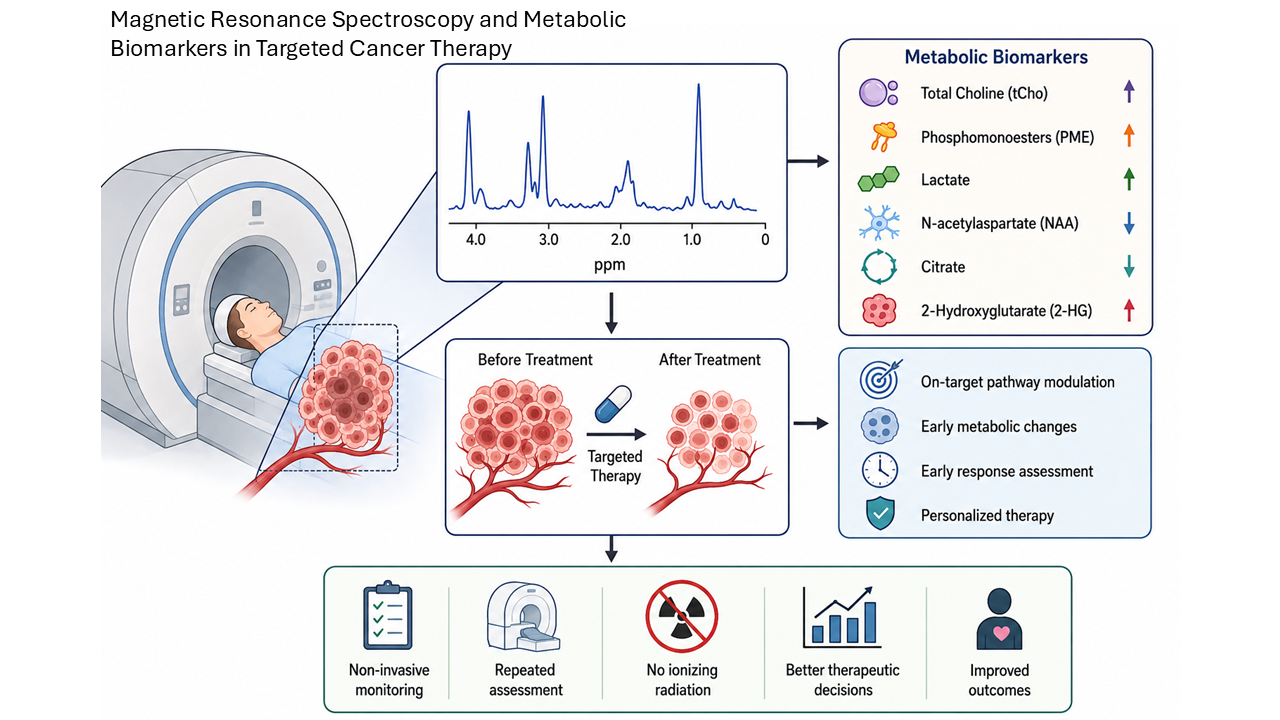
Anatomical imaging — measurements of tumour size on computed tomography or conventional magnetic resonance imaging (MRI) — remains the backbone of oncologic response assessment, yet it is structurally blind to the earliest events of treatment action. Targeted anticancer agents, by definition, act on specific molecular pathways whose blockade alters tumour metabolism within hours to days, long before any measurable change in tumour dimensions. Magnetic resonance spectroscopy (MRS) and spectroscopic imaging (MRSI) are uniquely positioned to capture these pharmacodynamic events non-invasively, repeatedly and without ionising radiation, by quantifying endogenous metabolites that report on membrane phospholipid turnover (total choline, phosphomonoesters), aerobic glycolysis (lactate), neuronal and tissue integrity (N-acetylaspartate, citrate), oncometabolite production (2-hydroxyglutarate in IDH-mutant glioma) and, with hyperpolarised 13C and deuterium (2H) tracers, real-time metabolic fluxes. This review synthesises the principles, biomarker repertoire and clinical evidence for MRS-based monitoring of targeted cancer therapy across glioma, breast, prostate and abdominal malignancies; examines how metabolic readouts document on-target pathway modulation for kinase, PI3K/AKT/mTOR, IDH, antiangiogenic and endocrine agents; surveys the maturing technologies of hyperpolarised 13C MRSI and deuterium metabolic imaging; and discusses the integration of MRS with multiparametric MRI, artificial intelligence and nanotheranostic drug development. We argue that the field is transitioning from proof-of-principle pharmacodynamic studies toward standardised, biomarker-guided adaptive therapy, and that the principal barriers — technical harmonisation, quantification standards and prospective validation — are now well defined and addressable. Functional imaging beyond anatomy, anchored in MRS-detectable metabolic biomarkers, offers a practical route to earlier response assessment, reduced exposure to ineffective therapy and more informative oncology drug development.
References
Amir, J., Muhammad, S., Kashif, M., Khan, A. A., Gul, M., Sun, H., Shah, M., Azizi, S., & Maaza, M. (2025). Synthesis, characterization and dielectric properties evaluation of NiO-Co3O4 nanocomposite. Journal of the Iranian Chemical Society, 22, 63-72. https://doi.org/10.1007/s13738-024-03129-0
Andronesi, O. C., Arrillaga-Romany, I. C., Ly, K. I., Bogner, W., Ratai, E. M., Reitz, K., Chi, A. S., Cahill, D. P., & Batchelor, T. T. (2018). Pharmacodynamics of mutant-IDH1 inhibitors in glioma patients probed by in vivo 3D MRS imaging of 2-hydroxyglutarate. Nature Communications, 9, 1474. https://doi.org/10.1038/s41467-018-03905-6
Baek, H. M., Chen, J. H., Nalcioglu, O., Su, M. Y. (2008). Proton MR spectroscopy for monitoring early treatment response of breast cancer to neo-adjuvant chemotherapy. Annals of Oncology, 19(5), 1022-1024.
Branzoli, F., & Marjańska, M. (2020). Magnetic resonance spectroscopy of IDH-mutated gliomas: current knowledge on the neurochemical profile. Current Opinion in Neurology, 33(4), 413-421. https://doi.org/10.1097/WCO.0000000000000833
Bushra, Kashif, M., Khairullah, Khan, A. A., Sun, H., Yousaf, J., & Ahmad, T. (2024). Synthesis and characterization of Fe-doped CuO nanoparticles: Catalytic efficiency in crystal violet dye degradation and exploration of electrical properties. Brazilian Journal of Science, 3(8), 1-18. https://doi.org/10.14295/bjs.v3i8.601
Bushra, Kashif, M., Khairullah, Khan, A. A., Sun, H., Yousaf, J., Shah, M. I. A., Hussain, S., Amir, J., Jamal, Y., & Ahmad, T. (2024). Synthesis and characterization of Fe-doped CuO nanoparticles: Catalytic efficiency in crystal violet dye degradation and exploration of electrical properties. Brazilian Journal of Science, 3(8), 1-18. https://doi.org/10.14295/bjs.v3i8.601
Cao, M. D., Sitter, B., Bathen, T. F., Bofin, A., Lundgren, S., & Gribbestad, I. S. (2012). Predicting long-term survival and treatment response in breast cancer patients receiving neoadjuvant chemotherapy by MR metabolic profiling. NMR in Biomedicine, 25(2), 369-378. https://doi.org/10.1002/nbm.1762
Chetry, M., Feng, R., Babar, S., Sun, H., Zafar, I., Mohany, M., Afridi, H. I., Khan, N. U., Ali, I., Shafiq, M., & Khan, S. (2025). Early detection and analysis of accurate breast cancer for improved diagnosis using deep supervised learning for enhanced patient outcomes. PeerJ Computer Science, 11, e2784. https://doi.org/10.7717/peerj-cs.2784
Chen, H. Y., Aggarwal, R., Bok, R. A., Ohliger, M. A., Zhu, Z., Lee, P., Gordon, J. W., Carvajal, L., Laeson, P. E. S., Kurhanewicz, J., & Vigneron, D. B. (2020). Hyperpolarized 13C-pyruvate MRI detects real-time metabolic flux in prostate cancer metastases to bone and liver: a clinical feasibility study. Prostate Cancer and Prostatic Diseases, 23, 269-276. https://doi.org/10.1038/s41391-019-0180-z
Cheng, L. L., MA Burns, M. A., Taylor, J. L., He, W., & . (2005). Metabolic characterization of human prostate cancer with tissue magnetic resonance spectroscopy. Cancer Research, 65(8), 3030-3034. https://doi.org/10.1158/0008-5472.CAN-04-4106
Chetta, P., & Zadra, G. (2021). Metabolic reprogramming as an emerging mechanism of resistance to endocrine therapies in prostate cancer. Cancer Drug Resistance, 4(1), 143-162. https://doi.org/10.20517/cdr.2020.54
Chetry, M., Feng, R., Babar, S., Sun, H., Zafar, I., Mohany, M., Afridi, H. I., Khan, N. U., Ali, I., Shafiq, M., & Khan, S. (2025). Early detection and analysis of accurate breast cancer for improved diagnosis using deep supervised learning for enhanced patient outcomes. PeerJ Computer Science, 11, e2784. https://doi.org/10.7717/peerj-cs.2784
Cho, N., Im, S. A., Kang, K. W., Park, I. A., Song, I-A., Lee, K-H., Kim, T-Y., Lee, H., Chun, I. K., Yoon, H-J., & Moon, W. K. (2016). Early prediction of response to neoadjuvant chemotherapy in breast cancer patients: comparison of single-voxel 1H-magnetic resonance spectroscopy and 18F-fluorodeoxyglucose positron emission tomography. European Radiology, 26, 2279-2290. https://doi.org/10.1007/s00330-015-4014-7
Day, S. E., Kettunen, M. I., Gallagher, F. A., Hu, E. E., Lerche, M., Wolber, J., Golman, K., Ardenkjaer-Larsen, J. H., & Brindle, K. M. (2007). Detecting tumor response to treatment using hyperpolarized 13C magnetic resonance imaging and spectroscopy. Nature Medicine, 13, 1382-1387. https://doi.org/10.1038/nm1650
De Feyter, H. M., Behar, K. L., Corbin, Z. A., Fulbright, R. K., Brown, P. B., McIntyre, S., Nixon, T. W., Rothman, D. L., & De Graaf, R. A. (2018). Deuterium metabolic imaging (DMI) for MRI-based 3D mapping of metabolism in vivo. Science Advances, 4(8). https://doi.org/10.1126/sciadv.aat7314
Glunde, K., & Bhujwalla, Z. M. (2011). Metabolic tumor imaging using magnetic resonance spectroscopy. Seminars in Oncology, 38(1), 26-41. https://doi.org/10.1053/j.seminoncol.2010.11.001
Gul, M., Kashif, M., Muhammad, S., Azizi, S., & Sun, H. (2025). Various methods of synthesis and applications of gold-based nanomaterials: A detailed review. Crystal Growth & Design, 25(7), 2227-2266. https://doi.org/10.1021/acs.cgd.4c01687
Gul, M., Kashif, M., Muhammad, S., Azizi, S., & Sun, H. (2025). Various methods of synthesis and applications of gold-based nanomaterials: A detailed review. Crystal Growth & Design, 25(7), 2227-2266. https://doi.org/10.1021/acs.cgd.4c01687
Hesketh, R. L., & Brindle, K. M. (2018). Magnetic resonance imaging of cancer metabolism with hyperpolarized 13C-labeled cell metabolites. Current Opinion in Chemical Biology, 45, 187-194. https://doi.org/10.1016/j.cbpa.2018.03.004
Jagannathan, N. R., Kumar, M., Seenu, V., Coshic, O., Dwivedi, S. N., Julka, P. K., Srivastava, A., & Rath, G. K. (2001). Evaluation of total choline from in-vivo volume localized proton MR spectroscopy and its response to neoadjuvant chemotherapy in locally advanced breast cancer. British Journal of Cancer, 84, 1016-1022. https://doi.org/10.1054/bjoc.2000.1711
Jamal, M., Nabi, G. A. K., Sun, H., Ullah, K., Khattak, O. A., Kashif, M., Khan, S., Alam, M., Hussain, S., Ullah, M., Aleena, S., Haq, H., Umar, S., Atif, M., Hussain, I., & Masood, A. (2024). Preparation of manganese-doped bismuth oxide for the photocatalytic degradation of methylene blue. Archives of Advanced Engineering Science, 1-7. 10.47852/bonviewAAES42023402.
Jia, B., Zhao, L., Tang, M., Xie, N., Huang, Y., Liang, X., Yang, G., Wu, Q., Sun, Z., Kwan, H. L., Sun, H., & Xu, K. (2026). Neuron–tumor crosstalk in cancer: Molecular mechanisms and translational advances. Molecular Cancer. https://doi.org/10.1186/s12943-026-02715-5
Kashif, M., Jawad, M., Khan, A., Sun, H., Ullah, K., Fakayode, O., & Azizi, S. (2024). Fe/Ti-codoped strontium oxide nanoparticles for enhanced photocatalytic degradation of methyl orange. Journal of Applied Research in Water and Wastewater, 11(1), 8-14. https://doi.org/10.22126/arww.2024.10753.1336
Kashif, M., Jawad, M., Khan, A., Sun, H., Ullah, K., Fakayode, O., Azizi, S. (2024). Fe/Ti-codoped strontium oxide nanoparticles for enhanced photocatalytic degradation of methyl orange. Journal of Applied Research in Water and Wastewater, 11(1), 8-14. https://doi.org/10.22126/arww.2024.10753.1336
Kashif, M., Gul, M., Shahzad, N., Sun, H., Shezan, S. A., Ahmad, N., Hamlaoui, O., & Tozan, H. (2026). Metal oxide nanoparticles: A comprehensive review of recent advances in synthesis strategies, characterization, and multifunctional applications. Catalysts, 16(8), 678. https://doi.org/10.3390/catal16080678
Kauppinen, R. A., & Peet, A. C. (2011). Using magnetic resonance imaging and spectroscopy in cancer diagnostics and monitoring: preclinical and clinical approaches. Cancer Biology & Therapy, 12(8), 665-679. https://doi.org/10.4161/cbt.12.8.18137
Kreis, F., Wright, A. J., Hesse, F., Fala, M., Hu, D., & Brindle, K. M. (2020). Measuring tumor glycolytic flux in vivo by using fast deuterium MRI. Radiology, 294(2). https://doi.org/10.1148/radiol.2019191242
Liu, S., Zhang, X., Wang, W., Li, X., Sun, X., Zhao, Y., Wang, Q. (2024). Metabolic reprogramming and therapeutic resistance in primary and metastatic breast cancer. Molecular Cancer, 23, 261. https://doi.org/10.1186/s12943-024-02165-x
Liu, S., Sun, H., Song, T., Liang, C., Deng, L., Zhu, H., Zhao, F., & Li, S. (2025). Comprehensive characterization of T cell subtypes in lung adenocarcinoma: Prognostic, predictive, and therapeutic implications. Translational Oncology, 55, 102332. https://doi.org/10.1016/j.tranon.2025.102332
Liu, Y., Zhou, Q., Song, S., & Tang, S. (2021). Integrating metabolic reprogramming and metabolic imaging to predict breast cancer therapeutic responses. Trends in Endocrinology & Metabolism, 32(10), 762-775.
Lodi, A., & Ronen, S. M. (2011). Magnetic resonance spectroscopy detectable metabolomic fingerprint of response to antineoplastic treatment. PLOS ONE, 6(10), e26155. https://doi.org/10.1371/journal.pone.0026155
Manton, D. J., Chaturvedi, A., Hubbard, A., Lind, M. J., Lowry, M., Maeaveyas, A., Pickles, M. D., & Turnbull, L. W. (2006). Neoadjuvant chemotherapy in breast cancer: early response prediction with quantitative MR imaging and spectroscopy. British Journal of Cancer, 94, 427-435. https://doi.org/10.1038/sj.bjc.6602948
Mignion, L., Dutta, P., Martinez, G. V., Foroutan, P., Gillies, R. J., & Jordan, B. F. (2014). Monitoring chemotherapeutic response by hyperpolarized 13C-fumarate MRS and diffusion MRI. Cancer Research, 74(3), 686-694. https://doi.org/10.1158/0008-5472.CAN-13-1914
Muhammad, S., Sun, H., Zahoor, S., Khan, S., Ullah, R., Fu, B., Ullah, S., Isimjan, T. T., Azizi, S., & Yang, X. (2026). Advancing MOFs for electrocatalytic ORR, UOR, and CO2RR: From fundamentals to device integration and deployment challenges. Materials Science and Engineering: R: Reports, 171, 101248. https://doi.org/10.1016/j.mser.2026.101248
Najac, C., & Ronen, S. M. (2016). MR molecular imaging of brain cancer metabolism using hyperpolarized 13C magnetic resonance spectroscopy. Topics in Magnetic Resonance Imaging, 25(5), 187-196 https://doi.org/10.1097/RMR.0000000000000104
Pan, F., Liu, X., Wan, J., Guo, Y., Sun, P., Zhang, X., Wang, J., Bao, Q., & Yang, L. (2024). Advances and prospects in deuterium metabolic imaging (DMI): a systematic review of in vivo studies. European Radiology Experimental, 8. https://doi.org/10.1186/s41747-024-00464-y
Peng, Z., Lv, X., Sun, H., Zhao, L., & Huang, S. (2025). 3D tumor cultures for drug resistance and screening development in clinical applications. Molecular Cancer, 24, 93. https://doi.org/10.1186/s12943-025-02281-2
Peng, Z., Lv, X., Sun, H., Zhao, L., & Huang, S. (2025). 3D tumor cultures for drug resistance and screening development in clinical applications. Molecular Cancer, 24, 93. https://doi.org/10.1186/s12943-025-02281-2
Pope, W. B., Prins, R. M., Albert Thomas, M., Nagarajan, R., Yen, K. E., Bittinger, M. A., Lai, A., Kornblum, H. I., Wu, H., Fantin, V. R., & Liau, L. M. (2012). Non-invasive detection of 2-hydroxyglutarate and other metabolites in IDH1 mutant glioma patients using magnetic resonance spectroscopy. Journal of Neuro-Oncology, 107, 197-205. https://doi.org/10.1007/s11060-011-0737-8
Saito, K., Matsumoto, S., Takakusagi, Y., Matsuo, M., Morris, H. D., Lizak, M. J., Munasinghe, J. P., Devasahayan, N., Subramanian, S., Mitchell, J. B., & Krishna, M. C. (2015). 13C-MR spectroscopic imaging with hyperpolarized [1-13C]pyruvate detects early response to radiotherapy in SCC tumors and HT-29 tumors. Clinical Cancer Research, 21(22), 5073-5081. https://doi.org/10.1158/1078-0432.CCR-14-1717
Serkova, N. J., & Brown, M. S. (2012). Quantitative analysis in magnetic resonance spectroscopy: From metabolic profiling to in vivo biomarkers. Bioanalysis, 4(3), 321-341. https://doi.org/10.4155/bio.11.320
Serrao, E. M., & Brindle, K. M. (2016). Potential clinical roles for metabolic imaging with hyperpolarized [1-13C] pyruvate. Frontiers in Oncology, 6. https://doi.org/10.3389/fonc.2016.00059
Shah, A. (2025). Bismuth vanadate nanoparticles- Structure, synthesis, and emerging engineering applications. Biomedical Journal of Scientific & Technical Research, 62(3), 54728-54740.DOI: 10.26717/BJSTR.2025.62.009758
Shah, J., Sun, H., Qiao, Z., Sharif, T., & Gul, M. (2024). Enhanced degradation of methylene blue dye using hydrothermally synthesized nickel-doped strontium oxide catalysts. Brazilian Journal of Science, 3, 13-27. https://doi.org/10.14295/bjs.v3i12.663
Sharma, U., & Jagannathan, N. R. (2022). Magnetic resonance imaging (MRI) and MR spectroscopic methods in understanding breast cancer biology and metabolism. Metabolites, 12(4), 295. https://doi.org/10.3390/metabo12040295
Sun, H., del Toro, F., Makki, M., Tenllado, F., & Canto, T. (2022). Adaptation of a potyvirus chimera increases its virulence in a compatible host through changes in HCPro. Plants, 11(17), 2262. https://doi.org/10.3390/plants11172262
Sun, H., Sohail, A., Shah, A., Liaqat, Z., Gul, M., & Liangyu. (2025). From precursors to performance: Diverse synthesis strategies for cerium oxide nanoparticles. Phytopharmacology Research Journal, 4(2), 28-42. https://ojs.prjn.org/index.php/prjn/article/view/82
Sun, H., Ciska, M., Makki, M., Tenllado, F., & Canto, T. (2024). Adaptive substitutions at two amino acids of HCPro modify its functional properties to separately increase the virulence of a potyviral chimera. Molecular Plant Pathology, 25(6), e13487. https://doi.org/10.1111/mpp.13487
Taglang, C., Batsios, G., Mukherjee, J., Tran, M., Gillespie, A. M., Hong, D., Romen, S. M., Pieper, R. O., & Viswanath, P. (2022). Deuterium magnetic resonance spectroscopy enables noninvasive metabolic imaging of tumor burden and response to therapy in low-grade gliomas. Neuro-Oncology, 24(7), 1101-1112. https://doi.org/10.1093/neuonc/noac022
Tiwari, V., Daoud, E. V., Hatanpaa, K. J., Gao, A., Zhang, S., An, Z., Ganji, S. K., Madden, C. J., Sherry, A. D., Malloy, C. R., & Choi, C. (2020). Glycine by MR spectroscopy is an imaging biomarker of glioma aggressiveness. Neuro-Oncology, 22(7), 1018-1029. https://doi.org/10.1093/neuonc/noaa034
Viswanath, P., Radoul, M., Izquierdo-Garcia, J. L., Luchman, H. A., Cairncross, J. G., Pieper, R. O., Phillips, J. J., & Ronen, S. M. (2018). Mutant IDH1 gliomas downregulate phosphocholine and phosphoethanolamine synthesis in a 2-hydroxyglutarate-dependent manner. Cancer & Metabolism, 6. https://doi.org/10.1186/s40170-018-0178-3
Wang, W., Gao, R., Zhang, L., Dong, Y., Du, Y., Dai, Q., Liu, B., Fang, C., Wang, C., Sun, H., Tong, F., & Huang, W. (2026). Precisely targeting cardiac remodeling nanomachine for restarting healthy heartbeat. Advanced Healthcare Materials, 15(3), e03478. https://doi.org/10.1002/adhm.202503478
Ward, C. S., Venkatesh, H. A., Chaumeil, M. M., Brandes, A. H., VanCriekinge, M., Dafni, H., Sukumar, S., Nelson, S. J., Vigneron, D. B., Hass-Kogan, D. A. & Ronen, S. M. (2010). Noninvasive detection of target modulation following phosphatidylinositol 3-Kinase inhibition using hyperpolarized 13C magnetic resonance spectroscopy. Cancer Research, 70(4), 1296-1305. https://doi.org/10.1158/0008-5472.CAN-09-2251
Woitek, R., & Gallagher, F. A. (2021). The use of hyperpolarised 13C-MRI in clinical body imaging to probe cancer metabolism. British Journal of Cancer, 124, 1187-1198. https://doi.org/10.1038/s41416-020-01224-6
Zeng, X., & Sun, H. (2025). Enhancing the understanding of complement protein changes in RVO: Insights and suggestions [Letter]. Journal of Inflammation Research, 18(0), 2781-2782. https://doi.org/10.2147/JIR.S522685
Zhang, B., Zhang, H., Zhu, L., Weng, X., & Sun, H. (2026). Microplastics in the human gastrointestinal system: A comprehensive study of metabolic risks and digestive toxicity. Msi Journal of Multidisciplinary Research, 3(4), 1-31. https://zenodo.org/records/19660158
Zhang, P., Liao, L., Dong, X., Peng, Z., Huang, S., Guo, D., & Sun, H. (2026). Mechanistic insights into Ginkgo biloba extract's anti-inflammatory effects in COPD: Regulation of Th1/Th2 balance via the p38 MAPK pathway. Current Medicinal Chemistry. https://doi.org/10.2174/0109298673432300260606201036
Zhu, H., Sun, H., Dai, J., Hao, J., & Zhou, B. (2024). Chitosan-based hydrogels in cancer therapy: Drug and gene delivery, stimuli-responsive carriers, phototherapy and immunotherapy. International Journal of Biological Macromolecules, 282(2), 137047. https://doi.org/10.1016/j.ijbiomac.2024.137047
Zhu, H., Sun, H., Dai, J., Hao, J., & Zhou, B. (2024). Chitosan-based hydrogels in cancer therapy: Drug and gene delivery, stimuli-responsive carriers, phototherapy and immunotherapy. International Journal of Biological Macromolecules, 282(2), 137047. https://doi.org/10.1016/j.ijbiomac.2024.137047
Downloads
Published
How to Cite
Issue
Section
License
Copyright (c) 2027 Hao Sun, Xiaojun Dong, Jinze Yu, Yuanyin Teng, Gaoyang Guo, Liangyu Li, Wei Wang, Bing Liu, Yuquan Li, Keyang Xu

This work is licensed under a Creative Commons Attribution 4.0 International License.
Authors who publish with this journal agree to the following terms:
1) Authors retain copyright and grant the journal right of first publication with the work simultaneously licensed under a Creative Commons Attribution License that allows others to share the work with an acknowledgement of the work's authorship and initial publication in this journal.
2) Authors are able to enter into separate, additional contractual arrangements for the non-exclusive distribution of the journal's published version of the work (e.g., post it to an institutional repository or publish it in a book), with an acknowledgement of its initial publication in this journal.
3) Authors are permitted and encouraged to post their work online (e.g., in institutional repositories or on their website) prior to and during the submission process, as it can lead to productive exchanges, as well as earlier and greater citation of published work.