Time-nonlocal modeling of khat addiction networks in Dire Dawa and Hararghe: Cultural persistence and economic feedback loops
DOI:
https://doi.org/10.14295/bjs.v6i2.937Keywords:
khat addiction, fractional derivatives, nonlocal influence, poverty trap, social network interventionAbstract
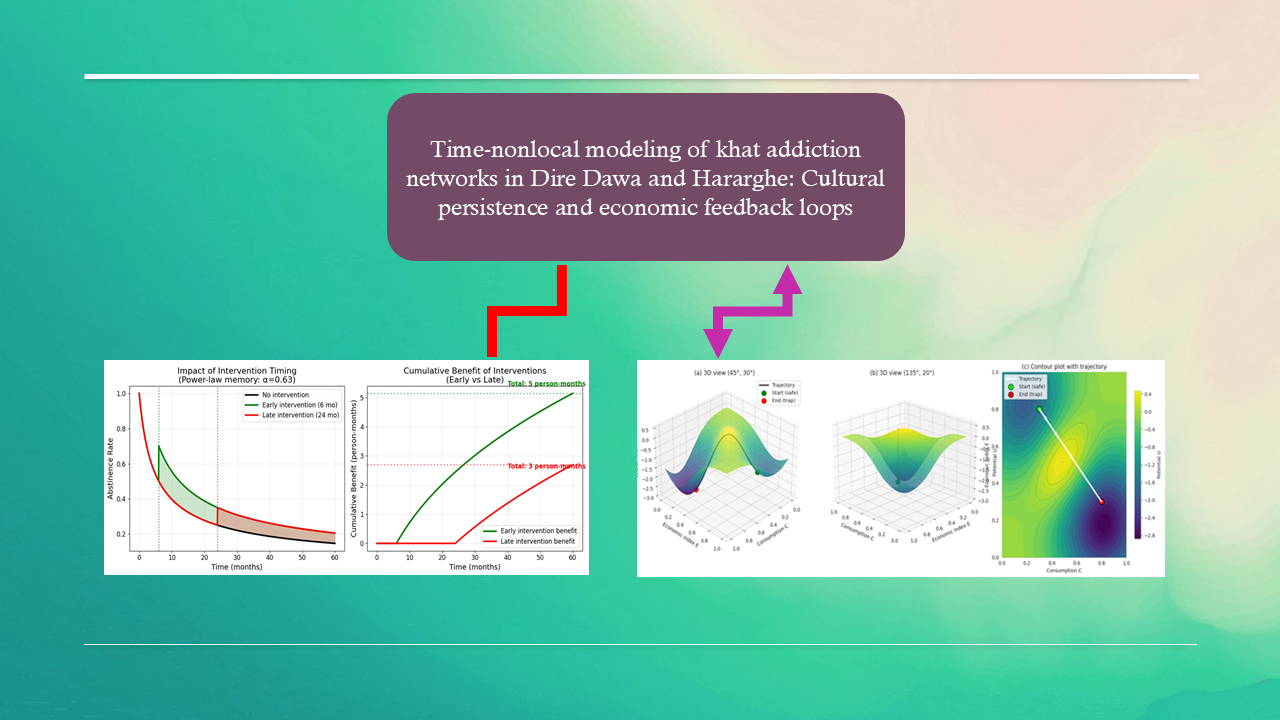
Khat (Catha edulis) use in Ethiopia, particularly in the Dire Dawa and Hararghe regions, represents a major public health challenge driven by neuroadaptive dependence, social reinforcement, and economic vulnerability. This study develops an integrated mathematical model combining Caputo fractional derivatives, nonlocal social influence, and economic feedback to describe addiction dynamics. The model was calibrated using cessation data (N = 87), household expenditure records (N = 423), and occupational social networks (387 nodes, 1,842 edges). Results indicate that persistent memory prolongs relapse periods and sustains higher long-term abstinence than conventional models, while nonlocal social influence accelerates the spread of consumption norms. Economic analysis identifies a poverty trap when khat expenditure exceeds 20% of household income. Key social influencers include cafe owners, elders, and taxi drivers, highlighting their central role in community-level transmission. Simulation results show that early preventive interventions combined with targeted economic support are substantially more effective and cost-efficient than delayed strategies. These findings demonstrate that long-term khat addiction is maintained by the interaction of neurobiological memory, social contagion, and economic constraints, emphasizing the importance of early intervention, community engagement, and timely economic assistance to prevent progression into persistent addiction-poverty cycles.
References
Ahmed, S. H. (2012). The science of making drug-addicted animals. Neuroscience, 211, 107-125. https://doi.org/10.1016/j.neuroscience.2011.08.014
Al-Motarreb, A., Baker, K., & Broadley, K. J. (2002). Khat: Pharmacological and medical aspects and its social use in Yemen. Phytotherapy Research, 16(5), 403-413. https://doi.org/10.1002/ptr.1106
Alidousti, J., & Ghafari, E. (2020). Stability analysis of a fractional-order epidemic model with time delay. Mathematics and Computers in Simulation, 169, 1-16. https://doi.org/10.1016/j.matcom.2019.10.008
Alzahrani, M. A., Alsahli, M. A., Alarifi, F. F., Hakami, B. O., Alkeraithe, F. W., Alhuqbani, M., Aldosari, Z., Aldosari, O., Almhmd, A. E., Binsaleh, S., & Almannie, R. (2023). A narrative review of the toxic effects on male reproductive and sexual health of chewing the psychostimulant, Catha edulis (Khat). Medical Science Monitor, 29, e939455-1-e939455-6. https://doi.org/10.12659/MSM.939455
Anderson, D. M., & Carrier, N. (2011). Khat: Social harms and legislation. International Journal of Drug Policy, 22(4), 309-313. https://doi.org/10.1016/j.drugpo.2011.02.003
Anderson, D., Beckerleg, S., Hailu, D., & Klein, A. (2007). The khat controversy: Stimulating the debate on drugs. Berg.
Area, I., Losada, J., & Nieto, J. J. (2017). A note on the fractional logistic equation. Physica A: Statistical Mechanics and its Applications, 444, 182-187. https://doi.org/10.1016/j.physa.2015.10.037
Atangana, A., & Gómez-Aguilar, J. F. (2018). Decolonisation of fractional calculus rules: Breaking commutativity and associativity to capture more natural phenomena. The European Physical Journal Plus, 133(4), 166. https://doi.org/10.1140/epjp/i2018-12021-7
Azariadis, C., & Stachurski, J. (2005). Poverty traps. In: Aghion, P., & Durlauf, S. N., (Eds.), Handbook of economic growth, 1A, 295-384 p., Elsevier.
Barabási, A.-L., & Albert, R. (1999). Emergence of scaling in random networks. Science, 286(5439), 509-512. https://doi.org/10.1126/science.286.5439.509
Barrett, C. B., Garg, T., & McBride, L. (2019). Well-being dynamics and poverty traps. Annual Review of Resource Economics, 11, 165-188. https://doi.org/10.1146/annurev-resource-100518-093944
Becker, J., Brackbill, D., & Centola, D. (2021). Network dynamics of social influence in the wisdom of crowds. Proceedings of the National Academy of Sciences, 118(26), e2026690118. https://doi.org/10.1073/pnas.2026690118
Becker, G. S., & Murphy, K. M. (1988). A theory of rational addiction. Journal of Political Economy, 96(4), 675-700. https://doi.org/10.1086/261558
Behrens, D. A., Caulkins, J. P., Tragler, G., Haunschmied, J. L., & Feichtinger, G. (1999). A dynamic model of drug initiation: Implications for treatment and drug control. Mathematical Biosciences, 159(1), 1-20. https://doi.org/10.1016/S0025-5564(99)00011-6
Beyene, A., & Gebissa, E. (2021). The political economy of khat trade in Eastern Ethiopia: The case of Dire Dawa city. Journal of Eastern African Studies, 15(2), 255-274. https://doi.org/10.1080/17531055.2021.1894512
Bologna, M., Flores, J. C., & Grigolini, P. (2020). A fractional calculus approach to epidemic spreading. Chaos, Solitons & Fractals, 130, 109453. https://doi.org/10.1016/j.chaos.2019.109453
Borgatti, S. P. (2006). Identifying sets of key players in a social network. Computational & Mathematical Organization Theory, 12(1), 21-34. https://doi.org/10.1007/s10588-006-7084-x
Carrier, N. (2005). The need for speed: Contrasting timeframes in the social life of Kenyan miraa. Africa, 75(4), 539-558. https://doi.org/10.3366/afr.2005.75.4.539
Carter, M. R., & Barrett, C. B. (2006). The economics of poverty traps and persistent poverty: An asset-based approach. The Journal of Development Studies, 42(2), 178-199. https://doi.org/10.1080/00220380500405261
Caulkins, J. P., Rydell, C. P., Everingham, S. S., Chiesa, J., & Bushway, S. (1999). An ounce of prevention, a pound of uncertainty: The cost-effectiveness of school-based drug prevention programs. RAND Corporation.
Central Statistical Agency of Ethiopia. (2023). Household consumption and expenditure survey 2022/23: Dire Dawa administrative region report. CSA.
Centola, D. (2010). The spread of behavior in an online social network experiment. Science, 329(5996), 1194-1197. https://doi.org/10.1126/science.1185231
Christakis, N. A., & Fowler, J. H. (2008). The collective dynamics of smoking in a large social network. New England Journal of Medicine, 358(21), 2249-2258. https://doi.org/10.1056/NEJMsa0706154
Christakis, N. A., & Fowler, J. H. (2007). The spread of obesity in a large social network over 32 years. New England Journal of Medicine, 357(4), 370-379. https://doi.org/10.1056/NEJMsa066082
Chruściński, D., & Kossakowski, A. (2016). Non-Markovian quantum evolution: Time-local generators and memory kernels. Reports on Mathematical Physics, 78(2), 167-188. https://doi.org/10.1016/S0034-4877(16)30036-2
Colzato, L. S., Ruiz, M. J., van den Wildenberg, W. P. M., & Hommel, B. (2011). Long-term effects of chronic khat use: Impaired inhibitory control. Frontiers in Psychology, 1, 219. https://doi.org/10.3389/fpsyg.2010.00219
Cox, G., & Rampes, H. (2003). Adverse effects of khat: A review. Advances in Psychiatric Treatment, 9(6), 456-463. https://doi.org/10.1192/apt.9.6.456
Diethelm, K. (2010). The analysis of fractional differential equations: An application-oriented exposition using differential operators of Caputo type. Springer.
Dire Dawa Health Bureau. (2024). Annual substance use surveillance report, 2023. Dire Dawa City Administration.
Everitt, B. J., & Robbins, T. W. (2005). Neural systems of reinforcement for drug addiction: From actions to habits to compulsion. Nature Neuroscience, 8(11), 1481–1489. https://doi.org/10.1038/nn1579
French, M. T., Salomé, H. J., Sindelar, J. L., & McLellan, A. T. (2000). Benefit-cost analysis of addiction treatment: Methodological guidelines. Health Services Research, 35(5 Pt 2), 1113-1134.
Garrappa, R. (2018). Numerical solution of fractional differential equations: A survey and a software. Fractional Calculus and Applied Analysis, 21(1), 1-34. https://doi.org/10.1515/fca-2018-0001
Gebissa, E. (2004). Leaf of Allah: Khat and agricultural transformation in Harerge, Ethiopia, 1875–1991. Ohio University Press.
Gebissa, E. (2010). Scourge of life or an economic lifeline? Public discourses on khat (Catha edulis) in Ethiopia. Substance Use & Misuse, 45(6), 804-818. https://doi.org/10.3109/10826081003590949
Gebissa, E. (2010). Taking the place of food: Khat in Ethiopia. Red Sea Press.
Gebrehanna, E., Berhane, Y., & Worku, A. (2014). Khat chewing among Ethiopian University Students: Prevalence, patterns, and associated factors. BioMed Research International, 2014, 1-7. https://doi.org/10.1155/2014/802092
Getsios, D., Blume, S., Ishak, K. J., Maclaine, G., & Hernández, L. (2014). Early intervention in Alzheimer's disease: A health economic study of the effects of diagnostic timing. BMC Neurology, 14, 101. https://doi.org/10.1186/1471-2377-14-101
Glick, H. A., Doshi, J. A., Sonnad, S. S., & Polsky, D. (2015). Economic evaluation in clinical trials (2nd ed.). Oxford University Press.
Gudata, Z. G., Cochrane, L., & Imana, G. (2020). Khat culture and economic wellbeing: Comparison of a chewer and non-chewer families in Harar city. Cogent Social Sciences, 6(1), 1848501. https://doi.org/10.1080/23311886.2020.1848501
Hethcote, H. W. (2000). The mathematics of infectious diseases. SIAM Review, 42(4), 599-653. https://doi.org/10.1137/S0036144500371907
Hoffman, R., & al'Absi, M. (2010). Khat use and neurobehavioral functions: Suggestions for future studies. Journal of Ethnopharmacology, 132(3), 554-563. https://doi.org/10.1016/j.jep.2010.05.033
Jaganathan, R. (2023). Markovian embedding of nonlocal equations using spectral representation. arXiv preprint arXiv:2402.00009.
Jose, S. A., Ramachandran, R., Baleanu, D., Panigoro, H. S., Alzabut, J., & Balas, V. E. (2023). Computational dynamics of a fractional order substance addictions transfer model with Atangana-Baleanu-Caputo derivative. Mathematical Methods in the Applied Sciences, 46(5), 5060-5085. https://doi.org/10.1002/mma.8818
Kahana, M. J. (2002). Note on the power law of forgetting [Unpublished manuscript]. University of Pennsylvania.
Kempe, D., Kleinberg, J., & Tardos, É. (2003). Maximizing the spread of influence through a social network. Proceedings of the Ninth ACM SIGKDD International Conference on Knowledge Discovery and Data Mining, 137-146. https://doi.org/10.1145/956750.956769
Killeen, P. R. (2011). Markov model of smoking cessation. Proceedings of the National Academy of Sciences, 108(3), 15549-15556. https://doi.org/10.1073/pnas.1011277108
Kim, D. A., Hwong, A. R., Stafford, D., Hughes, D. A., O'Malley, A. J., Fowler, J. H., & Christakis, N. A. (2015). Social network targeting to maximise population behaviour change: A cluster randomised controlled trial. The Lancet, 386(9989), 145-153. https://doi.org/10.1016/S0140-6736(15)60066-2
Kirshenbaum, A. P., Olsen, D. M., & Bickel, W. K. (2009). A quantitative review of the ubiquitous relapse curve. Journal of Substance Abuse Treatment, 36(1), 8-17. https://doi.org/10.1016/j.jsat.2008.04.001
Klein, A. (2008). Khat and the creation of tradition in the Somali diaspora. In: Fountain, S., & Kitzinger, J., (Eds.), Ethnography and substance use, 61-78 p., Routledge.
Kongson, J., Sudsutad, W., Thaiprayoon, C., Alzabut, J., & Tearnbucha, C. (2021). On analysis of a nonlinear fractional system for social media addiction involving Atangana–Baleanu–Caputo derivative. Advances in Difference Equations, 2021(1), 1-29. https://doi.org/10.1186/s13662-021-03515-5
Laine, E.-M., Piilo, J., & Breuer, H.-P. (2012). Nonlocal memory effects in the dynamics of open quantum systems. arXiv preprint arXiv:1111.4481.
Lang, Q., & Lu, J. (2024). Learning memory kernels in generalized Langevin equations. arXiv preprint arXiv:2402.11705.
Lesourd, C. (2023). Produce, export but control the khat money (Dire Dawa, Ethiopia). Cahiers D'études Africaines, 249, 9-36. https://doi.org/10.4000/etudesafricaines.40506
Magin, R. L. (2006). Fractional calculus in bioengineering. Begell House.
Mainardi, F. (2011). Models based on Mittag-Leffler functions for anomalous relaxation in dielectrics. European Physical Journal Special Topics, 193(1), 133-160. https://doi.org/10.1140/epjst/e2011-01385-8
Mains, D. (2019). Under construction: Technologies of development in urban Ethiopia. Duke University Press.
Meerschaert, M. M., Mortensen, J., & Wheatcraft, S. W. (2019). Fractional vector calculus for fractional advection-dispersion. Physica A: Statistical Mechanics and its Applications, 367, 53-64. https://doi.org/10.1016/j.physa.2005.07.019
Metzler, R., & Klafter, J. (2000). The random walk's guide to anomalous diffusion: A fractional dynamics approach. Physics Reports, 339(1), 1-77. https://doi.org/10.1016/S0370-1573(00)00070-3
Nigatu, W., Eticha, G., Kinfe, E., Wuletaw, Y., & Mekuriaw, W. (2022). What can research evidence tell us about effect of khat on health and socio-economy? Rapid evidence review. Ethiopian Journal of Public Health and Nutrition, 5(2).
Odenwald, M., Klein, A., & Warfa, N. (2009). Khat use and related problems in Somali combatants. PLOS Medicine, 6(12), e1000194. https://doi.org/10.1371/journal.pmed.1000194
Odenwald, M., Hinkel, H., Schauer, E., Neuner, F., Schauer, M., Elbert, T. R., & Rockstroh, B. (2010). The consumption of khat and other drugs in Somali combatants: A cross-sectional study. PLoS Medicine, 4(12), e341. https://doi.org/10.1371/journal.pmed.0040341
Odenwald, M., et al. (2009). The consumption of khat and other drugs in Somali combatants: A cross-sectional study. PLOS Medicine, 6(12), e1000194. https://doi.org/10.1371/journal.pmed.1000194
Picker, M. J., et al. (2024). A probabilistic model of relapse in drug addiction. Journal of Mathematical Psychology, 113, 102844. https://doi.org/10.1016/j.jmp.2024.102844
Podlubny, I. (1999). Fractional differential equations. Academic Press.
Qureshi, S., & Atangana, A. (2019). Fractional modeling for a chemical kinetic reaction in a batch reactor via nonlocal operator with power law kernel. Physica A: Statistical Mechanics and its Applications. https://doi.org/10.1016/j.physa.2019.123950
Redish, A. D., Jensen, S., & Johnson, A. (2008). A unified framework for addiction: Vulnerabilities in the decision process. Behavioral and Brain Sciences, 31(4), 415-437. https://doi.org/10.1017/S0140525X0800472X
Room, R., Fischer, B., Hall, W., Lenton, S., & Reuter, P. (2010). Cannabis policy: Moving beyond stalemate. Oxford University Press.
Rubin, D. C., & Wenzel, A. E. (1996). One hundred years of forgetting: A quantitative description of retention. Psychological Review, 103(4), 734-760. https://doi.org/10.1037/0033-295X.103.4.734
Sánchez, F., Wang, X., Castillo-Chávez, C., Gorman, D. M., & Gruenewald, P. J. (2007). Drinking as an epidemic: A simple mathematical model with recovery and relapse. In: Therapist’s guide to evidence-based relapse prevention, 353-368 p., Academic Press.
Shafqat, R. (2025). A fractional-order alcoholism model incorporating hypothetical social influence: A theoretical and numerical study. Journal of Mathematics. https://doi.org/10.1155/jom/6773909
Sidow, N. O., Gökgül, A., & Hassan, M. S. (2024). Chewing khat (Catha edulis) is a risk factor for stroke: A prospective study. International Journal of General Medicine, 17, 5707-5713. https://doi.org/10.2147/IJGM.S482246
Stumpf, M. P. H., & Porter, M. A. (2012). Critical truths about power laws. Science, 335(6069), 665-666. https://doi.org/10.1126/science.1216142
Valente, T. W. (2012). Network interventions. Science, 337(6090), 49-53. https://doi.org/10.1126/science.1217330
Valente, T. W. (2010). Social networks and health: Models, methods, and applications. Oxford University Press.
Valente, T. W., & Pumpuang, P. (2007). Identifying opinion leaders to promote behavior change. Health Education & Behavior, 34(6), 881-896. https://doi.org/10.1177/1090198106297855
West, B. J., Grigolini, P., & Bologna, M. (2017). Physics of the human mind. Springer. (Related modeling in West, B. J. et al. works on fractional dynamics; https://doi.org/10.1016/j.jtbi.2017.05.012
Wixted, J. T., & Carpenter, S. K. (2007). The Wickelgren power law and the Ebbinghaus savings function. Psychological Science, 18(2), 133-134. https://doi.org/10.1111/j.1467-9280.2007.01865.x
Wondemagegn, A. T., Cheme, M. C., & Kibret, K. T. (2017). Perceived psychological, economic, and social impact of khat chewing among adolescents and adults in Nekemte Town, East Welega Zone, West Ethiopia. BioMed Research International, 7427892. https://doi.org/10.1155/2017/7427892
Wu, L., Sun, P., Fu, Y., Hong, R., Wang, X., & Wang, M. (2019). A neural influence diffusion model for social recommendation. In: Proceedings of the 42nd International ACM SIGIR Conference on Research and Development in Information Retrieval, 235-244 p., ACM.
Downloads
Published
How to Cite
Issue
Section
License
Copyright (c) 2027 Belay Sitotaw Goshu

This work is licensed under a Creative Commons Attribution 4.0 International License.
Authors who publish with this journal agree to the following terms:
1) Authors retain copyright and grant the journal right of first publication with the work simultaneously licensed under a Creative Commons Attribution License that allows others to share the work with an acknowledgement of the work's authorship and initial publication in this journal.
2) Authors are able to enter into separate, additional contractual arrangements for the non-exclusive distribution of the journal's published version of the work (e.g., post it to an institutional repository or publish it in a book), with an acknowledgement of its initial publication in this journal.
3) Authors are permitted and encouraged to post their work online (e.g., in institutional repositories or on their website) prior to and during the submission process, as it can lead to productive exchanges, as well as earlier and greater citation of published work.