Reasons and consequences for the combination of quantum and classical theory
DOI:
https://doi.org/10.14295/bjs.v6i2.929Keywords:
quantum mechanics, classical mechanics, general wave mechanics, Schrödinger-Tu equation, wave mechanics equation with forceAbstract
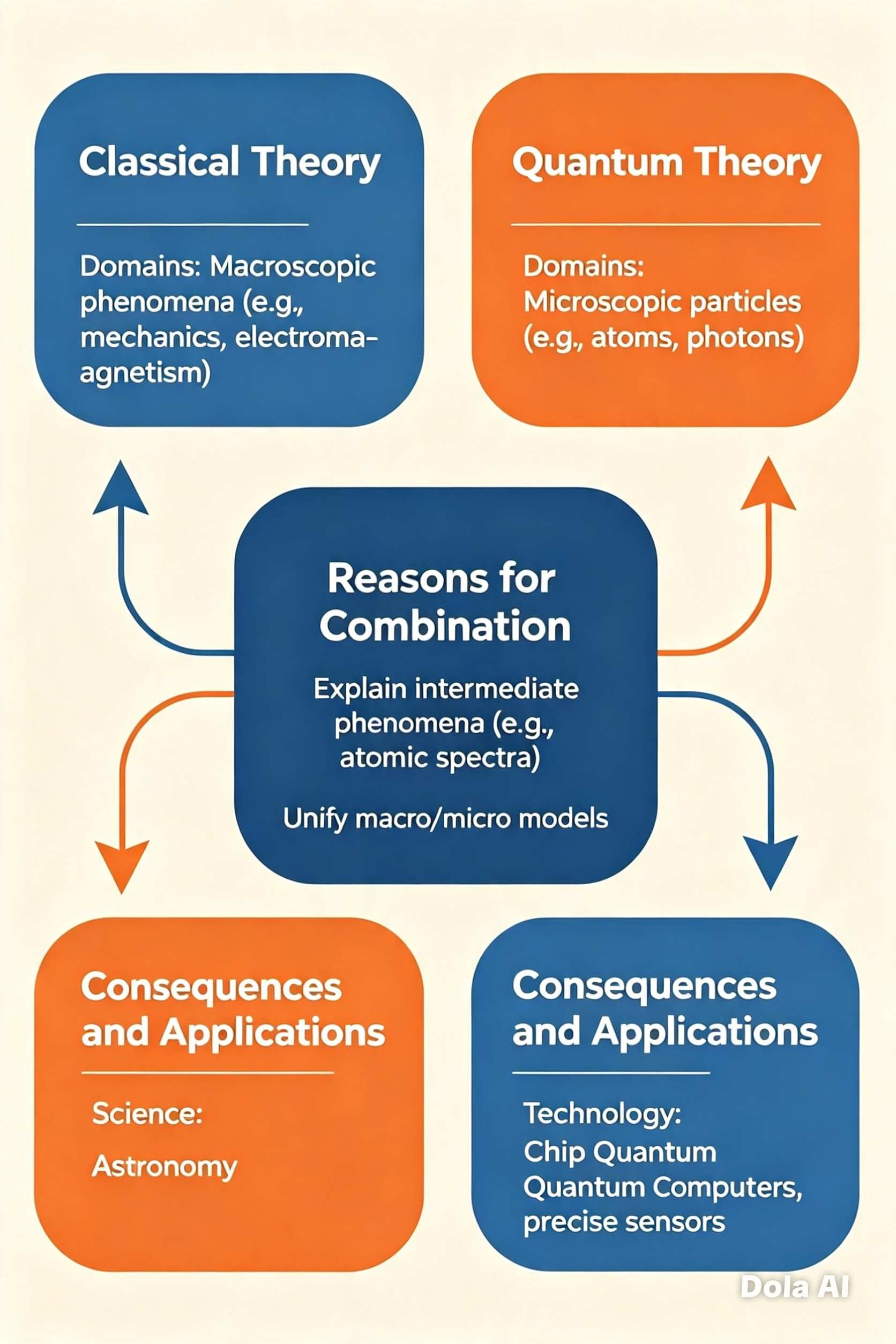
From the fact that many people are dedicated to the quantization of gravity, it can be seen that people crave the integration of quantum theory and macroscopic theory. Let's first combine quantum mechanics with classical mechanics to gain insightful experiences. The citation introduces the Schrödinger-Tu equation, which has gravitational potential energy and can describe macroscopic objects. Several successful computational examples related to atoms and molecules using the combination of quantum and classical methods for use were listed. The wave mechanics representation method of classical mechanics laws has been derived. This indicates that quantum mechanics and classical mechanics can be compatible and coexist. There is still much evidence to suggest that the Schrödinger equation (SE) cannot exclude classical mechanical laws: The mass m in the SE can be large enough to bring the described object into the macroscopic range; Steady state SE is the Tψ+Vψ=Eψ, a combination of the wave function ψ and the expression T+V=E in classical mechanics; The potential energy function in the SE can originate from macroscopic force fields; F=ma and the SE can be converted to each other; Completed electron diffraction experiments that exhibit both wave and particle characteristics simultaneously. Important conceptual changes can drive the renewal of physics. The shift from quantum and classical incompatibility to compatibility is an important conceptual change that can lead to the birth of general wave mechanics.
References
Bauer, M., Laurent, P., & Winkler, C. (2011). Integral challenges physics beyond Einstein. The European Space Agency.
Billings, L. (2025). Quantum physics is on the wrong track, says breakthrough prize winner Gerard’t Hooft. Breakthrough Prize winner gerard’t hooft says quantum mechanics is ‘nonsense’. Scientific American, 34(2), 104.
Born, M. (1923). Quantentheorie und Störungsrechnung. Naturwissenschaften, 11, 537-542. https://doi.org/10.1007/BF01554348
Born, M., Heisenberg, W. & Jordan, P. (1926). Zeitschrift für Physik, 35, 557-615. https://doi.org/10.1007/BF01379806
Born, M. (1926). Quantenmechanik der Stoßvorgänge. Zeitschrift für Physik, 37, 863-867. https://doi.org/10.1007/BF01397184
Carroll, S. (2025). Why even physicists still don’t understand quantum theory 100 years on. Nature, 638, 31-34. https://doi.org/10.1038/d41586-025-00296-9
Gibney, E. (2025). Physicists disagree wildly on what quantum mechanics says about reality, Nature survey shows. Nature, 643, 1175-1179. https://doi.org/10.1038/d41586-025-02342-y
Greene, B. (2005). The fabric of the cosmos: Space, time, and the texture of reality. Alfred, A. Knopf, 198 p.
Hallas, A. M. (2025). Underrepresentation of women last authors in Nature Physics. Nature Physics, 21, 491-493. https://doi.org/10.1038/s41567-025-02857-1
Heisenberg, W. (1925a). Uber quantentheoretische umdeutung kinematischer und mechanischer beziehungen. Zeitschrift für Physik, 33, 879-893.
Heisenberg, W. (1925b). Zur Quantentheorie der Multiplettstruktur und der anomalen Zeeman-Effekte. Zeitschrift für Physik, 32, 841-860. https://doi.org/10.1007/BF01331720
Heisenberg, W. (1926). Mehrkörperproblem und Resonanz in der Quantenmechanik. Zeitschrift für Physik, 38, 411-426. https://doi.org/10.1007/BF01397160
Heisenberg, W. (1927). Über den anschaulichen Inhalt der quantentheoretischen Kinematik und Mechanik. Zeitschrift für Physik, 43, 172-198. https://doi.org/10.1007/BF01397280
Partanen, M., & Tulkki, J. (2025a). Gravity generated by four one-dimensional unitary gauge symmetries and the standard model. Reports on Progress in Physics, 88, 069501. DOI 10.1088/1361-6633/adc82e
Partanen, M., & Tulkki, J. (2025b). Perihelion precession of planetary orbits solved from quantum field theory. Reports on Progress in Physics, 88, 057802. https://doi.org/10.1088/1361-6633/adc82e
Pauli Jr., W. (1926). Über das Wasserstoffspektrum vom Standpunkt der neuen Quantenmechanik. Zeitschrift für Physik A Hadrons and Nuclei, 36, 336-363. https://doi.org/10.1007/BF01450175
Schrödinger, E. (1928). Collected papers on wave mechanics. Third (Augmented) Edition, Blackie and Son, AMS Chelsea Publishing, American Mathematical Society, Providence, Rhode Island, 205 p.
Sivasundaram, S., & Nielsen, K. H. (2016). Surveying the attitudes of physicists concerning foundational issues of quantum mechanics. Preprint at arXiv. https://doi.org/10.48550/arXiv.1612.00676
Sharoglazova, V., Puplauskis, M., Mattschas, C., Toebes, C., & Klaers, J. (2025). Energy-speed relationship of quantum particles challenges Bohmian mechanics. Nature, 643, 67-72. https://doi.org/10.1038/s41586-025-09099-4
Tselentis, E-E., & Baumeler, Ä. (2025). Möbius games and other Bell tests for relativity.Physical Review A, 111, 052211. https://doi.org/10.1103/PhysRevA.111.052211
Tu, R. (1989). Preliminary application of non-point electron model in structural chemistry. Abstract Collection of Papers from Physical Chemistry Academic Conferences in Henan, Hunan, and Hubei Provinces, 237-238.
Tu, R. (2014). Some successfull applications for local-realism quantum mechanics: Nature of covalent-bond revealed and quantitative analysis of mechanical equilibrium for several molecules. Journal of Modern Physics, 5(6), 309-318. https://doi.org/10.4236/jmp.2014.56041
Tu, R. (2016). The principle and application of experimental method for measuring the interaction energy between electrons in atom. International Journal of Scientific Reports, 2(8), 187-200. https://doi.org/10.18203/issn.2454-2156.intjscirep20162808
Tu, R. (2024a). Establishing the Schrödinger equation for macroscopic objects and changing human scientific concepts. Advances in Theoretical & Computational Physics, 7(4), 01-03. https://dx.doi.org/10.33140/ATCP.07.04.18
Tu, R. (2024b). A wave-based model of electron spin: Bridging classical and quantum perspectives on magnetic moment. Advances in Theoretical & Computational Physics, 7(4), 01-10. https://dx.doi.org/10.33140/ATCP.07.04.11
Tu, R. (2024c). A review of research achievements and their applications on the essence of electron spin. Advances in Theoretical & Computational Physics, 7(4), 01-19. https://doi.org/https://dx.doi.org/10.33140/ATCP.07.04.10
Tu, R. (2024d). Solving the problem of source of electron spin magneticmoment. Physical Science International Journal, 28(6), 105-110. https://doi.org/10.9734/psij/2024/v28i6862
Tu, R. (2025a). Reasons and consequences for the combination of quantum and classical theory. Figshare. Dataset. Thesis. https://doi.org/10.6084/m9.figshare.30637301.v1
Tu, R. (2025b). Research progress on the Schrödinger equation that can describe the Earth's revolution and its applications. London Journal of Research in Science: Natural & Formal, 25(1), 17-28. https://journalspress.uk/index.php/LJRS/article/view/1157
Tu, R. (2025c). Research progress on the Schrödinger equation of gravitational potential energy. Advances in Theoretical & Computational Physics, 8(1), 01-07. https://dx.doi.org/10.33140/ATCP.08.01.01
Tu. R. (2025d). Schrödinger-Tu equation: A bridge between classical mechanics and quantum mechanics. International Journal of Quantum Technologies, 1(1), 1-9.
Tu, R. (2025e). Quantum mechanics and classical mechanics can be used together. Advances in Theoretical & Computational Physics, 8(4), 1-7. https://doi.org/10.33140/ATCP.08.04.02
Tu, R. (2025f). Quantum mechanics and classical mechanics can be used together. Preprint at viXra. https://vixra.org/pdf/2505.0059v3.pdf
Tu, R. (2025g). Add wings of force to quantum mechanics. Zhihu. https://zhuanlan.zhihu.com/p/1958532715482711659
Tu, R. (2025h). A new theoretical system combinating classical mechanics and quantum mechanics. Adv Theo Comp Phy, 8(2), 01-06. https://doi.org/10.33140/ATCP.08.02.01
Tu, R. (2025i). Derive Schrödinger equation from F=ma. Preprint at viXra. https://vixra.org/pdf/2509.0034v2.pdf
Tu, R. (2026). The mutual conversion between Schrödinger equation and F=ma visibility. Applied Science Research Periodicals, 4(1), 158-172. https://doi.org/10.63002/asrp.401.1279
Walborn, S. P., Terra Cunha, M. O., Pádua, S., & Monken, C. H. (2002). Double-slit quantum eraser. Physical Review A, 65(3), 033818. https://doi.org/10.1103/PhysRevA.65.033818
Downloads
Published
How to Cite
Issue
Section
License
Copyright (c) 2027 Runsheng Tu

This work is licensed under a Creative Commons Attribution 4.0 International License.
Authors who publish with this journal agree to the following terms:
1) Authors retain copyright and grant the journal right of first publication with the work simultaneously licensed under a Creative Commons Attribution License that allows others to share the work with an acknowledgement of the work's authorship and initial publication in this journal.
2) Authors are able to enter into separate, additional contractual arrangements for the non-exclusive distribution of the journal's published version of the work (e.g., post it to an institutional repository or publish it in a book), with an acknowledgement of its initial publication in this journal.
3) Authors are permitted and encouraged to post their work online (e.g., in institutional repositories or on their website) prior to and during the submission process, as it can lead to productive exchanges, as well as earlier and greater citation of published work.