Effect of the AgroPlus® adjuvant on the desiccation of hard-to-control weeds using ground and aerial applications
DOI:
https://doi.org/10.14295/bjs.v5i9.894Keywords:
application technology, agricultural adjuvants, herbicides, weed management, sprayingAbstract
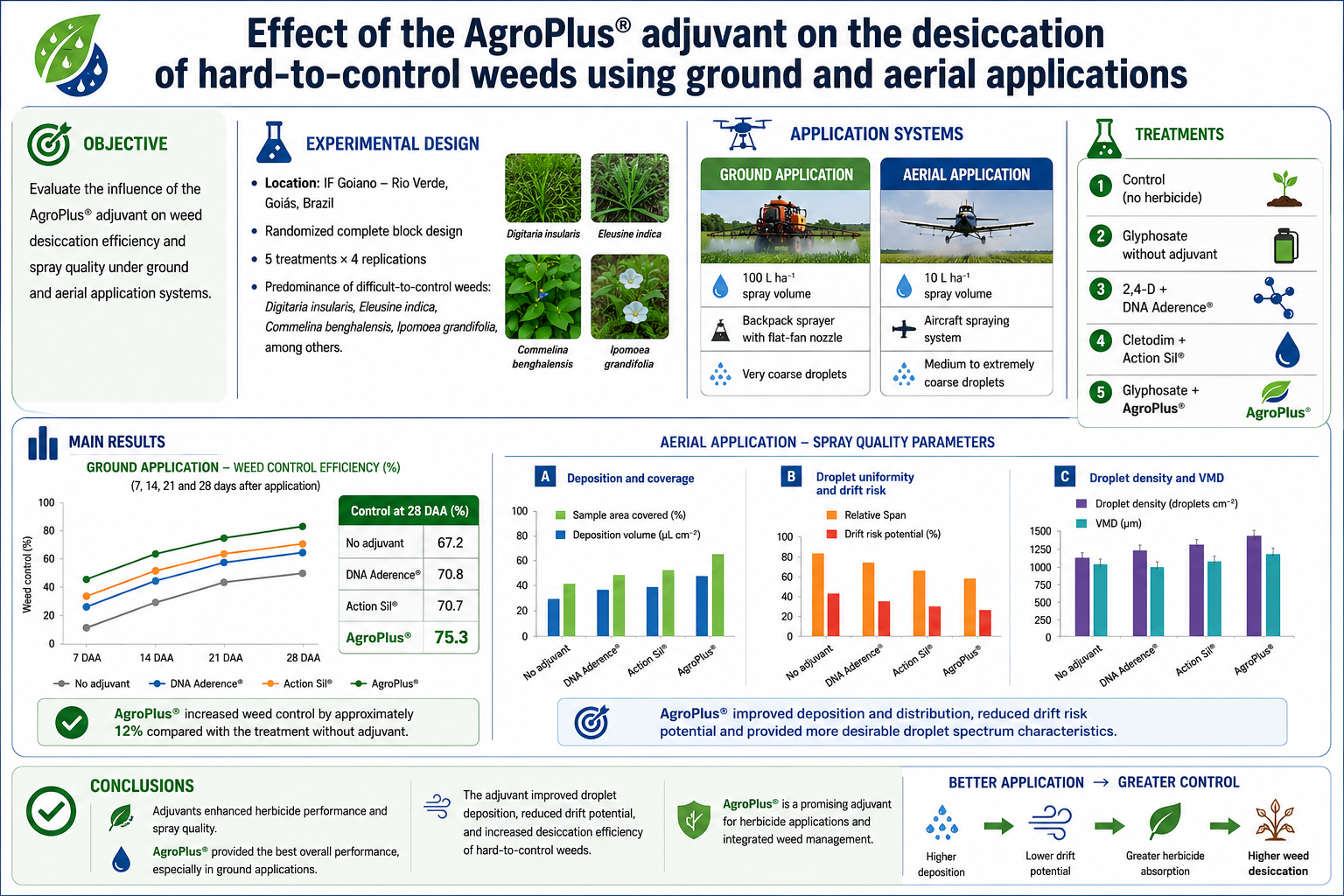
The desiccation of hard-to-control weeds represents a major challenge in agricultural production systems, particularly in areas with high infestations of perennial species and weeds at advanced growth stages. In this context, adjuvants have been widely used to enhance herbicide performance and optimize application quality. This study aimed to evaluate the influence of the AgroPlus® adjuvant on weed desiccation efficiency by comparing ground and aerial application systems. The experiments were conducted in an experimental area at the Goiano Federal Institute – Rio Verde Campus, under six months of fallow conditions with the predominance of several hard-to-control weed species. The experimental design consisted of randomized blocks with five treatments and four replications, involving different adjuvants associated with standard herbicides. Weed control efficiency was assessed at 7, 14, 21, and 28 days after application, in addition to spray quality parameters. The results demonstrated that the use of adjuvants increased desiccation efficiency compared with treatments without adjuvants. AgroPlus® showed superior performance, particularly in ground applications, providing greater weed control efficiency and more consistent results throughout the evaluation period. In aerial applications, although improvements in droplet quality were observed, no substantial differences among treatments were detected regarding weed control efficiency. It can be concluded that AgroPlus® improves application quality and enhances desiccation efficiency, with more pronounced effects under ground application systems.
References
Alcantara-de la Cruz, R., Guidi, Y. M., Ramirez-Castillo, M., Adegas, F. S., Carbonari, C. A., Velini, E. D., De Prado, R., & Duke, S. O. (2026). Thirty years of glyphosate-resistant crops and weeds: Current situation and future prospects. Pest Management Science, 82)7), 5987-6009. https://doi.org/10.1002/ps.70742 DOI: https://doi.org/10.1002/ps.70742
Andrade, H. A. F., Sagrilo, E., Júnior, J. O. L. O., Sousa, D. C., Costa, P. M., Silva, M. E. C., Alcantara, R. M. C. M., Furtado, M. B., & Souza, H. A. (2025). Early termination of Sudan grass (Sorghum sudanense) used as soil cover in a soybean cropping system in the Brazilian Cerrado. Revista Brasileira de Ciência do Solo, 49, e0240227. https://doi.org/10.36783/18069657rbcs20240227 DOI: https://doi.org/10.36783/18069657rbcs20240227
Basílio, S., Júnior, M. R. F., Alvarenga, C. B., Vitória, E. L., Vargas, B. C., Privitera, S., Caruso, L., Cerruto, E., & Manetto, G. (2024). Effect of adjuvants on physical-chemical properties, droplet size, and drift reduction potential. Agriculture, 14(12), 2271. https://doi.org/10.3390/agriculture14122271 DOI: https://doi.org/10.3390/agriculture14122271
Castro, E. B., Carbonari, C. A., Velini, E. D., Velini, E. D., Gomes, G. L. G. C., & Belapart, D. (2018). Influence of adjuvants on the surface tension, deposition and effectiveness of herbicides on fleabane plants. Planta Daninha, 36, e018177923. https://doi.org/10.5935/1806-6690.20250016 DOI: https://doi.org/10.1590/s0100-83582018360100067
Chen, D., & Chen, H. W. (2013). Using the Köppen classification to quantify climate variation and change: An example for 1901-2010. Environmental Development, 6, 68-79. https://doi.org/10.1016/j.envdev.2013.03.007 DOI: https://doi.org/10.1016/j.envdev.2013.03.007
Cordeau, S. (2022). Conservation agriculture and agroecological weed management. Agronomy, 12(4), 867. https://doi.org/10.3390/agronomy12040867 DOI: https://doi.org/10.3390/agronomy12040867
Daramola, O. S., Johnson, W. G., Jordan, D. L., Chahal, G. S., & Devkota, P. (2022). Spray water quality and herbicide performance: a review. Weed Technology, 36(6), 758-767. https://doi.org/10.1017/wet.2022.97 DOI: https://doi.org/10.1017/wet.2022.97
Ferreira, G. A. P., Donato, L. M., Montes, W. G., Rocha, L. M., & Santos, L. D. T. (2024). Control of Digitaria insularis (L.) Fedde in eucalyptus forests: Shading increases sensitivity to pgyphosate applied alone and in a mixture with carfenttrazone-ethyl. Discover Agriculture, 2. https://doi.org/10.1007/s44279-024-00014-5 DOI: https://doi.org/10.1007/s44279-024-00014-5
Ferreira, D. F. (2019). SISVAR: A computer analysis system to fixed effects split plot type designs. Brazilian Journal of Biometrics, 37(4), 529-535. https://doi.org/10.28951/rbb.v37i4.450 DOI: https://doi.org/10.28951/rbb.v37i4.450
Gomes, T. M., Fonseca, L. P., Menegassi, L. C., & Rossi, F. (2025). Phytosociological survey of weeds in rice crops under dairy irrigation with dairy effluent1. Revista Ciência Agronômica, 56, e2022291969. https://doi.org/10.5935/1806-6690.20250016 DOI: https://doi.org/10.5935/1806-6690.20250016
Guimarães, J. L. N., Araújo, F. C., Sousa, G. F. P., Veloso, J. C. L., Rabelo, G. L., & Freitas, M. A. M. (2019). Alternativas de manejo de capim-amargoso (Digitaria insularis). Multi-Science Journal, 2(1), 57-60. https://doi.org/10.33837/msj.v2i1.925 DOI: https://doi.org/10.33837/msj.v2i1.925
Henry, R.S., Fritz, B. K., Hoffmann, W. C., Kruger, G. R. (2016). An evaluation of three drift reduction adjuvants for aerial application of pesticides. GSTF Journal on Agricultural Engineering, 2, 6. https://doi.org/10.7603/s40872-015-0006-3 DOI: https://doi.org/10.7603/s40872-015-0006-3
Ma, J., Liu, K., Dong, X., Chen, C., Qiu, B., Zhang, S. (2022). Effects of leaf surface roughness and contact angle on In Vivo measurement of droplet retention. Agronomy, 12(9), 2228. https://doi.org/10.3390/agronomy12092228 DOI: https://doi.org/10.3390/agronomy12092228
Neto, R. A., Melo, A. A., Ulguim, A. R., Pedroso, R. M., Barbieri, G. F., Luchese, R. F., & Leichtweiss, E. M. (2020). Mixtures of 2,4-D and dicamba with other pesticides and their influence on application parameters. International Journal of Pest Management, 70(2), 121-130. https://doi.org/10.1080/09670874.2021.1959082 DOI: https://doi.org/10.1080/09670874.2021.1959082
Piasecki, C., Carvalho, I. R., Avila, L. A., Agostinetto, D., & Vargas, L. (2020). Glyphosate and Saflufenacil: Elucidating their combined action on the control of Glyphosate-resistant Conyza bonariensis. Agriculture, 10(6), 236. https://doi.org/10.3390/agriculture10060236 DOI: https://doi.org/10.3390/agriculture10060236
Rodrigues, J. S., Basinger, N. T., Leon, R. G., Bacha, A. L., Santos, R. T. S., Eason, K. M., Shilling, D., & Grey, T. L. (2024). Growth analysis of Glyphosate-resistant and susceptible Amaranthus palmeri biotypes. Plant-Environment Interactions, 5(6), e70023. https://doi.org/10.1002/pei3.70023 DOI: https://doi.org/10.1002/pei3.70023
Santos, W. F., Procópio, S. O., Silva, A. G., Fernandes, M. F., & Santos, E. R. (2018). Phytosociology of weed in the southwestern Goiás region. Acta Scientiarum, Agronomy, 40, e33049. https://doi.org/10.4025/actasciagron.v40i1.33049 DOI: https://doi.org/10.4025/actasciagron.v40i1.33049
Takano, H. K., Melo, M. S. C., Ovejero, R. F. L., Westra, P. H., Gaines, T. A., & Dayan, F. E. (2020). Trp2027Cys mutation evolves in Digitaria insularis with cross-resistance to ACCase inhibitors. Pesticide Biochemistry and Physiology, 164, 1-6. https://doi.org/10.1016/j.pestbp.2019.12.011 DOI: https://doi.org/10.1016/j.pestbp.2019.12.011
Tavares, R. M., & Cunha, J. P. A. R. (2023). Pesticide and adjuvant mixture impacts on the physical-chemical properties, droplet spectrum, and absorption of spray applied in soybean crop. AgriEngineering, 5(1), 646-6559. https://doi.org/10.3390/agriengineering5010041 DOI: https://doi.org/10.3390/agriengineering5010041
Xue, S., Han, J., Xi, X., Lan, Z., Wen, R., & Ma, X. (2024). Coordination of distinctive pesticide adjuvants and atomization nozzles on droplet spectrum evolution for spatial drift reduction. Chinese Journal of Chemical Engineering, 66, 250-262. https://doi.org/10.1016/j.cjche.2023.10.001 DOI: https://doi.org/10.1016/j.cjche.2023.10.001
Zanin, A. R. A., Neves, D. C., Teodoro, L. P. R., Júnior, C. A. S., Silva, S. P., Teodoro, P. E., & Baio, F. H. R. (2022). Reduction of pesticide application via real-time precision spraying. Scientific Reports, 12. https://doi.org/10.1038/s41598-022-09607-w DOI: https://doi.org/10.1038/s41598-022-09607-w
Zheng, J., & Xu, Y. (2023). A review: Development of plant protection methods and advances in pesticide application technology in agro-forestry production. Agriculture, 13(11), 2165. https://doi.org/10.3390/agriculture13112165 DOI: https://doi.org/10.3390/agriculture13112165
Wang, P., Xu, C., Li, C., Wang, L., Niu, Q., & Li, H. (2023). Investigation of factors enhancing droplets spreading on leaves with burrs. Frontiers in Plant Science, 14. https://doi.org/10.3389/fpls.2023.1220878 DOI: https://doi.org/10.3389/fpls.2023.1220878
Downloads
Published
How to Cite
Issue
Section
License
Copyright (c) 2026 Igor Assoni Oliveira, Gabriel Almeida Lemes, William Ferreira da Silva, Vitor Moreira Guimarães, Christiano Lima Lobo de Andrade, Marconi Batista Teixeira, Fernando Rodrigues Cabral Filho

This work is licensed under a Creative Commons Attribution 4.0 International License.
Authors who publish with this journal agree to the following terms:
1) Authors retain copyright and grant the journal right of first publication with the work simultaneously licensed under a Creative Commons Attribution License that allows others to share the work with an acknowledgement of the work's authorship and initial publication in this journal.
2) Authors are able to enter into separate, additional contractual arrangements for the non-exclusive distribution of the journal's published version of the work (e.g., post it to an institutional repository or publish it in a book), with an acknowledgement of its initial publication in this journal.
3) Authors are permitted and encouraged to post their work online (e.g., in institutional repositories or on their website) prior to and during the submission process, as it can lead to productive exchanges, as well as earlier and greater citation of published work.