Artificial intelligence in education: Possibilities and challenges for pedagogical practice
DOI:
https://doi.org/10.14295/bjs.v6i3.965Keywords:
personalized learning, artificial intelligence literacy, teacher training, educational technologies, digital educationAbstract
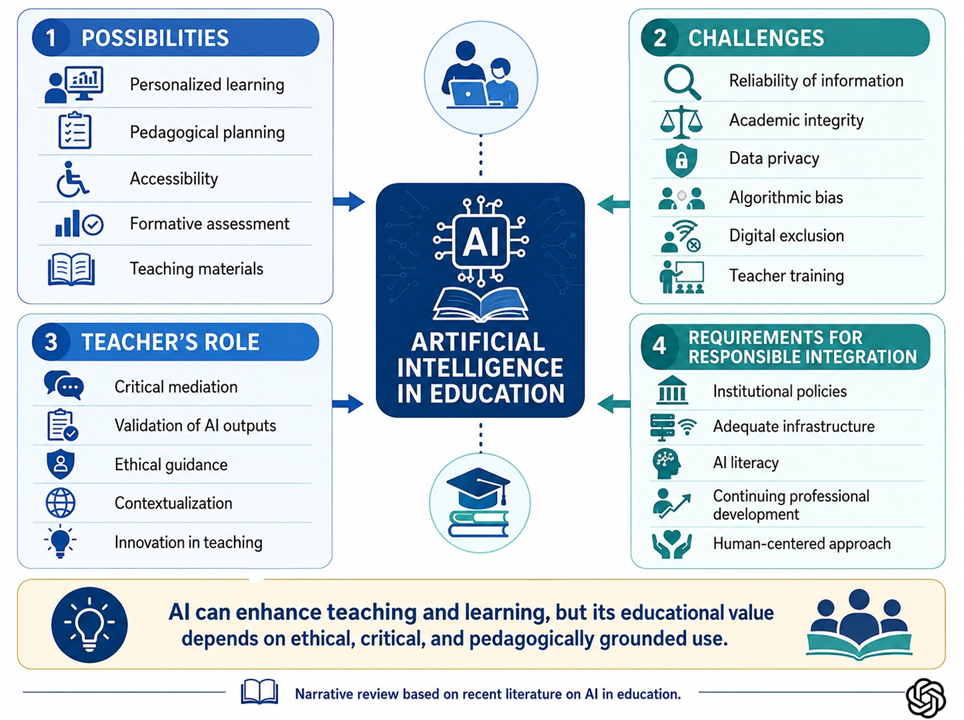
Artificial Intelligence (AI) has brought about significant changes in the educational landscape, driven primarily by the advancement of generative models and the increasing availability of tools capable of supporting teaching and learning processes. This study aimed to analyze the main possibilities and challenges associated with AI in pedagogical practice through a structured narrative literature review. Searches were conducted in the Web of Science Core Collection, Scopus, ERIC, SciELO, and Google Scholar, prioritizing publications from 2019 to 2026, while earlier foundational sources were retained when methodologically or conceptually relevant. The final interpretive corpus comprised 31 core sources, including peer-reviewed empirical studies, systematic and scoping reviews, meta-analyses, and institutional guidance. Evidence was synthesized into four themes: evolution and educational applications of AI, pedagogical potential, ethical and institutional challenges, and the changing role of teachers. The literature identifies opportunities for personalized learning, pedagogical planning, accessibility, formative assessment, and teaching-material development, but also recurring concerns involving information reliability, academic integrity, privacy, algorithmic bias, digital inequality, and teacher preparedness. Recent evidence indicates that positive outcomes are heterogeneous and depend on pedagogical scaffolding, human verification, institutional governance, and AI literacy. AI should therefore be understood as a supportive educational technology rather than a substitute for teacher mediation. Its integration requires critical, ethical, and pedagogically grounded use that preserves student autonomy, assessment validity, and educational equity.
References
Alfarwan, A. (2025). Generative AI use in K-12 education: a systematic review. Frontiers in Education, 10, 1647573. https://doi.org/10.3389/feduc.2025.1647573
Baggia, A., Tratnik, A., & Brezavšček, A. (2026). University teachers’ perceptions, attitudes, and practices with generative AI: a systematic literature review with a meta-analytic component. Quality & Quantity, 60, 14107-14139. https://doi.org/10.1007/s11135-026-02717-x
Belkina, M., Daniel, S., Nikolic, S., Haque, R., Lyden, S., Neal, P., Grundy, S., & Hassan, G. M. (2025). Implementing generative AI (GenAI) in higher education: A systematic review of case studies. Computers and Education: Artificial Intelligence, 8, 100407. https://doi.org/10.1016/j.caeai.2025.100407
Bittle, K., & El-Gayar, O. (2025). Generative AI and academic integrity in higher education: A systematic review and research agenda. Information, 16(4), 296. https://doi.org/10.3390/info16040296
Casal-Otero, L., Catalá, A., Fernández-Morante, C., Taboada, M., Cebreiro, B., & Barro, S. (2023). AI literacy in K-12: a systematic literature review. International Journal of STEM Education, 10, 29. https://doi.org/10.1186/s40594-023-00418-7
Chan, C. K. Y., & Tsi, L. H. Y. (2024). Will generative AI replace teachers in higher education? A study of teacher and student perceptions. Studies in Educational Evaluation, 83, 101395. https://doi.org/10.1016/j.stueduc.2024.101395
Chen, S., & Cheung, A. C. K. (2025). Effect of generative artificial intelligence on university students learning outcomes: A systematic review and meta-analysis. Educational Research Review, 49, 100737. https://doi.org/10.1016/j.edurev.2025.100737
Chiu, T. K. F., Xia, Q., Zhou, X., Chai, C. S., & Cheng, M. (2023). Systematic literature review on opportunities, challenges, and future research recommendations of artificial intelligence in education. Computers and Education: Artificial Intelligence, 4, 100118. https://doi.org/10.1016/j.caeai.2022.100118
Dong, L., Tang, X., & Wang, X. (2025). Examining the effect of artificial intelligence in relation to students’ academic achievement: A meta-analysis. Computers and Education: Artificial Intelligence, 8, 100400. https://doi.org/10.1016/j.caeai.2025.100400
Funa, A. A., & Gabay, R. A. E. (2025). Policy guidelines and recommendations on AI use in teaching and learning: A meta-synthesis study. Social Sciences & Humanities Open, 11, 101221. https://doi.org/10.1016/j.ssaho.2024.101221
Grant, M. J., & Booth, A. (2009). A typology of reviews: an analysis of 14 review types and associated methodologies. Health Information & Libraries Journal, 26(2), 91-108. https://doi.org/10.1111/j.1471-1842.2009.00848.x
Holmes, W., Bialik, M., & Fadel, C. (2019). Artificial intelligence in education: Promises and implications for teaching and learning. Center for Curriculum Redesign.
Ikram, M., Hanefar, S. B. M., Saleem, S. M. U., & Zulfiqar, F. (2026). Artificial intelligence in education: a systematic review of personalized learning trends and future directions. Frontiers in Education, 11, 1782626. https://doi.org/10.3389/feduc.2026.1782626
Kasneci, E., Sessler, K., Küchemann, S., Bannert, M., Dementieva, D., Fischer, F., Gasser, U., Groh, G., Günnemann, S., Hüllermeier, E., Krusche, S., Kutyniok, G., Michaeli, T., Nerdel, C., Pfeiffer, F., Poquet, O., Sailer, M., Schmidt, A., Seidel, T., Stadler, M., & Kasneci, G. (2023). ChatGPT for good? On opportunities and challenges of large language models for education. Learning and Individual Differences, 103, 102274. https://doi.org/10.1016/j.lindif.2023.102274
Kofinas, A. K., Tsay, C.-H., & Pike, D. (2025). The impact of generative AI on academic integrity of authentic assessments within a higher education context. British Journal of Educational Technology, 56, 2522-2549. https://doi.org/10.1111/bjet.13585
Liang, J., Stephens, J. M., & Brown, G. T. L. (2025). A systematic review of the early impact of artificial intelligence on higher education curriculum, instruction, and assessment. Frontiers in Education, 10, 1522841. https://doi.org/10.3389/feduc.2025.1522841
Lo, C. K. (2023). What is the impact of ChatGPT on education? A rapid review of the literature. Education Sciences, 13(4), 410. https://doi.org/10.3390/educsci13040410
Luo, J., Zheng, C., Yin, J., & Teo, H. H. (2025). Design and assessment of AI-based learning tools in higher education: a systematic review. International Journal of Educational Technology in Higher Education, 22, 42. https://doi.org/10.1186/s41239-025-00540-2
Memarian, B., & Doleck, T. (2026). A systematic review of academic integrity and misconduct with artificial intelligence in higher education. SN Computer Science, 7, 49. https://doi.org/10.1007/s42979-025-04569-y
Miao, F., & Cukurova, M. (2024). AI competency framework for teachers. UNESCO. https://doi.org/10.54675/ZJTE2084
Mouta, A., Pinto-Llorente, A. M., & Torrecilla-Sánchez, E. M. (2024). Uncovering blind spots in education ethics: Insights from a systematic literature review on artificial intelligence in education. International Journal of Artificial Intelligence in Education, 34, 1166-1205. https://doi.org/10.1007/s40593-023-00384-9
Mustafa, M. Y., Tlili, A., Lampropoulos, G., Huang, R., Jandrić, P., Zhao, J., Salha, S., Xu, L., Panda, S., Kinshuk, López-Pernas, S., & Saqr, M. (2024). A systematic review of literature reviews on artificial intelligence in education (AIED): a roadmap to a future research agenda. Smart Learning Environments, 11, 59. https://doi.org/10.1186/s40561-024-00350-5
Ncube, P. D. N., Dzvapatsva, G. P., Matobobo, C., & Ranga, M. M. (2026). Redefining student assessment in AI-infused learning environments: a systematic review of challenges and strategies for academic integrity. AI and Ethics, 6, 68. https://doi.org/10.1007/s43681-025-00871-w
Ouyang, F., & Jiao, P. (2021). Artificial intelligence in education: the three paradigms. Computers and Education: Artificial Intelligence, 2, 100020. https://doi.org/10.1016/j.caeai.2021.100020
Qian, Y. (2025). Pedagogical applications of generative AI in higher education: A systematic review of the field. TechTrends, 69, 1105-1120. https://doi.org/10.1007/s11528-025-01100-1
Sperling, K., Stenberg, C.-J., McGrath, C., Åkerfeldt, A., Heintz, F., & Stenliden, L. (2024). In search of artificial intelligence (AI) literacy in teacher education: a scoping review. Computers and Education Open, 6, 100169. https://doi.org/10.1016/j.caeo.2024.100169
Tan, X., Cheng, K. S., & Ling, M. H. A. (2025). Artificial intelligence in teaching and teacher professional development: A systematic review. Computers and Education: Artificial Intelligence, 8, 100355. https://doi.org/10.1016/j.caeai.2024.100355
UNESCO. (2023). Guidance for generative AI in education and research. United Nations Educational, Scientific and Cultural Organization. Available at: https://unesdoc.unesco.org/ark:/48223/pf0000386693. Accessed on: August 06, 2026.
Wang, X., Li, L., Tan, S. C., Yang, L., & Lei, J. (2023). Preparing for AI-enhanced education: conceptualizing and empirically examining teachers’ AI readiness. Computers in Human Behavior, 146, 107798. https://doi.org/10.1016/j.chb.2023.107798
Zawacki-Richter, O., Marín, V. I., Bond, M., & Gouverneur, F. (2019). Systematic review of research on artificial intelligence applications in higher education: where are the educators? International Journal of Educational Technology in Higher Education, 16, 39. https://doi.org/10.1186/s41239-019-0171-0
Zhang, X., Zhang, P., Shen, Y., Liu, M., Wang, Q., Gašević, D., & Fan, Y. (2024). A systematic literature review of empirical research on applying generative artificial intelligence in education. Frontiers of Digital Education, 1, 223-245. https://doi.org/10.1007/s44366-024-0028-5
Downloads
Published
How to Cite
Issue
Section
License
Copyright (c) 2027 Anderson Ferreira da Silva, Rosimeire Rozendo, Cristiane Aparecida Simão Silverio

This work is licensed under a Creative Commons Attribution 4.0 International License.
Authors who publish with this journal agree to the following terms:
1) Authors retain copyright and grant the journal right of first publication with the work simultaneously licensed under a Creative Commons Attribution License that allows others to share the work with an acknowledgement of the work's authorship and initial publication in this journal.
2) Authors are able to enter into separate, additional contractual arrangements for the non-exclusive distribution of the journal's published version of the work (e.g., post it to an institutional repository or publish it in a book), with an acknowledgement of its initial publication in this journal.
3) Authors are permitted and encouraged to post their work online (e.g., in institutional repositories or on their website) prior to and during the submission process, as it can lead to productive exchanges, as well as earlier and greater citation of published work.