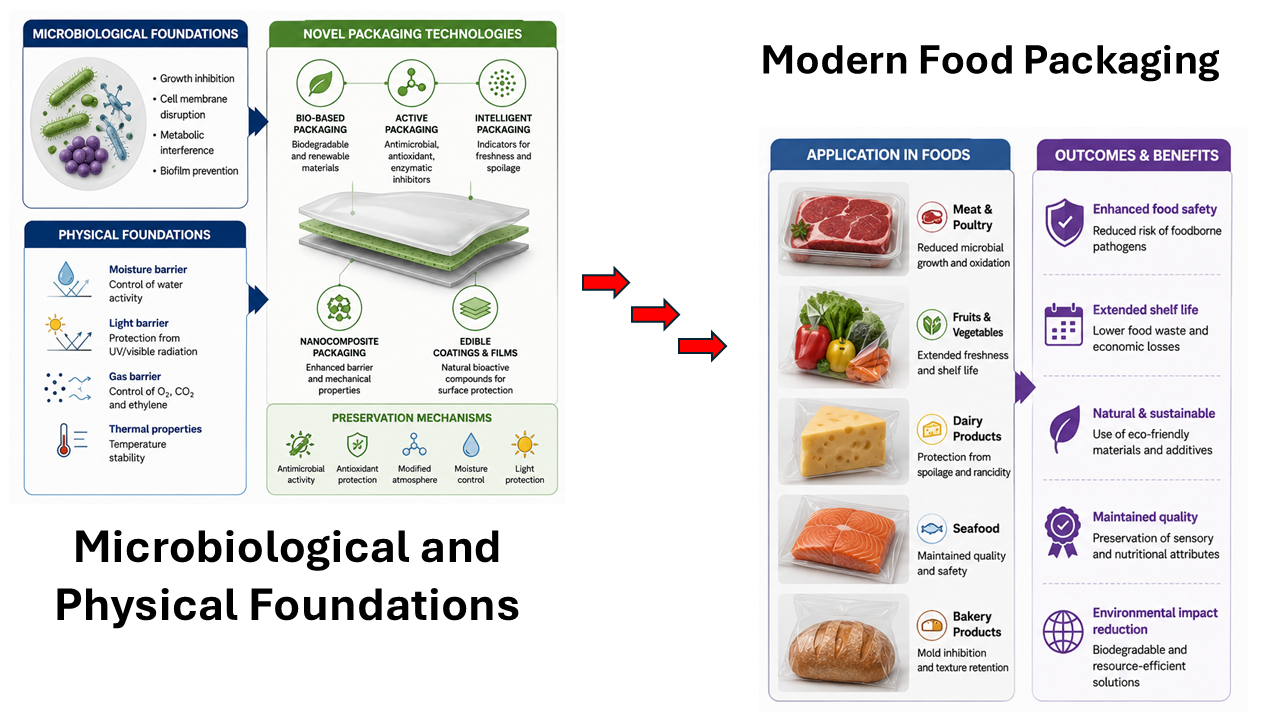
Microbiological and physical foundations of novel food preservation technologies using modern packaging
DOI:
https://doi.org/10.14295/bjs.v6i1.934Keywords:
non-thermal methods, HPP and PEF, environmental footprint, pathogen inactivation, active packagingAbstract
It is demonstrated that traditional thermal processing leads to the degradation of the nutritional composition of food products. The implementation of non-thermal methods (HPP, PEF, US) represents a key response to the global demand for minimally processed products. An analysis of the efficacy of high hydrostatic pressure (HPP) against microorganisms was conducted based on recent publications, demonstrating the inactivation of pathogens and spoilage-causing microorganisms. Factors influencing microbial inactivation via HPP—such as the composition of the suspension medium or food product, microbial species, cell growth phase, pH, and water activity (aw)—are characterized, and the mechanisms by which HPP affects microbial cell morphology and cell membranes are described. Food products can be processed within their final packaging, thereby reducing the risk of microbial contamination during post-processing stages. State-of-the-art preservation methods, combined with modern active packaging, form the foundation of contemporary food production; they ensure high product quality and enable significant improvements in the environmental performance of manufacturing facilities. The primary remaining drawbacks are the inability to achieve complete inactivation of bacterial spores using HPP or other methods considered "cold" alternatives to thermal processing, as well as the high cost of high hydrostatic pressure processing equipment.
References
Aganovic, K., Hertel, C., Vogel, R. F., Johne, R., Schlüter, O., & Schwarzenbolz, U. (2021). Aspects of high hydrostatic pressure food processing: perspectives on technology and food safety. Comprehensive Reviews in Food Science and Food Safety, 20(4), 3225-3266. https://doi.org/10.1111/1541-4337.12763
Agregán, R., Munekata, P. E. S., Zhang, W., Zhang, J., Pérez-Santaescolástica, C., & Lorenzo, J. M. (2021). High-pressure processing in the inactivation of Salmonella spp. in food products. Trends Food Science & Technology, 107, 31-37. https://doi.org/10.1016/j.tifs.2020.11.025
Ali, N. D., & Ibrahim, H. M. (2026). Review: Hurdle technologies in food microbial preservation. World Journal of Advanced Research and Reviews, 29(1), 1596-1609. https://doi.org/10.30574/wjarr.2026.29.1.0231
Aslam, M. U., Aslam, E., & Shahbaz, M. (2025). Emerging technologies in food processing: A narrative review. Insights-Journal of Health and Rehabilitation, 3(8), 786-793. https://doi.org/10.71000/8ksb5n90
Balasubramaniam, V. M., Martínez-Monteagudo, S. I., & Gupta, R. (2015). Principles and application of high pressure-based technologies in the food industry. Annual Review of Food Science and Technology, 6, 435-462. https://doi.org/10.1146/annurev-food-022814-015539
Bansal, V., Jabeen, K., Rao, P. S., Prasad, P., & Yadav, S. K. (2019). Effect of high-pressure processing on microbial safety, physicochemical properties, and bioactive compounds of whey-based sweet lime beverage. Journal of Food Measurement and Characterization, 13, 454-465. https://doi.org/10.1007/s11694-018-9959-1
Berdejo, D., García-Gonzalo, D., Oulahal, N., Denkova-Kostova, R., Shopska, V., Kostov, G., Degraeve, P., & Pagan, R. (2023). Minimal processing technologies for production and preservation of tailor-made foods. Food Technology and Biotechnology, 61(3), 357-377. https://doi.org/10.17113/ftb.61.03.23.8013
Chuang, S., Sheen, S., Sommers, C. H., Sheen, L. Y. (2021). Modeling the reduction of Salmonella and Listeria monocytogenes in ground chicken meat by high-pressure processing and trans-cinnamaldehyde. LWT – Food Science and Technology, 139, 110601. https://doi.org/10.1016/j.lwt.2020.110601
Daher, D., Le Gourrierec, S., & Pérez-Lamela, C. (2017). Effect of high pressure processing on the microbial inactivation in fruit preparations and other vegetable-based beverages. Agriculture, 7(9), 72. https://doi.org/10.3390/agriculture7090072
Daryaei, H., Yousef, A. E., & Balasubramaniam, V. M. (2016). Microbiological aspects of high-pressure processing of food: inactivation of microbial vegetative cells and spores. In: Balasubramaniam, V. M., Barbosa-Cánovas, G. V., & Lelieveld, H., eds. High Pressure Processing of Food, Springer; 271-294. https://doi.org/10.1007/978-1-4939-3234-4_14
Daryaei, A., Jones, E. E., Ghazalibiglar, H., Glare, T. R., & Falloon, R. E. (2016). Effects of temperature, light and incubation period on production, germination and bioactivity of Trichoderma atroviride. Journal of Applied Microbiology, 120(4), 999-1009. https://doi.org/10.1111/jam.13076
DSTU. (2016). 8302:2015. Information and documentation. Bibliographic reference. General provisions and rules of compilation. Kyiv: State Enterprise "UkrNDNTs".
Gędas, A. (2025). Inactivation mechanisms of pathogenic bacteria in fruit juices by conventional and non-thermal treatments [dissertation]. Hamburg, Germany: University of Hamburg, Hamburg School of Food Science, Department of Food Microbiology.
Gracia, M. J., Lázaro, R., Pérez-Arquillué, C., Pagán, R., Ramos, S., Garcia, J. L., & Bayarri, S. (2020). High- pressure processing of raw and dry-cured ham from experimentally infected pigs as a potential tool for the risk control of Toxoplasma gondii. Innovative Food Sci & Emerging Technologies, 61, 102315. https://doi.org/10.1016/j.ifset.2020.102315
Gautier, Y., Stirnemann, G., & Hénin, J. (2026). Molecular signatures of pressure-induced phase transitions in a lipid bilayer. The Journal of Physical Chemistry B, 130(13), 3795-3716. https://doi.org/10.1021/acs.jpcb.5c08607
Gonzalez, M. E., & Barrett, D. M. (2010). Thermal, high pressure and electric field processing effects on plant cell membrane integrity and relevance to fruit and vegetable quality. Journal of Food Science, 75(7), R121-R130. https://doi.org/10.1111/j.1750-3841.2010.01763.x
Guillou, S., & Membré, J. M. (2019). Inactivation of Listeria monocytogenes, Staphylococcus aureus and Salmonella enterica under high hydrostatic pressure: a quantitative analysis of existing literature data. Journal of Food Protection, 82(10), 1802-1814. https://doi.org/10.4315/0362-028X.JFP-19-132
Heinz, V., Alvarez, I., Stefan, A., & Knorr, D. (2001). Preservation of liquid foods by high-intensity pulsed electric fields: basic concepts for process design. Trends in Food Science & Technology, 11(11), 397-407. https://doi.org/10.1016/S0924-2244(01)00064-4
Hiremath, N. D., & Ramaswamy, H. S. (2012). High-pressure destruction kinetics of spoilage and pathogenic microorganisms in mango juice. Journal of Food Processing and Preservation, 36(2), 113-125. https://doi.org/10.1111/j.1745-4549.2011.00559.x
Hiremath, N. D., & Ramaswamy, H. S. (2011). High-pressure destruction kinetics of spoilage and pathogenic microorganisms in mango juice. Journal of Food Processing and Preservation. https://doi.org/10.1111/j.1745-4549.2011.00559.x
Huang, H-W., Hsu, C-P., & Wang, C-Y. (2020). Healthy expectations of high hydrostatic pressure treatment in food processing industry. Journal of Food and Drug Analysis, 28(1), 1-13. https://doi.org/10.1016/j.jfda.2019.10.002
Huang, H. W., Hsu, H. M., Yang, B. B., & Wang, C. Y. (2014). Responses of microorganisms to high hydrostatic pressure processing. Food Control, 40, 250-259. https://doi.org/10.1016/j.foodcont.2013.12.007
Jay, J. M., Loessner, M. J., & Golden, D. A. (2014). Modern Food Microbiology. 8th ed. Springer.
Kalagatur, N. K., Kamasani, J. R., Mudili, V., Krishna, K., Chauhan, O. P., & Sreepathi, M. H. (2018). Effect of high pressure processing on growth and mycotoxin production of Fusarium graminearum in maize. Food Bioscience, 21, 53-59. https://doi.org/10.1016/j.fbio.2017.11.005
Kameník, J., Dušková, M., Dorotíková, K., Hušáková, M., & Ježek, F. (2023). The effect of high-pressure processing on the survival of non-O157 shiga toxin-producing Escherichia coli in steak tartare: The good- or best-case scenario? Microorganisms, 11(2), 377. https://doi.org/10.3390/microorganisms11020377
Kaushik, N., Kaur, B. P., Rao, P. S., & Mishra, H. N. (2014). Effect of high-pressure processing on color, biochemical and microbiological characteristics of mango pulp (Mangifera indica cv. Amrapali). Innovative Food Science & Emerging Technologies, 22, 40-50. https://doi.org/10.1016/j.ifset.2013.12.011
Kaur, B. P., & Rao, P. S. (2017). Process optimization for high-pressure processing of black tiger shrimp (Penaeus monodon) using response surface methodology. Food Science and Technology International, 23(3), 197-208. https://doi.org/10.1177/1082013216673460
Kaur, B. P., & Rao, P. S. (2017). Modeling the combined effect of pressure and mild heat on the inactivation kinetics of Escherichia coli, Listeria innocua, and Staphylococcus aureus in black tiger shrimp (Penaeus monodon). Frontiers in Microbiology, 8, 1311. https://doi.org/10.3389/fmicb.2017.01311
Kerry, J. P., Grady, M. N., & Hogan, S. A. (2006). Past, current and potential utilisation of active and intelligent packaging systems for meat and muscle-based products: A review. Meat Science, 74(1), 113-130. https://doi.org/10.1016/j.meatsci.2006.04.024
Kerry, J., & Malley, D. (2014). Active Packaging. CRC Press.
Klotz, B., Mañas, P., & Mackey, B. M. (2010). The relationship between membrane damage, release of protein and loss of viability in Escherichia coli exposed to high hydrostatic pressure. International Journal of Food Microbiology, 137(2-3), 214-220. https://doi.org/10.1016/j.ijfoodmicro.2009.11.020
Knorr, D., Froehling, A., Jaeger, H., Reineke, K., Schlueter, O., & Schoessler, K. (2011). Emerging technologies in food processing. Annual Review of Food Science and Technology, 2, 203-235. https://doi.org/10.1146/annurev.food.102308.124129
Landi, G., Benedetti, M., Sforzini, M., Eslami, E., & Pataro, G. (2025). Comparative analysis of cost, energy efficiency, and environmental impact of pulsed electric fields and conventional thermal treatment with integrated heat recovery for fruit juice pasteurization. Foods, 14(13), 2239. https://doi.org/10.3390/foods14132239
Lee, Y. C., Hsieh, C. Y., Chen, M. L., Wang, C. Y., Lin, C. S., & Tsai, Y. H. (2020). High-pressure inactivation of histamine-forming bacteria Morganella morganii and Photobacterium phosphoreum. Journal of Food Protection, 83(4), 621-627. https://doi.org/10.4315/0362-028X.JFP-19-267
Lee, S., Vigoureux, T. F., Hyer, K., Small, B. J. (2020). Prevalent insomnia concerns among direct-care workers JAG. Journal of Applied Gerontology, 41(1), 274-284. https://doi.org/10.1177/0733464820978612
Leistner, L. (2000). Basic aspects of food preservation by hurdle technology. International Journal of Food Microbiology, 55(1-3), 181-186. https://doi.org/10.1016/S0168-1605(00)00161-6
Li, J., Wang, J., Zhao, X., Wang, W., Liu, D., Chen, S., Ye, X., & Ding, T. (2019). Inactivation of Staphylococcus aureus and Escherichia coli in milk by different processing sequences of ultrasound and heat. Journal of Food Safety, 39(2), e12614. https://doi.org/10.1111/jfs.12614
Li, Y., & Padilla-Zakour, O. I. (2021). High pressure processing vs thermal pasteurization of whole Concord grape puree: effect on nutritional value, quality parameters and refrigerated shelf life. Foods, 10(11), 2608. https://doi.org/10.3390/foods10112608
Loeffler, H., Waletzko-Hellwig, J., & Fischer, R. J. (2024). Systematic enhancement of microbial decontamination efficiency in bone graft processing by means of high hydrostatic pressure using Escherichia coli as a model organism. Journal of Biomedical Materials Research Part B Applied Biomaterials, 112(2), e35383. https://doi.org/10.1002/jbm.b.35383
Lyu, F., Zhang, T., Gui, M., Wang, Y., Zhao, L., Wu, X., Rao, L., & Liao, X. (2023). The underlying mechanism of bacterial spore germination: an update review. Comprehensive Reviews in Food Science and Food Safety, 22(4), 2728-2746. https://doi.org/10.1111/1541-4337.13160
Maldonado, J. A., Schaffner, D. W., Cuitiño, A. M., & Karwe, M. V. (2016). In situ studies of microbial inactivation during high-pressure processing. High Pressure Research, 36(1), 79-89. https://doi.org/10.1080/08957959.2015.1111887
Marsh, K., & Bugusu, B. (2007). Food packaging--roles, materials, and environmental issues. Journal of Food Science, 72(3), R39-R55. https://doi.org/10.1111/j.1750-3841.2007. 00301.x
Marx, G., Moody, A., & Bermúdez-Aguirre, D. (2011). A comparative study on the structure of Saccharomyces cerevisiae under nonthermal technologies: high hydrostatic pressure, pulsed electric fields and thermosonication. International Journal of Food Microbiology, 151(3), 327-337. https://doi.org/10.1016/j.ijfoodmicro.2011.09.027
Misra, N. N., Yepez, X., Xu, L., & Keener, K. M. (2019). In-package cold plasma technologies. Journal of Food Engineering, 244, 21-31. https://doi.org/10.1016/j.jfoodeng.2018.09.019
Mok, J. H., Sun, Y., Pyatkovskyy, T., Hu, X., Sastry, S. K. (2022). Mechanisms of Bacillus subtilis spore inactivation by single- and multi-pulse high hydrostatic pressure. Innovative Food Science & Emerging Technologies, 81, 103147. https://doi.org/10.1016/j.ifset.2022.103147
Mombert, P., Díaz-Otero, B., & Alonso-Prados, J. L. (2022). Study of the different evaluation areas in the pesticide risk assessment process: focus on pesticides based on microorganisms. EFSA Journal, 20(S1), e200412. https://doi.org/10.2903/j.efsa.2022.e200412
Moussa, M., Perrier-Cornet, J. M., & Gervais, P. (2007). Damage in Escherichia coli cells treated with a combination of high hydrostatic pressure and subzero temperature. Applied and Environmental Microbiology, 73(20), 6508-6518. https://doi.org/10.1128/AEM.01212-07
Pang, Y., Wu, R., Cui, T., Zhang, Z., Dong, L., Chen, F., & H, X. (2022). Proteomic response of Bacillus subtilis spores under high pressure combined with moderate temperature and random peptide mixture LK treatment. Foods, 11(8), 1123. https://doi.org/10.3390/foods11081123
Pavuluri, S. R., Kaur, B. P. (2014). High pressure inactivation kinetics of Escherichia coli in black tiger shrimp (Penaeus monodon). In: Proceedings of the International Conference on Biological, Civil and Environmental Engineering, Dubai, UAE, 17-18 p.
Pilavtepe-Çelik, M., Yousef, A. E., & Alpas, H. (2013). Physiological changes of Escherichia coli O157:H7 and Staphylococcus aureus following exposure to high hydrostatic pressure. Journal für Verbraucherschutz und Lebensmittelsicherheit, 8, 175-183. https://doi.org/10.1007/s00003-013-0828-x
Pilavtepe-Çelik, M. (2012). High hydrostatic pressure (HHP) inactivation of foodborne pathogens in low-acid juices. International Journal of Food Science + Technology, 48(4), 673-677. https://doi.org/10.1111/j.1365-2621.2012.03218.x
Pereira, R. N., & Vicente, A. A. (2010). Environmental impact of novel thermal and non-thermal technologies in food processing. Food Research International, 43, 1936-1943. https://doi.org/10.1016/j.foodres.2009.09.013
Pyatkovskyy, T. (2023). Inactivation of microorganisms by high hydrostatic pressure: a literature review. Bulletin of Medical and Biological Research, 5(4), 53-61. https://doi.org/10.61751/bmbr/4.2023.53
Pylypenko, L. N., Verkhivker, Y. H., Pylypenko, I. V. (2015). Preservation of Food Products. Microbiology, Energy, Control. Odessa.
Realini, C. E., & Marcos, B. (2014). Active and intelligent packaging systems for a modern society. Meat Science, 98(3), 404-419. https://doi.org/10.1016/j.meatsci.2014.06.031
Regulation. (2004). (EC) No. 1935/2004 of the European Parliament and of the Council of 27 October 2004 on materials and articles intended to come into contact with food.
Rendueles, E., Omer, M. K., Alvseike, O., Alonso-Calleja, C., Capita, R., Prieto, M. (2011). Microbiological food safety assessment of high hydrostatic pressure processing: a review. LWT Food Science and Technology, 44(5), 1251-1260. https://doi.org/10.1016/j.lwt.2010.11.001
Rocha-Pimienta, J., Martillanes, S., Ramírez, R., Garcia-Parra, J., & Delgado-Adámez, J. (2020). Bacillus cereus spores and Staphylococcus aureus vegetative cells inactivation in human milk by high- pressure processing. Food Control, 113, 107212. https://doi.org/10.1016/j.foodcont.2020.107212
Sarker, M. R., Akhtar, S., Torres, J. A, & Paredes-Sabja, D. (2015). High hydrostatic pressure-induced inactivation of bacterial spores. Critical Reviews in Microbiology, 41(1), 18-26. https://doi.org/10.3109/1040841X.2013.788475
Sehrawat, R., Kaur, B. P., Nema, P. K., Tewari, S., & Kumar, L. (2021). Microbial inactivation by high pressure processing: principle, mechanism and factors responsible. Food Science and Biotechnology, 30(1), 19-35. https://doi.org/10.1007/s10068-020-00831-6
Sehrawat, R., Kaur, B. P., Nema, P. K., Tewari, S., & Kumar, L. (2021). Microbial inactivation by high pressure processing: principle, mechanism and factors responsible. Food Science and Biotechnology, 30(1), 19-35. https://doi.org/10.1007/s10068-020-00831-6
Serment-Moreno, V., Barbosa-Cánovas, G. V., Torres, J. A., & Welti-Chanes, J. (2014). High-pressure processing: kinetic models for microbial and enzyme inactivation. Food Engineering Reviews, 6(3), 56-88. https://doi.org/10.1007/s12393-014-9075-x
Soni, A., Oey, I., Silcock, P., & Bremer, P. (2016). Bacillus spores in the food industry: a review on resistance and response to novel inactivation technologies. Comprehensive Reviews in Food Science and Food Safety, 15(6), 1139-1148. https://doi.org/10.1111/1541-4337.12231
Suppakul, P., Miltz, J., Sonneveld, K., & Bigger, S. W. (2003). Active packaging technologies with an impact on food quality and safety. Journal of Food Science, 68(2), 408-420. https://doi.org/10.1111/j.1365-2621.2003.tb05687.x
Toepfl, S., Heinz, V., Knorr, D. (2014). High-intensity pulsed electric fields applied for food preservation. In: Sun, D. W., ed. Emerging Technologies for Food Processing. Academic Press, 163-181 p.
Tomasula, P. M., Datta, N., Yee, W. C, McAloon, A. J., Nutter, D. W., Sampedro, F., & Bonnaillie, L. M. (2014). Computer simulation of energy use, greenhouse gas emissions, and costs for alternative methods of processing fluid milk. Journal of Dairy Science, 97(7), 4594-4611. https://doi.org/10.3168/jds.2013-7546
Yadav, B., Roopesh, M. S. (2022). Synergistically enhanced Salmonella Typhimurium reduction by sequential treatment of organic acids and atmospheric cold plasma and the mechanism study. Food Microbiology, 104, 103976. https://doi.org/10.1016/j.fm.2021.103976
Yang, D., Li, R., Dong, P., Rao, L., Wang, Y., & Liao, X. (2023). Influence of pressurization rate and mode on cell damage of Escherichia coli and Staphylococcus aureus by high hydrostatic pressure. Frontiers in Microbiology, 14, 1108194. https://doi.org/10.3389/fmicb.2023.1108194
Yang, B., Shi, Y., Xia, X., Xi, M., Wang, X., Ji, B., & Meng, J. (2012). Inactivation of foodborne pathogens in raw milk using high hydrostatic pressure. Food Control, 28(2), 273-278. https://doi.org/10.1016/j.foodcont.2012.04.030
Yang, Y., Li, X. M., Sun, Z. H., Yang, T., Tan, Z. L., Wang, B. F., Han, X. F., & He, Z. X. (2012). The growth performance and meat quality of goats fed diets based on maize or wheat grain. Journal of Animal Feed Sciences, 21(4), 587-598. https://doi.org/10.22358/jafs/66133/2012
Wang, C. Y., Hsu, C. P., Huang, H. W., & Yang, B. B. (2013). The relationship between inactivation and morphological damage of Salmonella enterica treated by high hydrostatic pressure. Food Research International, 54, 1482-1487. https://doi.org/10.1016/j.foodres.2013.08.004
Wang, C. Y., Huang, H. W., Hsu, C. P., Shyu, Y. T., & Yang, B. B. (2013). Inactivation and morphological damage of Vibrio parahaemolyticus treated with high hydrostatic pressure. Food Control, 32(2), 348-353. https://doi.org/10.1016/j.foodcont.2012.12.023
Wiśniewski, P., Chajęcka-Wierzchowska, W., & Zadernowska, A. (2024). Impact of high-pressure processing (HPP) on Listeria monocytogenes: an overview of challenges and responses. Foods, 13(1), 14. https://doi.org/10.3390/foods13010014
Woldemariam, H. W., & Emire, S. A. (2020). Recent trends in cold pasteurization of fruit juices using pulsed electric fields: a review. Annals of Food Science and Technology, 21(1), 1-15. Available in: www.afst.valahia.ro. Accessed on: May 14, 2026.
Wu, C. P., Wu, S. M., Lin, Y. H., Wu, Y. H., Huang, B. C., Huang, H. W., & Wang, C. Y. (2022). High-pressure processing-based hurdle strategy for microbial shelf life of packed food in the cold chain. Food Package Shelf Life, 34, 100983. https://doi.org/10.1016/j.fpsl.2022.100983
Downloads
Published
How to Cite
Issue
Section
License
Copyright (c) 2027 Pylypenko Liudmyla Mykolaivna, Verkhivker Yakov Grygorovych

This work is licensed under a Creative Commons Attribution 4.0 International License.
Authors who publish with this journal agree to the following terms:
1) Authors retain copyright and grant the journal right of first publication with the work simultaneously licensed under a Creative Commons Attribution License that allows others to share the work with an acknowledgement of the work's authorship and initial publication in this journal.
2) Authors are able to enter into separate, additional contractual arrangements for the non-exclusive distribution of the journal's published version of the work (e.g., post it to an institutional repository or publish it in a book), with an acknowledgement of its initial publication in this journal.
3) Authors are permitted and encouraged to post their work online (e.g., in institutional repositories or on their website) prior to and during the submission process, as it can lead to productive exchanges, as well as earlier and greater citation of published work.