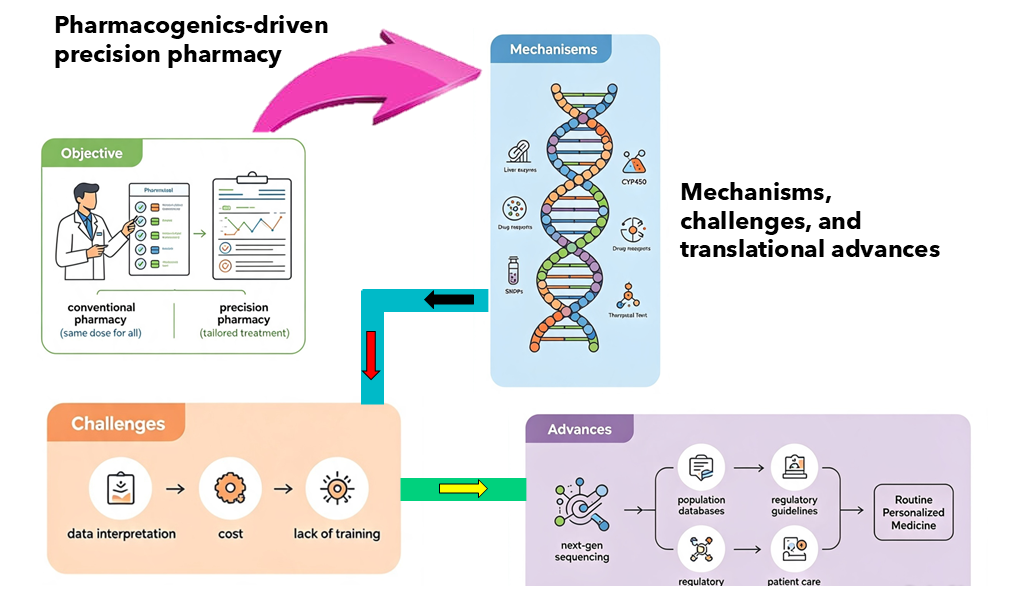
Pharmacogenomics-driven precision pharmacy: Mechanisms, challenges, and translational advances
DOI:
https://doi.org/10.14295/bjs.v6i1.933Keywords:
precision pharmacy, CYP450, personalized medicine, clinical pharmacology, polygenic risk scoresAbstract
Pharmacogenomics represents a transformative paradigm in clinical pharmacology, offering the promise of individualized drug therapy based on genetic profiles. This comprehensive review examines the mechanisms underlying pharmacogenomic variability, the current state of clinical implementation, and the translational advances driving precision pharmacy practice. We systematically discuss the role of pharmacokinetic genes, including cytochrome P450 enzymes (CYP2D6, CYP2C19, CYP2C9, CYP3A4/5), thiopurine S-methyltransferase (TPMT), and solute carrier organic anion transporter family member 1B1 (SLCO1B1), as well as pharmacodynamic targets such as vitamin K epoxide reductase complex subunit 1 (VKORC1) and adrenoceptor beta 1 (ADRB1). Human leukocyte antigen (HLA) genes and their association with severe adverse drug reactions are also critically evaluated. The review further explores the evidence base supporting clinical pharmacogenomic implementation, including guidelines from the Clinical Pharmacogenetics Implementation Consortium (CPIC), the Dutch Pharmacogenetics Working Group (DPWG), and major implementation initiatives such as the IGNITE network and the PREPARE study. We examine the integration of artificial intelligence and machine learning approaches for pharmacogenomic prediction, the emergence of polygenic risk scores, and the role of multi-omics integration in refining therapeutic decision-making. Challenges, including economic barriers, regulatory considerations, health equity concerns, and healthcare system integration, are thoroughly discussed. Finally, we outline future directions for the field, emphasizing the need for global diversification of pharmacogenomic data, enhanced clinical decision support systems, and policy frameworks that facilitate equitable access to precision pharmacy services.
References
Altman, R. B. (2023). The opportunities and challenges of the pharmacogenomics of artificial intelligence. Clinical Pharmacology & Therapeutics, 114(5), 905-908. https://doi.org/10.1016/j.clpt.2023.07.013
Amir, J., Muhammad, S., Kashif, M., Khan, A. A., Gul, M., Sun, H., Shah, M., Azizi, S., & Maaza, M. (2025). Synthesis, characterization and dielectric properties evaluation of NiO-Co3O4 nanocomposite. Journal of the Iranian Chemical Society, 22, 63-72. https://doi.org/10.1007/s13738-024-03129-0
Basile, A. O., & Ritchie, M. D. (2018). Informing pharmacogenomics with transcriptomics: state of the art. Pharmacogenomics, 19(3), 273-286. https://doi.org/10.2217/pgs-2017-0168
Birdwell, K. A., Decker, B., Barbarino, J. M., Peterson, J. F., Stein, C. M., Sadee, W., Vinks, A. A., He, Y., Swen, J .J., Caudle, K. E., & MacPhee, I. A. M. (2015). Clinical pharmacogenetics implementation consortium (CPIC) guidelines for CYP3A5 genotype and tacrolimus dosing. Clinical Pharmacology & Therapeutics, 98(1), 19-24. https://doi.org/10.1002/cpt.113
Bousman, C. A., Bengtsson, H. J., Javorsky, G., & (2023). Emerging concepts and technologies in pharmacogenomics: extending the frontier towards precision medicine. Pharmacogenomics, 24(5), 271-287. https://doi.org/10.2217/pgs-2023-0015
Bushra, Kashif, M., Khairullah, Khan, A. A., Sun, H., Kamal, J., Ishaq Ali Shah M., Hussain, S., Amir, J., Jamal, Y., & Ahmad, T. (2024). Synthesis and characterization of Fe-doped CuO nanoparticles: Catalytic efficiency in crystal violet dye degradation and exploration of electrical properties. Brazilian Journal of Science, 3(8), 1-18. https://doi.org/10.14295/bjs.v3i8.601
Caudle, K. E., Dunnenberger, H. M., Freimuth, R. R., Peterson, J. F., Burlison, J. D., Klein, T. E., Rellin, M. V., & Hoffman, J. M. (2017). Standardizing terms for clinical pharmacogenetic test results: consensus terms from the Clinical Pharmacogenetics Implementation Consortium (CPIC). Genetics in Medicine, 19(2), 215-223. https://doi.org/10.1038/gim.2016.87
Chen, P., Lin, J. J., Lu, C. S., Ong, C-T., & Tai, C-T. (2011). Carbamazepine-induced toxic effects and HLA-B*1502 screening in Taiwan. The New England Journal of Medicine, 364(12), 1126-1133. https://doi.org/10.1056/NEJMoa1009717
Chetry, M., Feng, R., Babar, S., Sun, H., Zafar, I., Mohany, M., Afridi, H. I., Khan, N. U., Ali, I., Shafiq, M., & Khan, S. (2025). Early detection and analysis of accurate breast cancer for improved diagnosis using deep supervised learning for enhanced patient outcomes. PeerJ. Computer science, 11, e2784. https://doi.org/10.7717/peerj-cs.2784
Crews, K. R., Gaedigk, A., Dunnenberger, H. M., & (2014). Clinical pharmacogenetics implementation consortium guidelines for cytochrome P450 2D6 genotype and codeine therapy: 2014 update. Clinical Pharmacology & Therapeutics, 95(4), 376-382. https://doi.org/10.1038/clpt.2013.254
Gage, B. F., Bass, A. R., Lin, H., McMillin, G. A., Merritt, K., Barrack, R. L., & Eby, C. S. (2017). Effect of genotype-guided warfarin dosing on clinical events and anticoagulation control among patients undergoing hip or knee arthroplasty: The GIFT randomized clinical trial. JAMA, 318(12), 1115-1124. https://doi.org/10.1001/jama.2017.11469
Gonzalez, F. J., Skoda, R. C., Kimura, S., Umeno, M., Zanger, U. M., Nebert, D. W., Gelboin, H. V., Hardwick, J. P., & Meyer, U. A. (1988). Characterization of the common genetic defect in humans deficient in debrisoquine metabolism. Nature, 331(6155), 442-446. https://doi.org/10.1038/331442a0
Gul, M., Kashif, M., Muhammad, S., Azizi, S., & Sun, H. (2025).Various methods of synthesis and applications of gold-based nanomaterials: A detailed review. Crystal Growth & Design, 25(7), 2227-2266. https://doi.org/10.1021/acs.cgd.4c01687
Hoffman, J. M., Haidar, C. E., Wilkinson, M. R., Crews, K. R., Pui, C-H., Reiss, U. M., & Gaur, A. H. (2014). PG4KDS: a model for the clinical implementation of pre-emptive pharmacogenetics. American Journal of Medical Genetics Part C Seminars in Medical Genetics, 166C(1), 45-55. https://doi.org/10.1002/ajmg.c.31387
Hresko, A., & Haga, S. B. (2019). Insurance coverage policies for pharmacogenetic testing: gaps and opportunities. Pharmacogenomics, 20(16), 1137-1148. https://doi.org/10.2217/pgs-2019-0091
Illing, P. T., Vivian, J. P., Dudek, N. L., Kostenko, L., Chen, Z., Gras, S., Burrows, S. R., Purcell, A. W., Rossjohn, J., & McCluskey, J. (2012). Immune self-reactivity triggered by drug-modified HLA-peptide repertoire. Nature, 486(7404), 554-558. https://doi.org/10.1038/nature11147
International Human Genome Sequencing Consortium. (2004). Finishing the euchromatic sequence of the human genome. Nature, 431(7011), 931-945. https://doi.org/10.1038/nature03001
International Warfarin Pharmacogenetics Consortium, Klein, T. E., & Altman, R. B. (2009). Estimation of the warfarin dose with clinical and pharmacogenetic data. The New England Journal of Medicine, 360(8), 753-764. https://doi.org/10.1056/NEJMoa0809329
Jamal, M., Khan, G. A., Sun, H., Ullah, K., Khattak, O. A., Kashif, M., Khan, S., Alam, M., Hussain, S., Ullah, M., Aleena, S., Haq, H., Umar, S., Atif, M., Hussain, I., & Masood, A. (2024). Preparation of manganese-doped bismuth oxide for the photocatalytic degradation of methylene blue. Archives of Advanced Engineering Science, 1-7. https://doi.org/10.47852/bonviewAAES42023402
Jamil, M., Shah, A., Aman, G., Shabir, F., Begum, R., Sun, H., Rafiq, S., Iqbal, N., Aman, N., Aman, N., Liaqat, Z., & Aleena, S. (2025). Bismuth vanadate nanoparticles: Structure, synthesis, and emerging engineering applications. Biomedical Journal of Scientific & Technical Research, 62(3), 54728-54740. https://doi.org/10.26717/BJSTR.2025.62.009758
Jia, B., Zhao, L., Tang, M., Xie, N., Huang, Y., Liang, X., Yang, G., Wu, Q., Sun, Z., Kwan, H. Y., Sun, H., & Xu, K. (2026). Neuron–tumor crosstalk in cancer: Molecular mechanisms and translational advances. Molecular Cancer. https://doi.org/10.1186/s12943-026-02715-5
Kashif, M., Jawad, M., Khan, A., Sun, H., Ullah, K., Fakayode, O., & Azizi, S. (2024). Fe/Ti-codoped strontium oxide nanoparticles for enhanced photocatalytic degradation of methyl orange. Journal of Applied Research in Water and Wastewater, 11(1), 8-14. https://doi.org/10.22126/arww.2024.10753.1336
Landry, L. G., Ali, N., Williams, D. R., Rehm, H. L., & Bonham, V. L. (2018). Lack of diversity in genomic databases is a barrier to translating precision medicine research into practice. Health Affairs, 37(5), 780-785. https://doi.org/10.1377/hlthaff.2017.1595
Liggett, S. B., Mialet-Perez, J., Thaneemit-Chen, S., & Bristow, M. R. (2006). A polymorphism within a conserved beta1-adrenergic receptor motif alters cardiac function and beta-blocker response in human heart failure. Proceedings of the National Academy of Sciences of the United States of America, 103(30), 11288-11293. https://doi.org/10.1073/pnas.0509937103
Limdi, N. A., Wadelius, M., Cavallari, L., Eriksson, N., Crawford, D. C., Lee, M-T. M., & Wagner, M. J. (2010). Warfarin pharmacogenetics: a single VKORC1 polymorphism is predictive of dose across 3 racial groups. Blood, 115(18), 3827-3834. https://doi.org/10.1182/blood-2009-12-255992
Link, E., Parish, S., & Armitage, J. (2008). SLCO1B1 variants and statin-induced myopathy--a genomewide study. The New England Journal of Medicine, 359(8), 789-799. https://doi.org/10.1056/NEJMoa0801936
Liu, S., Sun, H., Song, T., Liang, C., Deng, L., Zhu, H., Zhao, F., & Li, S. (2025). Comprehensive characterization of T cell subtypes in lung adenocarcinoma: Prognostic, predictive, and therapeutic implications. Translational Oncology, 55, 102332. https://doi.org/10.1016/j.tranon.2025.102332
Lorenzini, N. A., Luzum, J. A., & Pakyz, R. E. (2024). Machine learning for pharmacogenomic precision dosing: A systematic review. Clinical Pharmacology & Therapeutics, 115(3), 510-521. https://doi.org/10.1002/cpt.3135
Lötsch, J., & Geisslinger, G. (2005). Are mu-opioid receptor polymorphisms important for clinical opioid therapy? Trends in Molecular Medicine, 11(2), 82-89. https://doi.org/10.1016/j.molmed.2004.12.006
Mallal, S., Phillips, E., Carosi, G., Molina, J-M., Workman, C., & Jägel-Guedes, E. (2008). HLA-B*5701 screening for hypersensitivity to abacavir. The New England Journal of Medicine, 358(6), 568-579. https://doi.org/10.1056/NEJMoa0706135
Martin, A. R., Kanai, M., Kamatani, Y., Okada, Y., Neale, B. M., & Daly, M. J. (2019). Clinical use of current polygenic risk scores may exacerbate health disparities. Nature Genetics, 51(4), 584-591. https://doi.org/10.1038/s41588-019-0379-x
Mega, J. L, Close, S. L., Wiviott, S. D., & (2009). Cytochrome p-450 polymorphisms and response to clopidogrel. The New England Journal of Medicine, 360(4), 354-362. https://doi.org/10.1056/NEJMoa0809171
Motulsky, A. G. (1957). Drug reactions, enzymes, and biochemical genetics. JAMA, 165(7), 835-837. https://doi.org/10.1001/jama.1957.72980250010007
Muhammad, S., Sun, H., Zahoor, S., Khan, S., Ullah, R., Fu, B., Ullah, S., Isimjan, T. T., Azizi, S., & Yang, X. (2026). Advancing MOFs for electrocatalytic ORR, UOR, and CO2RR: From fundamentals to device integration and deployment challenges. Materials Science and Engineering: R: Reports, 171, 101248. https://doi.org/10.1016/j.mser.2026.101248
Oslin, D. W., Lynch, K. G., Shih, M. C., Wray, L. O., Brenner, L. A., Fuller, M. A., Vassy, J. L., Voora, D., & Wood, A. E. (2024). Effect of pharmacogenomic testing for CYP2D6 and CYP2C19 on time to remission of symptoms in major depressive disorder. JAMA Psychiatry, 81(1), 20-28. https://doi.org/10.1001/jama.2022.9805
Peng, Z., Lv, X., Sun, H., Zhao, L., & Huang, S. (2025). 3D tumor cultures for drug resistance and screening development in clinical applications. Molecular Cancer, 24. https://doi.org/10.1186/s12943-025-02281-2
Phillips, E. J., Sukasem, C., Whirl-Carrillo, M., Müller, D. J., Dunnenberger, H. M., & Chen, D. J. (2018). Clinical pharmacogenetics implementation consortium guideline for HLA genotype and use of carbamazepine and oxcarbazepine: 2017 update. Clinical Pharmacology & Therapeutics, 103(4), 574-581. https://doi.org/10.1002/cpt.1004
Pirmohamed, M., James, S., & Meakin, S. (2004). Adverse drug reactions as cause of admission to hospital: prospective analysis of 18,820 patients. BMJ, 329(7456), 15-19. https://doi.org/10.1136/bmj.329.7456.15
Pratt, V. M., Cavallari, L. H., Del Tredici, A. L., Moyer, A. M., Scott, S. A., Whirl-Carrillo, M., & Weck, K. E. (2019). Recommendations for clinical CYP2C9 genotyping allele selection: a joint recommendation of the Association for Molecular Pathology and College of American Pathologists. The Journal of Molecular Diagnostics, 21(5), 746-757. https://doi.org/10.1016/j.jmoldx.2019.04.003
Pulley, J. M., Denny, J. C., Peterson, J. F., Ramiez, A. H., Bowton, E., Crawford, D. C., Masys, D. R., & Wilke, R. A. (2012). Operational implementation of prospective genotyping for personalized medicine: the design of the Vanderbilt PREDSICT project. Clinical Pharmacology & Therapeutics, 92(1), 87-95. https://doi.org/10.1038/clpt.2011.371
Qin, Y., Yao, J., & Wu, D. C. (2024). Long-read sequencing of CYP2D6 in challenging pharmacogenes. Nature Methods, 21(2), 253-261. https://doi.org/10.1038/s41592-023-02125-x
Relling, M. V., & Klein, T. E. (2011). CPIC: Clinical pharmacogenetics implementation consortium of the national institutes of health pharmacogenomics research network. Clinical Pharmacology & Therapeutics, 89(3), 464-467. https://doi.org/10.1038/clpt.2010.279
Roberts, M. C., Kennedy, A. E., Chambers, D. A., & Khoury, M. J. (2017). The current state of implementation science in genomic medicine: opportunities for improvement. Genetics in Medicine, 19(8), 858-863. https://doi.org/10.1038/gim.2016.210
Rodrigues, A. T., Vilar, S., Bucala, R., Sherry, J., Volkman, S. K., & Das, S. (2023). Pharmacogenomics in global health infectious diseases: current state and future directions. Clinical Pharmacology & Therapeutics, 114(3), 498-512. https://doi.org/10.1002/cpt.2925
Shah, J., Sun, H., Qiao, Z., Sharif, T., & Gul, M. (2024). Enhanced degradation of methylene blue dye using hydrothermally synthesized nickel-doped strontium oxide catalysts. Brazilian Journal of Science, 3, 13-27. https://doi.org/10.14295/bjs.v3i12.663
Sirugo, G., Williams, S. M., & Tishkoff, S. A. (2019). The missing diversity in human genetic studies. Cell, 177(1), 26-31. https://doi.org/10.1016/j.cell.2019.02.048
Sultana, J., Cutroneo, P., & Trifiro, G. (2013). Clinical and economic burden of adverse drug reactions. Journal of Pharmacology and Pharmacotherapeutics, 4(Suppl1), S73-S77. https://doi.org/10.4103/0976-500X.120957
Sun, H., Ciska, M., Makki, M., Tenllado, F. & Canto, T. (2024) Adaptive substitutions at two amino acids of HCPro modify its functional properties to separately increase the virulence of a potyviral chimera. Molecular Plant Pathology, 25, e13487. https://doi.org/10.1111/mpp.13487
Sun, H., del Toro, F., Makki, M., Tenllado, F., & Canto, T. (2022). Adaptation of a Potyvirus chimera increases its virulence in a compatible host through changes in HCPro. Plants, 11(17), 2262. https://doi.org/10.3390/plants11172262
Sun, H., Sohail, A., Shah, A., Liaqat, Z., Gul, M., & Liangyu. (2025). From precursors to performance: Diverse synthesis strategies for cerium oxide nanoparticles. Phytopharmacology Research Journal, 4(2), 28-42. https://ojs.prjn.org/index.php/prjn/article/view/82
Swen, J. J., Nijenhuis, M., de Boer, A., Grandia, L., Maitland-van der Zee, A. H., Mulder, H., Deneer, V. H. M., & Guchelaar, H-J. (2011). Pharmacogenetics: from bench to byte--an update of guidelines. Clinical Pharmacology & Therapeutics, 89(5), 662-673. https://doi.org/10.1038/clpt.2011.34
Swen, J. J., van der Wouden, C. H., Manson, L. E., Abdullah-Koolmees, H., Blagec, K., & Blagus, T. (2023). A 12-gene pharmacogenetic panel to prevent adverse drug reactions: an open-label, multicentre, controlled, cluster-randomised crossover implementation study. The Lancet, 401(10381), 1159-1167. https://doi.org/10.1016/S0140-6736(23)00063-2
Torkamani, A., Wineinger, N. E., & Topol, E. J. (2018). The personal and clinical utility of polygenic risk scores. Nature Reviews Genetics, 19(9), 581-590. https://doi.org/10.1038/s41576-018-0018-x
Van Driest, S. L., Shi, Y., Bowton, E. A., Shildcrout, J. S., Peterson, J. F., Pulley, J., Denny, J. C., & Roden, D. M. (2014). Clinically actionable genotypes among 10,000 patients with preemptive pharmacogenomic testing. Clinical Pharmacology & Therapeutics, 95(4), 423-431. https://doi.org/10.1038/clpt.2013.229
Verbelen, M., Weale, M. E., & Lewis, C. M. (2017). Cost-effectiveness of pharmacogenetic-guided treatment: are we there yet? The Pharmacogenomics Journal, 17(5), 395-402. https://doi.org/10.1038/tpj.2017.21
Vo, T. T., Bajaj, D., Zeng-Treitler, Q., & Emery, S. (2023). Current state of pharmacogenomics education and practice: a scoping review. BMC Medical Education, 23(1), 1-15. https://doi.org/10.1186/s12909-023-04689-5
Wang, W., Gao, R., Zhang, L., Dong, Y., Du, Y., Dai, Q., Liu, B., Fang, C., Wang, C., Sun, H., Tong, F., & Huang, W. (2026). Precisely targeting cardiac remodeling nanomachine for restarting healthy heartbeat. Advanced Healthcare Materials, 15(3), e03478. https://doi.org/10.1002/adhm.202503478
Weitzel, K. W., Alexander, M., Bernhardt, B. A., Calman, N., Orlando, L. A., Denny, J. C., & Johnson, J. A. (2016). The IGNITE network: a model for genomic medicine implementation and research. BMC Medical Genomics, 9(1), 1. https://doi.org/10.1186/s12920-015-0162-5
Zanger, U. M., & Schwab, M. (2013). Cytochrome P450 enzymes in drug metabolism: regulation of gene expression, enzyme activities, and impact of genetic variation. Pharmacology & Therapeutics, 138(1), 103-141. https://doi.org/10.1016/j.pharmthera.2012.12.007
Zeng, X., & Sun, H. (2025). Enhancing the understanding of complement protein changes in RVO: Insights and suggestions [Letter]. Journal of Inflammation Research, 18(0), 2781-2782. https://doi.org/10.2147/JIR.S522685
Zhou, S. F. (2009). Polymorphism of human cytochrome P450 2D6 and its clinical significance: Part I. Clinical Pharmacokinetics, 48(11), 689-723. https://doi.org/10.2165/11318070-000000000-00000
Zhu, H., Sun, H., Dai, J., Hao, J., & Zhou, B. (2024). Chitosan-based hydrogels in cancer therapy: Drug and gene delivery, stimuli-responsive carriers, phototherapy and immunotherapy. International Journal of Biological Macromolecules, 282(Part 2), 137047. https://doi.org/10.1016/j.ijbiomac.2025.143373
Downloads
Published
How to Cite
Issue
Section
License
Copyright (c) 2027 Hao Sun, Zijun Qiao, Jinze Yu, Gaoyang Guo, Liangyu Li

This work is licensed under a Creative Commons Attribution 4.0 International License.
Authors who publish with this journal agree to the following terms:
1) Authors retain copyright and grant the journal right of first publication with the work simultaneously licensed under a Creative Commons Attribution License that allows others to share the work with an acknowledgement of the work's authorship and initial publication in this journal.
2) Authors are able to enter into separate, additional contractual arrangements for the non-exclusive distribution of the journal's published version of the work (e.g., post it to an institutional repository or publish it in a book), with an acknowledgement of its initial publication in this journal.
3) Authors are permitted and encouraged to post their work online (e.g., in institutional repositories or on their website) prior to and during the submission process, as it can lead to productive exchanges, as well as earlier and greater citation of published work.