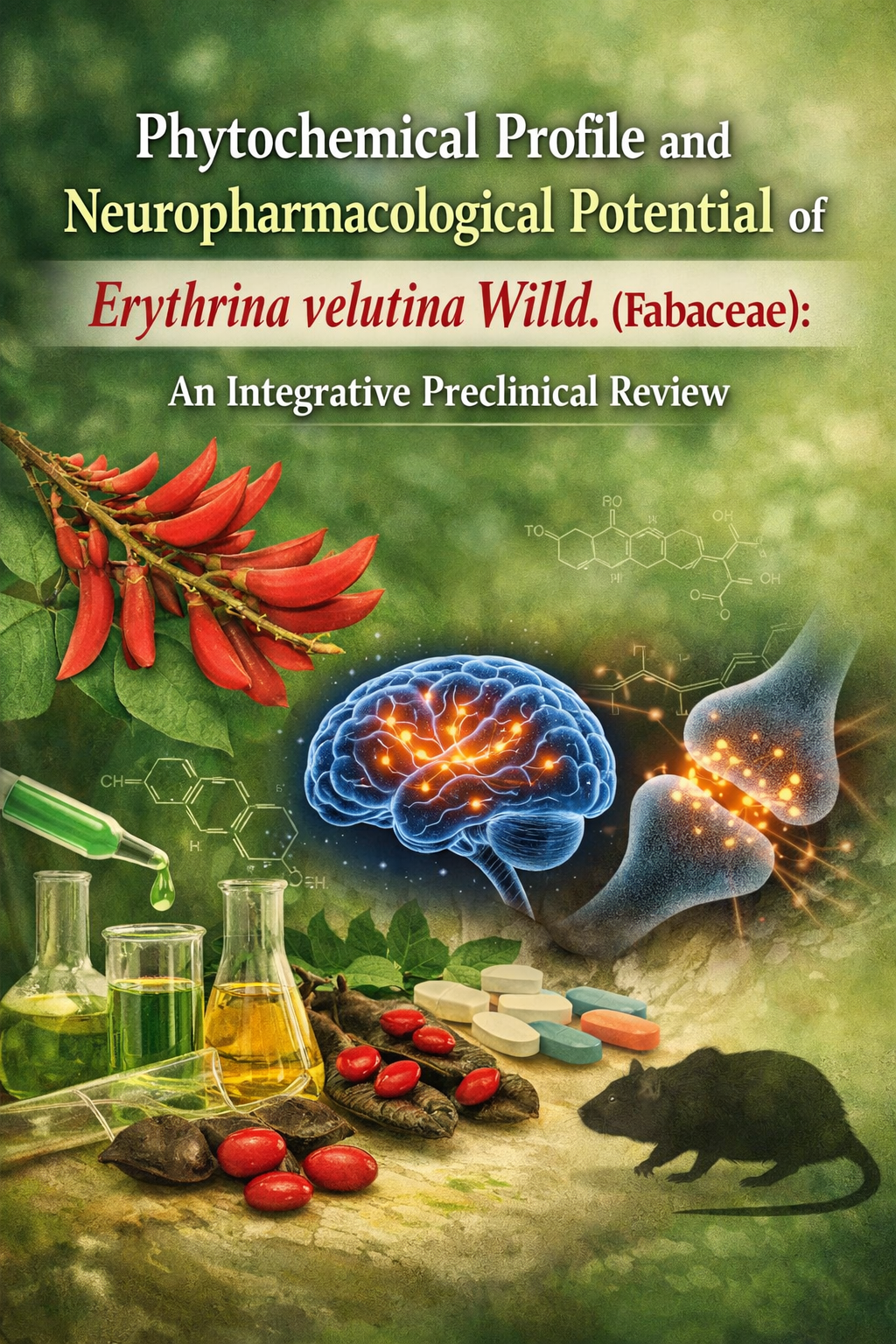
Phytochemical profile and neuropharmacological potential of Erythrina velutina Willd. (Fabaceae): An integrative preclinical review
DOI:
https://doi.org/10.14295/bjs.v5i4.845Keywords:
medicinal plants, alkaloids, flavonoids, neuroactive compounds, oxidative stressAbstract
Medicinal plants constitute an important source of bioactive compounds for the discovery of novel neuroactive agents. Erythrina velutina Willd. (Fabaceae). Popularly known as mulungu, has been traditionally used in the treatment of anxiety, insomnia, and other conditions related to the central nervous system (CNS), which has motivated extensive pharmacological and preclinical investigations. This integrative review critically synthesizes the available evidence on the phytochemical profile and neuropharmacological potential of E. velutina. The literature search was conducted in PubMed, SciELO, Web of Science, and the Virtual Health Library, including preclinical in vitro and in vivo studies, with no language or publication-year restrictions. The analyzed studies indicate a complex phytochemical composition characterized primarily by alkaloids, flavonoids, and other phenolic compounds. Preclinical evidence demonstrates anxiolytic, sedative, anticonvulsant, antioxidant, neuroprotective, and anticholinesterase activities associated with modulation of GABAergic and cholinergic neurotransmission, as well as with reductions in oxidative stress and neuronal protection. The available toxicological data suggest low acute toxicity and the absence of genotoxic effects at the experimentally evaluated doses. However, the lack of standardized extracts, compound-guided pharmacological studies, long-term toxicological assessments, and clinical investigations limits the translational extrapolation of the findings. Therefore, future studies focused on bioprospecting, elucidation of mechanisms of action, and clinical validation are required to consolidate the pharmacological potential of Erythrina velutina.
References
Adetunji, T. L., Acho, M. A., Samuel, V. O., Ohoro, C. R., & Ramulondi, M. (2024). Erythrina velutina Willd.: A review of its traditional uses, phytochemistry, pharmacology, and toxicology. Journal of Ethnopharmacology, 319, 117273. https://doi.org/10.1016/j.jep.2023.117273 DOI: https://doi.org/10.1016/j.jep.2023.117273
Albuquerque, U. P., Monteiro, J. M., Ramos, M. A., & Amorim, E. L. C. (2007). Medicinal and magical plants from a public market in Northeastern Brazil. Journal of Ethnopharmacology, 110, 76-91. https://doi.org/10.1016/j.jep.2006.09.010 DOI: https://doi.org/10.1016/j.jep.2006.09.010
Carvalho, A. C. B., Balbino, E. E., Maciel, A., & Perfeito, J. P. S. (2008). Status of herbal medicine registration in Brazil. Revista Brasileira de Farmacognosia, 18, 314-319. https://doi.org/10.1590/S0102-695X2008000200028 DOI: https://doi.org/10.1590/S0102-695X2008000200028
Carvalho, A. C. B., Rodrigues, S. A., & Teixeira-Silva, F. (2009). Evidence of the mechanism of action of the aqueous extract of the leaves of Erythrina velutina Willd. (Fabaceae). Journal of Ethnopharmacology, 122, 374-378. https://doi.org/10.1016/j.jep.2008.12.019 DOI: https://doi.org/10.1016/j.jep.2008.12.019
Craveiro, A. C. S., Carvalho, D. M. M., Nunes, R. S., Fakhouri, R., Rodrigues, S. A., & Teixeira-Silva, F. (2013). Acute toxicity of Erythrina velutina in experimental animals. Revista Brasileira de Farmacognosia, 18(Suppl.), 739-746. https://doi.org/10.1590/S0102-695X2008000500018
Craveiro, A. C. S., Carvalho, D. M. M., Nunes, R. S., Fakhouri, R., Rodrigues, S. A., & Teixeira-Silva, F. (2008). Acute toxicity of the aqueous extract of Erythrina velutina leaves in experimental animals. Revista Brasileira de Farmacognosia, 18, 739-743. https://doi.org/10.1590/S0102-695X2008000500018 DOI: https://doi.org/10.1590/S0102-695X2008000500018
Chacon, L. A., Rodrigues, R. R., Costa, R. M., Lima, A. P., Ferreira, G. D., Albuquerque, U. P., & Silva, T. C. (2022). Non-target molecular network and putative genes of flavonoid biosynthesis in Erythrina velutina Willd., a Brazilian semiarid native woody plant. Frontiers in Plant Science, 13, 947558. https://doi.org/10.3389/fpls.2022.947558 DOI: https://doi.org/10.3389/fpls.2022.947558
Dantas, M. C., Oliveira, F. S., Bandeira, S. M., Batista, J. S., Silva, C. D. Jr., Alves, P. B., Antoniolli, A. R., & Marchioro, M. (2004). Central nervous system effects of the crude extract of Erythrina velutina on rodents. Journal of Ethnopharmacology, 94, 129-133. https://doi.org/10.1016/j.jep.2004.05.007 DOI: https://doi.org/10.1016/j.jep.2004.05.007
Dias, K. C. F., Rodrigues, F. T., Santos, W. P., Oliveira, B., Ximenes, N. C., & Vasconcelos, S. M. M. (2019). Standardized extract of Erythrina velutina Willd. attenuates schizophrenia-like behaviors and oxidative parameters in experimental animal models. Journal of Pharmacy and Pharmacology, 71, 379-389. https://doi.org/10.1111/jphp.13039 DOI: https://doi.org/10.1111/jphp.13039
Faggion, S. A., Cunha, A. O. S., Fachim, H. A., Gavin, A. S., Santos, W. F., Pereira, A. M. S., & Beleboni, R. O. (2011). Anticonvulsant profile of the alkaloids (+)-erythravine and (+)-11-α-hydroxy-erythravine isolated from the flowers of Erythrina mulungu Mart. ex Benth. Epilepsy & Behavior, 20, 441-446. https://doi.org/10.1016/j.yebeh.2010.12.037 DOI: https://doi.org/10.1016/j.yebeh.2010.12.037
Fahmy, N. M., & Balbuena, T.S. (2020). Alkaloids of the genus Erythrina. Natural Product Research, 34, 1891-1912. https://doi.org/10.1080/14786419.2018.1564300 DOI: https://doi.org/10.1080/14786419.2018.1564300
Ferreira, G. D. S., Alves, A. B., Silva, L. R., Souza, V. M., Lima, D. A., Cardoso, R. L., & Costa, M. P. (2021). Tintura de mulungu (Erythrina velutina): preparo e caracterização de parâmetros de qualidade. Revista de Biologia & Farmácia e Gestão Agrícola, 17(1).
Gilbert, B., & Favoreto, R. (2012). Erythrina sp. Fabaceae (Leguminosae, Faboideae). Fitos – Eletrônico Diário, 7(3). DOI: https://doi.org/10.32712/2446-4775.2012.152
Gomes, A. S., Silva, F. R., Lima, C. T., Duarte, J. P., Oliveira, M. H., Santos, J. A., Cardoso, R. L., & Souza, P. M. (2022). Fabaceae Lindl. in a conservation unit in the semi-arid region of Paraíba, Brazil. Phytotaxa, 555, 17-41. https://doi.org/10.11646/phytotaxa.555.1.2 DOI: https://doi.org/10.11646/phytotaxa.555.1.2
Iqbal, T., Ahmad, I., Rasheed, A., Khan, M. I., & Anjum, F. M. (2013). Antioxidant activity and volatile and phenolic profiles of essential oil and extracts of Mentha longifolia. Journal of Analytical Methods in Chemistry, 536490. https://doi.org/10.1155/2013/536490 DOI: https://doi.org/10.1155/2013/536490
Lombardo, S., & Maskos, U. (2015). Role of the nicotinic acetylcholine receptor in Alzheimer’s disease pathology and treatment. Neuropharmacology, 96, 255-262. https://doi.org/10.1016/j.neuropharm.2015.03.009 DOI: https://doi.org/10.1016/j.neuropharm.2014.11.018
Palumbo, C., Gomes, M. A., Silva, L. R., Torres, P. S., & Mendes, B. F. (2016). Erythrina mulungu Mart. ex Benth e Erythrina velutina Willd. – aspectos farmacológicos e perspectiva antroposófica de plantas brasileiras. Arte Médica Ampliada, 36, 152-161.
Oliveira, B., Souza, R. C., Pereira, L. M., Costa, M. T., Fernandes, V. H., & Lima, C. S. (2018). Evaluation of the genotoxic effects of Erythrina velutina (Fabaceae) using the in vivo micronucleus test. Acta Horticulturae, 1198, 53-58. https://doi.org/10.17660/ActaHortic.2018.1198.10 DOI: https://doi.org/10.17660/ActaHortic.2018.1198.10
Organização Mundial da Saúde (OMS). (2021). Neurological disorders: public health challenges. Geneva: WHO.
Ozawa, M., Honda, K., Nakai, I., Kishida, A., & Ohsaki, A. (2008). Hypaphorine, an indole alkaloid from Erythrina velutina, induced sleep on normal mice. Bioorganic & Medicinal Chemistry Letters, 18, 3992-3994. https://doi.org/10.1016/j.bmcl.2008.06.002 DOI: https://doi.org/10.1016/j.bmcl.2008.06.002
Ozawa, M., Kishida, A., & Ohsaki, A. (2011). Erythrinan alkaloids from seeds of Erythrina velutina. Chemical and Pharmaceutical Bulletin, 59, 564-567. https://doi.org/10.1248/cpb.59.564 DOI: https://doi.org/10.1248/cpb.59.564
Ramos, R. M., Feitosa, J. M., Lima, V. S., Santos, R. C., Oliveira, A. M., Soares, L. A. L., & Silva, G. C. (2020). Comparative study of phytochemical composition, citotoxicity and potentials antioxidant and photoprotector of the bark and leaf of Erythrina velutina. Brazilian Journal of Development, 6, 33140-33158. https://doi.org/10.34117/bjdv6n6-026 DOI: https://doi.org/10.34117/bjdv6n6-026
Ribeiro, M. D. P., Oliveira, M. D. P., Silva, R. L. S., Costa, F. R., Souza, C. R. P., Ramos, R. M., Soares, L. A. L., & Oliveira, A. M. (2006). Effect of Erythrina velutina and Erythrina mulungu in rats submitted to animal models of anxiety and depression. Brazilian Journal of Medical and Biological Research, 39, 263-270. https://doi.org/10.1590/s0100-879x2006000200013. DOI: https://doi.org/10.1590/S0100-879X2006000200013
Rodrigues, F. T., Dias, K. C. F., Santos, W. P., Oliveira, B., Ximenes, N. C., & Vasconcelos, S. M. M. (2017). Effects of standard ethanolic extract from Erythrina velutina in acute cerebral ischemia in mice. Biomedicine & Pharmacotherapy, 96, 1230-1239. https://doi.org/10.1016/j.biopha.2017.11.093. DOI: https://doi.org/10.1016/j.biopha.2017.11.093
Rosa, D. S., Faggion, S. A., Fachim, H. A., Gavin, A. S., Santos, W. F., Pereira, A. M. S., & Beleboni, R. O. (2012). Erysothrine, an alkaloid extracted from flowers of Erythrina mulungu Mart. ex Benth: Evaluating its anticonvulsant and anxiolytic potential. Epilepsy & Behavior, 23, 205-212. https://doi.org/10.1016/j.yebeh.2012.01.003 DOI: https://doi.org/10.1016/j.yebeh.2012.01.003
Santos, W. P., Faggion, S. A., Oliveira, B., Dias, K. C. F., Carvalho, S. A., & Lima, D. L. G. (2012). In vitro and ex vivo anticholinesterase activities of Erythrina velutina leaf extracts. Pharmaceutical Biology, 50, 919-924. https://doi.org/10.3109/13880209.2011.649429 DOI: https://doi.org/10.3109/13880209.2011.649429
Silva, R. S., Veloso, C. L., Sousa, A. C. P., Silva, R. L. V., Oliveira, J., Nascimento, D. L., & Marques, F. J. (2020). Utilities of mulungu (Erythrina velutina Willd.). Brazilian Journal of Development, 6(3), 13779-13785. https://doi.org/10.34117/bjdv6n3-297 DOI: https://doi.org/10.34117/bjdv6n3-297
Silva, R. E. L., & Silva, L. L. C. (Orgs.). (2024). Saberes, ciência e plantas medicinais. Rio de Janeiro: Farmanguinhos/Fiocruz.
Souza, E. M. S. D., Oliveira, F. A., Santos, D. G., Ribeiro, M. F., Andrade, C. R., Silva, P. H. C., Gomes, A. S., Monteiro, J. M., & Albuquerque, U. P. (2016). Comparative structure of Erythrina velutina tree species in renovated lands and native populations. Genetics and Molecular Research, 15(2). http://dx.doi.org/10.4238/gmr.15028534. DOI: https://doi.org/10.4238/gmr.15028534
Souza, J. L., Duarte, M. C. T. M., Oliveira, L. M., Silva, R. L. S., Ferreira, G. D. S., Ramos, R. M., Santos, A. L. F., & Lima, P. R. S. (2022). Biotechnological potential of the medicinal plant Erythrina velutina Willd: a systematic review. Biocatalysis and Agricultural Biotechnology, 45, 102488. https://doi.org/10.1016/j.bcab.2022.102488 DOI: https://doi.org/10.1016/j.bcab.2022.102488
Vasconcelos, S. M., Pinto, A. C., Oliveira, M. F. L., & Albuquerque, U. P. (2007). Antivulsant activity of hydroalcoholic extracts of Erythrina velutina and Erythrina mulungu. Journal of Ethnopharmacology, 110, 271-274. https://doi.org/10.1016/j.jep.2006.09.023 DOI: https://doi.org/10.1016/j.jep.2006.09.023
Vasconcelos, S. M., Pinto, A. C., Oliveira, M. F. L., & Albuquerque, U. P. (2004). Central activity of hydroalcoholic extracts of Erythrina velutina and Erythrina mulungu in mice. Journal of Pharmacy and Pharmacology, 56, 389-393. https://doi.org/10.1211/0022357022746 DOI: https://doi.org/10.1211/0022357022746
Wanda, C., Oliveira, M. D. P., Sousa, F. A. C., Silva, C. S., & Lima, D. L. G. (2015). Medicinal plants of the Fabaceae family used to treat various diseases. In: Fabaceae: classificação, composição nutricional e benefícios à saúde. New York: Nova Science Publishers, Chap. 1.
Downloads
Published
How to Cite
Issue
Section
License
Copyright (c) 2026 Gabriela Acunha Razzera, Elize Musachio, Fernanda dos Santos Trombini, Cindhy Suely da Silva Medeiros, Maria Denise Schimith, Euler Esteves Ribeiro, Fernanda Barbisan

This work is licensed under a Creative Commons Attribution 4.0 International License.
Authors who publish with this journal agree to the following terms:
1) Authors retain copyright and grant the journal right of first publication with the work simultaneously licensed under a Creative Commons Attribution License that allows others to share the work with an acknowledgement of the work's authorship and initial publication in this journal.
2) Authors are able to enter into separate, additional contractual arrangements for the non-exclusive distribution of the journal's published version of the work (e.g., post it to an institutional repository or publish it in a book), with an acknowledgement of its initial publication in this journal.
3) Authors are permitted and encouraged to post their work online (e.g., in institutional repositories or on their website) prior to and during the submission process, as it can lead to productive exchanges, as well as earlier and greater citation of published work.