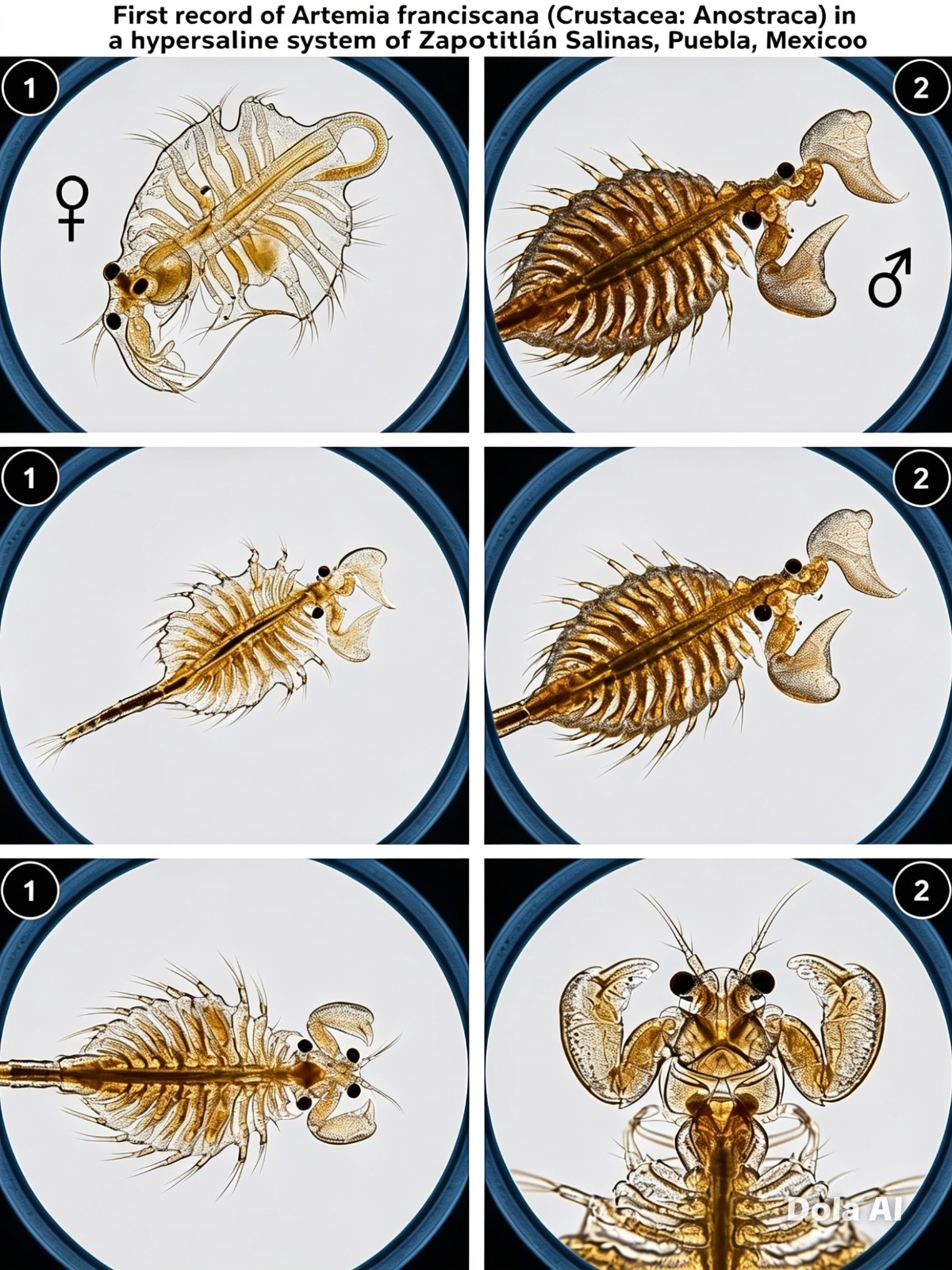
First record of Artemia franciscana (Crustacea: Anostraca) in a hypersaline system of Zapotitlán Salinas, Puebla, Mexico
DOI:
https://doi.org/10.14295/bjs.v6i1.901Keywords:
Artemia, biodiversity, hypersaline environments, phylogeny, Puebla, saltworksAbstract
The presence of Artemia franciscana is reported for the first time in the hypersaline saltworks of Zapotitlán Salinas, Puebla, Mexico. The objective of this study was to document the occurrence of this species in an inland hypersaline ecosystem and to evaluate the environmental conditions associated with its presence. Specimens were collected from traditional salt ponds between January 2024 and January 2025. Physicochemical variables, including temperature, salinity, pH, dissolved oxygen, electrical conductivity, and total dissolved solids, were recorded. Taxonomic identification was performed through amplification and sequencing of a fragment of the mitochondrial cytochrome c oxidase subunit I (COI) gene. Obtained sequences showed more than 99% identity with Artemia franciscana records available in GenBank and BOLD Systems. Phylogenetic analyses consistently grouped all samples within the Artemia franciscana clade with high support values. The simultaneous presence of adult organisms and viable cysts throughout different sampling periods indicates the establishment of a persistent population within the saltworks. These findings expand the known distribution of Artemia franciscana in Mexico and highlight the importance of inland hypersaline ecosystems as reservoirs of specialized biodiversity.
References
Abatzopoulos, T. J., Beardmore, J. A., Clegg, J. S., & Sorgeloos, P. (2002). Artemia: Basic and applied biology. Dordrecht: Kluwer Academic Publishers, (Eds.).
Amat, F., Hontoria, F., Navarro, J. C., Vieira, N., & Mura, G. (2005). Biodiversity loss in the genus Artemia in the Western Mediterranean region. Limnetica, 26(2), 387-404.
Amat, F., Hontoria, F., Ruiz, O., Green, A. J., Sánchez, M. I., Figuerola, J., & Hortas, F. (2007). The American brine shrimp as an exotic invasive species in the Western Mediterranean. Biological Invasions, 9, 615-626.
Belovsky, G. E., Larson, C. A., Mahon, H. K., Mellison, C., Stumpf, A. C., & Ramos Valencia, A. (2025). Demographic responses of an extremophile crustacean to environmental factors: Great Salt Lake (Utah, USA) brine shrimp (Artemia franciscana). Hydrobiologia, 852, 127-145.
Castro-Longoria, R. (2003). Artemia in Mexico. Hydrobiologia, 500, 57-63.
Choojit, T., Ratanaprapaporn, T., Dokkaew, S., Nhan, H. T., Kitikiew, S., & Kantha, P. (2025). Comparative analysis between Artemia parthenogenetica and Artemia franciscana size from China, Vietnam and United States of America. International Journal of Agricultural Technology, 21(2), 479-490.
Dávila, P., Arizmendi, M. C., Valiente-Banuet, A., Villaseñor, J. L., Casas, A., & Lira, R. (2002). La región de Tehuacán-Cuicatlán: diversidad biológica, conservación y desarrollo sustentable. México: Comisión Nacional para el Conocimiento y Uso de la Biodiversidad (CONABIO).
Fasciolo, G., Napolitano, G., Tomajoli, M. T. M., Geremia, E., Petito, A., & Gravato, C. (2025). Synthetic and natural red food dyes affect oxidative metabolism and the redox state in the nauplii of brine shrimp Artemia franciscana. Antioxidants, 14(6), 634.
Folmer, O., Black, M., Hoeh, W., Lutz, R., & Vrijenhoek, R. (1994). DNA primers for amplification of mitochondrial cytochrome c oxidase subunit I from diverse metazoan invertebrates. Molecular Marine Biology and Biotechnology, 3(5), 294-299.
Gajardo, G., & Beardmore, J. A. (2012). The brine shrimp Artemia: adapted to critical life conditions. Frontiers in Physiology, 3, 1-8.
Gajardo, G., Crespo, J., Triantafyllidis, A., Tzika, A., Baxevanis, A. D., Kappas, I., & Abatzopoulos, T. J. (2004). Species identification of Chilean Artemia populations based on mitochondrial DNA RFLP analysis. Biological Research, 37(2), 175-189.
Green, A. J., Sánchez, M. I., Amat, F., Figuerola, J., Hontoria, F., & Ruiz, O. (2005). Dispersal of invasive and native brine shrimps (Artemia) via waterbirds. Ecology Letters, 8(12), 1314-1323.
Hasan-Nataj-Niazi, E., Agh, N., Noori, F., Atashbar, B., & Van Stappen, G. (2022). Substitution of microalgae by bioflocs as a food source for the brine shrimp Artemia franciscana. Aquaculture Research, 53(12), 4374-4387.
Kumar, S., Stecher, G., Li, M., Knyaz, C., & Tamura, K. (2018). MEGA X: Molecular Evolutionary Genetics Analysis across computing platforms. Molecular Biology and Evolution, 35(6), 1547-1549.
Lukić, D., Redón, S., Green, A. J., Georgiev, B. B., Gajardo, G., & Varó, I. (2026). Artemia franciscana invasion causes rapid and dramatic ecological changes in hypersaline ecosystems. NeoBiota, 106, 339-355.
Mancilla-Villa, O. R., Rodríguez-Torres, I., & García-García, A. (2014). Hydrogeochemistry of saline systems in Puebla, Mexico. Revista Mexicana de Ciencias Geológicas, 31(1), 1-15.
Muñoz, J., Gómez, A., Green, A. J., Figuerola, J., Amat, F., & Rico, C. (2013). Evolutionary origin and global expansion of the brine shrimp Artemia franciscana. Molecular Ecology, 22(2), 522-538.
Sorgeloos, P., Lavens, P., Léger, P., Tackaert, W., & Versichele, D. (1986). Manual for the culture and use of brine shrimp Artemia in aquaculture. Rome: Food and Agriculture Organization of the United Nations (FAO), 319 p.
Van Stappen, G. (2002). Zoogeography. In: Abatzopoulos, T. J., Beardmore, J. A., Clegg, J. S., & Sorgeloos, P. (Eds.). Artemia: Basic and Applied Biology. Dordrecht: Kluwer Academic Publishers, 171-224 p.
Williams, W. D. (2006). The biology of saline lakes. Hydrobiologia, 552, 1-15.
Downloads
Published
How to Cite
Issue
Section
License
Copyright (c) 2027 Juan Ricardo Cruz-Aviña, Gabriel Gómez-Carreto, María Guadalupe Tenorio-Arvide, Carlos Alfonso Álvarez-González, Ruben Cabrera, Jhoana Díaz-Larrea

This work is licensed under a Creative Commons Attribution 4.0 International License.
Authors who publish with this journal agree to the following terms:
1) Authors retain copyright and grant the journal right of first publication with the work simultaneously licensed under a Creative Commons Attribution License that allows others to share the work with an acknowledgement of the work's authorship and initial publication in this journal.
2) Authors are able to enter into separate, additional contractual arrangements for the non-exclusive distribution of the journal's published version of the work (e.g., post it to an institutional repository or publish it in a book), with an acknowledgement of its initial publication in this journal.
3) Authors are permitted and encouraged to post their work online (e.g., in institutional repositories or on their website) prior to and during the submission process, as it can lead to productive exchanges, as well as earlier and greater citation of published work.