Seasonal effects on hematological parameters of Senepol and Zebu cattle raised in Vietnam
DOI:
https://doi.org/10.14295/bjs.v5i11.884Keywords:
hematological parameters, seasonal variation, tropical climate, Senepol cattle, Zebu cattleAbstract
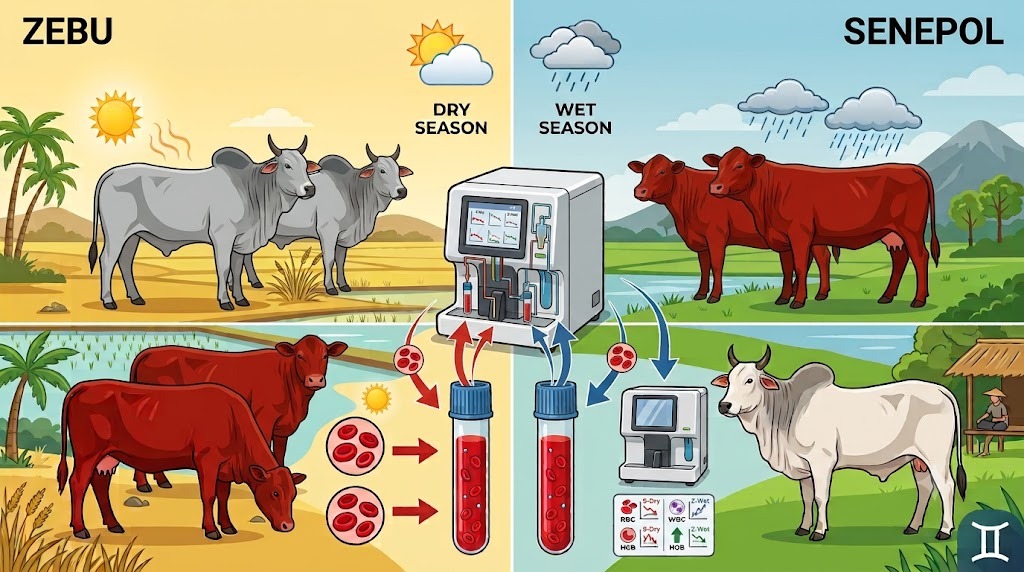
Seasonal conditions are recognized as important environmental factors influencing physiological and hematological characteristics in cattle raised under tropical climates. The present study aimed to evaluate the effects of seasonal conditions on hematological parameters in Senepol and Zebu cattle raised in Vietnam. A total of 40 clinically healthy cattle, including 20 Senepol and 20 Zebu animals aged between 12 and 36 months, were used in the experiment. Blood samples were collected during both the rainy and dry seasons and analyzed using an automated hematology analyzer. The evaluated parameters included white blood cell count (WBC), red blood cell count (RBC), hemoglobin concentration (HGB), hematocrit (HCT), erythrocyte indices, and platelet-associated parameters. Statistical analysis was performed using a paired-samples t-test at a significance level of P < 0.05. The results showed that seasonal variation significantly influenced several hematological parameters in both cattle breeds. WBC values increased during the dry season, whereas RBC and HGB values tended to decrease. Hematocrit values showed a moderate increase during the dry season. Erythrocyte indices, including MCV, MCH, and MCHC, remained relatively stable across seasons, while RDW-CV and RDW-SD values generally increased during the dry season. Platelet counts decreased, whereas MPV and PDW values showed increasing trends in both breeds. Seasonal hematological fluctuations were observed in both breeds; however, no direct statistical comparisons between breeds were performed. The findings indicate that seasonal conditions can influence hematological characteristics in imported cattle breeds raised in Vietnam and likely reflect normal physiological responses to seasonal environmental variation. These results provide useful reference data for health monitoring, veterinary assessment, and management strategies for imported cattle raised under tropical climatic conditions.
References
Abera, M., Getachew, T., Gizaw, S., & Tibbo, M. (2021). Physiological, biochemical, and growth parameters of Fogera cattle calves to heat stress during different seasons in sub-humid part of Ethiopia. Animals, 11(4), 1062. https://doi.org/10.3390/ani11041062
Berian, S. S., Gupta, S. K., Sharma, S., Ganai, I., Dua, S., & Sharma, N. (2019). Effect of heat stress on physiological and hemato-biochemical profile of cross bred dairy cattle. Journal of Animal Research, 9(1), 95-101. https://doi.org/10.30954/2277-940X.01.2019.13
Blond, B., Majkić, M., Spasojević, J., Hristov, S., Radinović, M., Nikolić, S., Anđušić, L., Čukić, A., Došenović Marinković, M., Vujanović, B. D., Obradović, N., & Cincović, M. (2024). Influence of heat stress on body surface temperature and blood metabolic, endocrine, and inflammatory parameters and their correlation in cows. Metabolites, 14(2), 104. https://doi.org/10.3390/metabo14020104
Chen, X., Shu, H., Sun, F., Yao, J., & Gu, X. (2023). Impact of heat stress on blood, production, and physiological indicators in heat-tolerant and heat-sensitive dairy cows. Animals, 13(16), 2562. https://doi.org/10.3390/ani13162562
Fielder, S. E. (2024). Hematology reference ranges. Merck Veterinary Manual. Merck & Co., Inc. Retrieved July 2, 2026, from https://www.merckvetmanual.com/reference-values-and-conversion-tables/reference-guides/hematology-reference-ranges
Habimana, V., Niyibizi, A., Shumbusho, F., Uzamukunda, D., Sindikubwabo, C., & Nyinawamwiza, L. (2023). Heat stress effects on milk yield traits and metabolites and mitigation strategies for dairy cattle breeds reared in tropical and subtropical countries. Frontiers in Veterinary Science, 10, 1121499. https://doi.org/10.3389/fvets.2023.1121499
Hoang, T. N., Pham, V. Q., Nguyen, V. T., Bui, N. H., Giang, V. S., Nguyen, T. T., & Le, T. N. T. (2021). Adaptability and reproductive performance of the first three parities of imported Red Angus cattle. Journal of Animal Husbandry Science and Technology, 270, 18-22.
Mekroud, M., Benallou, B., Ameur Ameur, A., Kaidi, R., & Aggad, H. (2021). Seasonal variations in hematological profile of Holstein dairy cows as an indicator for physiological status assessment. Agricultural Science and Technology, 13(1), 31-36.
Mladenović, V., Ilić, Z., Petrović, M. P., Ružić-Muslić, D., Caro Petrović, V., & Maksimović, N. (2024). Haematological and biochemical parameters of Podolian cattle breed cows. Journal of the Hellenic Veterinary Medical Society, 75(1), 7319-7328. https://doi.org/10.12681/jhvms.36517
Onasanya, G., Oke, F., Sanni, T., & Muhammad, A. (2015). Parameters influencing haematological, serum and bio-chemical references in livestock animals under different management systems. Open Journal of Veterinary Medicine, 5, 181-189. https://doi.org/10.4236/ojvm.2015.58025
Tran, T. A. N., Dao, T. M. Q., & Nguyen, T. T. H. (2025). Hematological physiology of Brahman and Wagyu crossbred cattle. Journal of Animal Husbandry Science and Technology, 307, 59-64.
Velayudhan, S. M., Kumar, R., Singh, S. V., Kumar, A., Gupta, I. D., & Singh, R. (2023). Molecular, physiological and hematological responses of crossbred dairy cattle in a tropical savanna climate. Biology, 12(1), 26. 10.3390/biology12010026
Watson, S. P., Harrison, P., & Halford, G. M. (2020). Platelets: The next decade. Platelets, 31, 1-2. DOI: 10.1080/09537104.2020.1694785
Yang, Y., Yang, S., Tang, J., Ren, G., Shen, J., Huang, B., & Qu, K. (2022). Comparisons of hematological and biochemical profiles in Brahman and Yunling cattle. Animals, 12(14), 1813. https://doi.org/10.3390/ani12141813
Downloads
Published
How to Cite
Issue
Section
License
Copyright (c) 2026 Thi Thu Hien Nguyen

This work is licensed under a Creative Commons Attribution 4.0 International License.
Authors who publish with this journal agree to the following terms:
1) Authors retain copyright and grant the journal right of first publication with the work simultaneously licensed under a Creative Commons Attribution License that allows others to share the work with an acknowledgement of the work's authorship and initial publication in this journal.
2) Authors are able to enter into separate, additional contractual arrangements for the non-exclusive distribution of the journal's published version of the work (e.g., post it to an institutional repository or publish it in a book), with an acknowledgement of its initial publication in this journal.
3) Authors are permitted and encouraged to post their work online (e.g., in institutional repositories or on their website) prior to and during the submission process, as it can lead to productive exchanges, as well as earlier and greater citation of published work.