Impact of climate change on the epidemiology of plant diseases
DOI:
https://doi.org/10.14295/bjs.v6i3.970Keywords:
climate change, plant disease epidemiology, host–pathogen interactions, emerging plant pathogens, disease forecastingAbstract
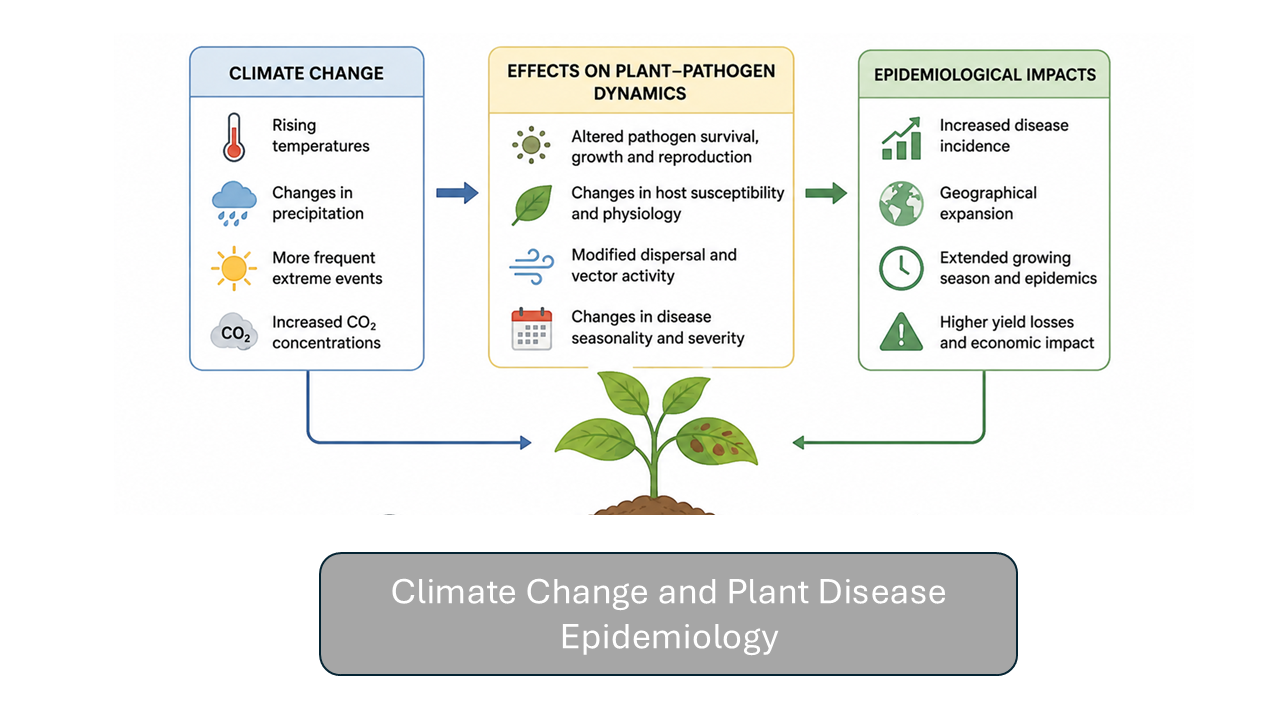
Climate change is increasingly recognized as a major driver of plant disease dynamics worldwide, altering environmental conditions that govern host–pathogen–environment interactions. This study aimed to synthesize current scientific evidence on the impacts of climate change on the epidemiology of plant diseases through an integrative literature review. A systematic search was conducted between March and April 2026 using the Web of Science, Scopus, SciELO, PubMed/MEDLINE, and CAPES Journal Portal databases. Peer-reviewed articles published between 2016 and 2026 in English or Portuguese were screened according to predefined inclusion and exclusion criteria, resulting in the selection of 17 studies for qualitative analysis. The findings demonstrated that climatic factors, particularly temperature, atmospheric CO2 concentration, relative humidity, precipitation patterns, and leaf wetness duration, significantly influence pathogen survival, reproduction, dispersal, infection efficiency, and disease severity. Temperature emerged as the most influential variable; however, its effects varied substantially among pathosystems, reflecting differences in pathogen biology and host responses. The reviewed studies also indicated that climate change is facilitating the emergence and geographic expansion of plant pathogens into previously unsuitable regions, thereby increasing phytosanitary risks for economically important crops. Furthermore, altered climatic conditions may compromise the effectiveness of conventional disease management strategies, highlighting the need for adaptive approaches. The evidence underscores the importance of integrating epidemiological surveillance, predictive modeling, climate-informed risk assessment, host resistance breeding, and integrated disease management into agricultural adaptation frameworks. Future research should prioritize multidisciplinary approaches to improve the prediction and mitigation of climate-driven disease outbreaks under diverse agroecological conditions.
References
Angelotti, F., Hamada, E., & Bettiol, W. (2024). A comprehensive review of climate change and plant diseases in Brazil. Plants, 13(17), 2447. https://doi.org/10.3390/plants13172447
Aslam, A. H., Ali, Z., Saleem, K., Maqbool, R., Dababat, A. A., Özdemir, F., Lahlali, R., Nurbekov, A., El Jarroudi, M., Bhavani, S., & Ali, M. A. (2026). Escalating threat of wheat stripe rust under climate change: Pathogen evolution, resistance durability, and future management. Plants, 15(7), 1073. https://doi.org/10.3390/plants15071073
Bebber, D. P., & Gurr, S. J. (2015). Range-expanding pests and pathogens in a warming world. Annual Review of Phytopathology, 53, 335-356. https://doi.org/10.1146/annurev-phyto-080614-120207
Bebber, D. P., Castillo, Á. D., & Gurr, S. J. (2016). Modelling coffee leaf rust risk in Colombia with climate reanalysis data. Philosophical Transactions of the Royal Society B: Biological Sciences, 371, 20150458. https://doi.org/10.1098/rstb.2015.0458
Bebber, D. P., Ramotowski, M. A. T., & Gurr, S. J. (2013). Crop pests and pathogens move polewards in a warming world. Nature Climate Change, 3(11), 985-988. https://doi.org/10.1038/nclimate1990
Bibi, F., & Rahman, A. (2023). An overview of climate change impacts on agriculture and their mitigation strategies. Agriculture, 13(8), 1508. https://doi.org/10.3390/agriculture13081508
Chakraborty, S., & Newton, A. C. (2011). Climate change, plant diseases and food security: An overview. Plant Pathology, 60(1), 2-14. https://doi.org/10.1111/j.1365-3059.2010.02411.x
Cohen, R., Elkabetz, M., Paris, H. S., Gur, A., Dai, N., Rabinovitz, O., & Freeman, S. (2022). Occurrence of Macrophomina phaseolina in Israel: Challenges for disease management and crop germplasm enhancement. Plant Disease, 106, 15-25. https://doi.org/10.1094/PDIS-07-21-1390-FE
COP30, Brasil. (2025). Novas NDCs: Como o Acordo de Paris molda o futuro do clima. Available at: https://cop30.br/pt-br/novas-ndcs-como-o-acordo-de-paris-molda-o-futuro-do-clima. Accessed: May 17, 2026.
Elad, Y., & Pertot, I. (2014). Climate change impacts on plant pathogens and plant diseases. Journal of Crop Improvement, 28(1), 99-139. https://doi.org/10.1080/15427528.2014.865412
Food and Agriculture Organization of the United Nations (FAO). (2022). FAO lista 5 doenças de plantas que a crise climática está agravando. Available at: https://brasil.un.org/pt-br/184058-fao-lista-5-doen%C3%A7as-de-plantas-que-crise-clim%C3%A1tica-est%C3%A1-agravando. Accessed: May 17, 2026.
Fortuna, T. M., Le Gall, P., Mezdour, S., & Calatayud, P-A. (2022). Impact of invasive insects on native insect communities. Current Opinion in Insect Science, 51, 100904. https://doi.org/10.1016/j.cois.2022.100904
Garrett, K. A., Forbes, G. A., Savary, S., Skelsey, P., Sparks, A. H., Valdivia, C., van Bruggen, A. H. C., Willocquet, L., Djurle, A., Duveiller, E., Eckersten, H., Pande, S., Vera Cruz, C., & Yuen, J. (2011). Complexity in climate-change impacts: An analytical framework for effects mediated by plant disease. Plant Pathology, 60(1), 15-30. https://doi.org/10.1111/j.1365-3059.2010.02409.x
Ghini, R., Hamada, E., & Bettiol, W. (2011). Impactos das mudanças climáticas sobre doenças de importantes culturas no Brasil. Jaguariúna: Embrapa Meio Ambiente. Available at: https://www.alice.cnptia.embrapa.br/alice/handle/doc/905258. Accessed: May 17, 2026.
Hernandez, H., & Martinez, L. R. (2018). Relationship of environmental disturbances and the infectious potential of fungi. Microbiology, 164(3), 233-241. https://doi.org/10.1099/mic.0.000620
Hossain, M. M., Sultana, F., Mostafa, M., Ferdus, H., Rahman, M., Rana, J. A., Islam, S. S., Adhikary, S., Sannal, A., Hosen, M. A. E., Nayeema, J., Emu, N. J., Kundu, M., Biswas, S. K., Farzana, L., & Sabbir, M. A. A. (2024). Plant disease dynamics in a changing climate: impacts, molecular mechanisms, and climate-informed strategies for sustainable management. Discover Agriculture, 2, 132. https://doi.org/10.1007/s44279-024-00144-w
Lee, Y. K., Lee, J. S., Lee, S.-J., Kim, M., Shin, H.-D., & Choi, Y.-J. (2025). Emergence and prevalence of Puccinia polysora in Korea: A comparative study of maize rust pathogens. Mycobiology, 53(5), 637-647. https://doi.org/10.1080/12298093.2025.2536365
Matić, S., Cucu, M. A., Garibaldi, A., & Gullino, M. L. (2018). Combined effect of CO₂ and temperature on wheat powdery mildew development. The Plant Pathology Journal, 34(4), 316-326. https://doi.org/10.5423/PPJ.OA.11.2017.0226
Moreno-Delafuente, A., Viñuela, E., Fereres, A., Medina, P., & Trębicki, P. (2020). Simultaneous increase in CO₂ and temperature alters wheat growth and aphid performance differently depending on virus infection. Insects, 11(8), 459. https://doi.org/10.3390/insects11080459
Page, M. J., McKenzie, J. E., Bossuyt, P. M., Boutron, I., Hoffmann, T. C., Mulrow, C. D., Shamseer, L., Tetzlaff, J. M., Akl, E. A., Brennan, S. E., Chou, R., Gluud, C., Mayo-Wilson, E., McDonald, S., McGuinness, L. A., Stewart, L. A., Thomas, J., Tricco, A. C., Welch, V. A., … Moher, D. (2021). The PRISMA 2020 statement: An updated guideline for reporting systematic reviews. BMJ, 372(71). https://doi.org/10.1136/bmj.n71
Rezaei, E. E., Webber, H., Asseng, S., Boote, K., Durand, J. L., Ewert, F., Martre, P., & MacCarthy. (2023). Climate change impacts on crop yields. Nature Reviews Earth & Environment, 4, 831-846. https://doi.org/10.1038/s43017-023-00491-0
Rising, J., Tedesco, M., Piontek, F., & Stainforth, D. A. (2022). The missing risks of climate change. Nature, 610, 643-651. https://doi.org/10.1038/s41586-022-05243-6
Saroeung, M., Hun, H., & Sarun, H. (2026). Impact of climate change on the incidence and severity of plant diseases: A comprehensive review. Journal of Agriculture and Environment, 3(3), 70-74. https://doi.org/10.5281/zenodo.18901092
Sarun, H. (2026). Epidemiology and integrated management of plant diseases in Cambodian agriculture. Journal of Agriculture and Environment, 3(3), 170-175. https://doi.org/10.5281/zenodo.19084760
Savary, S., Djurle, A., Yuen, J., Ficke, A., Rossi, V., Esker, P. D., Fernandes, J. M. C., Del Ponte, E. M., Kumar, J., Madden, L. V., Paul, P., McRoberts, N., Singh, P. K., Huber, L., Pope de Vallavieille, C., Saint-Jean, S., & Willocquet, L. (2017). A white paper on global wheat health based on scenario development and analysis. Phytopathology, 107(10), 1109-1122. https://doi.org/10.1094/PHYTO-01-17-0027-FI
Shabana, Y. M., Rashad, Y. M., Ghoneem, K. M., Arafat, N. S., Aseel, D. G., Qi, A., Richard, B., & Fitt, B. D. L. (2021). Biodiversity of pathogenic and toxigenic seed-borne mycoflora of wheat in Egypt and their correlations with weather variables. Biology, 10(10), 1025. https://doi.org/10.3390/biology10101025
Shahid, H., Hyder, S., Naeem, M., Sehar, A., Gondal, A. S., Rizvi, Z. F., Iqbal, R., Rahman, M. H. ur, Alwahibi, M. S., Elshikh, M. S., Ayaz, M., Arslan, M., de los Santos-Villalobos, S., & Montoya-Martínez, A. C. (2024). Impact of climate change on potential distribution of Dickeya zeae causal agent of stalk rot of maize in Sialkot district Pakistan. Scientific Reports, 14, 2614. https://doi.org/10.1038/s41598-024-52668-2
Shen, L.-L., Waheed, A., Wang, Y.-P., Nkurikiyimfura, O., Wang, Z.-H., Yang, L.-N., & Zhan, J. (2022). Mitochondrial genome contributes to the thermal adaptation of the oomycete Phytophthora infestans. Frontiers in Microbiology, 13, 928464. https://doi.org/10.3389/fmicb.2022.928464
Silva, C. M. da, Azevedo, G. A. de, Frade, L. F. da S., Barreto, A. V. R., Soares, J. V., Silva, M. P. da, Oliveira, M. dos S., Marques, D. F., Gomes, J. de S., Canuto, R. E. das F., & Silva, A. V. da. (2024). Melhoramento genético de plantas para adaptabilidade às mudanças climáticas. Revista de Gestão e Secretariado, 15(9), 1-19. https://doi.org/10.7769/gesec.v15i9.4161
Singh, B. K., Delgado-Baquerizo, M., Egidi, E., Guirado, E., Leach, J. E., Liu, H., & Trivedi, P. (2023). Climate change impacts on plant pathogens, food security and paths forward. Nature Reviews Microbiology, 21, 640-656. https://doi.org/10.1038/s41579-023-00900-7
Son, S., & Park, S. R. (2022). Climate change impedes plant immunity mechanisms. Frontiers in Plant Science, 13, 1032820. https://doi.org/10.3389/fpls.2022.1032820
Souza, M. T., Silva, M. D., & Carvalho, R. (2010). Revisão integrativa: O que é e como fazer. Einstein (São Paulo), 8(1), 102-106. https://doi.org/10.1590/S1679-45082010RW1134
Timmusk, S., Copolovici, D., Copolovici, L., Teder, T., Nevo, E., & Behers, L. (2019). Paenibacillus polymyxa biofilm polysaccharides antagonise Fusarium graminearum. Scientific Reports, 9, 662. https://doi.org/10.1038/s41598-018-37718-w
van Leeuwen, C., Sgubin, G., Bois, B., Ollat, N., Swingedouw, D., Zito, S., & Gambetta, G. A. (2024). Climate change impacts and adaptations of wine production. Nature Reviews Earth & Environment, 5, 258-275. https://doi.org/10.1038/s43017-024-00521-5
Verma, K. K., Song, X-P., Kumari, A., Jagadesh, M., Singh, S. K., Bhatt, R., Singh, M., Seth, C. S., & Li, Y-R. (2025). Climate change adaptation: Challenges for agricultural sustainability. Plant, Cell & Environment, 48(4), 2522-2533. https://doi.org/10.1111/pce.15078
Whittemore, R., & Knafl, K. (2005). The integrative review: Updated methodology. Journal of Advanced Nursing, 52(5), 546-553. https://doi.org/10.1111/j.1365-2648.2005.03621.x
Wu, E.-J., Wang, Y.-P., Yahuza, L., He, M.-H., Sun, D.-L., Huang, Y.-M., Liu, Y.-C., Yang, L.-N., Zhu, W., & Zhan, J. (2020). Rapid adaptation of the Irish potato famine pathogen Phytophthora infestans to changing temperature. Evolutionary Applications, 13(4), 768-780. https://doi.org/10.1111/eva.12899
Zou, Z., Liu, F., Chen, C., & Fernando, W. G. D. (2019). Effect of elevated CO₂ concentration on the disease severity of compatible and incompatible interactions of Brassica napus–Leptosphaeria maculans pathosystem. Plants, 8(11), 484. https://doi.org/10.3390/plants8110484
Downloads
Published
How to Cite
Issue
Section
License
Copyright (c) 2027 Maria Vitória Gualberto Rodrigues, Lucas Carlos Leão, Fabricius Sousa Oliveira, Marcelo Vaz de Oliveira, Aurélio Ferreira Melo, Matheus da Silva Santos, Porshia Sharma

This work is licensed under a Creative Commons Attribution 4.0 International License.
Authors who publish with this journal agree to the following terms:
1) Authors retain copyright and grant the journal right of first publication with the work simultaneously licensed under a Creative Commons Attribution License that allows others to share the work with an acknowledgement of the work's authorship and initial publication in this journal.
2) Authors are able to enter into separate, additional contractual arrangements for the non-exclusive distribution of the journal's published version of the work (e.g., post it to an institutional repository or publish it in a book), with an acknowledgement of its initial publication in this journal.
3) Authors are permitted and encouraged to post their work online (e.g., in institutional repositories or on their website) prior to and during the submission process, as it can lead to productive exchanges, as well as earlier and greater citation of published work.