Dietary red palm oil inclusion on growth performance, haematology, serum biochemistry, lipid profile, and oxidative stress markers of Wistar rats
DOI:
https://doi.org/10.14295/bjs.v6i4.968Keywords:
red palm oil, Wistar rats, haematology, lipid profile, oxidative stressAbstract
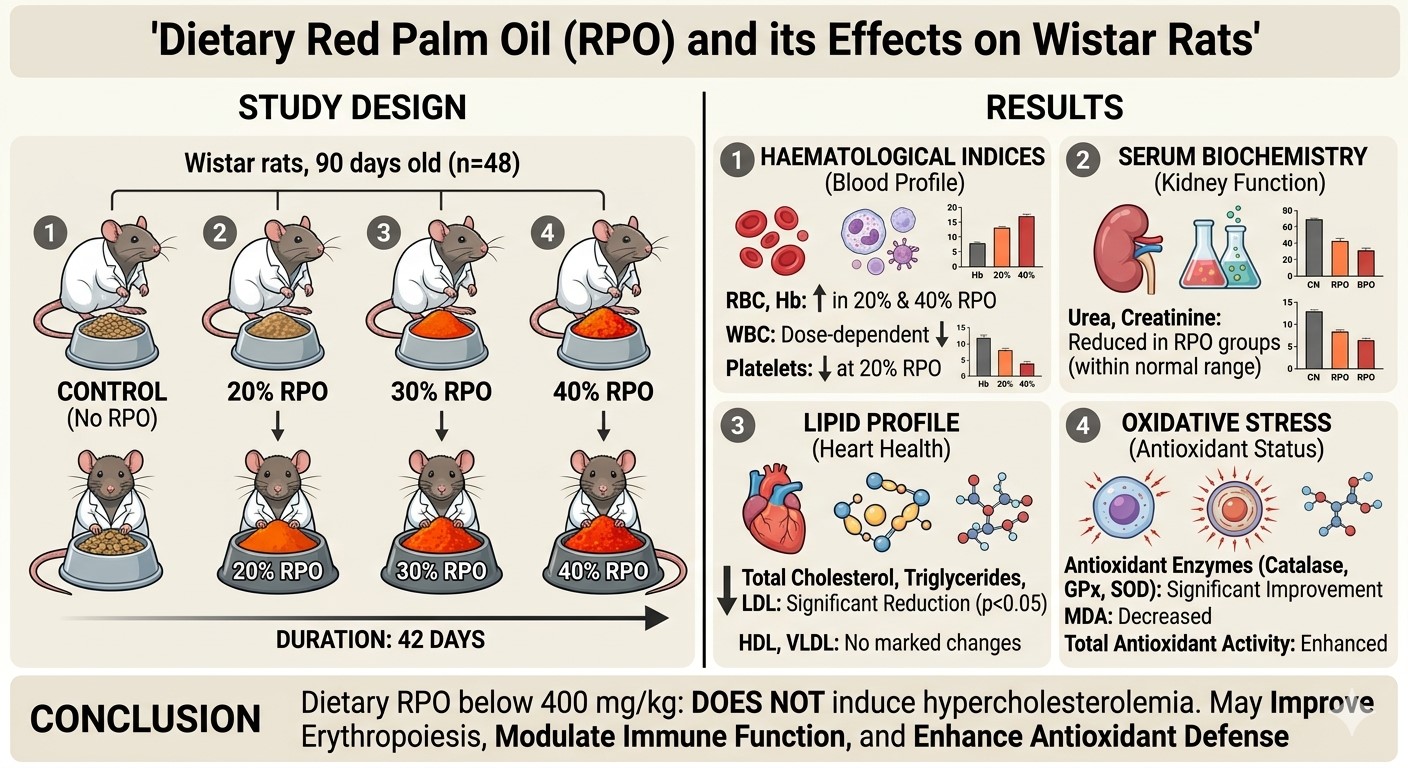
Red palm oil (RPO), rich in carotenoids, tocopherols and tocotrienols, has been associated with antioxidant, lipid-modulating and haematopoietic effects. However, its effects on growth performance, haematology, serum biochemistry, lipid metabolism and oxidative status remain debated. This study evaluated graded dietary RPO inclusion in Wistar rats over 42 days. Forty-eight 60-day-old rats (initial body weight 149 ± 1.0 g; 50:50 males and females) were individually housed and randomly assigned to four treatments (n = 12): basal diet containing 0 (control), 200, 300, or 400 mg RPO kg diet-1. RPO was manually incorporated into the diet and was not chemically characterised. Growth performance was monitored daily and weekly. At the end of the trial, blood samples from eight rats per treatment were analysed for haematological, serum biochemical, lipid and oxidative stress indices. Growth data were analysed using a 2×4 factorial arrangement (gender×diet), while treatment effects were assessed by analysis of variance and Student–Newman–Keuls mean separation (p < 0.05). Dietary RPO significantly influenced weight gain and daily weight gain in males compared to females (p < 0.05). Treatment × gender interactions were observed for daily weight gain, weight gain, and feed conversion ratio, whereas feed intake and feed efficiency were unaffected. Red blood cell counts were higher in the control and 200 and 400 mg kg-1 groups than in the 300 mg kg-1 group. White blood cell counts declined progressively across RPO-supplemented groups. Haemoglobin concentrations were higher at 200 and 400 mg kg-1 than in the control and 300 mg kg-1 groups. Mean corpuscular volume and mean corpuscular haemoglobin were higher at 300 and 400 mg kg-1, while platelet counts were lower at 200 mg kg-1 than in the other groups. Serum urea increased with RPO inclusion, whereas creatinine was highest at 300 mg kg-1 (p < 0.05). Total cholesterol (55.62 mg dL-1), triglycerides (83.70 mg dL-1), and low-density lipoprotein cholesterol (13.00 mg dL-1) decreased significantly following RPO inclusion (p < 0.05). High-density lipoprotein cholesterol, very-low-density lipoprotein cholesterol, and total cholesterol-to-HDL ratio were unaffected (p > 0.05). Catalase (9.78: p < 0.04), glutathione peroxidase (44.26: p < 0.05), superoxide dismutase (1.51: p < 0.05), glutathione (0.36: p < 0.04), and malondialdehyde (15.31: p < 0.02) were significantly influenced by dietary treatment, with the highest mean values varying across inclusion levels. Dietary RPO at 200–400 mg kg-1 produced non-linear, biomarker-specific and gender-dependent responses, with no inclusion level uniformly favourable. These findings indicate a modulatory rather than consistently protective effect under the conditions investigated. Larger, longer-term, gender-stratified studies using chemically characterised RPO and incorporating tissue- and pathway-level analyses are needed before optimal inclusion levels can be recommended.
References
Abd El-aal, Y. A., Abdel-Fattah, D. M., & Ahmed, K. E.-D. (2019). Some biochemical studies on trans fatty acid-containing diet. Diabetes & Metabolic Syndrome: Clinical Research & Reviews, 13, 1753-1757. https://doi.org/10.1016/j.dsx.2019.03.029
Agency for Toxic Substances and Disease Registry (ATSDR). (2024). Toxicological profile for chloroform. U.S. Department of Health and Human Services. Available in: <https://www.ncbi.nlm.nih.gov/books/NBK609968/>.
Ajuwon, O. R., Marnewick, J. L., Oguntibeju, O. O., & Davids, L. M. (2022). Red palm oil ameliorates oxidative challenge and inflammatory responses associated with lipopolysaccharide-induced hepatic injury by modulating NF-κβ and Nrf2/GCL/HO-1 signaling pathways in rats. Antioxidants, 11(8), 1629. https://doi.org/10.3390/antiox11081629
Ajuwon, O. R., Oguntibeju, O. O., & Marnewick, J. L. (2016). Hepatic, renal and endogenous antioxidant status modulatory effects of chronic co-supplementation of rooibos (Aspalathus linearis) and red palm oil (Elaeis guineensis) in male Wistar rats. African Journal of Traditional, Complementary and Alternative Medicines, 13(3), 1-15. https://doi.org/10.21010/ajtcam.v13i3.1
Albrahim, T., Alotaibi, M. H. M., Altamimi, N. M. M., Albariqi, A. M. A., Alqarni, L. A. O., Alassaf, S. N. A., Aloudah, H. S., Alahmed, M., Almnaizel, A. T., Aldraihem, M. R., & Alonazi, M. (2022). The impact of dietary consumption of palm oil and olive oil on lipid profile and hepatocyte injury in hypercholesterolemic rats. Pharmaceuticals, 15(9), 1103. https://doi.org/10.3390/ph15091103
Alwahaibi, N., Budin, S. B., Abdul Hamid, Z., Mohamed, J., Latip, J., Ismail, N. B., Ayatillah, A. B., & Matough, F. A. (2019). Tocotrienol rich fraction from palm oil reduces plasma and erythrocyte membrane lipid alteration in diabetic rats: Tocotrienols reduce dyslipidemia in plasma and erythrocytes. The Indonesian Biomedical Journal, 11(3). https://doi.org/10.18585/inabj.v11i3.691
Asiriuwa, N. U., Dowe, E., Osemwenkhae, O. P., Abu, D. O., Ezoguan, V., & Igbonomi, I. P. (2026). Palm oil modulates haematological profile and ATPase activities of Wistar rats. FUDMA Journal of Sciences, 10(9), 366-373. https://doi.org/10.33003/fjs-2026-1009-5401
Ayeleso, A. O., Brooks, N. L., & Oguntibeju, O. O. (2014). Modulation of antioxidant status in streptozotocin-induced diabetic male Wistar rats following intake of red palm oil and/or rooibos. Asian Pacific Journal of Tropical Medicine, 7(7), 536-544. https://doi.org/10.1016/S1995-7645(14)60090-0
Ayeleso, A. O., Oguntibeju, O. O., & Brooks, N. L. (2012). Effects of dietary intake of red palm oil on fatty acid composition and lipid profiles in male Wistar rats. African Journal of Biotechnology, 11(33), 8275-8279. https://doi.org/10.5897/AJB11.4080
Dauqan, E., Sani, H. A., Abdullah, A., & Kasim, Z. M. (2011). Effect of different oils (red palm olein, palm olein, corn oil, and coconut oil) on lipid profile in rats. Food and Nutrition Sciences, 2(4), 181-186. https://doi.org/10.4236/fns.2011.24036
Di Vincenzo, A., Tana, C., El Hadi, H., Pagano, C., Vettor, R., & Rossato, M. (2019). Antioxidant, anti-inflammatory, and metabolic properties of tocopherols and tocotrienols: Clinical implications for vitamin E supplementation in diabetic kidney disease. International Journal of Molecular Sciences, 20(20), 5101. https://doi.org/10.3390/ijms20205101
Emmanuel, O., Okezie, U. M., Iweala, E. J., & Ugbogu, E. A. (2021). Pretreatment of red palm oil extracted from palm fruit (Elaeis guineensis) attenuates carbon tetrachloride induced toxicity in Wistar rats. Phytomedicine Plus, 1, 100079. https://doi.org/10.1016/j.phyplu.2021.100079
Femi-Oloye, O. P., Owoloye, A., Olatunji-Ojo, A. M., Abiodun, A. C., Adewumi, B., Ibitoye, B. O., Oloye, F. F., Izegaegbe, J. I., Adebayo, T. M., Adedoja, A. J., Oginni, O. P., Gbore, F. A., & Akinwumi, F. O. (2020). Effects of commonly used food additives on haematological parameters of Wistar rats. Heliyon, 6(10), e05221. https://doi.org/10.1016/j.heliyon.2020.e05221
Food and Agriculture Organization of the United Nations (FAO). (n.d.). Oil palm. Available at: <https://www.fao.org/4/y4355e/y4355e03.htm>. Accessed on: October 28, 2026.
GenStat, 18th Edition (VSN International, Hemel Hempstead, United Kingdom).
Gesteiro, E., Guijarro, L., Sánchez-Muniz, F. J., Vidal-Carou, M. D. C., Troncoso, A., Venanci, L., Jimeno, V., Quilez, J., Anadón, A., & González-Gross, M. (2019). Palm oil on the edge. Nutrients, 11, 2008. https://doi.org/10.3390/nu11092008
Gual-Grau, A., Guirro, M., Boqué, N., & Arola, L. (2023). Physiological, metabolic and microbial responses to obesogenic cafeteria diet in rats: The impact of strain and sex. The Journal of Nutritional Biochemistry, 117, 109338. https://doi.org/10.1016/j.jnutbio.2023.109338
Jimoh, O. A. (2019). Oxidative stress indicators of rabbit breeds in Ibadan, Southwest Nigeria. Bulletin of the National Research Centre, 43, 62. https://doi.org/10.1186/s42269-019-0104-z
Khor, B. H., Tiong, H. C., Tan, S. C., Wong, S. K., Chin, K. Y., Karupaiah, T., Ima-Nirwana, S., & Abdul Gafor, A. H. (2021). Effects of tocotrienols supplementation on markers of inflammation and oxidative stress: A systematic review and meta-analysis of randomized controlled trials. PLoS One, 16(7), e0255205. https://doi.org/10.1371/journal.pone.0255205
Lékó, A. H., Gregory-Flores, A., Marchette, R. C. N., Gomez, J. L., Vendruscolo, J. C. M., Repunte-Canonigo, V., Choung, V., Deschaine, S. L., Whiting, K. E., Jackson, S. N., Cornejo, M. P., Perelló, M., You, Z.-B., Eckhaus, M., Rasineni, K., Janda, K. D., Zorman, B., Sumazin, P., Koob, G. F., Michaelides, M., Sanna, P. P., Leggio, L., & Vendruscolo, L. F. (2024). Genetic or pharmacological GHSR blockade has sexually dimorphic effects in rodents on a high-fat diet. Communications Biology, 7, 632. https://doi.org/10.1038/s42003-024-06303-5
Loganathan, R., Subramaniam, K. M., Radhakrishnan, A. K., Choo, Y.-M., & Teng, K.-T. (2017). Health-promoting effects of red palm oil: Evidence from animal and human studies. Nutrition Reviews, 75(2), 98-113. https://doi.org/10.1093/nutrit/nuw054
Madoromae, H., & Lertcanawanichakul, M. (2025). Red palm oil: Nutritional composition, bioactive properties, and potential applications in health and cosmetics: A narrative review. Molecules, 30(22), 4402. https://doi.org/10.3390/molecules30224402
Mancini, A., Imperlini, E., Nigro, E., Montagnese, C., Daniele, A., Orrù, S., & Buono, P. (2015). Biological and nutritional properties of palm oil and palmitic acid: Effects on health. Molecules, 20(9), 17339-17361. https://doi.org/10.3390/molecules200917339
Maric, I., Krieger, J.-P., van der Velden, P., Börchers, S., Asker, M., Vujicic, M., Wernstedt Asterholm, I., & Skibicka, K. P. (2022). Sex and species differences in the development of diet-induced obesity and metabolic disturbances in rodents. Frontiers in Nutrition, 9, 828522. https://doi.org/10.3389/fnut.2022.828522
May, C. Y., & Nesaretnam, K. (2014). Research advancements in palm oil nutrition. European Journal of Lipid Science and Technology, 116(10), 1301-1315. https://doi.org/10.1002/ejlt.201400076
Meeusen, J. W., Snozek, C. L., Baumann, N. A., Jaffe, A. S., & Saenger, A. K. (2015). Reliability of calculated low-density lipoprotein cholesterol. The American Journal of Cardiology, 116(4), 538-540. https://doi.org/10.1016/j.amjcard.2015.05.013
Meganathan, P., & Fu, J. Y. (2016). Biological properties of tocotrienols: Evidence in human studies. International Journal of Molecular Sciences, 17(11), 1682. https://doi.org/10.3390/ijms17111682
Ojieh, G. C., Oluba, O. M., Ogunlowo, Y. R., & Oyesiku, K. A. (2015). Comparative effect of palm oil and groundnut oil diets on lipid profile and antioxidant enzymes in rats. Journal of Nutrition & Food Sciences, 5(5), 1-4. https://doi.org/10.4172/2155-9600.1000401
Onafeso, O. D. (2023). The climate of Nigeria and its role in landscape modification. In: Faniran, A., Jeje, L. K., Fashae, O. A., & Olusola, A. O. (Eds.). Landscapes and landforms of Nigeria (World Geomorphological Landscapes). Cham: Springer. https://doi.org/10.1007/978-3-031-17972-3_2
Pang, K. L., & Chin, K. Y. (2019). The role of tocotrienol in protecting against metabolic diseases. Molecules, 24(5), 923. https://doi.org/10.3390/molecules24050923
Patel, S., Patel, S., Kotadiya, A., Patel, S., Shrimali, B., Joshi, N., Patel, T., Trivedi, H., Patel, J., Joharapurkar, A., & Jain, M. (2024). Age-related changes in hematological and biochemical profiles of Wistar rats. Laboratory Animal Research, 40(1), 7. https://doi.org/10.1186/s42826-024-00194-7
Rahmouni, F., Hamdaoui, L., Badraoui, R., & Rebai, T. (2017). Protective effects of Teucrium polium aqueous extract and ascorbic acid on hematological and some biochemical parameters against carbon tetrachloride (CCl4) induced toxicity in rats. Biomedicine & Pharmacotherapy, 91, 43-48. https://doi.org/10.1016/j.biopha.2017.04.071
Ranasinghe, R., Mathai, M., & Zulli, A. (2022). Revisiting the therapeutic potential of tocotrienol. BioFactors, 48(4), 813-856. https://doi.org/10.1002/biof.1873
Syarifah-Noratiqah, S.-B., Fairus, S., Zulfarina, M. S., Nasrullah, Z., Qodriyah, H. M. S., & Naina-Mohamed, I. (2020). The effects of palm oil on plasma and serum lipid parameters: A systematic review on animal intervention studies. Frontiers in Veterinary Science, 7, 303. https://doi.org/10.3389/fvets.2020.00303
Szulczewska-Remi, A., Nogala-Kałucka, M., & Nowak, K. W. (2019). Study on the influence of palm oil on blood and liver biochemical parameters, beta-carotene and tocochromanols content as well as antioxidant activity in rats. Journal of Food Biochemistry, 43(2), e12707. https://doi.org/10.1111/jfbc.12707
Tibaes, J. R. B., Azarcoya-Barrera, J., Wollin, B., Veida-Silva, H., Makarowski, A., Vine, D., Tsai, S., Jacobs, R., & Richard, C. (2022). Sex differences distinctly impact high-fat diet-induced immune dysfunction in Wistar rats. The Journal of Nutrition, 152(5), 1347-1357. https://doi.org/10.1093/jn/nxac024
U.S. Department of Agriculture, Economic Research Service (USDA). (2025). Oil crops outlook: May 2025. Available at: <https://www.ers.usda.gov/media/10718/ocs-25e.pdf>. Accessed on: October 28, 2026.
Ugbogu, E. A., Nwoku, C. D., Ude, V. C., & Emmanuel, O. (2019). Evaluating bioactive constituents and toxicological effects of aqueous extract of fermented Pentaclethra macrophylla seeds in rats. Avicenna Journal of Phytomedicine, 10(1), 101-113.
Unhapipatpong, C., Shantavasinkul, P. C., Kasemsup, V., Siriyotha, S., Warodomwichit, D., Maneesuwannarat, S., Vathesatogkit, P., Sritara, P., & Thakkinstian, A. (2021). Tropical oil consumption and cardiovascular disease: An umbrella review of systematic reviews and meta-analyses. Nutrients, 13(5), 1549. https://doi.org/10.3390/nu13051549
Utama, Z., Ningrum, A., Mayangsari, Y., & Raharjo, S. (2024). A comparison of palm oil, beef tallow, and corn oil effect on serum glucose and lipid profile in rats fed a high-fat diet. agriTECH, 44(2). https://doi.org/10.22146/agritech.84359
Zainal, Z., Khaza'ai, H., Radhakrishnan, A. K., & Chang, S. K. (2022). Therapeutic potential of palm oil vitamin E-derived tocotrienols in inflammation and chronic diseases: Evidence from preclinical and clinical studies. Food Research International, 156, 111175. https://doi.org/10.1016/j.foodres.2022.111175
Downloads
Published
How to Cite
Issue
Section
License
Copyright (c) 2027 Chinwe Uchechi Nwachukwu, Olatunji Abubakar Jimoh, Peter Kelechi Ajiogu, Jovi Richard Otite

This work is licensed under a Creative Commons Attribution 4.0 International License.
Authors who publish with this journal agree to the following terms:
1) Authors retain copyright and grant the journal right of first publication with the work simultaneously licensed under a Creative Commons Attribution License that allows others to share the work with an acknowledgement of the work's authorship and initial publication in this journal.
2) Authors are able to enter into separate, additional contractual arrangements for the non-exclusive distribution of the journal's published version of the work (e.g., post it to an institutional repository or publish it in a book), with an acknowledgement of its initial publication in this journal.
3) Authors are permitted and encouraged to post their work online (e.g., in institutional repositories or on their website) prior to and during the submission process, as it can lead to productive exchanges, as well as earlier and greater citation of published work.