Diet and hunting behavior of the gray wall jumping spider Menemerus bivittatus (Araneae: Salticidae) in homes in southern Campeche, Mexico
DOI:
https://doi.org/10.14295/bjs.v6i2.935Keywords:
Salticidae, predation, biological control, Musca domesticaAbstract
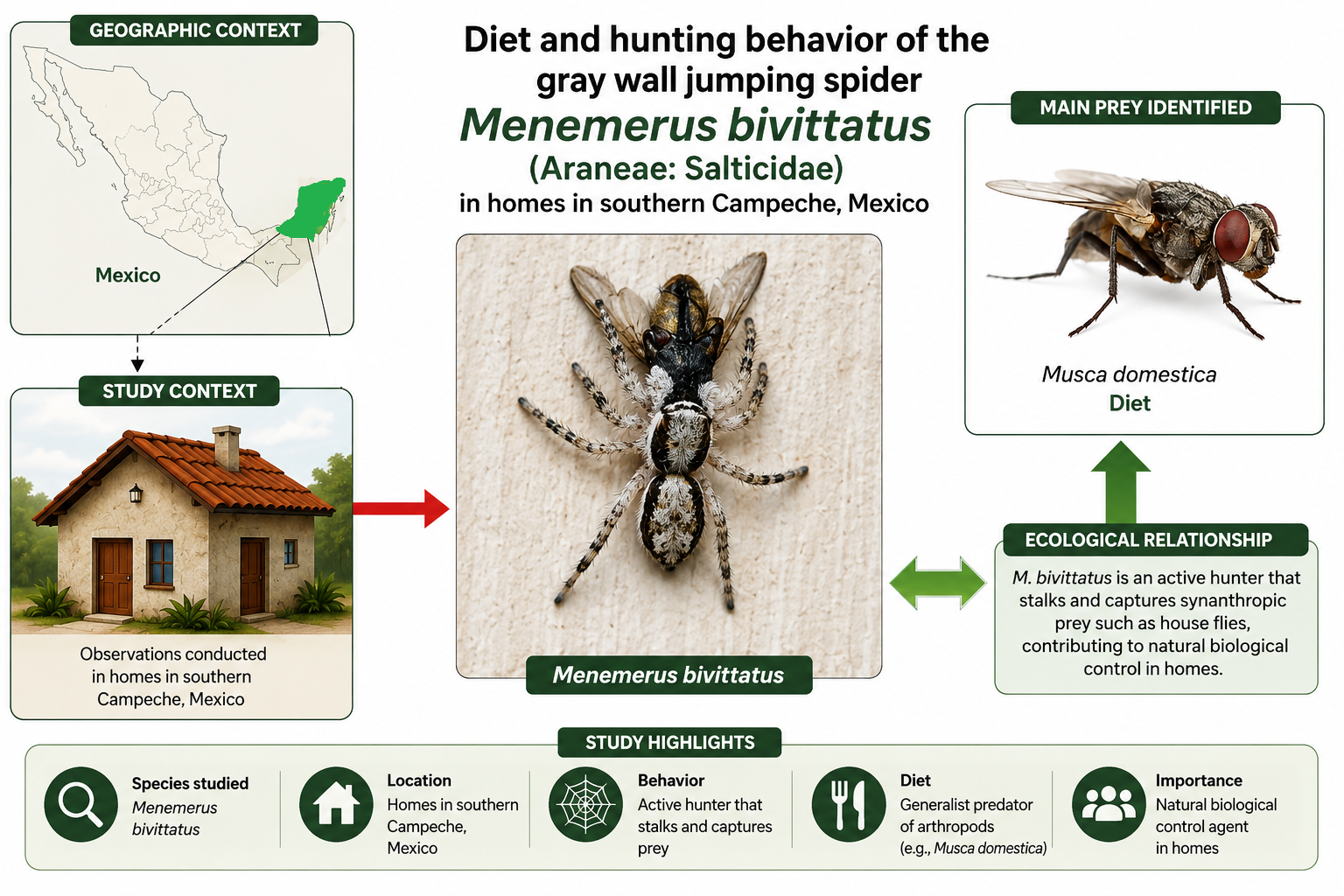
This research focused on identifying the prey consumed by the gray wall jumping spider Menemerus bivittatus in homes in southern Campeche state, Mexico, through direct observations of predation events. Between February and June 2026, direct observations of M. bivittatus individuals present on interior and exterior walls of houses were conducted. The capture and consumption of prey, as well as the hunting behavior of the observed individuals, were recorded. The results show that M. bivittatus primarily preyed on houseflies (Musca domestica), which were visually located and captured through precise jumps. The species used the walls of houses as foraging areas, taking advantage of the frequent presence of insects associated with urban environments. The study was based on direct observations, so the actual range of the species' diet may be greater than recorded. Future studies incorporating molecular tools could provide a more detailed characterization of the prey consumed. Menemerus bivittatus acts as an active predator of houseflies in urban environments in Campeche, potentially contributing to the natural control of synanthropic insects associated with human dwellings.
References
Birkhofer, K., Djoudi, E. A., Schnerch, B., & Michalko, R. (2022). Climatic conditions and functional traits affect spider diets in agricultural and non-agricultural habitats worldwide. Ecography. https://doi.org/10.1111/ecog.06090 DOI: https://doi.org/10.1111/ecog.06090
Bollinger, E., Zubrod, J., Englert, D., Graf, N., Weisner, O., Kolb, S., Schäfer, R. B., Entling, M., & Schulz, R. (2023). The influence of season, hunting mode, and habitat specialization on riparian spiders as key predators in the aquatic-terrestrial linkage. Scientific Reports, 13. https://doi.org/10.1038/s41598-023-50420-w DOI: https://doi.org/10.1038/s41598-023-50420-w
Cuff, J., Drake, L. E., Tercel, M. P., Stockdale, J. E., Orozco‐terWengel, P., Bell, J., Vaughan, I., Müller, C., & Symondson, W. (2020). Money spider dietary choice in pre- and post-harvest cereal crops using metabarcoding. Ecological Entomology, 46. https://doi.org/10.1111/een.12957 DOI: https://doi.org/10.1111/een.12957
Cuff, J., Tercel, M. P., Vaughan, I., Drake, L. E., Wilder, S. M., Bell, J. R., Müller, C., Orozco-terWengel, P., & Symondson, W. (2024). Prey nutrient content is associated with the trophic interactions of spiders and their prey selection under field conditions. Oikos. https://doi.org/10.1111/oik.10712 DOI: https://doi.org/10.1111/oik.10712
Eitzinger, B., Abrego, N., Gravel, D., Huotari, T., Vesterinen, E., & Roslin, T. (2018). Assessing changes in arthropod predator–prey interactions through DNA-based gut content analysis-variable environment, stable diet. Molecular Ecology, 28, 266 - 280. https://doi.org/10.1111/mec.14872 DOI: https://doi.org/10.1111/mec.14872
Hambäck, P., Cirtwill, A., García, D., Grudzinska-Sterno, M., Miñarro, M., Tasin, M., Yang, X., & Samnegård, U. (2021). More intraguild prey than pest species in arachnid diets may compromise biological control in apple orchards. Basic and Applied Ecology. https://doi.org/10.1016/j.baae.2021.09.006 DOI: https://doi.org/10.1016/j.baae.2021.09.006
Harland, D. P., Li, D., Jackson, R. R., & Zurek, D. B. (2019). Dim-light vision in jumping spiders (Araneae, Salticidae): Identification of prey and rivals. Journal of Experimental Biology, 222(9), jeb198069. https://doi.org/10.1242/jeb.198069 DOI: https://doi.org/10.1242/jeb.198069
INEGI, Instituto Nacional de Estadística y Geografía. (2010). Compendio de información geográfica municipal 2010: Escárcega, Campeche (Clave geoestadística 04009). https://www.inegi.org.mx/contenidos/app/mexicocifras/datos_geograficos/04/04009.pdf
Kar, S., Mondal, B., Pal, A., Mondal, A., & Mazumdar, A. (2022). Report of spiders preying on adult Culicoides spp. using molecular based marker with notes on its feeding activity. International Journal of Tropical Insect Science, 42, 1877 - 1883. https://doi.org/10.1007/s42690-021-00715-0 DOI: https://doi.org/10.1007/s42690-021-00715-0
Kennedy, S. R., Tsau, S., Gillespie, R., & Krehenwinkel, H. (2020). Are you what you eat? A highly transient and prey‐influenced gut microbiome in the grey house spider Badumna longinqua. Molecular Ecology, 29, 1001 - 1015. https://doi.org/10.1111/mec.15370 DOI: https://doi.org/10.1111/mec.15370
Kripp, A., Eitzinger, B., Hatamli, K., Huszarik, M., Melcher, A., Röder, N., & Entling, M. (2026). Separation of the trophic niches in a community of riparian generalist predators. Food Webs. https://doi.org/10.1016/j.fooweb.2026.e00445 DOI: https://doi.org/10.1016/j.fooweb.2026.e00445
Macías‐Hernández, N., Athey, K., Tonzo, V., Wangensteen, O., Arnedo, M., & Harwood, J. (2018). Molecular gut content analysis of different spider body parts. PLoS ONE, 13. https://doi.org/10.1371/journal.pone.0196589 DOI: https://doi.org/10.1371/journal.pone.0196589
Melcher, A., Krehenwinkel, H., Harms, D., & Birkhofer, K. (2025). Estimating required sample sizes for gut content metabarcoding studies of dietary diversity in spiders. Journal of Applied Entomology, 149, 1034 - 1039. https://doi.org/10.1111/jen.13433 DOI: https://doi.org/10.1111/jen.13433
Melcher, A., Weber, S., Birkhofer, K., Harms, D., & Krehenwinkel, H. (2024). To pool or not to pool: Pooled metabarcoding does not affect estimates of prey diversity in spider gut content analysis. Ecological Entomology, 49, 768-778. https://doi.org/10.1111/een.13382 DOI: https://doi.org/10.1111/een.13382
Pekár, S., Líznarová, E., Bočánek, O., & Zdráhal, Z. (2019). Circadian rhythms in the locomotor activity of the spiders Carrhotus xanthogramma (Salticidae) and Philodromus cespitum (Philodromidae): Temporal patterns and sexual differences. European Journal of Entomology, 116, 157-165. DOI: https://doi.org/10.14411/eje.2019.017
Ramírez, D. S., Guevara, G., Pérez, L. M. F., Van Der Meijden, A., González-Gómez, J. C., Valenzuela‐Rojas, J. C., & Quiroga, C. P. F. (2021). Deciphering the diet of a wandering spider (Phoneutria boliviensis; Araneae: Ctenidae) by DNA metabarcoding of gut contents. Ecology and Evolution, 11, 5950-5965. https://doi.org/10.1002/ece3.7320 DOI: https://doi.org/10.1002/ece3.7320
Saqib, H. S. A., Liang, P., You, M., & Gurr, G. (2021). Molecular gut content analysis indicates the inter‐ and intra‐guild predation patterns of spiders in conventionally managed vegetable fields. Ecology and Evolution, 11, 9543-9552. https://doi.org/10.1002/ece3.7772 DOI: https://doi.org/10.1002/ece3.7772
Schmidt, J. M., Sebastian, P. J., Wilder, S., & Rypstra, A. (2012). The Nutritional Content of Prey Affects the Foraging of a Generalist Arthropod Predator. PLoS ONE, 7. https://doi.org/10.1371/journal.pone.0049223 DOI: https://doi.org/10.1371/journal.pone.0049223
Van Schrojenstein Lantman, I. M., Vesterinen, E., Hertzog, L., Martel, A., Verheyen, K., Lens, L., & Bonte, D. (2020). Body size and tree species composition determine variation in prey consumption in a forest-inhabiting generalist predator. Ecology and Evolution, 11, 8295-8309. https://doi.org/10.1002/ece3.7659 DOI: https://doi.org/10.1002/ece3.7659
Verschut, V., Strandmark, A., Esparza-Salas, R., & Hambäck, P. (2018). Seasonally varying marine influences on the coastal ecosystem detected through molecular gut analysis. Molecular Ecology, 28, 307-317. https://doi.org/10.1111/mec.14830 DOI: https://doi.org/10.1111/mec.14830
Whitney, T. D., Sitvarin, M. I., Roualdes, E. A., Bonner, S. J., & Harwood, J. (2018). Selectivity underlies the dissociation between seasonal prey availability and prey consumption in a generalist predator. Molecular Ecology, 27, 1739-1748. https://doi.org/10.1111/mec.14554 DOI: https://doi.org/10.1111/mec.14554
Zuev, A., Heidemann, K., Leonov, V., Schaefer, I., Scheu, S., Tanasevitch, A., Tiunov, A., Tsurikov, S., & Potapov, A. (2020). Different groups of ground-dwelling spiders share similar trophic niches in temperate forests. Ecological Entomology, 45. https://doi.org/10.1111/een.12918 DOI: https://doi.org/10.1111/een.12918
Downloads
Published
How to Cite
Issue
Section
License
Copyright (c) 2027 Maximiliano Vanoye Eligio, Felix Alejandra Luna Medina, María del Carmen Gómez Camal, Paula Viveros Moreno, Ludwin Jaime Estrada Ramírez, Edith González Lazo, Jimmy Ricardo Mier Guerra, Juan Manuel Ortega Almeyda, Rosa Elena Medina Hernández, Benito Bernardo Dzib Castillo

This work is licensed under a Creative Commons Attribution 4.0 International License.
Authors who publish with this journal agree to the following terms:
1) Authors retain copyright and grant the journal right of first publication with the work simultaneously licensed under a Creative Commons Attribution License that allows others to share the work with an acknowledgement of the work's authorship and initial publication in this journal.
2) Authors are able to enter into separate, additional contractual arrangements for the non-exclusive distribution of the journal's published version of the work (e.g., post it to an institutional repository or publish it in a book), with an acknowledgement of its initial publication in this journal.
3) Authors are permitted and encouraged to post their work online (e.g., in institutional repositories or on their website) prior to and during the submission process, as it can lead to productive exchanges, as well as earlier and greater citation of published work.