A compartmental model of Marburg virus disease incorporating corpse mediated transmission and high mortality: Dynamics, reproduction number, and control implications
DOI:
https://doi.org/10.14295/bjs.v6i2.932Keywords:
Marburg virus disease, mathematical model, corpse-mediated transmission, safe burials, basic reproduction numberAbstract
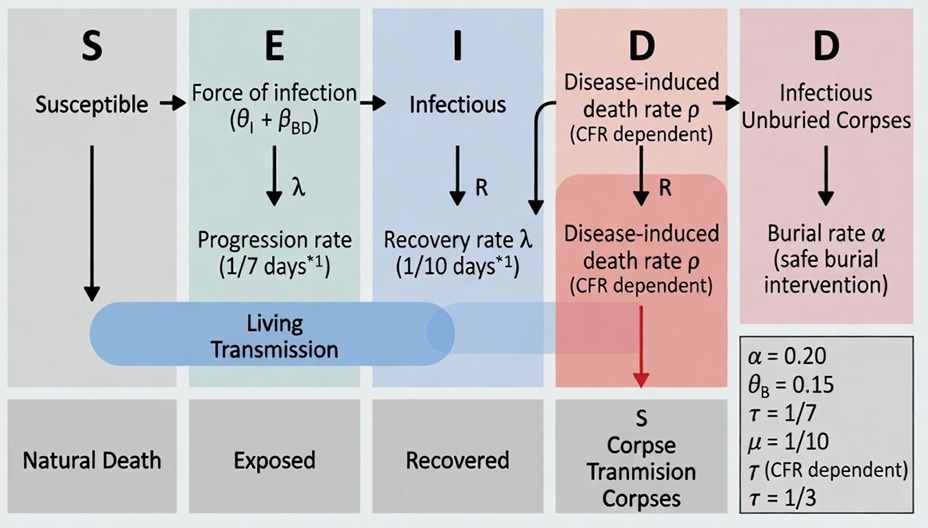
Marburg virus disease (MVD) is a severe hemorrhagic fever with case fatality ratios up to 90%. Corpse-mediated transmission during traditional burials is a recognized driver of secondary cases, yet few mathematical models explicitly quantify this pathway for MVD. To develop and analyze a compartmental model of MVD transmission that incorporates infectious corpses as a separate compartment andSEIR-type to evaluate the effectiveness of safe burial interventions (reducing corpse transmission rate βBor increasing burial rate ν) and case isolation (reducing living transmission rate β). A deterministic SEIR-type model with six compartments (susceptible, exposed, infectious, recovered, cumulative dead, and infectious unburied corpses) was formulated. The basic reproduction number R0 was derived via the next-generationdisease-free matrix method. Local and global stability of the disease-free equilibrium were established. Numerical simulations were performed using baseline parameters (β = 0.20, βB = 0.15, σ = 1/7, γ = 1/10, μ = 0.07, ν = 0.5 day⁻¹, and CFR = 41%). Baseline R₀ = 2.08, of which 43% comes from corpse transmission. Safe burial alone reduces R0 to 1.45, isolation alone to 1.73, and combined interventions achieve R0 = 0.86 (< 1). Sensitivity analysis shows β has the strongest influence, but ν and βBare critical when CFR > 50%. Case isolation is the most effective single intervention, but safe, dignified burials are indispensable for MVD control, especially at high CFR. Combined non-pharmaceutical strategies can suppress outbreaks without a vaccine. Outbreak response should prioritize rapid burial teams, surveillance, health worker training, and community engagement, implemented in a phased manner.
References
Amman, B. R., Carroll, S. A., Reed, Z. B., Sealy, T. K., Balinandi, S., Swanepoel, R., & Towner, J. S. (2012). Seasonal pulses of Marburg virus circulation in juvenile Rousettus aegyptiacus bats coincide with periods of increased risk of human infection. PLoS Pathogens, 8(10), e1002877. https://doi.org/10.1371/journal.ppat.1002877
Bausch, D. G., Nichol, S. T., Muyembe Tamfum, J. J., Borchert, M., Rollin, P. E., Sleurs, H., & Colebunders, R. (2006). Marburg hemorrhagic fever associated with multiple genetic lineages of virus. New England Journal of Medicine, 355(9), 909-919. https://doi.org/10.1056/NEJMoa051465
Bouba, A., Helle, K. B., Schneider, K. A., & Rychtář, J. (2023). Predicting the combined effects of case isolation, safe funeral practices, and contact tracing during Ebola virus disease outbreaks. PLoS One, 18(1), e0276351. https://doi.org/10.1371/journal.pone.0276351
Centers for Disease Control and Prevention. (2005). Brief Report: Outbreak of Marburg virus hemorrhagic fever—Angola, October 1, 2004–March 29, 2005. MMWR Morbidity and Mortality Weekly Report, 54(12), 308-309.
Chowell, G., Nishiura, H., & Bettencourt, L. M. A. (2009). Comparative estimation of the reproduction number for pandemic influenza from daily case notification data. Journal of the Royal Society Interface, 6(43), 155-167. https://doi.org/10.1098/rsif.2008.0310
Haque, Z., Kamrujjaman, M., Alam, M. S., & Biswas, M. H. A. (2023). A nonlinear fractional epidemic model for the Marburg virus transmission with public health education. Scientific Reports, 13. https://doi.org/10.1038/s41598-023-45689-4
Huntley, J. F., Maloney, M. J., & Dye, J. M. (2025). Marburg virus disease: A systematic review of the literature. PLOS Neglected Tropical Diseases, 19(2), e0012345. https://doi.org/10.1371/journal.pntd.0012345
Legrand, J., Grais, R. F., Boelle, P. Y., Valleron, A. J., & Flahault, A. (2007). Understanding the dynamics of Ebola epidemics. Epidemiology and Infection, 135(4), 610-621. https://doi.org/10.1017/S0950268806007217
Letafati, A., Fakhr, S. S. H., Najafabadi, A. Q., Karami, N., & Karami, H. (2025). Marburg virus disease: A narrative review. Health Science Reports, 8(5), e70669. https://doi.org/10.1002/hsr2.70669
Mehedi, M., Groseth, A., Feldmann, H., & Ebihara, H. (2011). Clinical aspects of Marburg hemorrhagic fever. Future Virology, 6(9), 1091-1106. https://doi.org/10.2217/fvl.11.79
Pisapia, R., Fusco, F. M., Scorzolini, L., Fontana, L., & Nicastri, E. (2025). Clinical features of Marburg virus disease: a review of all reported patients since 1967. eClinicalMedicine Part of The Lancet, 89, 103581.
ReliefWeb. (2005, April 18). Angola: Cultural practices raise risk of Marburg spreading. The New Humanitarian. https://reliefweb.int/report/angola/angola-cultural-practices-raise-risk-marburg-spreading
Sematimba, J., Luboobi, L. S., & Nsubuga, R. (2023). Mathematical modelling of the transmission dynamics of Marburg virus disease with optimal control and cost effectiveness analysis based on lessons from Ebola virus disease. SSRN Electronic Journal. https://doi.org/10.2139/ssrn.4661182
Shuai, Z., & van den Driessche, P. (2013). Global stability of infectious disease models using Lyapunov functions. SIAM Journal on Applied Mathematics, 73(4), 1513-1532. https://doi.org/10.1137/120876642
Smith, H. L. (1995). Monotone dynamical systems: An introduction to the theory of competitive and cooperative systems. American Mathematical Society. (No DOI for book, but reference provided.)
Towner, J. S., Khristova, M. L., Sealy, T. K., Vincent, M. J., Erickson, B. R., Bawiec, D. A., … Nichol, S. T. (2006). Marburgvirus genomics and association with a large hemorrhagic fever outbreak in Angola. Journal of Virology, 80(13), 6497-6516. https://doi.org/10.1128/JVI.00069-06
Towner, J. S., Pourrut, X., Albariño, C. G., Nkogue, C. N., Bird, B. H., Grard, G., … Leroy, E. M. (2007). Marburg virus infection detected in a common African bat. PLoS ONE, 2(8), e764. https://doi.org/10.1371/journal.pone.0000764
Towner, J. S., Amman, B. R., Sealy, T. K., Carroll, S. A., Comer, J. A., Kemp, A., … Nichol, S. T. (2009). Isolation of genetically diverse Marburg viruses from Egyptian fruit bats. PLoS Pathogens, 5(7), e1000536. https://doi.org/10.1371/journal.ppat.1000536
van den Driessche, P., & Watmough, J. (2002). Reproduction numbers and sub threshold endemic equilibria for compartmental models of disease transmission. Mathematical Biosciences, 180(1 2), 29-48. https://doi.org/10.1016/S0025-5564(02)00108-6
Washachi, J. D., Amoka, J. A., Orapine, H. O., & Baidu, A. A. (2023). Mathematical modelling of transmission dynamics of Marburg virus with effective quarantine approach. Caliphate Journal of Science and Technology, 5(3), Article 262339.
World Health Organization. (2005, March 23). Marburg haemorrhagic fever, Angola. Available in: https://www.who.int/emergencies/disease-outbreak-news/item/2005_03_23-en. Accessed on: March 10, 2026.
World Health Organization. (2022, September 26). Marburg virus disease, Ghana. Available in: https://www.who.int/emergencies/disease-outbreak-news/item/2022-DON409. Accessed on: March 10, 2026.
World Health Organization. (2025, January 20). Marburg virus disease. Available in: https://www.who.int/news-room/fact-sheets/detail/marburg-virus-disease. Accessed on: March 10, 2026.
Downloads
Published
How to Cite
Issue
Section
License
Copyright (c) 2027 Belay Sitotaw Goshu

This work is licensed under a Creative Commons Attribution 4.0 International License.
Authors who publish with this journal agree to the following terms:
1) Authors retain copyright and grant the journal right of first publication with the work simultaneously licensed under a Creative Commons Attribution License that allows others to share the work with an acknowledgement of the work's authorship and initial publication in this journal.
2) Authors are able to enter into separate, additional contractual arrangements for the non-exclusive distribution of the journal's published version of the work (e.g., post it to an institutional repository or publish it in a book), with an acknowledgement of its initial publication in this journal.
3) Authors are permitted and encouraged to post their work online (e.g., in institutional repositories or on their website) prior to and during the submission process, as it can lead to productive exchanges, as well as earlier and greater citation of published work.