Management system and performance of Yoruba and Fulani ecotype chickens in Ogbomoso North Local Government Area
DOI:
https://doi.org/10.14295/bjs.v5i12.923Keywords:
management, system, performance, Yoruba ecotype, Fulani ecotype, OgbomosoAbstract
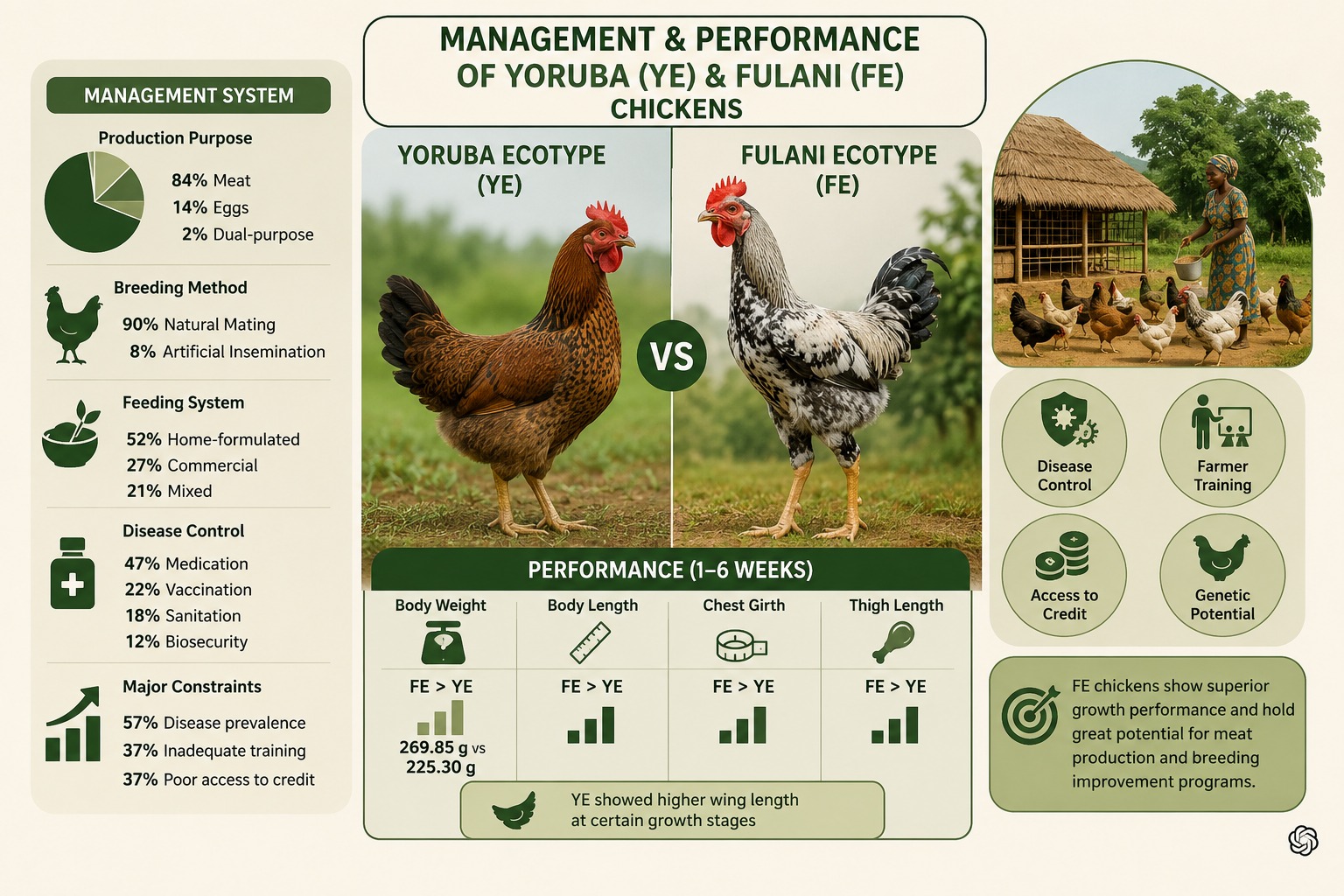
This study evaluated the management practices, production constraints, and growth performance of two Nigerian indigenous chicken ecotypes, the Fulani Ecotype (FE) and Yoruba Ecotype (YE), in Ogbomoso North Local Government Area. Data were collected from 49 poultry farmers using structured questionnaires and direct observations, while growth performance was assessed from the first to the sixth week of age through body weight and morphometric measurements. Descriptive statistics were used to characterize production systems and management practices, and growth traits were compared between ecotypes. Most farmers reared chickens primarily for meat production (84%) under traditional management systems, relying mainly on natural mating and home-formulated feeds. Disease prevalence was identified as the major production constraint, followed by inadequate farmer training and limited access to credit facilities. Growth evaluation revealed significant differences (p < 0.05) between the ecotypes. FE chickens consistently exhibited greater body weight, body length, chest girth, and thigh length than YE chickens throughout most of the experimental period. At six weeks of age, FE birds reached a mean body weight of 269.85 g, compared with 225.30 g in YE birds, whereas YE chickens showed relatively greater wing length at specific growth stages. Overall, indigenous chicken production in the study area remains predominantly traditional and is limited by health, technical, and financial challenges. The superior growth performance of the Fulani Ecotype highlights its potential as a valuable genetic resource for meat production and breeding programmes aimed at improving indigenous chicken productivity.
References
Abdul-Rahman, M., Adedeji, T. A., & Yakubu, A. (2022). Morphological characterization of Nigerian local chickens for genetic improvement. Nigerian Journal of Animal Production, 49(2), 120-128.
Adedokun, O. O., Adeyinka, I. A., & Bello, S. A. (2021). Management practices and performance of indigenous Yoruba ecotype chickens in rural southwestern Nigeria. Journal of Animal Production Research, 33(1), 55-63.
Adene, D. F., and Oguntade, A. E. (2020). The Nigerian poultry industry: Current status, challenges, and opportunities. Proceedings of the Poultry Science Association of Nigeria Conference, 17-25 p.
Ajayi, F. O., Adeleke, M. A., Sanni, M. T., & Yakubu, A. (2020). Growth performance and body conformation traits of Nigerian indigenous chickens. Nigerian Journal of Animal Production, 47(3), 45-56.
Begna, D., Bacha, T., Boki, S., & Bekana, K. (2025). Breeding practices of indigenous chickens in the Liban Jawi district of the West Shewa Zone, Ethiopia: A qualitative and quantitative analysis. Poultry Science, 104(1), 104536. https://doi.org/10.1016/j.psj.2024.104536
Chebom, C., Melesse, A. and Betsha, S. (2024). Quantifying phenotypic variability of indigenous chickens using morphometric traits by applying multivariate analysis: Input for sustainable rural chicken farming. Heliyon, 10(21), e39850.
Food and Agriculture Organization. (FAO). (2020). Poultry sector – Nigeria: Review and analysis. FAO Animal Production and Health Livestock Country Reviews. Rome.
Google (2023). Satellite imagery of Ogbomoso, Oyo State, Nigeria. Retrieved from Google Earth.
Houghton, E., Nguyen, K. T. M., Syndicus, I., & Nguyen, D. T. (2025). Making a living and zoonotic disease risk management in coloured broiler poultry farms in Northern Viet Nam. Agriculture and Human Values, 42, 1535-1551. https://doi.org/10.1007/s10460-024-10696-8
Isa, A. M., Musa, I. S., & Lawal, B. (2019). Characterization of Fulani ecotype chickens in northwestern Nigeria. Nigerian Journal of Animal Science, 21(3), 85-92.
Kpomasse, C. C., Kouame, Y. A. E., N’nanle, O., Houndonougbo, F. M., Tona, K., & Oke, O. E. (2022). The productivity and resilience of the indigenous chickens in the tropical environments: improvement and future perspectives. Journal of Applied Animal Research, 51(1), 456-469. https://doi.org/10.1080/09712119.2023.2228374
Lamido, M., Bature, I., & Aliyu, A. M. (2024). Prediction of body weight from morphometric traits in indigenous normal feathered chickens of Nigeria. Nigerian Journal of Animal Production, 159-163.
Lamido, M., Rotimi, E. A., & Allamin, H. (2024). Relationships between body weights and morphometric traits of indigenous normal feathered chickens. FUDMA Journal of Agriculture and Agricultural Technology, 10(2), 121-125.
Lamido, M., Rotimi, E. A., & Garba, M. G. (2023). Effect of genotype, sex and age and its association between body weights and body measurements in indigenous chicken population. FUDMA Journal of Agriculture and Agricultural Technology, 9(4), 1-8.
Mdemu, S., Matondo, A. B., Christensen, J. P., Amasha, A. E., Ngowi, H. A., Westwood, E., Ochai, S. O., Nonga, H. E., Osbjer, K., & Mdegela, R. H. (2025). Factors influencing the frequency, knowledge, attitudes and practices of antibiotic use in commercial layer chicken farms, Tanzania. Frontier Antibiotic, 4, 1571096.
Morris, K. M., Sutton, K. S., Solomon, B., Wondmeneh, E., & Dessie, T. (2024). Phenotypic and genomic characterization of performance of tropically adapted chickens raised in smallholder farm conditions in Ethiopia. Frontiers in Genetics, 15, 1-14. https://doi.org/10.3389/fgene.2024.1383609
Musa, A. A., Abdulmalik, S. E., Shoyombo, A. J., Akinsola, O. M., & Usman, T. (2018). Morphological characterization of Nigerian chicken genotypes using multivariate analyses. International Journal of Poultry Science, 17(11), 560-567. https://doi.org/10.3923/ijps.2018.560.567
Nielsen, S. S., Kemunto, N. P., Muloi, D., Bojesen, A. M., & Knight-Jones, T. J. D. (2025). Flexible assessment of biosecurity in small- and medium-scale poultry farms in low- and middle-income countries. Acta Veterinaria Scandinavica, 67, 9. https://doi.org/10.1186/s13028-025-00796-8
Oke, U. K., Herbert, U., Nwachukwu, E. N., & Iheukwumere, F. C. (2017). Evaluation of growth traits and linear body measurements of Nigerian local chickens. Livestock Research for Rural Development, 29(9), 1-9.
Oladeji, J. O., Adewumi, M. K., & Fakoya, E. O. (2022). Feeding practices and productivity of indigenous poultry in southwestern Nigeria. Nigerian Journal of Animal Production, 49(1), 35-42.
Oluwafemi, R. A., & Adeola, R. G. (2021). Rural poultry farming and livelihood sustainability in southwestern Nigeria. Journal of Rural Development, 40(3), 215-225.
Rachman, M. P., Bamidele, O., Dessie, T., Smith, J., Hanotte, O., & Gheyas, A. A. (2024). Genomic analysis of Nigerian indigenous chickens reveals their genetic diversity and adaptation to heat stress. Scientific Reports, 14, 2209. https://doi.org/10.1038/s41598-024-52569-4
Saleem, F., Ameer, A., Afzal, F., Usman, M., Irshad, M., & Sattar, S. (2025). A cross-sectional survey of poultry management systems, practices and antimicrobial use in relation to disease outbreak in Pakistan. BMC Research Notes, 18, 144. https://doi.org/10.1186/s13104-025-07220-4
Singh, M., Mollier, R. T., Paton, R. N., Pongener, N., Yadav, R., Singh, V., Katiyar, R., Kumar, R., Sonia, C., Bhatt, M., Babu, S., Rajkhowa, D. J., & Mishra, V. K. (2022). Backyard poultry farming with improved germplasm: Sustainable food production and nutritional security in fragile ecosystem. Frontiers in Sustainable, 6. https://doi.org/10.3389/fsufs.2022.962268
Singh, B., Bhat, A., & Ravi, K. (2024). Antibiotics misuse and antimicrobial resistance development in agriculture: A global challenge. Environment & Health, 2(9), 618-622. https://doi.org/10.1021/envhealth.4c00094
Wondmeneh, E., Vam der Waaji, E. H., Udo, H. M.J., Tadelle, D., & Van Arendonk, J. A. M. (2016). Comparison of different poultry breeds under station and on-farm conditions in Ethiopia. Livestock Science, 83, 72-77. https://doi.org/10.1016/j.livsci.2015.11.019
Downloads
Published
How to Cite
Issue
Section
License
Copyright (c) 2026 Abimbola Deborah Matt-Obabu, Azeem Oladiran Ige, Hameed Olayemi Salawu, Hammed Opeyemi Oladipupo, Adeola Badrat Ajibola, Tolulope Margaret Adedibu, Abigeal Oluwakemi Akingbade, David Olasunkanmi Oyelami

This work is licensed under a Creative Commons Attribution 4.0 International License.
Authors who publish with this journal agree to the following terms:
1) Authors retain copyright and grant the journal right of first publication with the work simultaneously licensed under a Creative Commons Attribution License that allows others to share the work with an acknowledgement of the work's authorship and initial publication in this journal.
2) Authors are able to enter into separate, additional contractual arrangements for the non-exclusive distribution of the journal's published version of the work (e.g., post it to an institutional repository or publish it in a book), with an acknowledgement of its initial publication in this journal.
3) Authors are permitted and encouraged to post their work online (e.g., in institutional repositories or on their website) prior to and during the submission process, as it can lead to productive exchanges, as well as earlier and greater citation of published work.