Vanadium pentoxide (V₂O₅) as a next-generation electrode: Classification, synthesis strategies, and electrochemical applications
DOI:
https://doi.org/10.14295/bjs.v6i4.986Keywords:
vanadium pentoxide, energy storage, nanostructures, zinc-ion batteries, supercapacitorsAbstract
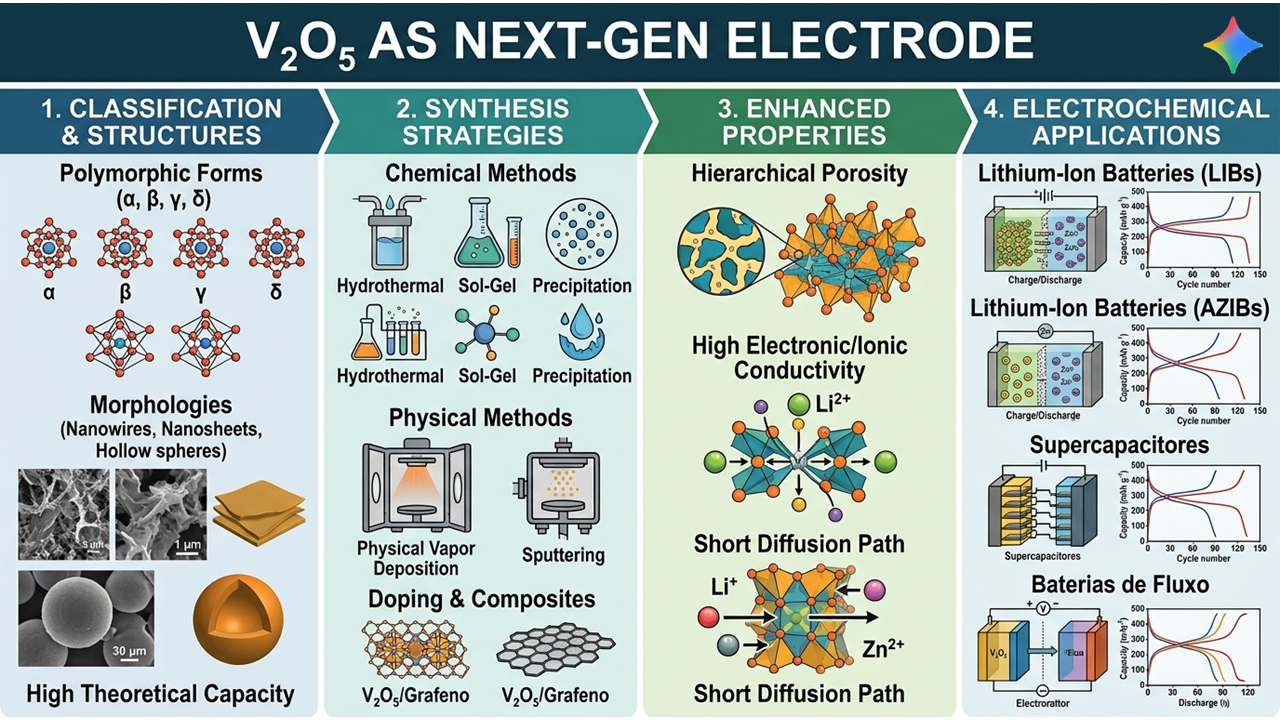
The escalating demand for advanced electrochemical energy storage drives the search for high-performance electrode materials. Vanadium pentoxide (V₂O₅) has emerged as a premier candidate due to its abundance, rich redox chemistry, and distinctive layered structure that facilitates multivalent-ion intercalation. This review systematically examines recent advancements in V₂O₅ research, beginning with a structural classification of its nanomaterials (0D to 3D). We critically evaluate state-of-the-art synthesis strategies—such as hydrothermal and sol-gel methods—highlighting how precise morphological control governs electrochemical behavior. Furthermore, we explore the diverse applications of V₂O₅ across next-generation platforms, with particular emphasis on aqueous zinc-ion batteries, lithium/sodium-ion systems, and high-energy supercapacitors. Addressing inherent limitations like low intrinsic conductivity and structural degradation during cycling, we analyze the latest mitigation strategies, including defect engineering and conductive hybridization. Finally, this review outlines remaining bottlenecks and future perspectives, offering a strategic roadmap to accelerate the transition of V₂O₅ electrodes from laboratory research to commercial energy storage technologies.
References
Akhtar, N., Sharif, T., Ateeq, M., Ahmad, S., Fazil, P., Kashif, M., Khan, J. A., & Joseph, C. G. (2026). Degradation of rosuvastatin by Uv/Persulfate and Uv/Persulfate/Fe2+ processes: Kinetics, mechanism, toxicity and economic evaluations. Chemical Papers. https://doi.org/10.1007/s11696-026-05448-3
Amir, J., Muhammad, S., Kashif, M., Khan, A. A., Gul, M., Sun, H., Shah, M., Azizi, S., & Maaza, M. (2025). Synthesis, characterization and dielectric properties evaluation of Nio-Co3O4 nanocomposite. Journal of the Iranian Chemical Society, 22(1), 63-72. https://doi.org/10.1007/s13738-024-03129-0
Ghani, U., Hussain, S., Kashif, M., Matinise, N., Sun, H., & Malik, M. (2026). Green synthesis and characterization of Syzygium cumini leaf-extract‑derived Cu2O/CuO@SiO2 nanoparticles for catalytic hydrogen production via NaBH4 methanolysis. Materials Research Innovations, 1-13. https://doi.org/10.1080/14328917.2026.2738448
Gul, M., Kashif, M., Muhammad, S., Azizi, S., & Sun, H. (2025). Various methods of synthesis and applications of gold-based nanomaterials: A detailed review. Crystal Growth & Design, 25(7), 2227-2266. https://doi.org/10.1021/acs.cgd.4c01687
Hussain, S., Kashif, M., Ali, M., Gul, M., Azizi, S., & Maaza, M. (2026). Ligand-engineered mesoporous silica: Cutting-edge architectures for targeted toxic heavy metal sequestration—a review. Advances in Materials Science and Engineering, 2026(1), 3228002. https://doi.org/10.1155/amse/3228002
Kashif, M., Gul, M., Shahzad, N., Sun, H., Shezan, SK. A., Ahmad, N., Hamlaoui, O., & Tozan, H. (2026a). Metal oxide nanoparticles: A comprehensive review of recent advances in synthesis strategies, characterization and multifunctional applications. Catalysts, 16(8), 678. https://doi.org/10.3390/catal16080678
Kashif, M., Jawad, M., Khan, A. A., Sun, H., Ullah, K., Fakayode, O., & Azizi, S. (2024). Fe/Ti-codoped strontium oxide nanoparticles for enhanced photocatalytic degradation of methyl orange. Journal of Applied Research in Water and Wastewater, 11(1), 8-14. https://doi.org/10.22126/arww.2024.10753.1336
Kashif, M., Sharif, T., Khan, S., Shahzad, N., Amir, J., Gul, M., Shahid, K., Qarni, A., Shah, A., & Matinise, N. (2026b). Synthesis strategies and multifaceted applications of molybdenum-based nanomaterials: A comprehensive review. Scientifica, 2026(1), 1764400. https://doi.org/10.1155/sci5/1764400
Khan, M., Sun, X., Kashif, M., Zada, A., Azizi, S., Ragab, A. H., Taher, M. A., Abbas, Q., & Shehzad, K. (2025a). Exploration of bismuth-based nanomaterials: From fundamental concepts to innovative synthesis techniques and emerging applications. Coordination Chemistry Reviews, 538, 216687. https://doi.org/10.1016/j.ccr.2025.216687
Khan, S., Kalsoom, U., Kashif, M., Hussain, S. A., Gul, M., Azizi, S., & Maaza, M. (2025b). Smart and sustainable microplastic removal: Hybrid systems, bio-inspired technologies, real-time sensing, and policy integration. Water, Air, & Soil Pollution, 236(14), 900. https://doi.org/10.1007/s11270-025-08468-z
Li, Y., Xu, J., Liu, H., Hu, X., Zhang, Q., Peng, W., Li, Y., Zhang, F., Han, Y., & Fan, X. (2022). Suppressing vanadium dissolution in “water-in-salt” electrolytes for 3.2 V aqueous sodium-ion pseudocapacitors. Energy, Environmental, and Catalysis Applications, 14(31), 35485-35494. https://doi.org/10.1021/acsami.2c05174
Shah, M., Hameed, A., Kashif, M., Majeed, N., Muhammad, J., Shah, N., Rehan, T., Khan, A., Uddin, J., Khan, A., & Kashtoh, H. (2024). Advances in agar-based composites: A comprehensive review. Carbohydrate Polymers, 346, 122619. https://doi.org/10.1016/j.carbpol.2024.122619
Tian, X., Zhu, Q., & Xu, B. (2021). “Water-in-salt” electrolytes for supercapacitors: A review. ChemSusChem, 14(12), 2501-2515. https://doi.org/10.1002/cssc.202100230
Temam, A. G., Alshoaibi, A., Getaneh, S. A., Awanda, C., Nwanya, A. C., Ejikeme, P. M., & Ezema, F. I. (2023). Recent progress on V2O5 based electroactive materials: Synthesis, properties, and supercapacitor application. Current Opinion in Electrochemistry, 38, 101239. https://doi.org/10.1016/j.coelec.2023.101239
Wang, Q., Xu, J., Zhang, W., Mao, M., Wei, Z., Wang, L., Cui, C., Zhu, Y., & Ma, J. (2018). Research progress on vanadium-based cathode materials for sodium ion batteries. Journal of Materials Chemistry A, 6(19), 8815-8838. https://doi.org/10.1039/c8ta01627e
Yao, J., Li, Y., Massé, R. C., Uchaker, E., & Cao, G. (2018). Revitalized interest in vanadium pentoxide as cathode material for lithium-ion batteries and beyond. Energy Storage Materials, 11, 205-259. https://doi.org/10.1016/j.ensm.2017.10.014
Yue, Y., & Liang, H. (2017). Micro- and nano-structured vanadium pentoxide (V2O5) for electrode of lithium-ion batteries. Advanced Energy Materials, 7(17), 1602545. https://doi.org/10.1002/aenm.201602545
Zahoor, S., Muhammad, S., Kashif, M., Shahzad, N., Liu, Y-C., Celik, C., Ambreen, N., Ali, A., Wu, H-F., Azizi, S., & Wen, C. (2026). Advances in mesoporous nanomaterials for photocatalytic degradation of pollutants: Fundamentals, material classifications, challenges and future prospects. Coordination Chemistry Reviews, 549, 217239. https://doi.org/10.1016/j.ccr.2025.217239
Zhou, T., Liang, P., Li, S., Cheng, Y., & Li, X. (2025). Oxigen-vacancy-rich V2O5@NC composite with enhanced zinc-storage performance for aqueous zinc-ion batteries. Materials, 18(22), 5216. https://doi.org/10.3390/ma18225216
Downloads
Published
How to Cite
Issue
Section
License
Copyright (c) 2027 Muhammad Ahrar

This work is licensed under a Creative Commons Attribution 4.0 International License.
Authors who publish with this journal agree to the following terms:
1) Authors retain copyright and grant the journal right of first publication with the work simultaneously licensed under a Creative Commons Attribution License that allows others to share the work with an acknowledgement of the work's authorship and initial publication in this journal.
2) Authors are able to enter into separate, additional contractual arrangements for the non-exclusive distribution of the journal's published version of the work (e.g., post it to an institutional repository or publish it in a book), with an acknowledgement of its initial publication in this journal.
3) Authors are permitted and encouraged to post their work online (e.g., in institutional repositories or on their website) prior to and during the submission process, as it can lead to productive exchanges, as well as earlier and greater citation of published work.