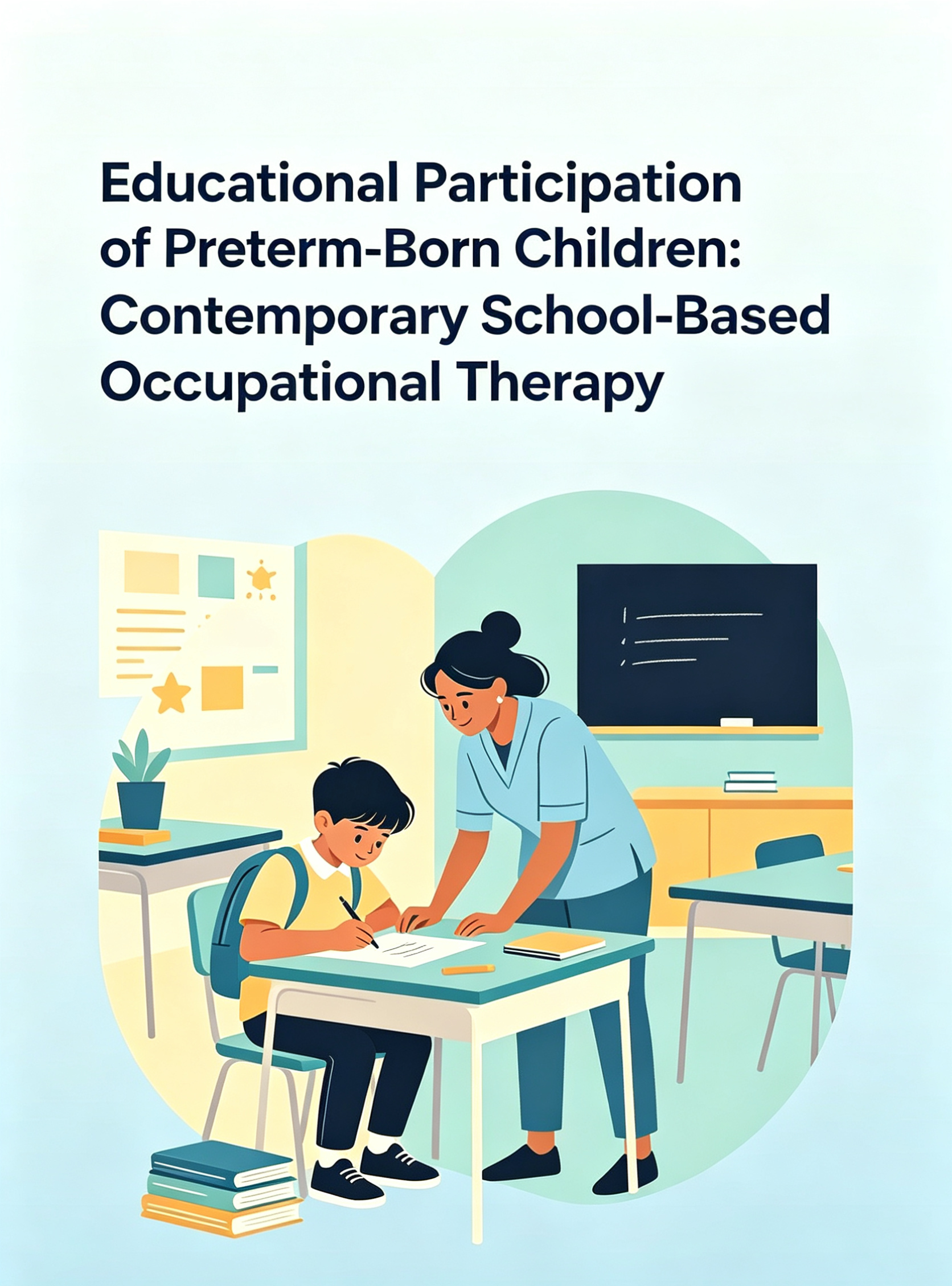
Educational participation of children born preterm: The contemporary role of school-based occupational therapy
DOI:
https://doi.org/10.14295/bjs.v5i12.902Keywords:
prematurity, occupational participation, school-based occupational therapy, neurodiversity-affirming practice, multi-tiered systems of supportAbstract
Advances in neonatal intensive care have transformed the survival rates of infants born prematurely, resulting in a growing demographic of children with early-arrival histories entering formal education systems. While severe, high-risk neurodevelopmental diagnoses are typically established during infancy, the more subtle, low-severity "echoes" of prematurity frequently remain dormant, manifesting later as significant barriers to occupational participation in the classroom. This narrative literature review synthesizes contemporary evidence regarding the educational experiences of children born preterm and examines the role of school-based occupational therapy (SBOT) in promoting occupational participation within inclusive educational environments. Deliberately shifting away from traditional bottom-up, deficit-remediation models that seek to "normalize" the child, this paper explores how the nuanced legacy of prematurity impacts the core occupations of the student-specifically academic performance, social participation, and play. Grounded in the Occupational Therapy Practice Framework: Domain and Process (4th ed.) and neurodiversity-affirming paradigms, the review highlights the central role of SBOTs in utilizing Universal Design for Learning (UDL), Multi-Tiered Systems of Support (MTSS), and environment-centric adaptations. Ultimately, the paper advocates for a top-down, collaborative, and systemic approach to optimize the occupational engagement of students navigating the late-emerging challenges of premature birth.
References
Aarnoudse-Moens, C. S. H., Weisglas-Kuperus, N., van Goudoever, J. B., & Oosterlaan, J. (2009). Meta-analysis of neurobehavioral outcomes in very preterm and/or very low birth weight children. Pediatrics, 124(2), 717-728. https://doi.org/10.1542/peds.2008-2816
American Occupational Therapy Association. (2020). Occupational therapy practice framework: Domain and process (4th ed.). American Journal of Occupational Therapy, 74(Suppl. 2), 7412410010. https://doi.org/10.5014/ajot.2020.74S2001
Anderson, P. J., & Doyle, L. W. (2003). Neurobehavioral outcomes of school-age children born extremely low birth weight or very preterm. JAMA, 289(24), 3264-3272. https://doi.org/10.1001/jama.289.24.3264
Behboodi, S., Chaimani, A., Benhammou, V., Twilhaar, E. S., Johnson, S., Zeitlin, J., & Sentenac, M. (2025). Trends over time in cognitive outcomes of children born very preterm: A systematic review and meta-analysis. JAMA Pediatrics, 179(10), 1074-1081. https://doi.org/10.1001/jamapediatrics.2025.2221
Burstein, O., Aryeh, T., & Geva, R. (2026). Neonatal care and developmental outcomes following preterm birth: A systematic review and meta-analysis. Developmental Psychology, 62(2), 492-512. https://doi.org/10.1037/dev0001844
Cahill, S. M., & Beisbier, S. (2020). Occupational therapy practice guidelines for children and youth ages 5-21 years. American Journal of Occupational Therapy, 74(4), 7404397010. https://doi.org/10.5014/ajot.2020.744001
Daskalou, S. D., Ouzouni, C., Gerosideris, N., Karagianni, V., & Katsouri, I. G. (2024). Neurodevelopmental outcomes and occupational participation of preterm children at school age: A scoping review. Brazilian Journal of Science, 3(6), 54-71. https://doi.org/10.14295/bjs.v3i6.560
Daskalou, S. D., Gerosideris, N., Tsakni, G., Vlotinou, P., Bablekos, G., & Katsouri, I. G. (2025). Identifying cognitive vulnerability in school-aged children born preterm: The role of neonatal and early-life factors. Early Human Development, 211, 106396. https://doi.org/10.1016/j.earlhumdev.2025.106396
Daskalou, S. D., Sergentanis, T. N., Gerosideris, N., Ouzouni, C., Stratou, E., & Katsouri, I. G. (2026). Psychiatric and functional outcomes in preterm school-aged children in Greece. Psychiatry International, 7(3), 92. https://doi.org/10.3390/psychiatryint7030092
Doyle, L. W., Spittle, A., Anderson, P. J., & Cheong, J. L. Y. (2021). School-aged neurodevelopmental outcomes for children born extremely preterm. Archives of Disease in Childhood, 106(9), 834-838. https://doi.org/10.1136/archdischild-2021-321668
Johnson, S., & Marlow, N. (2017). Early and long-term outcome of infants born extremely preterm. Archives of Disease in Childhood, 102(1), 97-102. https://doi.org/10.1136/archdischild-2015-309581
Kollndorfer, K., Hörle, D. A., & Fischmeister, F. P. S. (2025). Attentional deficits following preterm birth: A systematic review and meta-analysis. Brain Sciences, 15(10), 1115. https://doi.org/10.3390/brainsci15101115
Kramer-Roy, D., Tokolahi, E., Boltin, S., & Dancza, K. (2025). The School-Based Occupational Therapy International Network (SBOT-IN): A community of practice inspiring occupational therapists to promote inclusive education. Journal of Occupational Therapy, Schools, & Early Intervention, 18(1), 1-12. https://doi.org/10.1080/19411243.2024.2382719
Laverdure, P., & Beisbier, S. (2021). Occupation- and activity-based interventions to improve performance of activities of daily living, play, and leisure for children and youth ages 5 to 21: A systematic review. American Journal of Occupational Therapy, 75(1), 7501205050. https://doi.org/10.5014/ajot.2021.039560
Maalouf, Y., Provost, S., & Mazer, B. (2024). Executive and attentional functioning interventions in preterm children: A systematic review. Journal of Pediatric Psychology, 49(10), 731-748. https://doi.org/10.1093/jpepsy/jsae068
O’Donoghue, C., O’Leary, J., & Lynch, H. (2021). Occupational therapy services in school-based practice: A pediatric occupational therapy perspective from Ireland. Occupational Therapy International, 2021, 6636478. https://doi.org/10.1155/2021/6636478
Rossetti, L., Pascoe, L., Piazza, C., Mills, T., Stedall, P., Cheong, J. L. Y., & Anderson, P. J. (2024). Executive function in children born moderate-to-late preterm: A meta-analysis. Pediatrics, 154(6), e2024067382. https://doi.org/10.1542/peds.2024-067382
Rossetti, L., Pascoe, L., Mainzer, R. M., Ellis, R., Olsen, J. E., Spittle, A. J., Doyle, L. W., Cheong, J. L. Y., & Anderson, P. J. (2025). Executive function outcomes at school age in children born moderate-to-late preterm. The Journal of Pediatrics, 284, 114634. https://doi.org/10.1016/j.jpeds.2025.114634
Silveira-Maia, M. (2024). Inclusive education policies in Portugal: Implications for the practice of occupational therapists. Cadernos Brasileiros de Terapia Ocupacional, 32(spe1), e3796. https://doi.org/10.1590/2526-8910.ctoEN392337962
Spittle, A. J., Treyvaud, K., Lee, K. J., Anderson, P. J., & Doyle, L. W. (2018). The role of social risk in an integrated model of child development for children born very preterm. Child: Care, Health and Development, 44(4), 523-530. https://doi.org/10.1111/cch.12559
Twilhaar, E. S., Wade, R. M., de Kieviet, J. F., van Goudoever, J. B., van Elburg, R. M., & Oosterlaan, J. (2018). Cognitive outcomes of children born extremely or very preterm since the 1990s and associated risk factors: A meta-analysis and meta-regression. JAMA Pediatrics, 172(4), 361-367. https://doi.org/10.1001/jamapediatrics.2017.5323
Ziviani, J., Poulsen, A. A., & Cuskelly, M. (2022). The art and science of motivation: A therapist’s guide to working with children (2nd ed.). Jessica Kingsley Publishers.
Downloads
Published
How to Cite
Issue
Section
License
Copyright (c) 2026 Symeon Dimitrios Daskalou, Ioanna Giannoula Katsouri

This work is licensed under a Creative Commons Attribution 4.0 International License.
Authors who publish with this journal agree to the following terms:
1) Authors retain copyright and grant the journal right of first publication with the work simultaneously licensed under a Creative Commons Attribution License that allows others to share the work with an acknowledgement of the work's authorship and initial publication in this journal.
2) Authors are able to enter into separate, additional contractual arrangements for the non-exclusive distribution of the journal's published version of the work (e.g., post it to an institutional repository or publish it in a book), with an acknowledgement of its initial publication in this journal.
3) Authors are permitted and encouraged to post their work online (e.g., in institutional repositories or on their website) prior to and during the submission process, as it can lead to productive exchanges, as well as earlier and greater citation of published work.