Seasonal and environmental drivers of necrophagous Diptera assemblages in tropical agricultural landscapes
DOI:
https://doi.org/10.14295/bjs.v5i7.873Keywords:
carrion ecology, forensic entomology, habitat heterogeneity, necrophagous Diptera, tropical agricultural landscapesAbstract
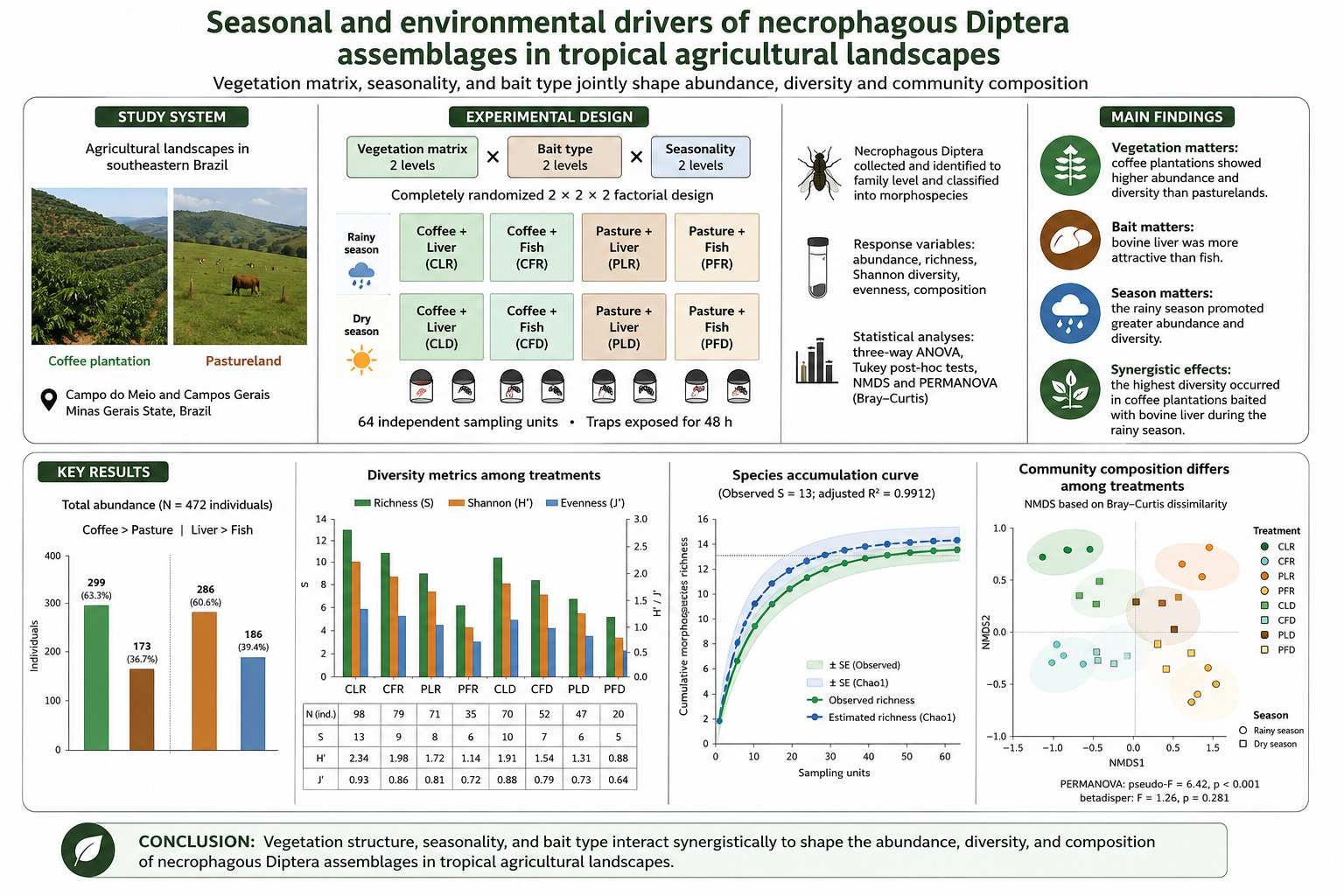
Carrion-associated Diptera play important ecological roles in nutrient cycling and decomposition processes, yet the combined effects of vegetation structure, seasonality, and resource quality on their assemblage organization in tropical agricultural systems remain poorly understood. This study evaluated the influence of vegetation matrix, seasonal variation, and bait type on the abundance, richness, diversity, and community composition of necrophagous Diptera in agricultural landscapes of southeastern Brazil. Sampling followed a completely randomized factorial design combining two vegetation matrices, coffee plantations and pasturelands, with two bait types, bovine liver and fish, across dry and rainy seasons, totaling 64 independent sampling units. Traps remained exposed for 48 h, and collected specimens were identified to family level and classified into morphospecies. Community structure was evaluated using diversity indices, factorial analyses, Tukey post-hoc tests, and multivariate analyses based on Bray–Curtis dissimilarity, including NMDS and PERMANOVA. A total of 472 individuals distributed among 13 morphospecies and seven Diptera families were recorded. Coffee plantations exhibited higher abundance and diversity values than pasture areas, particularly during the rainy season, whereas bovine liver showed greater attractiveness than fish bait. The highest diversity values were observed in coffee plantations baited with bovine liver during the rainy season, suggesting synergistic interactions among vegetation complexity, climatic conditions, and resource quality. Multivariate analyses revealed significant differences in community composition among treatments. Overall, vegetation structure, seasonality, and bait type jointly influenced the organization of necrophagous Diptera assemblages under the evaluated tropical agricultural conditions.
References
Amendt, J., Richards, C. S., Campobasso, C. P., Zehner, R., & Hall, M. J. R. (2011). Forensic entomology: applications and limitations. Forensic Science, Medicine and Pathology, 7, 379-392. https://doi.org/10.1007/s12024-010-9209-2 DOI: https://doi.org/10.1007/s12024-010-9209-2
Barton, P. S., Cunningham, S. A., Lindenmayer, D. B., & Manning, A. D. (2013). The role of carrion in maintaining biodiversity and ecological processes in terrestrial ecosystems. Oecologia, 171, 761-772. https://doi.org/10.1007/s00442-012-2460-3 DOI: https://doi.org/10.1007/s00442-012-2460-3
Benbow, M. E., Barton, P. S., Ulyshen, M. D., Beasley, J. C., DeVault, T. L., Strickland, M. S., Tomberlin, J. K., Jordan, H. R., & Pechal, J. L. (2019). Necrobiome framework for bridging decomposition ecology of autotrophically and heterotrophically derived organic matter. Ecological Monographs, 89(2), e01331. https://doi.org/10.1002/ecm.1331 DOI: https://doi.org/10.1002/ecm.1331
Benbow, M. E., Tomberlin, J. K., & Tarone, A. M. (2015). Carrion ecology, evolution, and their applications. Boca Raton: CRC Press. https://doi.org/10.1201/9781003610885 DOI: https://doi.org/10.1201/b18819
Carrera, M. (1967). Insetos de interesse médico e veterinário. São Paulo: Editora da Universidade de São Paulo.
Carvalho, C. J. B., & Queiroz, R. G. (2003). Chave para identificação das famílias de Diptera do Brasil. Curitiba: Universidade Federal do Paraná.
Dekeirsschieter, J., Verheggen, F. J., Gohy, M., Hubrecht, F., Bourguignon, L., Lognay, G., & Haubruge, E. (2009). Cadaveric volatile organic compounds released by decaying pig carcasses (Sus domesticus L.) in different biotopes. Forensic Science International, 189, 46-53. https://doi.org/10.1016/j.forsciint.2009.03.034 DOI: https://doi.org/10.1016/j.forsciint.2009.03.034
Fahrig, L. (2017). Ecological responses to habitat fragmentation per se. Annual Review of Ecology, Evolution, and Systematics, 48, 1-23. https://doi.org/10.1146/annurev-ecolsys-110316-022612 DOI: https://doi.org/10.1146/annurev-ecolsys-110316-022612
Moreira, E. A., Pinto, G. S., Neves, L. C. R. S., & Martins, C. A. (2014). Fauna de dípteros necrófagos e suas respostas à complexidade vegetal. Revista da Universidade Vale do Rio Verde, 12(1), 444-454. http://dx.doi.org/10.5892/ruvrd.v12i1.1373 DOI: https://doi.org/10.5892/ruvrd.v12i1.1373
Moretti, M., Dias, A. T. C., de Bello, F., Altermatt, F., Chown, S. L., Azcárate, F. M., et al. (2017). Handbook of protocols for standardized measurement of terrestrial invertebrate functional traits. Functional Ecology, 31(3), 558-567. https://doi.org/10.1111/1365-2435.12776 DOI: https://doi.org/10.1111/1365-2435.12776
Oliveira-Costa, J., & Vasconcelos, S. D. (2021). Insect succession on carrion and its importance in forensic entomology. Entomologia Experimentalis et Applicata, 169(1), 7-19. https://doi.org/10.1111/eea.12963 DOI: https://doi.org/10.1111/eea.12963
Paczkowski, S., & Schütz, S. (2011). Post-mortem volatiles of vertebrate tissue. Applied Microbiology and Biotechnology, 91, 917-935. https://doi.org/10.1007/s00253-011-3413-y DOI: https://doi.org/10.1007/s00253-011-3417-x
Prevedello, J. A., & Vieira, M. V. (2010). Does the type of matrix matter? A quantitative review of the evidence. Biodiversity and Conservation, 19, 1205-1223. https://doi.org/10.1007/s10531-010-9750-z DOI: https://doi.org/10.1007/s10531-009-9750-z
Pyke, G. H. (1984). Optimal foraging theory: a critical review. Annual Review of Ecology and Systematics, 15, 523-575. https://doi.org/10.1146/annurev.es.15.110184.002515 DOI: https://doi.org/10.1146/annurev.es.15.110184.002515
R Core Team. (2023). R: A language and environment for statistical computing. Vienna: R Foundation for Statistical Computing.
Sánchez-Bayo, F., & Wyckhuys, K. A. G. (2019). Worldwide decline of the entomofauna: a review of its drivers. Biological Conservation, 232, 8-27. https://doi.org/10.1016/j.biocon.2019.01.020 DOI: https://doi.org/10.1016/j.biocon.2019.01.020
Seibold, S., Gossner, M. M., Simons, N. K., Blüthgen, N., Müller, J., Ambarlı, D., et al. (2019). Arthropod decline in grasslands and forests is associated with landscape-level drivers. Nature, 574, 671-674. https://doi.org/10.1038/s41586-019-1684-3 DOI: https://doi.org/10.1038/s41586-019-1684-3
Tomberlin, J. K., Mohr, R., Benbow, M. E., Tarone, A. M., & VanLaerhoven, S. (2011). A roadmap for bridging basic and applied research in forensic entomology. Annual Review of Entomology, 56, 401-421. https://doi.org/10.1146/annurev-ento-051710-103143 DOI: https://doi.org/10.1146/annurev-ento-051710-103143
Tscharntke, T., Tylianakis, J. M., Rand, T. A., Didham, R. K., Fahrig, L., Batáry, P., Bengtsson, J., Clough, Y., Crist, T. O., Dormann, C. F., Ewers, R. M., Fründ, J., Holt, R. D., Holzschuh, A., Klein, A. M., Kleijn, D., Kremen, C., Landis, D. A., Laurance, W., Lindenmayer, D., Scherber, C., Sodhi, N., Steffan-Dewenter, I., Thies, C., van der Putten, W., & Westphal, C. (2012). Landscape moderation of biodiversity patterns and processes. Biological Reviews, 87(3), 661-685. https://doi.org/10.1111/j.1469-185X.2011.00216.x DOI: https://doi.org/10.1111/j.1469-185X.2011.00216.x
Wang, Y., Li, X., Zhang, Y., & Chen, H. (2022). Resource type influences carrion-associated Diptera assemblages in subtropical environments. Journal of Insect Science, 22(5), 1-10. https://doi.org/10.1093/jisesa/ieac045 DOI: https://doi.org/10.1093/jisesa/ieac045
Downloads
Published
How to Cite
Issue
Section
License
Copyright (c) 2026 Lilian Cristina Rocha Silva, Edimar Agnaldo Moreira, Cleiton Antônio Martins

This work is licensed under a Creative Commons Attribution 4.0 International License.
Authors who publish with this journal agree to the following terms:
1) Authors retain copyright and grant the journal right of first publication with the work simultaneously licensed under a Creative Commons Attribution License that allows others to share the work with an acknowledgement of the work's authorship and initial publication in this journal.
2) Authors are able to enter into separate, additional contractual arrangements for the non-exclusive distribution of the journal's published version of the work (e.g., post it to an institutional repository or publish it in a book), with an acknowledgement of its initial publication in this journal.
3) Authors are permitted and encouraged to post their work online (e.g., in institutional repositories or on their website) prior to and during the submission process, as it can lead to productive exchanges, as well as earlier and greater citation of published work.