Sorghum mosaic disease: Epidemiology, transmission, and management challenges of sorghum mosaic caused by sorghum mosaic virus in tropical agricultural systems
DOI:
https://doi.org/10.14295/bjs.v5i9.900Keywords:
sorghum mosaic virus, sorghum, viral epidemiology, aphids, integrated managementAbstract
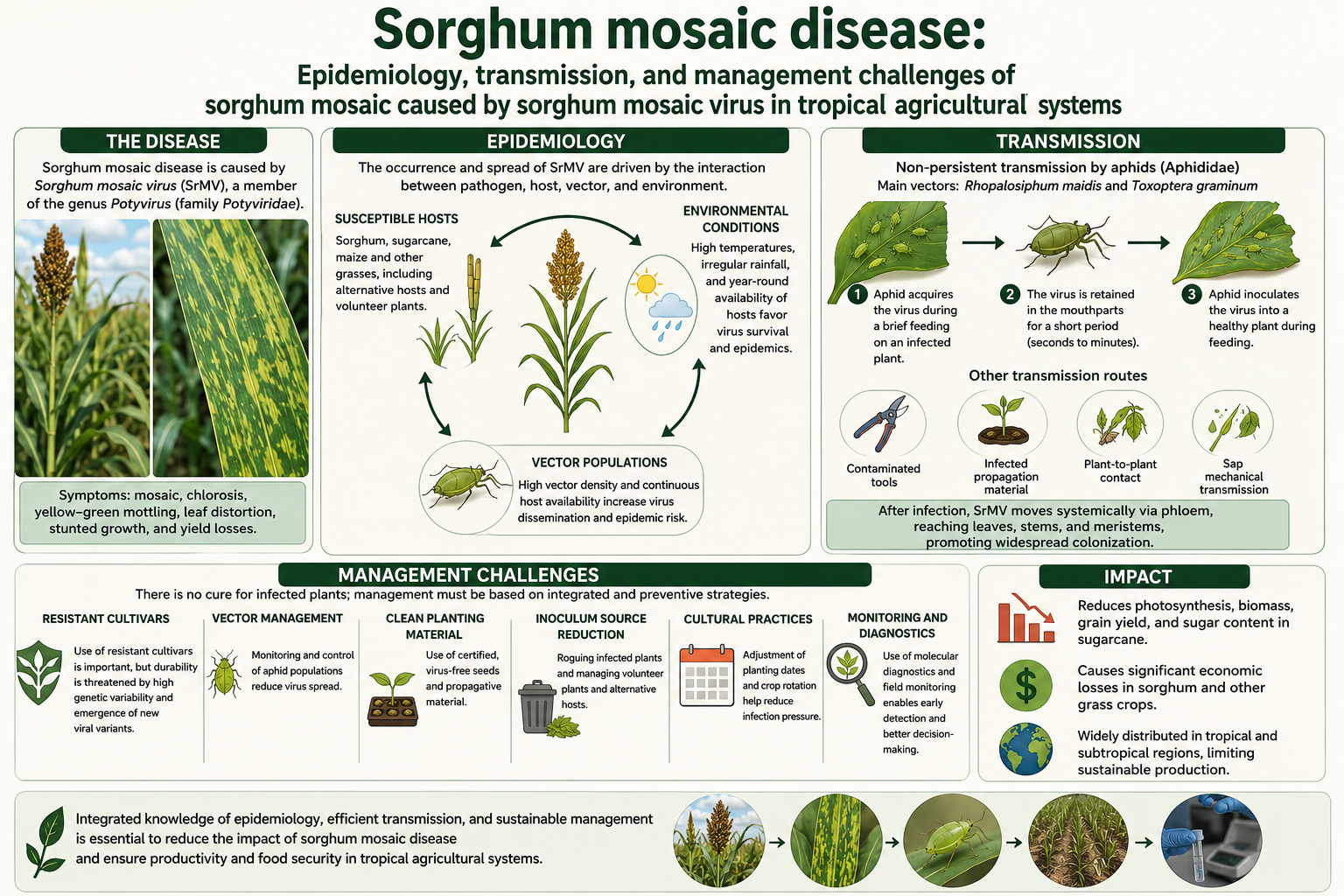
Sorghum (Sorghum bicolor L. Moench) is a crop of major relevance for food security, animal production, and bioenergy, particularly due to its high tolerance to water deficit and adaptability to adverse environmental conditions. However, its productivity is significantly constrained by viral diseases, among which sorghum mosaic, caused by Sorghum mosaic virus, stands out as one of the most economically important. In this context, this study aimed to critically review the epidemiology, transmission mechanisms, and management challenges associated with SrMV in tropical agricultural systems. This work was conducted as a qualitative literature review, based on a systematic search of scientific articles, books, dissertations, theses, and technical reports published between 2020 and 2025, retrieved from national and international scientific databases. The findings indicate that SrMV, a member of the genus Potyvirus, exhibits high genetic variability, which enhances its adaptive potential and contributes to its widespread distribution. The virus is primarily transmitted by aphids in a non-persistent manner, with epidemiological dynamics strongly influenced by tropical environmental conditions, the abundance of alternative host plants, and the continuous presence of susceptible grass species in cropping systems. Disease management is largely dependent on preventive and integrated strategies, including the deployment of resistant cultivars, effective vector control, eradication of inoculum sources, and the implementation of integrated pest management (IPM) practices. Overall, the study highlights that a comprehensive understanding of the epidemiological behavior and transmission biology of SrMV is essential for the development of sustainable and effective management strategies, thereby supporting the stability and productivity of sorghum-based cropping systems in tropical regions.
References
Abreha, K. B., Enyew, M., Carlsson, A. S., Vetukuri, R. R., Feyissa, T., Motlhaodi, T., Ng’Uni, D., & Geleta, M. (2022). Sorghum in drylands: morphological, physiological and molecular responses of sorghum under drought stress. Planta, 255, 20. https://doi.org/10.1007/s00425-021-03799-7 DOI: https://doi.org/10.1007/s00425-021-03799-7
Agyemang, E. D., Ofosu, R., Desiderio, F., Galbacs, Z. N., Takács, A. P., & Varállyay, É. (2025). The occurrence and diversity of viroses identified in monocotyledonous weeds. Agronomy, 15(1), 74. https://doi.org/10.3390/agronomy15010074 DOI: https://doi.org/10.3390/agronomy15010074
Bueno, M. P., Oliveira, E. A., & Dias, F. X. (2024). Manejo de sorgo no Brasil: inovações tecnológicas e cultivares utilizadas. International Journal of Scientific Management and Tourism, 10(2), 1-25. DOI: https://doi.org/10.55905/ijsmtv10n2-037
Chavula, P. (2022). Successes of integrated pest management in sorghum production: a review. International Journal of Academic and Applied Research (IJAAR), 6(7), 110-115.
Chen, J., Zeng, Z., Chen, J., Li, Y., Zhang, Y., Maqsood, A., Chen, J., & Shen, W. (2025). Silicon application enhances resistance against sorghum mosaic virus infection in sugarcane. Physiologia Plantarum, 177(1), e70127. https://doi.org/10.1111/ppl.70127 DOI: https://doi.org/10.1111/ppl.70127
Cui, H., & Wang, A. (2016). Plum pox virus 6k1 protein is required for viral replication and targets the viral replication complex at the early stage of infection. Journal of Virology, 90(10), 5119-5131. https://doi.org/10.1128/JVI.00024-16 DOI: https://doi.org/10.1128/JVI.00024-16
Fingu-Mabola, J. C., & Francis, F. (2021). Aphid–plant–phytovirus pathosystems: factors influencing from vector behaviour to virus spread. Agriculture, 11(6), 502. https://doi.org/10.3390/agriculture11060502 DOI: https://doi.org/10.3390/agriculture11060502
Goh, C. J., & Hahn, Y. (2021). Analysis of proteolytic processing sites in potyvirus polyproteins revealed differential amino acid preferences of Nia-pro protease in each of seven cleavage sites. PLOS One, 16(1), e0245853. https://doi.org/10.1371/journal.pone.0245853 DOI: https://doi.org/10.1371/journal.pone.0245853
Hadebe, S. T., Modi, A. T., & Mabhaudhi, T. (2017). Drought tolerance and water use of cereal crops: a focus on sorghum as a food security crop in Sub-Saharan Africa. Journal of Agronomy and Crop Science, 203(3), 177-191. https://doi.org/10.1111/jac.12191 DOI: https://doi.org/10.1111/jac.12191
Hossain, M. S., Islam, M. N., Rahman, M. M., Mostofa, M. G., & Khan, M. A. R. (2022). Sorghum: a prospective crop for climatic vulnerability, food and nutritional security. Journal of Agriculture and Food Research, 8, 100300. https://doi.org/10.1016/j.jafr.2022.100300 DOI: https://doi.org/10.1016/j.jafr.2022.100300
Inoue-Nagata, A. K., Jordan, R., Kreuze, J., Li, F., López-Moya, J. J., Mäkinen, K., Ohshima, K., & Wylie, S. J. (2022). ICTV virus taxonomy profile: Potyviridae 2022. Journal of General Virology, 103(5), 001738. https://doi.org/10.1099/jgv.0.001738 DOI: https://doi.org/10.1099/jgv.0.001738
Karimi, N., & Saeidi, H. (2022). A taxonomic revision of the genus Sorghum Moench (Poaceae: Andropogoneae) in Iran. Iranian Journal of Botany, 28(1). https://doi.org/10.22092/ijb.2022.126795
Kazungu, F. K., Muindi, E. M., & Mulinge, J. M. (2023). Overview of sorghum (Sorghum bicolor L.), its economic importance, ecological requirements and production constraints in Kenya. International Journal of Plant & Soil Science. https://dx.doi.org/10.9734/IJPSS/2023/v35i12744 DOI: https://doi.org/10.9734/ijpss/2023/v35i12744
Khalifa, M., & Eltahir, E. A. B. (2023). Assessment of global sorghum production, tolerance, and climate risk. Frontiers in Sustainable Food Systems, 7, 1184373. https://doi.org/10.3389/fsufs.2023.1184373 DOI: https://doi.org/10.3389/fsufs.2023.1184373
Klein, P., & Smith, C. M. (2020). Host plant selection and virus transmission by Rhopalosiphum maidis are conditioned by potyvirus infection in Sorghum bicolor. Arthropod-Plant Interactions, 14, 811-823. https://doi.org/10.1007/s11829-020-09783-4 DOI: https://doi.org/10.1007/s11829-020-09783-4
Lu, G., Wang, Z., Xu, F., Pan, Y-B., Grisham, M. P., & Xu, L. (2021). Sugarcane mosaic disease: characteristics, identification and control. Microorganisms, 9(9), 1984. https://doi.org/10.3390/microorganisms9091984. DOI: https://doi.org/10.3390/microorganisms9091984
Majer, E., Salvador, Z., Zwart, M. P., Willemsen, A., Elena, S. F., & Daròs, J-A. (2014). Relocation of the Nib gene in the Tobacco etch Potyvirus genome. Journal of Virology, 88(8). https://doi.org/10.1128/jvi.03336-13 DOI: https://doi.org/10.1128/JVI.03336-13
Mäkinen, K., Aspelin, W., Pollari, M., & Wang, L. (2023). How do they do it? The infection biology of potyviruses. Advances in Virus Research, 117, 1-79. https://doi.org/10.1016/bs.aivir.2023.07.001 DOI: https://doi.org/10.1016/bs.aivir.2023.07.001
Mathur, S., Umakanth, A.V., Tonapi, V. A. (2017). Sweet sorghum as biofuel feedstock: recent advances and available resources. Biotechnol Biofuels, 10, 146. https://doi.org/10.1186/s13068-017-0834-9 DOI: https://doi.org/10.1186/s13068-017-0834-9
Mauck, K., Bosque-Pérez, N. A., Eigenbrode, S. D., Moraes, C. M., & Mescher, M. C. (2012). Transmission mechanisms shape pathogen effects on host–vector interactions: evidence from plant viruses. Functional Ecology, 26(5), 1162-1175. https://doi.org/10.1111/j.1365-2435.2012.02026.x DOI: https://doi.org/10.1111/j.1365-2435.2012.02026.x
Mei, Y., Liu, G., Zhang, C., Hill, J. H., & Whitham, S. A. (2019). A sugarcane mosaic virus vector for gene expression in maize. Plant Direct, 3(8), e00158. https://doi.org/10.1002/pld3.158 DOI: https://doi.org/10.1002/pld3.158
Minayo, M. C. S. (2012). Análise qualitativa: teoria, passos e fidedignidade. Ciências & Saúde Coletiva, 17(3), 621-626. DOI: https://doi.org/10.1590/S1413-81232012000300007
Mollov, D., Grinstead, S., Warnke, K., Grisham, M., Hale, A., Daugrois, J. H., Roumagnac, P., & Rott, P. C. (2025). Evidence for an Asian origin of Sorghum mosaic virus infecting sugarcane in Louisiana and the Western hemisphere. Plant Disease, 109(9). https://doi.org/10.1094/PDIS-11-24-2359-RE DOI: https://doi.org/10.1094/PDIS-11-24-2359-RE
Nemera, B., Kebede, M., Enyew, M., & Feyissa, T. (2022). Genetic diversity and population structure of sorghum [Sorghum bicolor (L.) Moench] in Ethiopia as revealed by microsatellite markers. Acta Agriculturae Scandinavica, Section B — Soil & Plant Science, 72(1), 873-884. https://doi.org/10.1080/09064710.2022.2117078 DOI: https://doi.org/10.1080/09064710.2022.2117078
Okosun, O. O., Allen, K. C., Glover, J. P., & Reddy, G. V. P. (2021). Biology, ecology, and management of key sorghum insect pests. Journal of Integrated Pest Management, 12(1), 1-18. https://doi.org/10.1093/jipm/pmaa027 DOI: https://doi.org/10.1093/jipm/pmaa027
Rice, J. L., & Hoy, J. W. (2020). Recovery from mosaic caused by sorghum mosaic virus in sugarcane and impact on yield. Plant Disease, 104(12), 3166-3172. https://doi.org/10.1094/PDIS-02-20-0376-RE DOI: https://doi.org/10.1094/PDIS-02-20-0376-RE
Santos, G. C. L., Garcia, P., & Gonzaga Neto, S. (2020). Crescimento e eficiência do uso da água do sorgo sob distintos regimes hídricos contínuos. Archivos de Zootecnia, 69(266), 164-172 DOI: https://doi.org/10.21071/az.v69i266.5111
Silva, W. O., Barros, J. R. A., Simões, W. L., Oliveira, A. R., Nascimento, L. A., Angelotti, F. (2024). Disponibilidade hídrica e temperatura da época de cultivo no desempenho de cultivares de sorgo. Agrária - Revista Brasileira de Ciências Agrárias, 19(2), e3665. https://doi.org/10.5039/agraria.v19i2a3665 DOI: https://doi.org/10.5039/agraria.v19i2a3665
Silveira, E. S. R. (2023). Consultoria: safra de sorgo 2022/23 – acompanhamento e manejo na mesorregião do sul e sudoeste de Minas Gerais - MG. 2023. Monografia, graduação em Bacharelado em Agronomia pela Universidade Federal de Lavras, Lavras, MG, Brasil. Available at: https://r.search.yahoo.com/_ylt=AwrijEQhjgtqrFEDdSkf7At.;_ylu=Y29sbwNiZjEEcG9zAzEEdnRpZAMEc2VjA3Ny/RV=2/RE=1779170978/RO=10/RU=https%3a%2f%2fsip.prg.ufla.br%2farquivos%2fphp%2fbibliotecas%2frepositorio%2fdownload_documento%2fbaixar_por_anosemestre_matricula.php%3farquivo%3d20231_201820088/RK=2/RS=G4E7.sFQNuBZAYvXHR4y4tpy7F4-. Accessed on May 01, 2026.
Souza, I. R. P., Xavier, A. S., Vasconcelos, M. J. V., & Barros, B. A. (2020). Espécies de potyvírus causando mosaico comum em sorgo no estado de Minas Gerais. Sete Lagoas: EMBRAPA, 28 p. (Boletim de Pesquisa e Desenvolvimento, 199). Available at: https://www.researchgate.net/publication/338486881_Especies_de_Potyvirus_Causando_Mosaico_Comum_em_Sorgo_no_Estado_de_Minas_Gerais. Accessed on May 18, 2026.
Spindel, J. E., Dahlberg, J., Colgan, M., Hollingworth, J., Sivert, J., Staggenborg, S. H., Hutmacher, R., Jansson, C., & Vogel, J. P. (2018). Association mapping by aerial drone reveals 213 genetic associations for Sorghum bicolor biomass traits under drought. BMC Genomics, 19, 679. DOI: https://doi.org/10.1186/s12864-018-5055-5
Parizipour, M. G., Tahmasebi, A., & Shahriari, A. G. (2025). Computational analysis of microRNAs in sweet Sorghum (Sorghum bicolor) infected by Sorghum mosaic virus. Sugar Tech, 27, 1796-1805. https://doi.org/10.1007/s12355-025-01622-1 DOI: https://doi.org/10.1007/s12355-025-01622-1
Viswanathan, R., Nithya, K., Vishnuvardhan, J., Balasaravanan, S., Kaverinathan, K., & Visalatchi, D. (2023). Sorghum (Sorghum bicolor) a new host to sugarcane yellow leaf and mosaic viruses in India. Indian Phytopathology, 76, 867-877. https://doi.org/10.1007/s42360-023-00662-5 DOI: https://doi.org/10.1007/s42360-023-00662-5
Widysari, K., Alazem, M., & Kim, K-H. (2020). Soybean resistance to soybean mosaic virus. Plants, 9(2), 219. https://doi.org/10.3390/plants9020219 DOI: https://doi.org/10.3390/plants9020219
Xu, H-M., He, E-Q., Yang, Z. L., Bi, Z-W., Bao, W. Q., Su, S-R., Lu, J-J., & Gao, S-J. (2023). Phylogeny and genetic divergence among Sorghum mosaic virus isolates infecting sugarcane. Plants, 12(21), 3759. https://doi.org/10.3390/plants12213759 DOI: https://doi.org/10.3390/plants12213759
Yin, Y., Wang, M., Sun, Y., Zhao, P., & Ye, J. (2026). Sugarcane viral diseases: Epidemiology, detection, and advanced breeding methods for resistance. Virology, 621, 110940. https://doi.org/10.1016/j.virol.2026.110940 DOI: https://doi.org/10.1016/j.virol.2026.110940
Zhang, H., Cheng, G., Ynag, Z., Wang, T., & Xu, J. (2019). Identification of sugarcane host factors interacting with the 6k2 protein of the sugarcane mosaic virus. International Journal of Molecular Sciences, 20(16), 3867. https://doi.org/10.3390/ijms20163867 DOI: https://doi.org/10.3390/ijms20163867
Zhang, Y. L., Pennerman, K. K., Wang, H., & Yin, G. (2026). Characterization of a Sorghum mosaic virus (SrMV) isolate in China. Saudi Journal of Biological Sciences, 23(2), 237-242. https://doi.org/10.1016/j.sjbs.2015.02.013 DOI: https://doi.org/10.1016/j.sjbs.2015.02.013
Downloads
Published
How to Cite
Issue
Section
License
Copyright (c) 2026 Osvaldo Mascarenhas Neto, Alinne Crisóstomo de Moraes, Cláudio Roberto da Silva Júnior, Hellen Dias Neres, Jéssica Tatielle Martins Freitas, José Saraiva Lucena Júnior, Rian Freitas Veríssimo, Sophy Louise Lassance Dantas, Antonio Carlos Pereira de Menezes Filho

This work is licensed under a Creative Commons Attribution 4.0 International License.
Authors who publish with this journal agree to the following terms:
1) Authors retain copyright and grant the journal right of first publication with the work simultaneously licensed under a Creative Commons Attribution License that allows others to share the work with an acknowledgement of the work's authorship and initial publication in this journal.
2) Authors are able to enter into separate, additional contractual arrangements for the non-exclusive distribution of the journal's published version of the work (e.g., post it to an institutional repository or publish it in a book), with an acknowledgement of its initial publication in this journal.
3) Authors are permitted and encouraged to post their work online (e.g., in institutional repositories or on their website) prior to and during the submission process, as it can lead to productive exchanges, as well as earlier and greater citation of published work.