Effects of plant growth-promoting bacteria on maize performance: A systematic review and meta-analysis
DOI:
https://doi.org/10.14295/bjs.v5i9.882Keywords:
rhizobacteria, bioinoculants, crop yield, plant–microbe interactions, sustainable agricultureAbstract
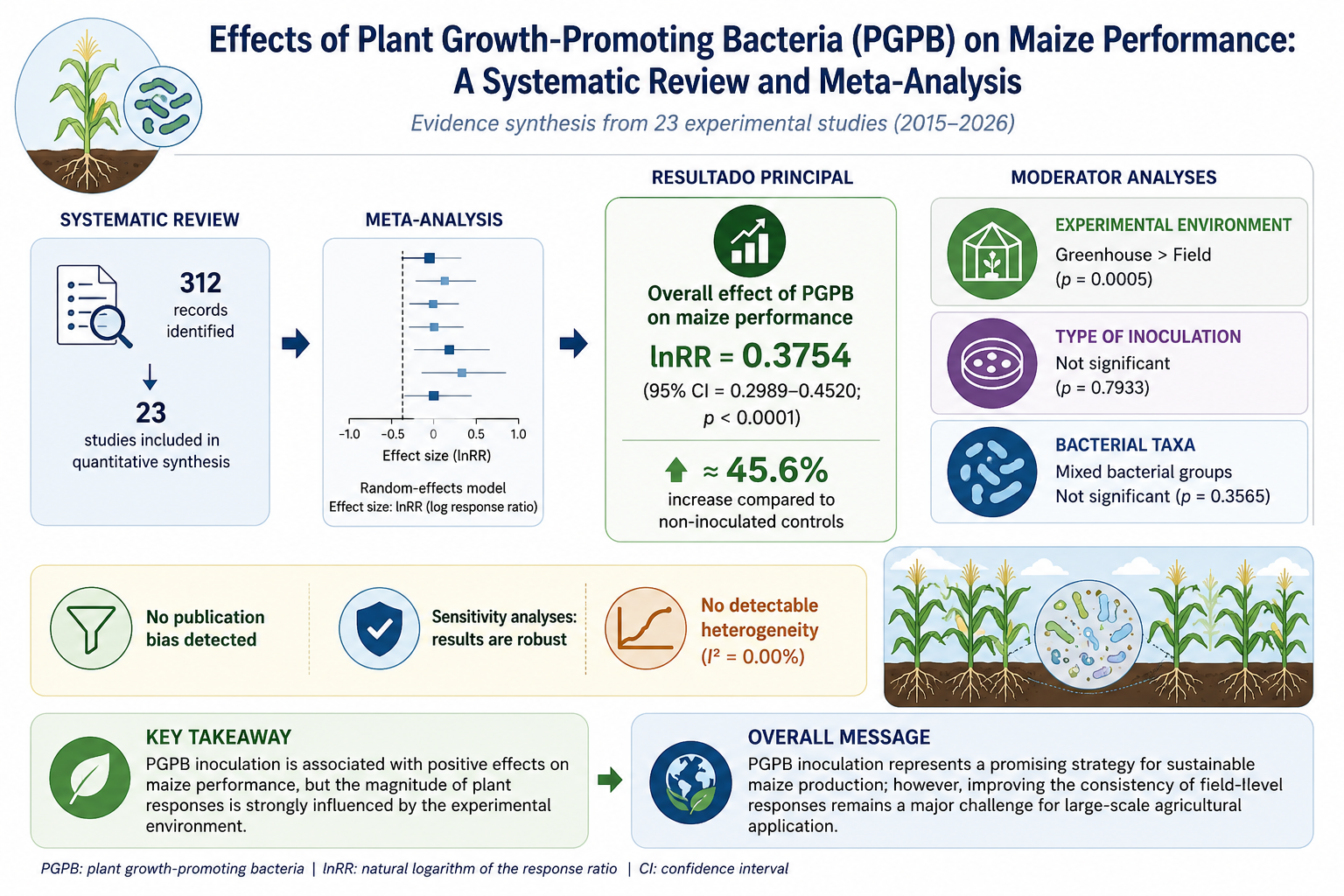
Plant growth-promoting bacteria (PGPB) have been increasingly investigated as sustainable alternatives for improving crop productivity and reducing dependence on chemical fertilizers in agricultural systems. However, the effectiveness of microbial inoculation in maize remains variable across environmental and experimental conditions. This study aimed to quantify the overall effects of PGPB inoculation on maize performance and evaluate the influence of environmental and microbial factors on plant responses through a systematic review and meta-analysis. The review followed PRISMA 2020 guidelines and included experimental studies published between 2015 and 2026. A total of 23 studies providing sufficient statistical information met the eligibility criteria and were included in the quantitative synthesis. To ensure transparency and reproducibility, the complete dataset, PRISMA 2020 flow diagram, methodological quality assessment, and detailed search strategies are provided as supplementary materials. Effect sizes were calculated using the natural logarithm of the response ratio (lnRR) and analyzed using random-effects models. PGPB inoculation was generally associated with positive effects on maize performance, with an overall pooled effect size of lnRR = 0.3754 (95% CI = 0.2989–0.4520; p < 0.0001), corresponding to an average increase of approximately 45.6% relative to non-inoculated controls. No detectable heterogeneity was observed among studies (I² = 0.00%), indicating relatively consistent responses within the analyzed dataset. Moderator analyses demonstrated that the experimental environment significantly influenced the magnitude of plant responses, with greenhouse studies showing stronger positive effects than field experiments. No statistically significant differences were detected among inoculation types or bacterial taxa. Publication bias was not detected, and sensitivity analyses indicated that the pooled effect size was not disproportionately influenced by individual studies. Overall, the findings suggest that PGPB inoculation may represent a promising strategy for sustainable maize production, although the magnitude and consistency of responses remain dependent on environmental context and experimental conditions. The study also highlights the importance of integrating microbial functional traits, environmental filters, and microbiome interactions to improve the field-level performance of microbial inoculants in agricultural systems.
References
Backer, R., Rokem, J. S., Ilangumaran, G., Lamont, J., Praslickova, D., Ricci, E., Subramanian, S., & Smith, D. L. (2018). Plant growth-promoting rhizobacteria: Context, mechanisms of action, and roadmap to commercialization of biostimulants for sustainable agriculture. Frontiers in Plant Science, 9, 1473. https://doi.org/10.3389/fpls.2018.01473 DOI: https://doi.org/10.3389/fpls.2018.01473
Barbosa, J. Z., Hungria, M., Corrêa, R. S., Magri, E., Correia, T. D., & Roberto, L. A. (2022). Meta-analysis of maize responses to Azospirillum brasilense inoculation in Brazil: Benefits and lessons to improve inoculation efficiency. Applied Soil Ecology, 170, 104276. https://doi.org/10.1016/j.apsoil.2021.104276 DOI: https://doi.org/10.1016/j.apsoil.2021.104276
Basu, A., Prasad, P., Das, S. N., Kalam, S., Sayyed, R. Z., Reddy, M. S., & El Enshasy, H. (2021). Plant growth promoting rhizobacteria (PGPR) as green bioinoculants: Recent developments, constraints, and prospects. Sustainability, 13(3), 1140. https://doi.org/10.3390/su13031140 DOI: https://doi.org/10.3390/su13031140
Borenstein, M., Hedges, L. V., Higgins, J. P. T., & Rothstein, H. R. (2009). Introduction to meta-analysis. John Wiley & Sons. https://doi.org/10.1002/9780470743386 DOI: https://doi.org/10.1002/9780470743386
Compant, S., Samad, A., Faist, H., & Sessitsch, A. (2019). A review on the plant microbiome: Ecology, functions, and emerging trends. Microorganisms, 7(2), 29. https://doi.org/10.3390/microorganisms7020029 DOI: https://doi.org/10.1016/j.jare.2019.03.004
French, E., Kaplan, I., Iyer-Pascuzzi, A., Nakatsu, C. H., & Enders, L. (2021). Emerging strategies for precision microbiome management in agriculture. Nature Plants, 7(3), 256-267. https://doi.org/10.1038/s41477-021-00878-9 DOI: https://doi.org/10.1038/s41477-020-00830-9
Galindo, F. S., Teixeira Filho, M. C. M., Buzetti, S., Santini, J. M. K., Ludkiewicz, M. G. Z., Baggio, G., & Andreotti, M. (2019). Maize yield response to nitrogen rates and sources associated with Azospirillum brasilense. Agronomy Journal, 111(4), 1985-1997. https://doi.org/10.2134/agronj2018.07.0481 DOI: https://doi.org/10.2134/agronj2018.07.0481
Kaminsky, L. M., Trexler, R. V., Malik, R. J., Hockett, K. L., & Bell, T. H. (2019). The inherent conflicts in developing soil microbial inoculants. Trends in Biotechnology, 37(2), 140-151. https://doi.org/10.1016/j.tibtech.2018.11.011 DOI: https://doi.org/10.1016/j.tibtech.2018.11.011
Ke, X., Feng, S., Wang, J., Lu, W., Zhang, W., Chen, M., Lin, M., Gai, J., Xu, M., & Guo, Y. (2019). Effects of inoculation with Pseudomonas stutzeri A1501 on maize plant growth and rhizosphere microbiome. Systematic and Applied Microbiology, 42(2), 248-260. https://doi.org/10.1016/j.syapm.2018.10.010 DOI: https://doi.org/10.1016/j.syapm.2018.10.010
Meena, M., Swapnil, P., Zehra, A., Dubey, M. K., & Upadhyay, R. S. (2020). PGPR-mediated induction of systemic resistance and physio-chemical alterations in plants against pathogens: Current perspectives. Journal of Basic Microbiology, 60(10), 828-861. https://doi.org/10.1002/jobm.202000273 DOI: https://doi.org/10.1002/jobm.202000370
Nascimento, F. X., Hernández, A. G., Glick, B. R., Rossi, M. J., & Rodrigues, E. P. (2020). Plant growth-promoting bacteria improve growth and nutrient use efficiency in maize under water deficit conditions. Heliyon, 6(9), e05106. https://doi.org/10.1016/j.heliyon.2020.e05106 DOI: https://doi.org/10.1016/j.heliyon.2020.e05106
Niu, B., Paulson, J. N., Zheng, X., & Kolter, R. (2017). Simplified and representative bacterial community of maize roots. Proceedings of the National Academy of Sciences of the United States of America, 114(12), E2450–E2459. https://doi.org/10.1073/pnas.1616148114 DOI: https://doi.org/10.1073/pnas.1616148114
Olanrewaju, O. S., Glick, B. R., & Babalola, O. O. (2017). Mechanisms of action of plant growth-promoting bacteria. World Journal of Microbiology and Biotechnology, 33(11), 197. https://doi.org/10.1007/s11274-017-2364-9 DOI: https://doi.org/10.1007/s11274-017-2364-9
Rohatgi, A. (2022). WebPlotDigitizer. Version 4.6. https://automeris.io/WebPlotDigitizer
Sandini, I. E., Pacentchuk, F., Hungria, M., Nogueira, M. A., Cruz, S. P., Nakatani, A. S., & Araujo, R. S. (2019). Seed inoculation with Pseudomonas fluorescens promotes growth, yield and reduces nitrogen application in maize. International Journal of Agriculture and Biology, 22(6), 1369-1375. https://doi.org/10.17957/IJAB/15.1210 DOI: https://doi.org/10.17957/IJAB/15.1210
Schütz, L., Gattinger, A., Meier, M., Müller, A., Boller, T., Mäder, P., & Mathimaran, N. (2018). Improving crop yield and nutrient use efficiency via biofertilization—A global meta-analysis. Frontiers in Plant Science, 8, 2204. https://doi.org/10.3389/fpls.2017.02204 DOI: https://doi.org/10.3389/fpls.2017.02204
Trivedi, P., Leach, J. E., Tringe, S. G., Sa, T., & Singh, B. K. (2020). Plant–microbiome interactions: From community assembly to plant health. Nature Reviews Microbiology, 18(11), 607-621. https://doi.org/10.1038/s41579-020-0412-1 DOI: https://doi.org/10.1038/s41579-020-0412-1
Vejan, P., Abdullah, R., Khadiran, T., Ismail, S., & Boyce, A. N. (2016). Role of plant growth promoting rhizobacteria in agricultural sustainability. Molecules, 21(5), 573. https://doi.org/10.3390/molecules21050573 DOI: https://doi.org/10.3390/molecules21050573
Viechtbauer, W. (2010). Conducting meta-analyses in R with the metafor package. Journal of Statistical Software, 36(3), 1-48. https://doi.org/10.18637/jss.v036.i03 DOI: https://doi.org/10.18637/jss.v036.i03
Zeffa, D. M., Perini, L. J., Silva, M. B., Oliveira, A. L. M., Hungria, M., Nogueira, M. A., & Gonçalves, L. S. A. (2018). Influence of nitrogen topdressing on Azospirillum inoculation in maize. Bragantia, 77(4), 664-672. https://doi.org/10.1590/1678-4499.2017252 DOI: https://doi.org/10.1590/1678-4499.2017273
Downloads
Published
How to Cite
Issue
Section
License
Copyright (c) 2026 Marcos Vinício Silva, Edimar Agnaldo Moreira, Daniele Maria Marques

This work is licensed under a Creative Commons Attribution 4.0 International License.
Authors who publish with this journal agree to the following terms:
1) Authors retain copyright and grant the journal right of first publication with the work simultaneously licensed under a Creative Commons Attribution License that allows others to share the work with an acknowledgement of the work's authorship and initial publication in this journal.
2) Authors are able to enter into separate, additional contractual arrangements for the non-exclusive distribution of the journal's published version of the work (e.g., post it to an institutional repository or publish it in a book), with an acknowledgement of its initial publication in this journal.
3) Authors are permitted and encouraged to post their work online (e.g., in institutional repositories or on their website) prior to and during the submission process, as it can lead to productive exchanges, as well as earlier and greater citation of published work.