Effects of the Adoption of Improved Fish Processing Technologies on Food Security among Artisanal Fish Processors in Ondo State, Nigeria
DOI:
https://doi.org/10.14295/bjs.v5i7.857Keywords:
Processing technologies, technology adoption, food safety, fish processorsAbstract
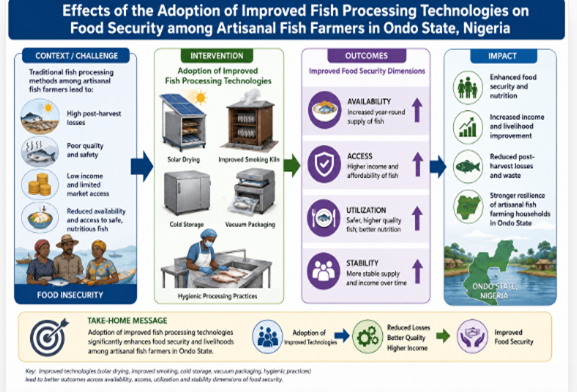
Agricultural post-harvest challenges remain a critical but under-explored dimension of food security in developing countries. This study examined the effects of adopting improved fish processing technologies on the food security status of artisanal fish processors in Ondo State, Nigeria. A multi-stage sampling technique was employed, utilizing a structured questionnaire administered through an interview schedule. Data collected were analyzed using descriptive statistics, the Foster-Greer-Thorbecke (FGT) food security index, and binary logistic regression. Four major fishing communities were purposively selected based on the intensity of artisanal fishing activities, after which respondents were randomly selected, yielding a total of 121 valid observations. The results revealed that the majority of respondents were male (52.9%), within the economically active age group, and possessed considerable processing experience. Most respondents operated at a moderate level of technology adoption (66.1%), while 63.6% were classified as food-secure. Traditional processing methods remained dominant, although improved technologies such as chorkor ovens and solar dryers were gradually being adopted. The major constraints to adoption included a lack of storage facilities, high cost of equipment, pest infestation, and weak extension services. The findings further showed that adoption of improved fish processing technologies had a significant positive effect on food security status, while access to storage facilities also improved the likelihood of being food-secure. Conversely, marital status exerted a negative influence on food security. The study concludes that the adoption of improved fish processing technologies plays a crucial role in enhancing household food security and reducing post-harvest losses. Therefore, it is recommended that the government and relevant stakeholders strengthen extension services, improve access to affordable processing technologies, and invest in storage infrastructure to promote wider adoption and ensure sustainable livelihoods among artisanal fish processors.
References
Adebayo, S. T., Yusuf, S. A., & Oyediran, W. O. (2017). Socioeconomic determinants of rural household livelihood activities in South-West Nigeria. Nigerian Journal of Agricultural Economics, 8(2), 45–58.
Adewale, B. A., Oladimeji, Y. U., & Olorunsanya, E. O. (2020). Determinants of agricultural technology adoption in Nigeria: Evidence from logit and double hurdle approaches. Journal of Agricultural Economics and Development, 9(1), 15–27. DOI: https://doi.org/10.5897/JDAE2018.0998
Adeyeye, S. A. O., Oyewole, O. B., & Obadina, A. O. (2015). Traditional fish processing methods and their implications on quality and safety in Nigeria. Food Science and Quality Management, 43, 1–9.
Agbon, A. O., Ogbonna, C. C., & Solomon, J. R. (2002). Fish preservation and processing in rural Nigeria: Challenges and prospects. Nigerian Journal of Fisheries Research, 4(2), 23–31.
Ajzen, I. (1991). The theory of planned behavior. Organizational Behavior and Human Decision Processes, 50(2), 179–211. https://doi.org/10.1016/0749-5978(91)90020-T DOI: https://doi.org/10.1016/0749-5978(91)90020-T
Akinola, A. A., Akinyemi, A. A., & Bolaji, B. O. (2006). Adoption of improved fish processing technologies in Nigeria: Constraints and prospects. Nigerian Journal of Fisheries, 3(2), 45–53.
Akinola, A. A., Akinyemi, A. A., & Bolaji, B. O. (2018). Adoption of improved fish processing technologies and livelihood outcomes among artisanal fish processors in Nigeria. Journal of Fisheries and Aquatic Sciences, 13(2), 89–98.
Amao, A. O., Adeyemi, A. A., & Oladimeji, Y. U. (2024). Fish consumption patterns and dietary protein contribution in rural Nigeria. Journal of Agricultural and Food Nutrition Studies, 12(1), 45–58.
Aminu, F. O., Adekunle, O. A., & Ojo, M. A. (2017). Income contribution of fish processing enterprises in Lagos State, Nigeria. Journal of Fisheries Economics and Development, 5(1), 33–41.
Aworh, O. C. (2008). The role of traditional food processing technologies in national development: The West African experience. African Journal of Food Agriculture Nutrition and Development, 8(1), 1–16.
Ayeloja, A. A., George, F. O., & Olusola, A. O. (2020). Economic impact of improved fish processing technologies on artisanal fishers in Nigeria. Journal of Fisheries and Aquatic Sciences, 15(2), 65–74.
Ayuba, V. O., & Omeji, S. (2006). Cold chain limitations and fish distribution in rural Nigeria. Journal of Aquatic Sciences, 21(2), 45–52.
Bolorunduro, P. I., & Adesehinwa, A. O. K. (2007). Strategies for improving fish processing technologies adoption in Nigeria. Nigerian Journal of Fisheries, 4(2), 45–53.
Bolorunduro, P. I., & Faleye, A. E. (2003). Constraints to the adoption of improved fisheries technologies in Nigeria. Journal of Applied Aquaculture, 13(1), 67–78.
Bolorunduro, P. I., Abdullahi, S. A., & Adeyemi, M. Y. (2005). Post-harvest fish losses and the need for improved processing technologies in Nigeria. Nigerian Journal of Fisheries, 2(1), 15–24.
Cochran, W. G. (1963). Sampling techniques (2nd ed.). John Wiley & Sons.
Cragg, J. G. (1971). Some statistical models for limited dependent variables with application to the demand for durable goods. Econometrica, 39(5), 829–844. https://doi.org/10.2307/1909582 DOI: https://doi.org/10.2307/1909582
Danso-Abbeam, G., Dagunga, G., & Ehiakpor, D. S. (2018). Adoption of agricultural innovations and its effects on food security among smallholder farmers in Ghana. Heliyon, 4(4), e00644. https://doi.org/10.1016/j.heliyon.2018.e00644
Davies, R. M. (2009). Adoption of improved fish processing technologies in Nigeria: Constraints and opportunities. Nigerian Journal of Fisheries, 6(1), 33–41.
Davies, R. M., & Bekibele, D. O. (2008). Traditional fish smoking methods and associated health risks in Nigeria. Journal of Fisheries Technology, 12(2), 67–74.
Eyo, A. A. (2001). Fish processing technology in the tropics. University of Ilorin Press.
Fakoya, E. O., Oloruntoba, A., & Ogunfowora, O. (2012). Women participation in fish processing and marketing in coastal fishing communities of Nigeria. International Journal of Agricultural Economics and Extension, 4(3), 123–131.
FAO. (2010). The state of world fisheries and aquaculture 2010. Food and Agriculture Organization of the United Nations. https://www.fao.org
FAO. (2014). The state of world fisheries and aquaculture 2014: Opportunities and challenges. Food and Agriculture Organization of the United Nations. https://www.fao.org
Fapojuwo, O. E., Akinbile, L. A., & Ogunyinka, E. O. (2018). Age dynamics and agricultural productivity among rural farmers in Nigeria. Journal of Agricultural Extension, 22(1), 78–88.
Federal Department of Fisheries (FDF). (2009). Annual fisheries statistics report. Federal Ministry of Agriculture and Rural Development, Nigeria.
Fishbein, M., & Ajzen, I. (1975). Belief, attitude, intention and behavior: An introduction to theory and research. Addison-Wesley.
Food and Agriculture Organization (FAO). (2018). The state of world fisheries and aquaculture 2018: Meeting the sustainable development goals. FAO. https://www.fao.org
Food and Agriculture Organization (FAO). (2020). The state of world fisheries and aquaculture 2020: Sustainability in action. FAO. https://www.fao.org
George, F. O., Akinwumi, F. O., & Adewuyi, G. O. (2014). Health implications of traditional fish smoking methods in Nigeria: Polycyclic aromatic hydrocarbons (PAHs) contamination. Food Control Journal, 38, 210–216.
Hosmer, D. W., Lemeshow, S., & Sturdivant, R. X. (2013). Applied logistic regression (3rd ed.). Wiley. DOI: https://doi.org/10.1002/9781118548387
Kumar, A., Singh, R., & Kumar, P. (2018). Youth participation in agriculture and technology adoption in developing countries. Agricultural Economics Review, 29(2), 123–134.
Kumolu-Johnson, C. A., & Ndimele, P. E. (2011). Fish production, consumption and processing in Nigeria: Status and constraints. African Journal of Aquatic Science, 36(2), 105–112.
Mwangi, M., & Kariuki, S. (2015). Factors determining the adoption of new agricultural technologies by smallholder farmers in developing countries. Journal of Agricultural and Food Economics, 3(1), 1–14.
Odediran, O. A., & Ojebiyi, W. G. (2017). Awareness and adoption of improved fish processing technologies among fish processors in Lagos State, Nigeria. International Journal of Fisheries and Aquatic Studies, 5(3), 123–130.
Okidim, I. A., & Obe-Nwaka, N. C. (2021). Experience and efficiency in fish processing among rural households in Rivers State, Nigeria. International Journal of Fisheries and Aquatic Studies, 9(3), 112–119.
Okonta, A. A., & Ekelemu, J. K. (2005). A preliminary study of microbial quality of fish smoked in traditional kilns in Nigeria. Journal of Applied Sciences and Environmental Management, 9(1), 5–10.
Oladipo, I. C., Abayomi, O. O., & Oladipo, S. O. (2015). Nutritional composition and health benefits of fish in human diet. International Journal of Fisheries and Aquatic Studies, 3(1), 45–50.
Olaoye, O. J., Ojebiyi, W. G., & Adegboye, O. S. (2015). Assessment of traditional fish smoking methods and associated health risks in Nigeria. Journal of Fisheries and Aquatic Science, 10(2), 112–120.
Olaoye, O. J., Ojebiyi, W. G., & Adegboye, O. S. (2016). Socio-economic determinants of adoption of improved aquaculture technologies in Lagos State, Nigeria. Aquaculture Research, 47(5), 1503–1513.
Olaoye, O. J., Ojebiyi, W. G., & Adegboye, O. S. (2018). Determinants of adoption of improved fish processing technologies among artisanal fish processors in Nigeria. Aquaculture International, 26(3), 789–805.
Olaoye, O. J., Oloruntoba, A., & Ojebiyi, W. G. (2020). Improved fish processing technologies and household food security among rural fish processors in Nigeria. Aquaculture Reports, 17, 100–110.
Olatunji, O. S., & Ogunremi, J. B. (2016). Economic analysis of fish farming and processing in Rivers State, Nigeria. Nigerian Journal of Agricultural Economics, 7(2), 89–97.
Oyediran, W. O., Adebayo, S. T., & Yusuf, S. A. (2016). Fish importation and food security challenges in Nigeria. African Journal of Agricultural Economics and Rural Development, 9(2), 55–64.
Papke, L. E., & Wooldridge, J. M. (1996). Econometric methods for fractional response variables with an application to 401(k) plan participation rates. Journal of Applied Econometrics, 11(6), 619–632. https://doi.org/10.1002/(SICI)1099-1255(199611)11:6<619::AID-JAE418>3.0.CO;2-1 DOI: https://doi.org/10.1002/(SICI)1099-1255(199611)11:6<619::AID-JAE418>3.0.CO;2-1
Rogers, E. M. (2003). Diffusion of innovations (5th ed.). Free Press.
World Bank. (2019). Fish to 2030: Prospects for fisheries and aquaculture. World Bank Group. https://www.worldbank.org
Downloads
Published
How to Cite
Issue
Section
License
Copyright (c) 2026 Deborah Tosin Fajobi, Damilola Toluse Adeomi, Janet Temitope Ojediran, Olasumbo Kafilat Jubreel

This work is licensed under a Creative Commons Attribution 4.0 International License.
Authors who publish with this journal agree to the following terms:
1) Authors retain copyright and grant the journal right of first publication with the work simultaneously licensed under a Creative Commons Attribution License that allows others to share the work with an acknowledgement of the work's authorship and initial publication in this journal.
2) Authors are able to enter into separate, additional contractual arrangements for the non-exclusive distribution of the journal's published version of the work (e.g., post it to an institutional repository or publish it in a book), with an acknowledgement of its initial publication in this journal.
3) Authors are permitted and encouraged to post their work online (e.g., in institutional repositories or on their website) prior to and during the submission process, as it can lead to productive exchanges, as well as earlier and greater citation of published work.