Beyond soldiers: Defensive roles of workers in Neotropical Syntermitinae termites
DOI:
https://doi.org/10.14295/bjs.v6i4.967Keywords:
defence, termite behaviour, worker caste, nest repair, SyntermitinaeAbstract
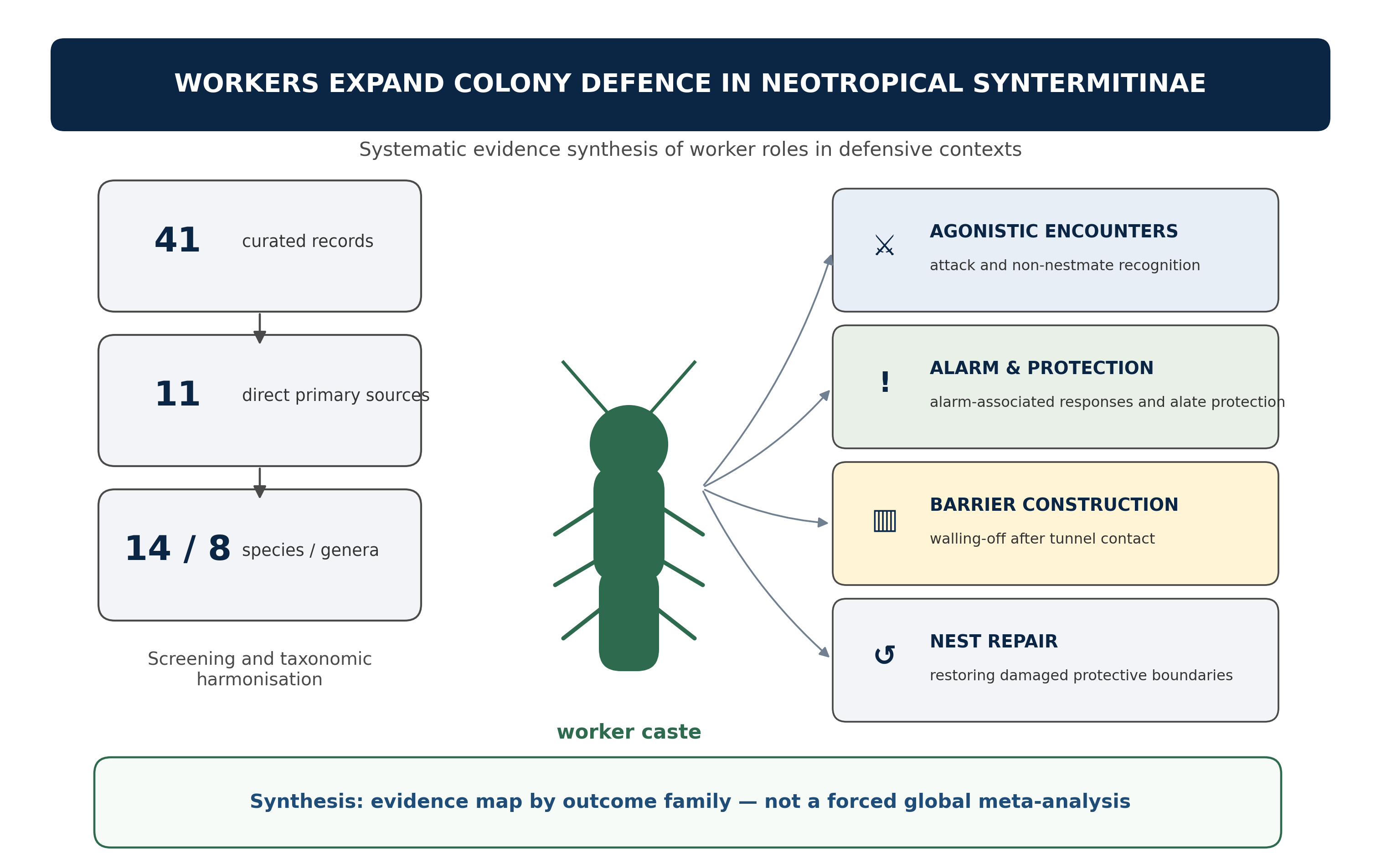
Termite defence is often described through soldier morphology and secretions, yet colony protection also depends on workers that detect, confront, isolate and repair threats. This review examined the evidence for worker defensive participation in Neotropical Syntermitinae, with emphasis on behavioural, structural and alarm-related functions. A structured public-source literature search was conducted on 25 August 2026 across scholarly web indexing, PubMed, SciELO, Scopus, Web of Science, publisher pages, biological archives, institutional repositories, taxonomic catalogues and backward-forward citation chasing. Searches combined current and historical taxonomic names with terms for workers, defence, aggression, alarm, nest repair, and termite-termite interactions. After eligibility screening, taxonomic harmonisation, duplicate and derivative-report removal, and source verification, 41 curated records were evaluated and 11 independent primary sources directly documented worker participation in defensive contexts. The evidence covered 14 current species in eight genera, but was strongly concentrated in Cornitermes cumulans and Brazilian systems. Workers acted as an agonistic caste in nestmate and heterospecific encounters, participated in collective alate protection, contributed to alarm-associated responses, and built or restored barriers after nest damage or competitive tunnel contact. Recent studies on worker head and salivary glands in C. cumulans add a mechanistic context, but do not yet demonstrate a defensive chemical function. A single global meta-analysis was not defensible because the available studies reported incompatible response units, including instantaneous aggression counts, survival functions, repair time, binary observations, and qualitative field accounts. The synthesis therefore supports a broader view of Syntermitinae defence in which soldiers remain specialised, but workers provide essential tactical and structural functions. Future experiments should quantify worker-only and worker-soldier responses with shared outcomes, colony-level replication, and openly available summary data.
References
Andrade, M. R. L., Eloi, I., de Oliveira, M. H., & Bezerra-Gusmão, M. A. (2024). Dynamics of dimorphic workers of Constrictotermes cyphergaster (Blattodea: Termitidae) during nest repair. Journal of Insect Science, 24(1), 1. https://doi.org/10.1093/jisesa/iead118
Clemente, L. O., Constantino, R., Costa, D. A., & DeSouza, O. (2021). The role of mandible morphology in termite inquilinism. Entomologia Experimentalis et Applicata, 169(12), 1103-1112. https://doi.org/10.1111/eea.13103
Costa, D. A. (2015). Custos do encontro entre cupins inquilinos e hospedeiros (Blattodea: Isoptera). PhD thesis. Universidade Federal de Viçosa, Viçosa, Brazil.
Costa-Leonardo, A. M., da Silva, I. B., Janei, V., Esteves, F. G., dos Santos-Pinto, J. R. A., & Palma, M. S. (2019). Worker defensive behavior associated with toxins in the Neotropical termite Neocapritermes braziliensis (Blattaria, Isoptera, Termitidae, Termitinae). Journal of Chemical Ecology, 45(9), 755-767. https://doi.org/10.1007/s10886-019-01098-w
Costa-Leonardo, A. M., Janei, V., Bacci, L. M. G., & da Silva, I. B. (2025a). Morphology of the head-associated exocrine glands in Cornitermes cumulans with the description of a novel gland for the worker caste. Tissue and Cell, 93, 102688. https://doi.org/10.1016/j.tice.2024.102688
Costa-Leonardo, A. M., Janei, V., & da Silva, I. B. (2025b). Salivary glands associated with polyethism in the termite Cornitermes cumulans (Isoptera, Termitidae, Syntermitinae). Zoomorphology, 144(3), 53. https://doi.org/10.1007/s00435-025-00740-4
Costa-Leonardo, A. M., da Silva, I. B., Poiani, S. B., dos Santos-Pinto, J. R. A., Esteves, F. G., da Silva, L. H. B., & Palma, M. S. (2020). Proteomic components provide insights into the defensive secretion in termite workers of the soldierless genus Ruptitermes. Journal of Proteomics, 213, 103622. https://doi.org/10.1016/j.jprot.2019.103622
Cristaldo, P. F. (2010). Mecanismos de defesa em ninhos de cupins (Insecta: Isoptera). MSc thesis. Universidade Federal de Viçosa, Viçosa, Brazil.
Guimarães, M. P. M. (2018). A manutenção da muralha: o investimento diferencial no reparo de danos em paredes de cupinzeiros. MSc thesis. Universidade Federal de Viçosa, Viçosa, Brazil.
Hellemans, S., Rocha, M. M., Wang, M., Romero Arias, J., Aanen, D. K., Bagnères, A.-G., Buček, A., Carrijo, T. F., Chouvenc, T., Cuezzo, C., Constantini, J. P., Constantino, R., Dedeine, F., Deligne, J., Eggleton, P., Evans, T. A., Hanus, R., Harrison, M. C., Harry, M., Josens, G., Jouault, C., Kalleshwaraswamy, C. M., Kaymak, E., Korb, J., Lee, C.-Y., Legendre, F., Li, H.-F., Lo, N., Lu, T., Matsuura, K., Maekawa, K., McMahon, D. P., Mizumoto, N., Oliveira, D. E., Poulsen, M., Sillam-Dussès, D., Su, N.-Y., Tokuda, G., Vargo, E. L., Ware, J. L., Šobotník, J., Scheffrahn, R. H., Cancello, E., Roisin, Y., Engel, M. S., & Bourguignon, T. (2024). Genomic data provide insights into the classification of extant termites. Nature Communications, 15(1), 6724. https://doi.org/10.1038/s41467-024-51028-y
Janowiecki, M. A., Jandák, V., Brothánek, M., Jiříček, O., Vargo, E. L., & Šobotník, J. (2024). Effect of soldiers on vibroacoustic alarm response in workers of subterranean termites (Blattodea: Rhinotermitidae). Insectes Sociaux, 71(1), 75-83. https://doi.org/10.1007/s00040-023-00945-0
Jost, C., Haifig, I., de Camargo-Dietrich, C. R. R., & Costa-Leonardo, A. M. (2012). A comparative tunnelling network approach to assess interspecific competition effects in termites. Insectes Sociaux, 59(3), 369-379. https://doi.org/10.1007/s00040-012-0229-7
Kikuchi, K., Bourguignon, T., & Mizumoto, N. (2025). Nesting strategy reflects individual worker movement in termites. Movement Ecology, 13(1), 88. https://doi.org/10.1186/s40462-025-00612-y
Li, X.-Y., Wang, H., Khan, Z., Xiao, Y.-L., & Dong, Y.-N. (2026). Defensive behavior of termite workers depends on the queen rather than soldiers in Reticulitermes chinensis (Blattodea: Heterotermitidae). Insectes Sociaux. https://doi.org/10.1007/s00040-026-01125-6
Lucena, E. F. de, Cysneiros, G., Figueiredo, R. E. C. R. de, Rocha, M. M. da, Haugaasen, T., Peres, C. A., & Vasconcellos, A. (2026). Mapinguaritermes marizalensis, a new species of Syntermitinae (Blattodea, Termitidae) from Brazilian Amazon. Zootaxa, 5814(4), 498-512. https://doi.org/10.11646/zootaxa.5814.4.3
Marins, A. (2007). Agressividade em Cornitermes cumulans (Kollar) (Insecta: Isoptera) submetidos a estresse. MSc thesis. Universidade Federal de Viçosa, Viçosa, Brazil.
Marins, A., & DeSouza, O. (2008). Nestmate recognition in Cornitermes cumulans termites (Insecta: Isoptera). Sociobiology, 51(1), 1-9.
Martins, E. G. (2021). Habituation facilitates host-inquiline cohabitation in termites. MSc thesis. Universidade Federal de Viçosa, Viçosa, Brazil. https://doi.org/10.47328/ufvbbt.2021.031
Mill, A. E. (1983). Observations on Brazilian termite alate swarms and some structures used in the dispersal of reproductives (Isoptera: Termitidae). Journal of Natural History, 17(3), 309-320. https://doi.org/10.1080/00222938300770231
Moreira, E. A. (2015). Glândula frontal dos soldados de Syntermitinae (Termitidae): uma abordagem ultraestrutural e comportamental dessa nova subfamília de cupins. MSc thesis. Universidade Federal de Alfenas, Alfenas, Brasil.
Pontes-Nogueira, M., Aguilera, S. M., Palma-Onetto, V., Wang, M., Hellemans, S., Scheffrahn, R. H., Cancello, E. M., Bourguignon, T., & Carrijo, T. F. (2026). Phylogeny and biogeography of the termite genus Labiotermes Holmgren, 1912 (Isoptera, Syntermitinae) suggests predominant sympatric speciation. Journal of Biogeography, 53(1), e70124. https://doi.org/10.1111/jbi.70124
Redford, K. H. (1984). The termitaria of Cornitermes cumulans (Isoptera, Termitidae) and their role in determining a potential keystone species. Biotropica, 16(2), 112-119. https://doi.org/10.2307/2387842
Rocha, M. M., Cancello, E. M., & Carrijo, T. F. (2012). Neotropical termites: revision of Armitermes Wasmann (Isoptera, Termitidae, Syntermitinae) and phylogeny of the Syntermitinae. Systematic Entomology, 37(4), 793-827. https://doi.org/10.1111/j.1365-3113.2012.00645.x
Rocha, M. M., Morales-Corrêa e Castro, A. C., Cuezzo, C., & Cancello, E. M. (2017). Phylogenetic reconstruction of Syntermitinae (Isoptera, Termitidae) based on morphological and molecular data. PLoS ONE, 12(3), e0174366. https://doi.org/10.1371/journal.pone.0174366
Rocha, M. M., Cuezzo, C., Constantini, J. P., Oliveira, D. E., Santos, R. G., Carrijo, T. F., & Cancello, E. M. (2019). Overview of the morphology of Neotropical termite workers: history and practice. Sociobiology, 66(1), 1-32. https://doi.org/10.13102/sociobiology.v66i1.2067
Rocha, M. M., & Cancello, E. M. (2022). Updated taxonomy of Syntermitinae (Blattodea: Isoptera, Termitidae), with the description of three new genera. Zootaxa, 5138(4), 445-463. https://doi.org/10.11646/zootaxa.5138.4.6
Satoh, A., Planas-Sitjà, I., Cronin, A. L., & Mizumoto, N. (2026). Variation in soldier investment is linked to the evolution of termite soldier defense strategies. Evolutionary Ecology, 40(2), 21. https://doi.org/10.1007/s10682-026-10386-3
Sillam-Dussès, D., Jandák, V., Stiblik, P., Delattre, O., Chouvenc, T., Balvín, O., Cvačka, J., Soulet, D., Synek, J., Brothánek, M., Jiříček, O., Engel, M. S., Bourguignon, T., & Šobotník, J. (2023). Alarm communication predates eusociality in termites. Communications Biology, 6(1), 83. https://doi.org/10.1038/s42003-023-04438-5
Thorne, B. L. (1982). Termite-termite interactions: workers as an agonistic caste. Psyche: A Journal of Entomology, 89(1-2), 133-150. https://doi.org/10.1155/1982/86584
Valadares, L., da Silva, I. B., Costa-Leonardo, A. M., & Sandoz, J.-C. (2023). Differentiation of workers into soldiers is associated with a size reduction of higher-order brain centers in the Neotropical termite Procornitermes araujoi. Scientific Reports, 13(1), 18279. https://doi.org/10.1038/s41598-023-45221-0
Downloads
Published
How to Cite
Issue
Section
License
Copyright (c) 2027 Edimar Agnaldo Moreira

This work is licensed under a Creative Commons Attribution 4.0 International License.
Authors who publish with this journal agree to the following terms:
1) Authors retain copyright and grant the journal right of first publication with the work simultaneously licensed under a Creative Commons Attribution License that allows others to share the work with an acknowledgement of the work's authorship and initial publication in this journal.
2) Authors are able to enter into separate, additional contractual arrangements for the non-exclusive distribution of the journal's published version of the work (e.g., post it to an institutional repository or publish it in a book), with an acknowledgement of its initial publication in this journal.
3) Authors are permitted and encouraged to post their work online (e.g., in institutional repositories or on their website) prior to and during the submission process, as it can lead to productive exchanges, as well as earlier and greater citation of published work.