Biological concrete in modern civil construction: Advances, applications, and challenges — A narrative review
DOI:
https://doi.org/10.14295/bjs.v5i11.918Keywords:
bioconcrete, sustainable infrastructure, biomineralization, eco-friendly materials, concrete repair, civil engineeringAbstract
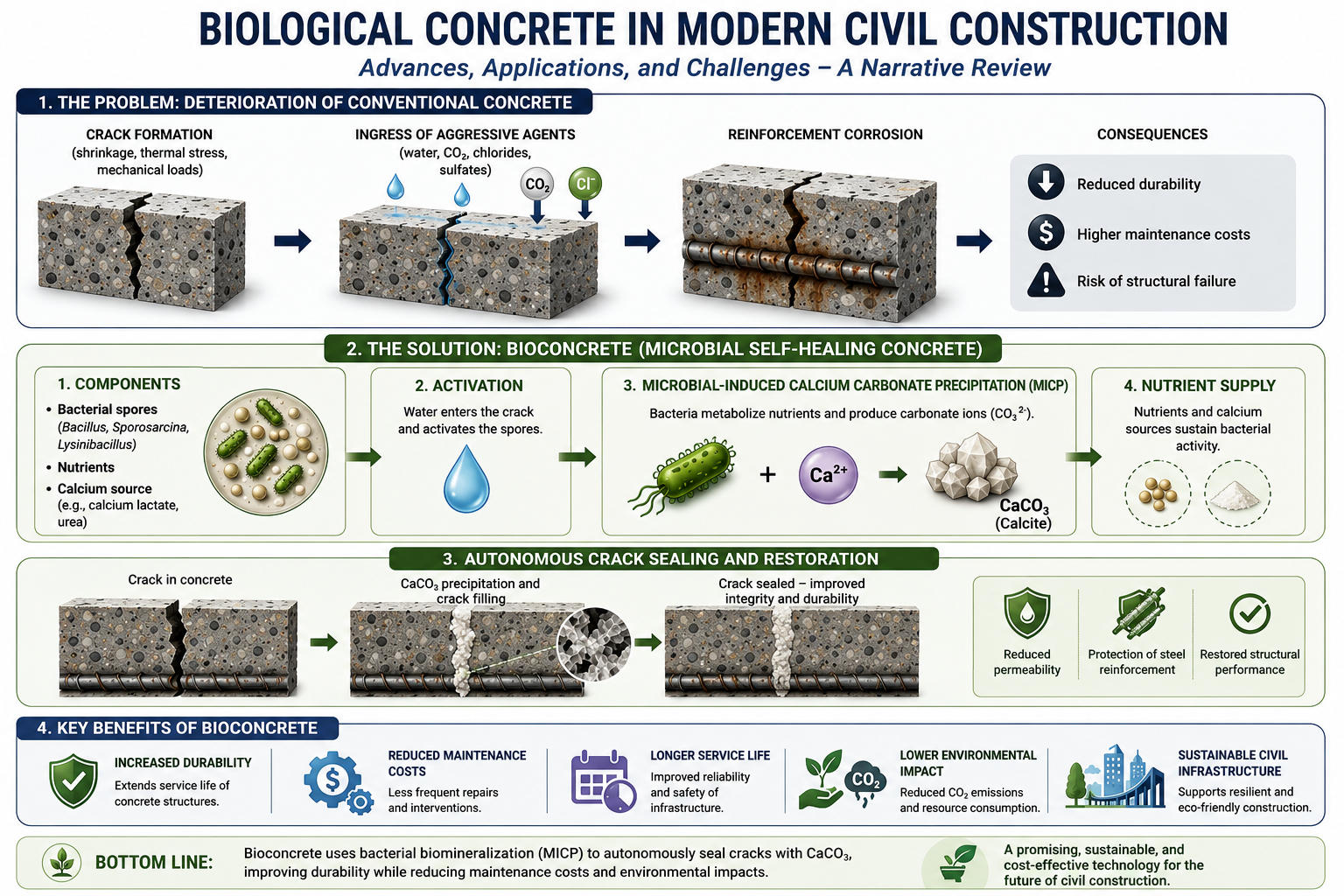
Concrete and mortar are among the most widely used construction materials worldwide; however, their susceptibility to crack formation significantly compromises structural durability and increases maintenance costs. Although crack formation cannot be entirely prevented, several remediation techniques have been developed. Conventional repair methods, including chemical sealants and polymer-based materials such as epoxy resins, often present environmental concerns, potential health risks, and limited long-term effectiveness. Consequently, sustainable and durable alternatives have gained increasing attention in recent years. Among these alternatives, microbial self-healing concrete has emerged as a promising technology due to its ability to autonomously repair cracks through biologically induced calcium carbonate (CaCO3) precipitation. This process is primarily mediated by aerobic and anaerobic bacteria capable of surviving within the concrete matrix and producing mineral deposits that seal cracks, restore structural integrity, and enhance durability. Compared with traditional repair techniques, microbial self-healing systems offer advantages such as prolonged effectiveness, reduced maintenance requirements, and lower environmental impact. This narrative review examines the mechanisms involved in microbial CaCO3 production and discusses the application of bioconcrete in civil construction. The review covers the characteristics of conventional concrete, the main pathological manifestations affecting concrete structures, current remediation strategies, and recent advances in the development of high-performance bioconcrete. Furthermore, the potential of biological concrete as a sustainable, cost-effective, and environmentally friendly technology for modern civil construction is critically evaluated. The findings highlight the significant role of microbial-based self-healing materials in improving infrastructure longevity while supporting more sustainable construction practices.
References
Abo-El-Enein, S. A., Ali, A. H., Talkhan, F. N., & Abdel-Gawwad, H. A. (2023). Application of microbial biocementation to improve the physico-mechanical properties of cement mortar. HBRC Journal, 9(1), 36-40. https://doi.org/10.1016/J.HBRCJ.2012.10.004
Achal, V., Mukherjee, A., Basu, P. C., & Reddy, M. S. (2009a). Lactose mother liquor as an alternative nutrient source for microbial concrete production by Sporosarcina pasteurii. Journal of Industrial Microbiology and Biotechnology, 36(3), 433-438. https://doi.org/10.1007/s10295-008-0514-7
Achal, V., Mukherjee, A., Basu, P. C., & Reddy, M. S. (2009b). Strain improvement of Sporosarcina pasteurii for enhanced urease and calcite production. Journal of Industrial Microbiology and Biotechnology, 36(7), 981-988. https://doi.org/10.1007/s10295-009-0578-z
Achal, V., Mukherjee, A., & Reddy, M. S. (2010). Biocalcification by Sporosarcina pasteurii using corn steep liquor as the nutrient source. Industrial Biotechnology, 6(3), 170-174. https://doi.org/10.1089/ind.2010.6.170
Achal, V., Mukherjee, A., & Reddy, M. S. (2011a). Microbial concrete - a way to enhance the durability of building structures. Journal of Materials in Civil Engineering, 23(6), 730-734. https://doi.org/10.1061/(ASCE)MT.1943-5533.0000159
Achal, V., Mukherjee, A., & Reddy, M. S. (2011b). Effect of calcifying bacteria on permeation properties of concrete structures. Journal of Industrial Microbiology and Biotechnology, 38(9), 1229-1234. https://doi.org/10.1007/s10295-010-0901-8
Chahal, N., Siddique, R., & Rajor, A. (2012). Influence of bacteria on the compressive strength, water absorption and rapid chloride permeability of fly ash concrete. Construction and Building Materials, 28(1), 351-356. https://doi.org/10.1016/j.conbuildmat.2011.07.042
Achal, V., Mukerjee, A., Sudhakara Reddy, M. (2013). Biogenic treatment improves the durability and remediates the cracks of concrete structures. Construction and Building Materials, 48, 1-5. https://doi.org/10.1016/j.conbuildmat.2013.06.061
Achal, V., Mukherjee, A., Kumari, D., & Zhang, Q. (2015). Biomineralization for sustainable construction - a review of processes and applications. Earth-Science Reviews, 148, 1-17. https://doi.org/10.1016/j.earscirev.2015.05.008
Achal, V., & Mukherjee, A. (2015). A review of microbial precipitation for sustainable construction. Construction and Building Materials, 93, 1224-1235. https://doi.org/10.1016/j.conbuildmat.2015.04.051
Adhikary, S. K., Rathod, N., Adhikary, S. D., Kumar, A., & Perumal, P. (2024). Chemical-based self-healing concrete: A review. Discover Civil Engineering, 1, 119. https://doi.org/10.1007/s44290-024-00130-7
Adolphe, J. P., Loubière, J. F., Paradas, J., & Soleilhavoup, F. (1990). Procédé detraitement biologique d’une surface artificielle. París: Francia European Patent 90400G97.0. (after French patent 8903517, 1989).
Ahmad, M. R., Chen, B., & Shah, S. F. A. (2021). Mechanical and microstructural characterization of bio-concrete prepared with optimized alternative green binders. Construction and Building Materials, 281, 122533. https://doi.org/10.1016/j.conbuildmat.2021.122533
Aguilera, L. A. P., Zapata, J. A. N., & Morales, B. O. O. (2015). La bioprecipitación de carbonato de calcio por la biota nativa como un método de restauración. Nexo Revista Científica, 28(01), 25-40. https://doi.org/10.5377/nexo.v28i01.1779
Akhtar, J. N., Khan, R. A., Khan, R. A., Akhtar, M. N., & Thomas, B. S. (2023). A comparative study os strength and durability characteristics os concrete and mortar admixture by bacterial calcite precipitation: A review. Materialstoday: Proceedings. https://doi.org/10.1016/j.matpr.2023.03.490
Aldea, C. -A., Shah, S. P., & Karr, A. (1999). Permeability of cracked concrete. Materials and Structures, 32, 370-376. https://doi.org/10.1007/BF02479629
Al-Sabaeei, A. M., Al-Fakih, A., Noura, S., Yaghoubi, E., Alaloul, W., Al-Mansob, R. A., Khan, M. I., & Yaro, N. S. A. (2022). Utilization of palm oil its by-products in bio-asphalt and bio-concrete mixtures: A review. Construction and Building Materials, 337, 127552. https://doi.org/10.1016/j.conbuildmat.2022.127552
Amran, M., Onazi, A. M., Fediuk, R., Vatin, N. I., Rashid, R. S. M., Abdelgader, H., & Ozbakkaloglu, T. (2022). Self-healing concrete as a prospective construction material: A review. Materials, 15(9), 3214. https://doi.org/10.3390/ma15093214
Andalib, R., Abd Majid, M. Z., Hussin, M. W., Ponraj, M., Keyvanfar, A., Mirza, J., & Lee, H.-S. (2016). Optimum concentration of Bacillus megaterium for strengthening structural concrete. Construction and Building Materials, 118, 180-193. https://doi.org/10.1016/J.CONBUILDMAT.2016.04.142
Angst, U. M., Rossi, E., Käthler, C. B., Mannes, D., Trtik, P., Elsener, B., Zhou, Z., & Strobl, M. (2024). Chloride-induced corrosion of steel in concrete – insights from bimodal neutron and X-ray microtomography combined with ex-situ microscopy. Materials and Structures, 57. https://doi.org/10.1617/s11527-024-02337-7
Araújo, C. E. S. B., Abreu, B. G., Órfão, R. B., & Amarante, M. S. (2019). Bioconcreto. Revista Diálogos Interdisciplinares, 8(2), 45-55. https://revistas.brazcubas.br/index.php/dialogos/article/view/686
Ariyanti, D., Handayani, N. A., & Hadiyanto, H. (2011). An overview of biocement production from microalgae. International Journal of Science and Engineering, 2, 30-33. http://ejournal.undip.ac.id/index.php/ijse/article/view/1265/1049
Arroyo, L. F., Tanaka, K. Y. M., Teixeira, T. M., Alves, C. E. S., & Feliz, G. A. A. (2016). Concreto Biológico: Uma proposta Sustentável. In: VIII Mostra de Trabalhos de Iniciação Científica e I Mostra Interna de Trabalhos de Iniciação Tecnológica e Inovação, 23 a 25 Outubro. Available in: https://www.unicesumar.edu.br/mostra-2016/wp-content/uploads/sites/154/2017/01/leonardo_franco_arroyo.pdf Access in: Apr. 02, 2024.
Atlas, R. M., Chowdhury, A. N., & Gauri, K. L. (1988). Microbial calcification of gypsum-rock and sulfated marble. Studies in Conservation, 33(3),149-153. https://doi.org/10.1179/sic.1988.33.3.149
Banerjee, S., & Joshi, S. R. (2014). Ultrastructural analysis of calcite crystal patterns formed by biofilm bacteria associated with cave speleothems. Journal of Microscopy and Ultrastructure, 2(4), 217-223. https://doi.org/10.1016/j.jmau.2014.06.001
Bang, S. S., Galinat, J. K., & Ramakrishnan, V. (2001). Calcite precipitation induced by polyurethane-immobilized Bacillus pasteurii. Enzyme and Microbial Technology, 28(4-5), 404-409. https://doi.org/10.1016/S0141-0229(00)00348-3
Barton, L. L., & Northup, D. E. (2011). Microbial ecology. Wiley-Blackwell.
Bashir, J., Kathawari, I., Tiwary, A., & Singh, K. (2016). Bio concrete - The self-healing concrete. Indian Journal of Science and Technology, 9(47). https://doi.org/10.17485/ijst/2016/v9i47/132872
Babu, N. G., & Siddiraju, S. (2016). An experimental study on strength and fracture properties of self-healing concrete. International Journal of Civil Engineering and Technology, 7(3), 398-406. https://www.researchgate.net/publication/+311258447
Barbosa, D. S.; & Moraes, T. F. (2023). Bioconcreto: uma revisão da sua aplicação no fechamento de fissuras. Revista Científica UMC, 8(3), 1-14. https://seer.umc.br/index.php/revistaumc/article/view/1946
Bauer, F. L. A. (2013). Materiais de Construção. 5ª Edição. Rio de Janeiro: LTC.
Beatty, D. N., Williams, S. L., & Srubar, W. V. (2022). Biomineralized materials for sustainable and durable construction. Annual Review of Materials Research, 52, 411-439. https://doi.org/10.1146/annurev-matsci-081720-105303
Belie, N. D., & Muynck, W. (2008). Crack repair in concrete using biodeposition. ICCRRR II. Cape Town, South Africa, 291-292 p.
Bertolini, L., Elsener, B., Pedeferri, P., Redaelli, E., & Polder, R. (2021). Corrosion of steel in concrete: Prevention, diagnosis, repair. Second, a completely revised and enlarged edition, Wiley-VCH Verlag GmbH & Co. KGaA.
Caldas, L. R., Saraiva, A. B., Andreola, V. M., & Filho, R. D. T. (2020). Bamboo bio-concrete as na alternative for buildings’ climate change mitigation and adaptation. Construction and Building Materials, 263, 120652. https://doi.org/10.1016/j.conbuildmat.2020.120652
Castainer, S., Metayer-Levrel, G. L., & Perthuisot, J. (2000). Bacterial roles in the precipitation of carbonate minerals. In: Riding, R. E., & Awramik, S. M. (eds), Microbial sediments. Springer, Berlin Heidelberg, 32-39.
Castainer, S., Metayer-Levrel, G. L., & Perthuisot, J. P. (1999). Ca-carbonates precipitation and limestone genesis-the microbiogeologist point of view. Sedimentary Geology, 126(1-4), 9-23. https://doi.org/10.1016/S0037-0738(99)00028-7
Castro-Alonso, M. J., Montñaez-Hernandez, L. E., Sanchez-Muñoz, M. A., Franco, M. R. M., Narayanasamy, R., & Balagurusamy, N. (2019). Microbially induced calcium carbonate precipitation (MICP) and its potential in bioconcrete: microbiological and molecular concepts. Frontiers in Materials, 6, 126. https://doi.org/10.3389/fmats.2019.00126
Charpe, A. U., Latkar, M. V., & Chakrabarti, T. (2017). Microbially assisted cementation–a biotechnological approach to improve mechanical properties of cement. Construction and Building Materials, 135, 472-476. https://doi.org/10.1016/j.conbuildmat.2017.01.017
Choi, S-J., Park, J., Kim, J-M., Song, H-Y., & Lee, J-I. (2025). Mechanical and self-healing performance of cement composites containing bacteria extracted from waste concrete. Materials, 18(24), 5483. https://doi.org/10.3390/ma18245483
Costa, L. B., Lima, F. G. C., Leite, G. S., Mergulhão, R. A. C., & Oliveira, R. G. (2021). Bioconcreto e sua aplicabilidade na recuperação de manifestações patológicas na construção civil. Revista Mangaio Acadêmico, 6, 47-67. https://estacio.periodicoscientificos.com.br/index.php/mangaio/article/view/1553
Deeba, S., Ammasi, A. K. (2024). State-of-the-art review on self-healing in mortar, concrete, and composites. Case Studies in Construction Materials, 20, e03298. https://doi.org/10.1016/j.cscm.2024.e03298
DeJong, J. T., Soga, K., Kavazanjia, E., Burns, S. (2013). Biogeochemical processes and geotechnical applications: progress, opportunities and challenges. Géotechnique, 63(4), 287-301. https://doi.org/10.1680/geot.SIP13.P.017
Dick, J., De Windt, W., De Graef, B., Saveyn, H., Van Der Meeren, P., De Belie, N., & Verstraete, W. (2006). Bio-deposition of a calcium carbonate layer on degraded limestone by Bacillus species. Biodegradation, 17, 357-367. https://doi.org/10.1007/s10532-005-9006-x
Durga, C. S. S., Ruben, N., Chand, M. S. R., & Venkatesh, C. (2020). Performance studies on rate of self healing in bio concrete. Materials Today: Proceedings, 27, 158-162. http://dx.doi.org/10.1016/j.matpr.2019.09.151
Elias, P. M., Brandão, I. Y. N., & Maass, D. (2025). Unlocking hidden value: the metallurgical promise of Rhodococcus spp. Reviews in Environmental Science and Bio/Technology, 24, 557-569. https://doi.org/10.1007/s11157-025-09738-2
Ersan, Y., Boon, N., & De Belie, N. (2015). Microbial self-healing concrete: denitrification as an enhanced and environment-friendly approach. In: 5th International Conference on Self-Healing Materials, ed., Nicholson, k. (Ghent).
Fang, C., He, J., Achal, V., & Plaza, G. (2019). Tofu wastewater as efficient nutritional source in biocementation for improved mechanical strength of cement mortars. Geomicrobiology Journal, 36(6), 515-521. https://doi.org/10.1080/01490451.2019.1576804
Feng, J., Chen, B., Sun, W., & Wang, Y. (2021). Microbial induced calcium carbonate precipitation study using Bacillus subtilis with application to self-healing concrete preparation and characterization. Construction and Building Materials, 280, 122460. https://doi.org/10.1016/j.conbuildmat.2021.122460
Gauri, K. L., & Bandyopadhyay, J. K. (1999). Carbonate stone, chemical behaviour, durability, and conservation. John Wiley & Sons.
Gonsalves, G. M. (2011). Bioconcrete-a sustainable substitute for concrete? (Master’s thesis). Universitat Politècnica de Catalunya, Institut Universitari de Recerca en Ciència i Tecnologies de la Sostenibilitat, Barcelone, Spain.
Griffiths, S., Sovacool, B. K., Del Rio, D. D. F., Foley, A. M., Bazilian, M. D., & Uratani, J. M. (2023). Decarbonizing the cement and concrete industry: A systematic review of socio-technical systems, technological innovations, and policy options. Renewable and Sustainable Energy Reviews, 180, 113291. https://doi.org/10.1016/j.rser.2023.113291
Growth, I., Schumann, P., Laiz, L., Sanchez-Moral, S., Cañveras, J. C., & Saiz-Jimenez, C. (2001). Geomicrobiological study of the Grotta dei Cervi, Porto Badisco, Italy. Geomicrobiology Journal, 18(3), 241-258. https://doi.org/10.1080/01490450152467778
Handore, A. V., Khandelwal, S. R., Karmakar, R., Jagtap, A. S., & Handore, D. V. (2021). Bioconcrete: The promising prospect for green construction. In: Ecological and Health Effects of Building Materials. Capter, 567-584. https://doi.org/10.1007/978-3-030-76073-1_29
Huntzinger, D. N., & Eatmon, T. D. (2009). A life-cycle assessment of Portland cement manufacturing: comparing the traditional process with alternative technologies. Journal of Cleaner Production, 17(7), 668-675. https://doi.org/10.1016/j.jclepro.2008.04.007
Huseien, G. F., Saleh, A. T., & Ghoshal, S. K. (2022). Effective microorganism solution and high volume of fly ash blended sustainable bio-concrete. Biomimetics, 7(2), 65. https://doi.org/10.3390/biomimetics7020065
Helene, P. R. L. (1993). Contribuição ao estudo da corrosão em armaduras de concreto armado. Tese. Escola Politécnica da Universidade de São Paulo, São Paulo, Brasil. https://repositorio.usp.br/item/000738379
Freitas, A. Á., Romão, E. M., Anício, S. O., & Barros, A. J. (2021). Bioconcreto: uma revisão de sua aplicação na construção civil. Research, Society and Development, 10(4), e37210414270. http://dx.doi.org/10.33448/rsd-v10i4.14270
Fukuda, D., Nara, Y., Hayashi, D., Ogawa, H., & Kaneko, K. (2023). Influence of fracture width on sealability in high-strength and ultra-low-permeability concrete in seawater. Materials, 6(7), 2578-2594. https://doi.org/10.3390/ma6072578
Gardner, D., Lark, R., Jefferson, T. & Davies, R. (2018). A survey on problems encountered in current concrete construction and the potential benefits of self-healing cementitious materials. Case Studies in Construction Materials, 8, 238-247.
Goyal, N. (2015). Self-healing concrete can repair its own cracks with bacteria. http://www.industrytap.com/self-healing-concrete-can-repair-cracksbacteria/29051
Gursel, A. P., Masanet, E., Horvath, A., & Stadel, A. (2014). Life-cycle inventory analysis of concrete production: a critical review. Cement and Concrete Composites, 51, 38-48. https://doi.org/10.1016/j.cemconcomp.2014.03.005
Ivanov, V., & Stabnikov, V. (2017). Biotechnological admixtures for cement and mortars construction biotechnology. In: Green energy and technology, Springer Science Business Media S, Chapter 3, 41-50 p. https://link.springer.com/chapter/10.1007/978-981-10-1445-1_3
Jakubovskis, R., Jankuté, A., Urbonavicius, J., & Gribniak, V. (2020). Analysis of mechanical performance and durability of self-healing biological concrete. Construction and Building Materials, 260, 119822. https://doi.org/10.1016/j.conbuildmat.2020.119822
Jonkers, H. M., & Schlangen, E. (2009). A two component bacteria-based on self-healing concrete. In: Concrete Repair, Rehabilitation, and Retrofitting II: 2nd International Conference on Concrete Repair, Rehabilitation and Retrofitting, eds Alexander, M. G., Beushausen, H., Dehn, F., & Moyo, P. (Cape Town: CRC Press). https://doi.org/10.1201/9781439828403.ch27
Jonkers, H. M., Thijssen, A., Muyzer, G., Copuroglu, O., & Schlangen, E. (2010). Application of bacteria as self-healing agent for the development of sustainable concrete. Ecological Engineering, 36(2), 230-235. https://doi.org/10.1016/j.ecoleng.2008.12.036
Jonkers, H. M. (2011). Bacteria-based self-healing concrete. Heron, 56(1-2), 5-16.
Jroundi, F., Gonzalez-Muñoz, M. T., Garcia-Bueno, A., & Rodriguez-Navarro, C. (2014). Consolidation of archaeological gypsum plaster by bacterial biomineralization of calcium carbonate. Acta Biomaterialia, 10(9), 3844-3854. https://doi.org/10.1016/j.actbio.2014.03.007
Knoeri, C., Sanyé-Mengual, E., & Althaus, H-J. (2013). Comparative LCA of recycled and conventional concrete for structural applications. The International Journal of Life Cycle Assessment, 18(5), 909-918. https://doi.org/10.1007/s11367-012-0544-2
Knorre, H., & Krumbein, K. E. (2000). Bacterial calcification. In: Microbial sediments, Riding, R. E., Awramik, S. M., Springer, Berlin, 25-31 p.
Kunal, Siddique, R., & Rajor, A. (2014). Influence of bacterial treated cement kiln dust on the properties of concrete. Construction and Building Materials, 52, 42-51. https://doi.org/10.1016/j.conbuildmat.2013.11.034
Le Metayer-Levrel, G., Castanier, S., Orial, G., Loubiere, J. F., & Perthuisot, J. P. (1999). Applications of bacterial carbonatogenesis to the protection and regeneration of limestones in buildings and historic patrimony. Sedimentary Geology, 126(1-4), 25-34.
Masoud, M. A., El-Khayatt, A. M., Mahmoud, K. A., Rashad, A. M., Shahien, M. G., Bakhit, B. R., & Zayed, A. M. (2023). Valorization of hazardous chrysotile by H3BO3 incorporation to produce an innovative eco-friendly radiation shielding concrete: Implications on physico-mechanical, hydration, microstructural, and shielding properties. Cement and Concrete Composites, 141, 105120.
Mohanadoss, P., Amirreza, T., Rosli, M. Z., Ismail, M., Majid, M. Z. A., Ali, K., & Hesam, K. (2015). Bio concrete strength, durability, permeability, recycling and effects on human health: a review. In: Proceedings of the Third International Conference Advances in Civil, Structural and Mechanical Engineering. Institute of Research Engineering and Doctors, USA, 1-2 p. http://dx.doi.org/10.15224/978-1-63248-062-0-28
Mondal, S., Das, P., Kumar Chakraborty, A. (2017). Application of bacteria in concrete. Materials Today: Proceedings, 4(9), 9833-9836. https://doi.org/10.1016/j.matpr.2017.06.276
Montaño-Salazar, S. M., Lizarro-Marriaga, J., & Brandão, P. F. B. (2018). Isolation and potential biocementation of calcite precipitation inducing bacteria from Colombian buildings. Current Microbiology, 75, 256-265. https://doi.org/10.1007/s00284-017-1373-0
Mors, R. M., & Jonkers, H. M. (2016). Feasibility of lactate derivative based agent as additive for concrete for regain of crack water tightness by bacterial metabolism. Industrial Crops and Products, 106, 97-104. https://doi.org/10.1016/j.indcrop.2016.10.037
Muynck, W., Belie, N., & Verstraete, W. (2007). Improvement of concrete durability with the aid of bacteria. In: Proceedings of the first international conference on self healing materials. Noordwijk aan zee, The Netherla.
Nagrockiene, D., & Girskas, G. (2016). Research into the properties of concrete modified with natural zeolite addition. Construction and Building Materials, 113, 964-969. https://doi.org/10.1016/j.conbuildmat.2016.03.133
Nanayakkara, S. M. A., & Elakneshwaran, T. (2005). Self-healing of cracks in concrete with portland limestone cement. Institution of Civil Engineering Publishing.
Nasser, A. A., Sorour, N. M., Saafan, M. A., & Abbas, R. N. (2022). Microbially-induced-calcite-precipitation (MICP): A biotechnological approach to enhance the durability of concrete using Bacillus pasteurii and Bacillus sphaericus. Helyon, 8(7), e09879.
Neville, A. M. (2011). Properties of Concrete. 5th Edition, 846 p.
Oliveira, A. M. (2012). Fissuras e rachaduras causadas por recalque diferencial de fundações. Belo Horizonte: Monografia (Especialização em Gestão em Avaliações e perícias) – Universidade Federal de Minas Gerais, MG, Brasil.
Oliveira, D. D. N., Almeida, E. S., & Cardoso, L. S. P. (2014). Estudo do uso de esgoto tratado por ETE biológica na fabricação de blocos de concreto para alvenaria de vedação. In: V Congresso Brasileiro de Gestão Ambiental, Belo Horizonte, Minas Gerais, 24 a 27 de Nov. 2014. Available in: http://repositoriosenaiba.fieb.org.br/bitstream/fieb/347/1/Estudo%20do%20uso%20de%20esgoto%20....pdf Access in: Apr. 02, 2024.
Pacheco-Torgal, F., & Labrincha, J. A. (2013). Biotech cementitious materials: some aspects of an innovative approach for concrete with enhanced durability. Construction and Building Materials, 40, 1136-1141. https://doi.org/10.1016/j.conbuildmat.2012.09.080
Paula, S. M. (2006). Uma abordagem de parâmetros da biomineralização em um sistema constituído por carbonato de cálcio. Tese de Doutorado em Física pelo Instituto de Física pela Universidade de São Paulo, São Paulo, 182 p.
Perito, B., Marvasi, M., Barabesi, C., Mastromei, G., Bracci, S., Vendrell, M., & Tiano, P. (2014). A Bacillus subtilis cell fraction (BCF) inducing calcium carbonate precipitation: biotechnological perspectives for monumental stone reinforcement. Journal of Cultural Heritage, 15(4), 345-351. https://doi.org/10.1016/j.culher.2013.10.001
Piñar, G., Jimenez-Lopez, C., Sterflinger, K., Ettenauer, J., Jroundi, F., Fernandez-Vivas, A., & Gonzalez-Muñoz, M. T. (2010). Bacterial community dynamics during the application of a Myxococcus xanthus-inoculated culture medium used for consolidation of ornamental limestone. Microbial Ecology, 60, 15-28. https://doi.org/10.1007/s00248-010-9661-2
Qian, CX., Zheng, TW., Rui, YF. (2021). Living concrete with self-healing fungtion on craks attributed to inclusion of microorganisms: Theory, technology and engineering applications – A review. Science China Technological Sciences, 64, 2067-2083. https://doi.org/10.1007/s11431-021-1879-6
Qian, C., Wang, R., Cheng, L., & Wang, J. (2010). Theory of microbial carbonate precipitation and its application in restoration of cement-based materials defects. Chinese Journal of Chemistry, 28(5), 847-857. https://doi.org/10.1002/CJOC.201090156
Rahmani, H., & Bazrgar, H. (2015). Effect of coarse cement particles on the self-healing of dense concretes. Institution of civil engineering publishing. Magazine of Concrete Research, 67(9), 476-486. https://doi.org/10.1680/macr.14.00158
Rao, S. M. V., Reddy, V. S., Hafsa, M., Veena, P., Anusha, P. (2013). Bioengineered concrete - A sustainable self-healing con-struction material. Research Journal of Engineering Sciences, 2(6), 45-51. https://www.isca.me/IJES/Archive/v2/i6/8.ISCA-RJEngS-2013-065.pdf
Reis, L. V. (2017). Biotecnologia microbiana da construção: potencial de biomineralização de bactérias ureolíticas de solo de cerrado e de rejeitos de construção civil. Dissertação de Mestrado pelo Programa de Pós-Graduação em Ciências Ambientais pela Universidade Federal de Goiás, 103 p.
Rodriguez-Navarro, C., Rodriguez-Gallego, M., Ben Chekroun, K., Gonzalez-Muñoz, M. T. (2003). Conservation of ornamental stone by Myxococcus xanthus induced carbonate biomineralization. Applied and Environmental Microbiology, 69(4), 2182-2193. https://doi.org/10.1128/AEM.69.4.2182-2193.2003
Rong, H., & Qian, C. X. (2012). Characterization of microbe cementitious materials. Chinnese Science Bulletin, 57, 1333-1338. https://doi.org/10.1007/s11434-012-5047-9
Rong, H., Qian, C. X., & Li, L. Z. (2012). Study on microstructure and properties of sandstone cemented by microbe cement. Construction and Building Materials, 36, 687-694. https://doi.org/10.1016/j.conbuildmat.2012.06.063
Rooij, D., Tittelboom, K. V., Belie, N., & Schlangen, E. (2013). Self-healing phenomena in cement-based materials: State-of-the-art report of RILEM technical committee. http://dx.doi.org/10.1007/978-94-007-6624-2
Roque, B. A., Brasileiro, P. P. F., Brandão, Y. B., Casazza, A. A., Converti, A., Benachour, M., & Sarubbo, L. A. (2023). Self-healing concrete: Concepts, energy saving and sustainability. Energies, 16(4), 1650. https://doi.org/10.3390/en16041650
Ruan, S., Qiu, J., Weng, Y., Yang, Y., Yang, E. H., Chu, J., & Unluer, C. (2019). The use of microbial induced carbonate precipitation in healing cracks within reactive magnesia cement-based blends. Cement and Concrete Research, 115, 176-188. https://doi.org/10.1016/j.cemconres.2018.10.018
Rusznyák, A., Akob, D. M., Nietzsche, S., Eusterhues, K., Totsche, K. U., Neu, T. R., Frosch, T., Popp, J., Keiner, R., Geletneky, J., Katzschmann, L., Schulze, E., & Küsel, K. (2012). Calcite biomineralization by bacterial isolates from the recently discovered pristine karstic herrenberg cave. Applied and Environmental Microbiology, 78(4), 1157-1167. https://doi.org/10.1128/AEM.06568-11
Safiuddin, M., Amrul Kaish, A. B. M., Woon, C-O., Raman, S. N. (2018). Early-age cracking in concrete: causes, consequences, remedial measures, and recommendations. Applied Sciences, 8(10), 1730. https://doi.org/10.3390/app8101730
Santos, J. R., Effting, C., Serbent, P. M., & Matsuda, B. J. (2023). Biomineralização de carbonato de cálcio no concreto pela ação do Bacillus pumilus. Revista Engenharia Sanitária e Ambiental, 28, e20220277. https://doi.org/10.1590/S1413-415220220277
Sarayu, K., Iyer, N. R., & Murthy, A. R. (2014). Exploration on the biotechnological aspect of the ureolytic bacteria for the production of the cementitious materials - a review. Applied Biochemistry and Biotechnology, 172, 2308-2323. https://doi.org/10.1007/s12010-013-0686-0
Seifan, M., Samani, A. K., & Berenjian, A. (2016). Bioconcrete: next generation of self-healing concrete. Applied Microbiology and Biotechnology, 100, 2591-2602. https://doi.org/10.1007/s00253-016-7316-z
Shaikk, A., & John, R. (2017). Self-healing concrete by bacterial and chemical admixtures. International Journal Scientific & Engineering Research, 8(3), 145-152.
Sharma, T. K., Alazhari, M., Heath, A., Paine, K., & Cooper, R. M. (2017). Alkaliphilic Bacillus species show potential application in concrete crack repair by virtue of rapid spore production and germination then extracellular calcite formation. Journal of Applied Microbiology, 122(5), 1233-1244. https://doi.org/10.1111/JAM.13421
Sahmaran, M., Yildirim, G., Ozbay, E., Ahmed, K., & Lachemi, M. (2014). Self-healing ability of cementitious composites: effect of addition of pre-soaked expanded perlite. Magazine of Concrete Research, 66(8), 409-419. https://doi.org/10.1680/macr.13.00250
Seifan, M., Samani, A. K., & Berenjian, A. (2016). Bioconcrete: next generation of self-healing concrete. Applied Microbiology and Biotechnology, 100, 2591-2602. https://doi.org/10.1007/s00253-016-7316-z
Sierra-Beltran, M. G., Jonkers, H. M., & Schlangen, E. (2014). Characterization of sustainable bio-based mortar for concrete repair. Construction and Building Materials, 67(Part C), 344-352. https://doi.org/10.1016/j.conbuildmat.2014.01.012
Silva, F. P. C., Passarini, V. C., & Santos, F. C. S. (2017). Bioconcreto: a tecnologia para construção Sustentável. INOVAE – Journal of Engineering, Architecture and Technology Innovation, 5(2), 41-58. http://35.247.246.3/index.php/inovae/article/view/1678
Silva, M. G., Saade, M. R. M., & Gomes, V. (2013). Influence of service life, strength and cement type on life cycle environmental performance of concrete. Revista IBRACON de Estruturas e Materiais, 6(6), 844-453. https://doi.org/10.1590/S1983-41952013000600002
Silva, F. B., Boon, N., De Belie, N., & Verstraete, W. (2015). Industrial application of biological self-healing concrete: challenges and economical feasibility. Journal of Commercial Biotechnology, 21, 31-38. https://doi.org/10.5912/jcb662
Soundharya, S., & Nirmal, K. K. (2014). Strength improvement studies on self-healing characteristics of bacterial concrete. International Journal of Engineering Science Invention Research and Development, I(IV), 162-164.
Stocks-Fischer, S., Galinat, J. K., & Bang, S. S. (1999). Microbiological precipitation of CaCO3. Soil Biology and Biochemistry, 31(11), 1563-1571. https://doi.org/10.1016/S0038-0717(99)00082-6
Tebo, B. M., Johnson, H. A., McCarthy, J. K., Templeton, A. S. (2005). Geomicrobiology of manganese (II) oxidation. Trends Microbiology, 13(9), 421-428. https://doi.org/10.1016/j.tim.2005.07.009
Tiano, P., Biagiotti, L., and Mastromei, G. (1999). Bacterial bio-mediated calcite precipitation for monumental stones conservation: methods of evaluation. Journal of Microbiological Methods, 36(1-2), 139-145. https://doi.org/10.1016/S0167-7012(99)00019-6
Torrijos, M. C., Giaccio, G., & ZErbino, R. (2010). Internal cracking and transport properties in damaged concretes. Materials and Structures, 43, 109-121. https://doi.org/10.1617/s11527-010-9602-z
Umesh, U. J., Lahoti, M., Chen, Z., Qiu, J., Cao, B., & Yang, E. H. (2018). Viability of bacterial spores and crack healing in bacteria-containing geopolymer. Construction and Building Materials, 169, 716-723. https://doi.org/10.1016/j.conbuildmat.2018.03.039
Van Tittelboom, K., De Belie, N., De Muynck, W., & Verstraete, W. (2010). Use of bacteria to repair cracks in concrete. Cement and Concrete Research, 40(1), 157-166. https://doi.org/10.1016/j.cemconres.2009.08.025
Van den Heede, P., & De Belie, N. (2012). Environmental impact and life cycle assessment (LCA) of traditional and ‘green’ concretes: literature review and theoretical calculations. Cement and Concrete Composites, 34(4), 431-442. https://doi.org/10.1016/j.cemconcomp.2012.01.004
Vashishta, R., Attrib, S., Sharmab, D., Shuklaa, A., & Goelb, G. (2018). Monitoring bio calcification potential of Lysini bacillus sp. isolated from alluvial soils for improved compressive strength of concrete. Microbiology Research, 207, 226-231. https://doi.org/10.1016/j.micres.2017.12.010
Xu, W., Cui, C., Luo, C-K., & Zhang, Q-H. (2022). Fatigue crack monitoring of steel bridge with coating sensor based on potential difference method. Construction and Building Materials, 350, 128868. https://doi.org/10.1016/j.conbuildmat.2022.128868
Yahya, Z., Giuntini, F., Abdullah, M. M. A. B., & Bras, A. (2026). Physical and mechanical properties of bio-modified geopolymer concrete employing bacteria. Journal of Building Engineering, 117, 114799. https://doi.org/10.1016/j.jobe.2025.114799
Zaitsev, Y. B., & Wittmann, F. H. (1981). Simulation of crack propagation and failure of concrete. Matériaux et Construction, 14, 357-365. https://doi.org/10.1007/BF02478729
Zhang, J., Zhou, A., Liu, Y., Zhao, B., Luan, Y., Wang, S., Yue, X., & Li, Z. (2017). Microbial network of the carbonate precipitation process induced by microbial consortia and the potential application to crack healing in concrete. Scientific Reports, 7, 14600. https://doi.org/10.1038/s41598-017-15177-z
Zhengyao, Q., Shuaiqi, G., Zheng, Y., Giakoumatos, E. C., Qingliang, Y., Voets, I. K. (2021). A simple methods to create hydrophobic mortar using bacterial grown in liquid cultures. Construction and Building Materials, 297, 1-9. https://doi.org/10.1016/j.conbuildmat.2021.123744
Wang, J. Y., Soens, H., Verstraete, W., & De Belie, N. (2014a). Self-healing concrete by use of microencapsulated bacterial spores. Cement and Concrete Research, 56, 139-152.
Wang, J. Y., Snoeck, D., Van Vlierberghe, S., Verstraete, W., & De Belie, N. (2014b). Application of hydrogel encapsulated carbonate precipitating bacteria for approaching a realistic self-healing in concrete. Construction and Building Materials, 68, 110-119. https://doi.org/10.1016/j.conbuildmat.2014.06.018
Wang, J., Van Tittelboom, K., De Belie, N., & Verstraete, W. (2012). Use of silica gel or polyurethane immobilized bacteria for self-healing concrete. Construction and Building Materials, 26(1), 532-540. https://doi.org/10.1016/j.conbuildmat.2011.06.054
Wang, J. Y., De Belie, N., & Verstraete, W. (2012b). Diatomaceous earth as a protective vehicle for bacteria applied for self-healing concrete. Journal of Industrial Microbiology and Biotechnology, 39(4), 567-577. https://doi.org/10.1007/s10295-011-1037-1
Wang, J. Y., Soens, H., Verstraete, W., & De Belie, N. (2014c). Self-healing concrete by use of microencapsulated bacterial spores. Cement and Concrete Research, 56, 139-152. https://doi.org/10.1016/j.cemconres.2013.11.009
Wiktor, V., & Jonkers, H. M. (2011) Quantification of crack-healing in novel bacteria-based self-healing concrete. Cement Concrete Composites, 33(7), 763-770. https://doi.org/10.1016/j.cemconcomp.2011.03.012
Wong, P. Y., Mal, J., Sandak, A., Luo, L., Jian, J., & Pradhan, N. (2024). Advances in microbial self-healing concrete: A critical review of mechanisms, developments, and future directions. Science of the Total Environment, 947, 174553. https://doi.org/10.1016/j.scitotenv.2024.174553
Downloads
Published
How to Cite
Issue
Section
License
Copyright (c) 2026 Ihan Fortunato Martins, Abner Santos Baroni Sales

This work is licensed under a Creative Commons Attribution 4.0 International License.
Authors who publish with this journal agree to the following terms:
1) Authors retain copyright and grant the journal right of first publication with the work simultaneously licensed under a Creative Commons Attribution License that allows others to share the work with an acknowledgement of the work's authorship and initial publication in this journal.
2) Authors are able to enter into separate, additional contractual arrangements for the non-exclusive distribution of the journal's published version of the work (e.g., post it to an institutional repository or publish it in a book), with an acknowledgement of its initial publication in this journal.
3) Authors are permitted and encouraged to post their work online (e.g., in institutional repositories or on their website) prior to and during the submission process, as it can lead to productive exchanges, as well as earlier and greater citation of published work.