Anthropogenic polar melt and the lengthening day: Rotational slowdown, sea level redistribution, and navigation impacts
DOI:
https://doi.org/10.14295/bjs.v6i3.960Keywords:
length of day, polar ice melt, Earth rotation, GNSS timing errors, climate driven secular slowdownAbstract
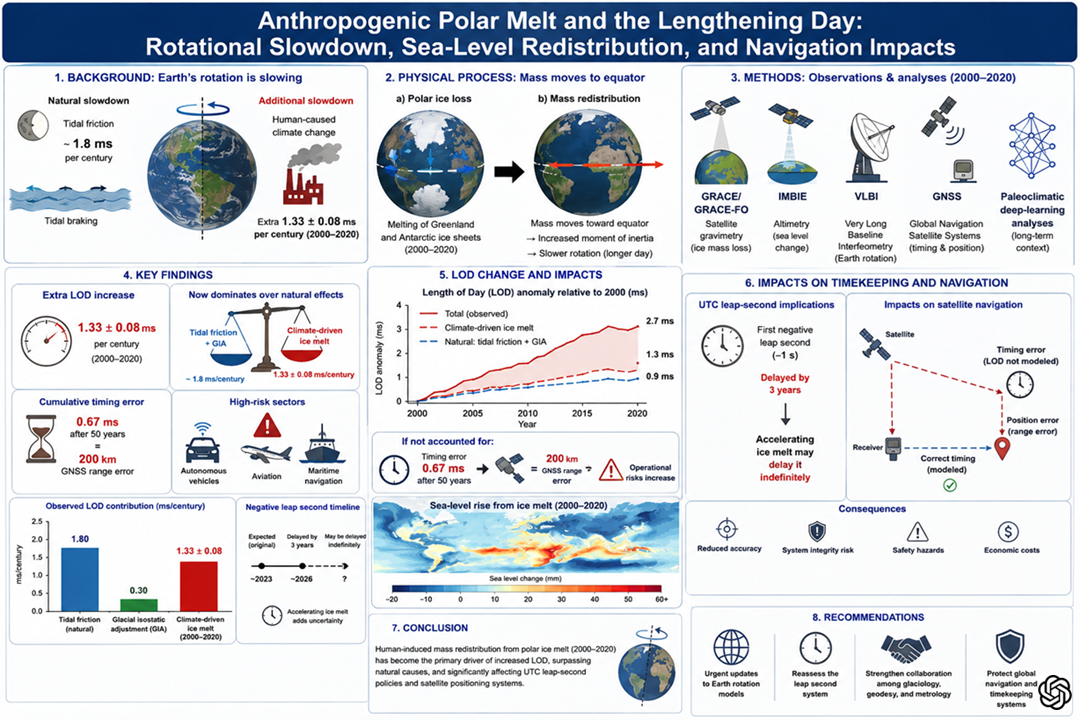
Earth's rotation is not constant. Tidal friction has lengthened the day by about 1.8 ms per century over the years. Recent observations show an additional slowdown in rotation linked to human-caused climate change. Purpose: This review brings together the physical processes, observational evidence, and technological effects of climate-driven polar ice melt on Earth’s length of day (LOD), focusing on the years 2000 to 2020. We use satellite gravimetry (GRACE/GRACE-FO), altimetry (IMBIE), very long baseline interferometry (VLBI), GNSS, and paleoclimatic deep-learning analyses to quantify ice sheet mass loss, sea level change, and resulting LOD shifts. From 2000 to 2020, melting of the Greenland and Antarctic ice sheets moved mass toward the equator. This increased Earth’s moment of inertia and slowed its rotation by an extra 1.33 ± 0.08 ms per century. This climate-related effect now surpasses the natural slowdown caused by tidal friction and glacial isostatic adjustment. If this is not accounted for, the total timing error will reach 0.67 ms after 50 years, equivalent to a 200 km GNSS range error. This poses serious risks for autonomous vehicles, aviation, and maritime navigation. The expected first negative leap second has been delayed by three years; however, the accelerating ice melt may push it back indefinitely. Human-induced mass redistribution has become the primary cause of increased LOD, significantly affecting UTC leap-second policies and satellite positioning. We need urgent updates to Earth rotation models, a reassessment of the leap second system, and collaboration among glaciology, geodesy, and metrology to protect global navigation and timekeeping systems.
References
Adhikari, S., Ivins, E. R., & Larour, E. (2024). Climate driven polar motion and lengthening of days: A NASA funded synthesis. Proceedings of the National Academy of Sciences, 121(32), e2406930121. https://doi.org/10.1073/pnas.2406930121
Agnew, D. C. (2024). A global timekeeping problem postponed by global warming. Nature, 628, 788-792. https://doi.org/10.1038/s41586-024-07170-0
Berger, T. E., & Lohmeyer, W. Q. (2025). Rising CO₂ likely to speed decrease in ‘space sustainability’. EurekAlert! https://www.eurekalert.org/news-releases/1084567
Bizouard, C., Lambert, S., Gattano, C., Becker, O., & Richard, J. Y. (2019). Earth’s rotation: Observations and relation to deep interior. Surveys in Geophysics, 42, 117-151. https://doi.org/10.1007/s10712-019-09571-x
Brouwer, W. S., & Hanssen, R. F. (2023). A treatise on InSAR geometry and 3 D displacement estimation. IEEE Transactions on Geoscience and Remote Sensing, 61, 5217811. https://doi.org/10.1109/TGRS.2023.3322595
Cheng, M., Tapley, B. D., & Ries, J. C. (2013). Deceleration in the Earth's oblateness. Journal of Geophysical Research: Solid Earth, 118, 740 747. https://doi.org/10.1002/jgrb.50058
DeConto, R. M., Pollard, D., Alley, R. B., et al. (2021). The Paris Climate Agreement and future sea level rise from Antarctica. Nature, 593, 83-87. https://doi.org/10.1038/s41586-021-03427-0
Gillet, N., Jault, D., & Finlay, C. C. (2015). Core mantle coupling and decadal length of day variations. Earth and Planetary Science Letters, 424, 1-9. https://doi.org/10.1016/j.epsl.2015.05.010
Google Maps Help. (2024). Improve location accuracy. Available at: https://support.google.com/maps/answer/2839912. Accessed on: June 05, 2026.
Goshu, B. S., & Alemu, Y. T. (2025). Examining the influence of large-scale hydroelectric projects on Earth's rotation, polarity shifts, and magnetic reversals. Budapest International Research in Exact Sciences (BirEx) Journal, 7(2), 157-180
Huang, H., Ma, C., Laskar, J., Sinnesael, M., Farhat, M., Hoang, N. H., Gao, Y., Zeeden, C., Zhong, H., Hou, M., & Wang, C. (2024). Geological evidence reveals a staircase pattern in Earth’s rotational deceleration evolution. PNAS – Proceedings of the National Academy of Sciences of the United States of America, 121(33), e2317051121. https://doi.org/10.1073/pnas.2317051121
IPCC. (2024). IPCC AR6 Synthesis Report LR Figure 3.4 (a): Sea level rise: observations and projections 2020 2100, 2150, 2300 (relative to 1900). NASA Socioeconomic Data and Applications Center (SEDAC). https://doi.org/10.7927/adkr-bn17
Kendall, R. A., Mitrovica, J. X., & Latychev, K. (2019). Sea level fingerprints of ice sheet mass change: A review of recent advances. Geophysical Journal International, 216(2), 1201-1225. https://doi.org/10.1093/gji/ggy468
Kouba, J. (2009). A guide to using International GNSS Service (IGS) products. International GNSS Service. Available at: https://igscb.jpl.nasa.gov/guidelines.html. Accessed on: July 06, 2026.
Lambeck, K. (1977). The Earth’s variable rate of rotation: A discussion of some meteorological and oceanic causes and consequences. Philosophical Transactions of the Royal Society of London. Series A, Mathematical and Physical Sciences, 284(1326), 495-516. https://doi.org/10.1098/rsta.1977.0021
Lambeck, K. (1980). The Earth’s variable rotation: Geophysical causes and consequences. Cambridge University Press.
Levine, J. (2024). The leap second crisis: A review. Metrologia, 61(2), 022001. https://doi.org/10.1088/1681-7575/ad1e2e
Montenbruck, O., & Steigenberger, P. (2020). System specific systematic errors in earth rotation parameters derived from GPS, GLONASS, and Galileo. GPS Solutions, 24(3), 74. https://doi.org/10.1007/s10291-020-00986-w
Montenbruck, O., & Steigenberger, P. (2021). Precise orbit and Earth parameter determination supported by LEO satellites, inter satellite links and synchronized clocks of a future GNSS. Advances in Space Research, 67(5), 1578-1592. https://doi.org/10.1016/j.asr.2020.12.012
Moreira, A., Prats Iraola, P., Younis, M., Krieger, G., & Reigber, A. (2013). A tutorial on synthetic aperture radar. IEEE Geoscience and Remote Sensing Magazine, 1(1), 6-43. https://doi.org/10.1109/MGRS.2013.2248301
Obleukhov, O., & Byagowi, A. (2022). The negative leap second: A challenge for digital infrastructure. Meta Engineering Blog. Available at: https://engineering.fb.com/2022/07/25/production-engineering/negative-leap-second/. Accessed on: July 10, 2026.
Otosaka, I. N., Shepherd, A., Ivins, E. R., Schlegel, N-J., Liang, C-C., Schröder, L., van Wessem, J. M., van der Wal, W., & Wouters, B. (2023). Mass balance of the Greenland and Antarctic ice sheets from 1992 to 2020. Earth System Science Data, 15(4), 1597-1616. https://doi.org/10.5194/essd-15-1597-2023
Peltier, W. R., & Wu, P. (2023). Glacial isostatic adjustment and the secular trend in length of day. Geophysical Journal International, 232(1), 1-15. https://doi.org/10.1093/gji/ggac312
Peltier, W. R., & Wu, P. (2023). Glacial isostatic adjustment and the secular trend in length of day. Geophysical Journal International, 232(1), 1-15. https://doi.org/10.1093/gji/ggac312
Ray, R. D., & Erofeeva, S. Y. (2014). Long term tidal variability and the Earth’s rotation. Journal of Geophysical Research: Oceans, 119(7), 4544-4556. https://doi.org/10.1002/2014JC010076
Rekier, J., Chao, B. F., Chen, J., Dehant, V., Rosat, S., & Zhu, P. (2022). Earth’s rotation: Observations and relation to deep interior. Surveys in Geophysics, 43, 149-175. https://doi.org/10.1007/s10712-021-09669-x
Romshoo, S. A., Murtaza, K. O., Shah, W., Ramzan, T., Ameen, U., & Bhat, M. H. (2022). Anthropogenic climate change drives melting of glaciers in the Himalaya. Environmental Science and Pollution Research, 29, 52732-52751. https://doi.org/10.1007/s11356-022-19524-0
Rosen, R. D. (1993). The axial momentum balance of Earth and its fluid envelope. Surveys in Geophysics, 14(1), 1-29. https://doi.org/10.1007/BF01044078
Satpathy, S. S., Franzke, C. L. E., Yuan, N., Maher, N., Park, W., & Lee, S-S. (2026). Anthropogenic warming-driven atmospheric circulation shifts and angular momentum increase: influence on the Earth’s rotation. npj Climate and Atmospheric Science, 9, 101. https://doi.org/10.1038/s41612-026-01382-z
Schuh, H., & Böhm, J. (2013). Very Long Baseline Interferometry for geodesy and astrometry. In: Xu, G., (Ed.), Sciences of Geodesy – II, 339-389 p, Springer. https://doi.org/10.1007/978-3-642-28000-9_7
Seoane, L., Ramillien, G., Frappart, F., & Darrozes, J. (2024). The increasingly dominant role of climate change on length of day variations. Geophysical Research Letters, 51(14), e2024GL108901. https://doi.org/10.1029/2024GL108901
Shahvandi, M. K., Adhikari, S., Dumberry, M., Mishra, S., & Soja, B. (2024). The increasingly dominant role of climate change on length of day variations. Proceedings of the National Academy of Sciences, 121(30), e2406930121. https://doi.org/10.1073/pnas.2406930121
Shahvandi, M. K., Soja, B., & et al. (2025). Unprecedented day length increase in the late Pliocene–Holocene inferred from foraminifera and deep learning. Journal of Geophysical Research: Solid Earth, 130(3), e2025JB032161. https://doi.org/10.1029/2025JB032161
Steigenberger, P., & Montenbruck, O. (2020). System specific systematic errors in earth rotation parameters derived from GPS, GLONASS, and Galileo. GPS Solutions, 24(3), 74. https://doi.org/10.1007/s10291-020-00986-w
Tang, X., Li, Z., & Wang, K. (2022). A time synchronization algorithm based on correlation analysis in GNSS/INS integrated navigation. IEEE Transactions on Instrumentation and Measurement, 71, 8500912. https://doi.org/10.1109/TIM.2022.3156789
Tapley, B. D., Bettadpur, S., Watkins, M., & Reigber, C. (2004). The gravity recovery and climate experiment: Mission overview and early results. Geophysical Research Letters, 31(9), L09607. https://doi.org/10.1029/2004GL019920
Willeit, M., Ganopolski, A., & Robinson, A. (2025). Rate induced tipping of the West Antarctic Ice Sheet. Communications Earth & Environment, 6, 112. https://doi.org/10.1038/s43247-025-01123-6
Zhang, Y. (2020). Mass balance of Greenland and Antarctica ice sheets from satellite gravimetry (Master’s thesis). Ohio State University.
Downloads
Published
How to Cite
Issue
Section
License
Copyright (c) 2027 Belay Sitotaw Goshu

This work is licensed under a Creative Commons Attribution 4.0 International License.
Authors who publish with this journal agree to the following terms:
1) Authors retain copyright and grant the journal right of first publication with the work simultaneously licensed under a Creative Commons Attribution License that allows others to share the work with an acknowledgement of the work's authorship and initial publication in this journal.
2) Authors are able to enter into separate, additional contractual arrangements for the non-exclusive distribution of the journal's published version of the work (e.g., post it to an institutional repository or publish it in a book), with an acknowledgement of its initial publication in this journal.
3) Authors are permitted and encouraged to post their work online (e.g., in institutional repositories or on their website) prior to and during the submission process, as it can lead to productive exchanges, as well as earlier and greater citation of published work.