Pratylenchus zeae in maize: Current advances, economic impacts, and challenges for sustainable management
DOI:
https://doi.org/10.14295/bjs.v6i2.939Keywords:
Pratylenchus zeae, maize, root-lesion nematode, plant–nematode interaction, crop productivityAbstract
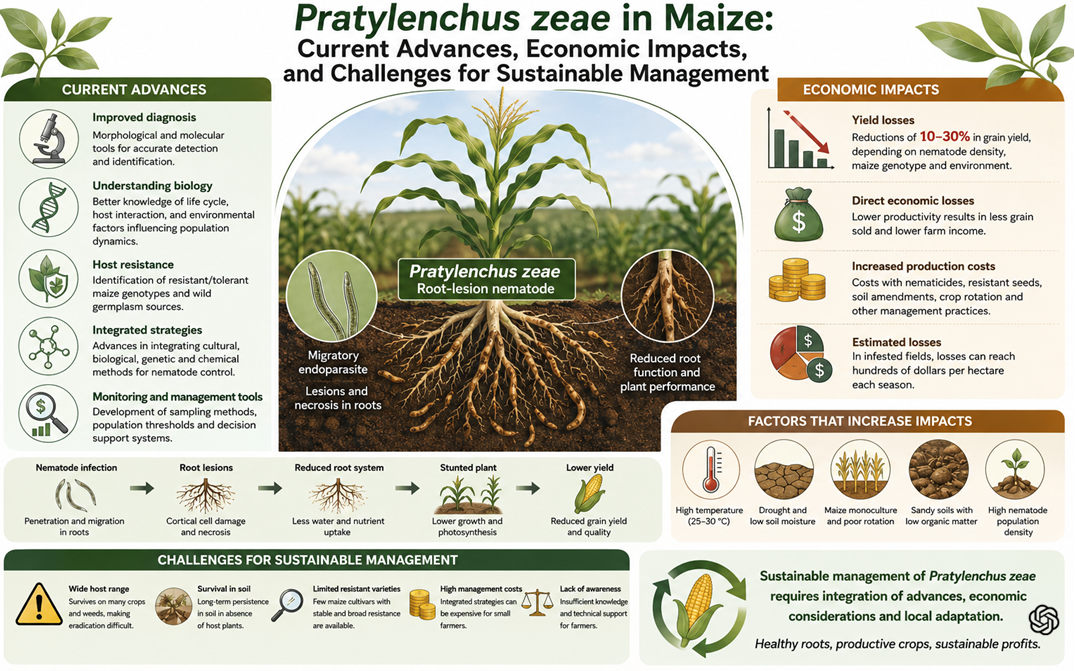
Maize (Zea mays L.) is one of the most important crops worldwide, playing a fundamental role in food security, animal nutrition, and industrial production. However, its productivity is frequently threatened by plant-parasitic nematodes, among which Pratylenchus zeae stands out as one of the most relevant species in tropical and subtropical production systems. This study aimed to conduct a narrative literature review on the impacts of P. zeae on maize, synthesizing scientific advances published between 2016 and 2025 and identifying current knowledge gaps related to its management. The review was based on a qualitative and descriptive approach, using scientific articles, theses, dissertations, technical documents, and review papers retrieved from SciELO, CAPES Periodicals Portal, Brazilian Digital Library of Theses and Dissertations (BDTD), Web of Science, and PubMed/MEDLINE databases. The available evidence indicates that P. zeae acts primarily within the root system, causing cortical lesions, impairing water and nutrient uptake, reducing plant vigor, and increasing susceptibility to abiotic and biotic stresses. The persistence and spread of the nematode are strongly influenced by continuous cultivation of susceptible hosts, inadequate crop rotation practices, weed reservoirs, and the use of highly susceptible genotypes. Current management strategies emphasize integrated approaches combining nematological diagnosis, population monitoring, crop rotation, cover crops, weed management, host resistance, biological control agents, and soil health improvement practices. Despite significant advances in understanding the biology and ecology of P. zeae, important gaps remain regarding economic damage thresholds, regionalized risk assessments, and the validation of management practices under commercial field conditions. Overall, sustainable management of Pratylenchus zeae requires an integrated systems-based approach supported by region-specific research capable of improving decision-making and reducing nematode-associated yield losses in maize production systems.
References
Abreu, A. B. L. (2018). Comportamento do nematoide das lesões radiculares nas culturas do milho e soja. Dissertação de Mestrado em Agronomia, Universidade Federal de Mato Grosso do Sul, Campo Grande. Available from: https://ppgagronomiacpcs.ufms.br/files/2018/01/Disserta%C3%A7%C3%A3o_Alexandra-Botelho-de-Lima-Abreu.pdf . Accessed: April 26, 2026.
Abd-Elgawad, M. M. M. (2024). Upgrading strategies for managing nematode pests on profitable crops. Plants, 13(11), 1558. https://doi.org/10.3390/plants13111558
Alisaac, E., & Mahlein, A-K. (2023). Fusarium head blight on wheat: Biology, modern detection and diagnosis and integrated disease management. Toxins, 15(3), 192. https://doi.org/10.3390/toxins15030192
Andrade-Piedra, J. L., Sharma, K., Kroschel, J., Ogero, K., Kreuze, J., Legg, J. P., Kumar, P. L., Spielman, D. J., Navarrete, I., Perez, W., Atieno, E., & Garrett, K. A. (2025). Phytosanitary challenges and solutions for roots and tubers in the tropics. Annual Review of Phytopathology, 63, 627-650. https://doi.org/10.1146/annurev-phyto-021722-030316
Araújo, T. R., Diniz, F. A. S., Mendes, B. L., Almeida, L. C., & Santiago, T. R. (2025). Pratylenchus zeae is the main root lesion nematode affecting sugarcane in the world’s most important producing regions. Physiological and Molecular Plant Pathology, 136, 102576. https://doi.org/10.1016/j.pmpp.2025.102576
Araújo, F. G., Teixeira, S. J. C., Souza, J. C., & Arieira, C. R. D. (2023). Cover crops and biocontrol agents in the management of nematodes in soybean crop. Revista Caatinga, 36(2), 243-250. http://dx.doi.org/10.1590/1983-21252023v36n201rc
Atandi, J. G. et al. (2017). Organic farming provides improved management of plant parasitic nematodes in maize and bean cropping systems. Agriculture, Ecosystems & Environment, 247, 265-272. https://doi.org/10.1016/j.agee.2017.07.002
Artega-Ojeda, R. M., Larralde-Corona, C. P., Cometta, S., & Narváez-Zapata, J. A. (2026). Bridging the lab-field gap: Towards scalable biocontrol applications for sustainable maize protection. Agronomy, 16(6), 598. https://doi.org/10.3390/agronomy16060598
Baloch, N. (2025). Microbial contributions to maize crop production: a comprehensive review of challenges and future perspectives. Discover Agriculture, 3. https://doi.org/10.1007/s44279-025-00164-0
Barros, F. M. R., Pedrinho, A., Mendes, L. W., Freitas, C. C. G., & Andreote, F. D. (2022). Interactions between soil bacterial diversity and plant-parasitic nematodes in soybean plants. Environmental Microbiology, 88(17). https://doi.org/10.1128/aem.00963-22
Bellé, C. (2017). Reproduction of Pratylenchus zeae on weeds. Planta Daninha, 35, e017158528. https://doi.org/10.1590/S0100-83582017350100006
Benjamin, J., Oyedokun, D. O., Oziegbe, E. V., Oni, J., Ogundare, E. B., Ujah, G. O., & Adebayo, A. (2024). Cereal production in Africa: the threat of current plant pathogens in changing climate-a review. Discover Agriculture, 2. https://doi.org/10.1007/s44279-024-00040-3
Benjamin, J., Adejumo, S. A., Claudius-Cole, A. (2021). Maize response to sole and combined effects of nitrogen and nematode stresses. Advanced Journal of Graduate Research, 9(1), 71-80. https://doi.org/10.21467/ajgr.9.1.71-80
Bigolin, T., & Talamini, E. (2024). Impacts of climate change scenarios on the corn and soybean double-cropping system in Brazil. Climate, 12(3), 42. https://doi.org/10.3390/cli12030042
Botelho, L. L. R., Cunha, C. C. A., Macedo, M. (2011). O método da revisão integrativa nos estudos organizacionais. Gestão e Sociedade, 5(11), 121-136. https://ges.face.ufmg.br/index.php/gestaoesociedade/article/view/1220
Carvalho, S. L. (2025). Bioprospecção de Pratylenchus spp. em áreas cultiváveis com milho doce no Sul de Goiás. Revista DELOS, 18(63), e3531. https://ojs.revistadelos.com/ojs/index.php/delos/article/view/3531
Chadfield, V. G. A., Hartley, S. E., & Redeker, K. R. (2022). Associational resistance through Intercropping reduces yield losses to soil-borne pests and diseases. New Phytologist, 235(6), 2393-2405. https://doi.org/10.1111/nph.18302
Chapagain, B. C., Lamichhane, S., Sapkota, S., Koirala, D., & Pokharel, S. (2025). Biology, damage, and integrated control strategies for major plant-parasitic nematodes. Turkish Journal of Agriculture – Food Science and Technology International Peer-Reviewed Journal, 13(9), 2845-2857. https://doi.org/10.24925/turjaf.v13i9.2845-2857.7724
CONAB (2025). Boletim da safra de grãos 2024/2025. Brasília: Companhia Nacional de Abastecimento, 2025. Available in: https://www.gov.br/conab/pt-br/atuacao/informacoes-agropecuarias/safras/safra-de-graos/boletim-da-safra-de-graos Accessed: April 26, 2026.
Confort, P. M. S., & Inomoto, M. M. (2023). Effect of seed treatment with the biological agent Pasteuria thornei on the control of Pratylenchus zeae in maize. European Journal of Plant Pathology, 166, 275-284. https://doi.org/10.1007/s10658-023-02659-2
Costa, D. C. (2019). Levantamento de espécies de nematoides-das-lesões-radiculares (Pratylenchus spp.) no Cerrado brasileiro e avaliação de danos à cultura do arroz. Brasília, DF: Embrapa Recursos Genéticos e Biotecnologia, 40 p. (Boletim de Pesquisa e Desenvolvimento, 345). Available in: https://www.infoteca.cnptia.embrapa.br/infoteca/bitstream/doc/1112005/1/BPD345ed0120192.pdf. Accessed: May 20, 2026.
Débia, P. J. G. (2016). Penetration of Pratylenchus zeae in antagonistic plants. Nematology, 18(7), 871-873. https://doi.org/10.1163/15685411-00002991
Embrapa (2013). Sistemas de produção inadequados contribuíram para aumento das populações de fitonematoides. Brasília: Empresa Brasileira de Pesquisa Agropecuária. Available at: https://www.embrapa.br/busca-de-noticias/-/noticia/1707033. Accessed: April 14, 2026.
Embrapa (2024). Milho: dados de produção mundial e brasileira. Brasília: Empresa Brasileira de Pesquisa Agropecuária. Available in: https://www.embrapa.br/agropensa/agro-em-dados/agricultura/milho. Accessed: April 12, 2026.
Espada, M., Vicente, C. S. L., & Vieira, P. (2025). Molecular insights in to migratiory plant-parasitic nematodes. Annual Review of Phytopathology, 63, 403-430. https://doi.org/10.1146/annurev-phyto-112624-103056
FAO. (2024). Food Outlook – Biannual report on global food markets. Rome: Food and Agriculture Organization of the United Nations. Available at: https://openknowledge.fao.org/handle/20.500.14283/cd1158en. Accessed: April 26, 2026.
Gorný, A., & Cox, K. (2021). Lesion nematode in corn. Raleigh: NC State Extension Publications. Available at: https://content.ces.ncsu.edu/lesion-nematode-in-corn. Accessed: May 20, 2026.
Goulart, A. M. C. (2008). Aspectos gerais sobre nematóides-das-lesões-radiculares: gênero Pratylenchus. Planaltina, DF: Embrapa Cerrados, 30 p. (Documentos, 219). Available at: https://www.infoteca.cnptia.embrapa.br/infoteca/bitstream/doc/571924/1/doc219.pdf. Accessed: May 20, 2026.
Grabau, Z. J., & Vann, C. (2024). Management of plant-parasitic nematodes in Florida field corn production. Gainesville: University of Florida, IFAS Extension. Available at: https://ask.ifas.ufl.edu/publication/NG014. Accessed: May 20, 2026.
Grabau, Z. J., Vetsch, J. A., Chen, S., & Southern Research and Outreach Center. (2017). Effects of fertilizer, nematicide, and tillage on plant-parasitic nematodes and yield in corn and soybean. Agronomy Journal, 109(4), 1651-1662. https://doi.org/10.2134/agronj2016.09.0548
Hu, Y. J. (2023). Pratylenchus zeae, a causative agent of corn root rot in Jiangsu Province of China. Plant Disease, 107(8), 2558. https://doi.org/10.1094/PDIS-10-22-2456-PDN
Izuogu, N. B., & Usman, S. (2019). Efficacy of compost tea from animal waste in the management of Pratylenchus zeae infecting two maize varieties. Journal of Agricultural Research, 57(3), 167-173. https://doi.org/10.58475/d7kbr094
Khan, M. R., & Quintanilla, M. (2023). Nematode diseases of crops and their sustainable management. Academic Press. https://doi.org/10.1016/C2020-0-03866-1
Kim, KPH., & Lee, B-M. (2023). Effects of climate change and drought tolerance on maize growth. Plants, 12(20), 3548. https://doi.org/10.3390/plants12203548
Lamichhane, J. R., Barbetti, M. J., Chilvers, M. I., Pandey, A. K., & Steinberg, C. (2024). Exploiting root exudates to manage soil-borne disease complexes in a changing climate. Trends in Microbiology, 32(1), 27-37.
Liang, X., Yu, S., Ju, Y., Wang, Y., & Yin, D. (2025). Integrated management practices foster soil health, productivity, and agroecosystem resilience. Agronomy, 15(8), 1816. https://doi.org/10.3390/agronomy15081816
Lopez-Nicora, H., Peng, D., Saikai, K., & Rashidifard, M. (2023). Nematode problems in maize and their sustainable management. In: Khan, M. R., & Quintanilla, M. (ed.). Nematode diseases of crops and their sustainable management. London: Academic Press, 167-181. https://doi.org/10.1016/B978-0-323-91226-6.00018-3
Lu, Y., Yang, S., Chen, W., Xie, H., & Xu, C. (2024). Advances in migratory plant endoparasitic nematode effectors. International Journal of Molecular Sciences, 25(12), 6435. https://doi.org/10.3390/ijms25126435
Miedaner, T., & Garbelotto, M. M. (2024). Human-mediated migration of plants, their pathogens and parasites. Journal of Plant Pathology, 106, 301-325. https://doi.org/10.1007/s42161-024-01589-0
Njero, F., Wambua, A., Muge, E., Haesaert, G., Gettemans, J., & Misinzo, G. (2023). Major biotic stresses affecting maize production in Kenya and their implications for food security. PeerJ, 11, e15685. https://doi.org/10.7717/peerj.15685
Nzogela, Y. B. (2020). Pathogenicity of the root-lesion nematode, Pratylenchus zeae, on rice genotypes under different hydro-ecologies in Tanzania. Nematology, 22(2), 221-233. https://doi.org/10.1163/15685411-00003302
Oliveira, C. M. G., & Inomoto, M. M. (2023). Nematoides que atacam a cultura do milho no Brasil. O Biológico, 85, 1-13.
Pfordt, A., & Paulus, S. (2024). A review on detection and differentiation of maize diseases and pests by imaging sensors. Journal of Plant Diseases and Protection, 132. https://doi.org/10.1007/s41348-024-01019-4
Pires, D., Vicente, C. S. L., Menéndez, E., Faria, J. M. S., Camacho, M. J., & Inácio, M. L. (2022). The fight against plant-parasitic nematodes: Current status of bacterial and fungal biocontrol agents. Pathogens, 11(10), 1178. https://doi.org/10.3390/pathogens11101178
Procópio, A. C. C. (2023). Hospedabilidade de Pratylenchus zeae em genótipos de milho e sorgo. Trabalho de conclusão de curso de graduação em Agronomia pela Universidade Federal de Uberlândia, Uberlândia, Brasil. Available at: https://repositorio.ufu.br/handle/123456789/41271. Accessed: April 26, 2026
Quintanilla, M., & Fazlabadi, R. Y. (2023). Chapter 3 – Methods of sustainable management of plant nematodes, limitations, and challenges for crop growers. In: Nematode Diseases of Crops and their Sustainable Management, 55-63. https://doi.org/10.1016/B978-0-323-91226-6.00028-6
Rother, E. T. (2007). Revisão sistemática X revisão narrativa. Acta Paulista de Enfermagem, 20(2), v–vi.
Rutter, W. B., Franco, J., & Gleason, C. (2022). Rooting out the mechanisms of root-knot nematode-plant interactions. Annual Review of Phytopathology, 60, 43-76. https://doi.org/10.1146/annurev-phyto-021621-120943
Santana-Gomes, S. M. (2019). Planting different crops in succession to manage Pratylenchus zeae in sugarcane. Nematropica, 49(1), 63-70.https://journals.flvc.org/nematropica/article/view/115618
Santana-Gomes, S. M. (2018). Pratylenchus zeae and P. brachyurus reproduction in green manure maize/soybean consortium systems. Journal of Phytopathology, 166(11-12), 826-831. https://doi.org/10.1111/jph.12759
Santana-Gomes, S. M. (2019). Reproduction of Pratylenchus zeae and P. brachyurus in cover crops. Revista Caatinga, 32(2), 295-301. http://dx.doi.org/10.1590/1983-21252019v32n201rc
Sikora, R. A., Helder, J., Molendijk, L. P. G., Desaeger, J., den Akker, S. E-van., & Mahlein, A-K. (2023). Integrated nematode management in a world in transition: Constraints, policy, processes, and technologies for the future. Annual Review of Phytopathology, 61, 209-230. https://doi.org/10.1146/annurev-phyto-021622-113058
Sousa, R. L. (2018). Nematoide das lesões radiculares (Pratylenchus spp.) no Cerrado Brasileiro: reação de cultivares de arroz e levantamento de espécies associadas a culturas. Dissertação de Mestrado em Fitopatologia pela Universidade de Brasília, Brasília, Brasil. Available at: https://repositorio.unb.br/handle/10482/34827. Accessed: April 26, 2026.
Syngenta (2022). Agroconsult, Sociedade Brasileira de Nematologia. Pesquisa sobre danos econômicos causados por nematoides e doenças iniciais nas principais culturas no Brasil. São Paulo: Syngenta. Available at: https://www.syngenta.com.br/press-release/institucional/pesquisa-inedita-revela-mapa-de-crescimento-e-danos-economicos-causados. Accessed: April 26, 2026.
Tiwari, S. P., Masih, D., Jatav, R., Tiwari, G., & Husain, R. (2024). Lesion nematode (Pratylenchus spp): ‘Emerging threats’ in horticulture and agriculture, a review. Journal of Research in Agriculture and Animal Science, 11(12), 17-33.
Thiruchchelvan, N. (2024). Root-lesion nematode (Pratylenchus spp.) extraction from maize roots: a comparison of three methods. New Zealand Plant Protection, 77, 36-42. https://doi.org/10.30843/nzpp.2024.77.11782
Thiruchchelvan, N., Kularathna, M., Moukarzel, R., Casonato, S., & Condron, L. M. (2024). Prevalence and abundance of plant-parasitic nematodes in New Zealand maize fields: effects of territory, soil orders, crop stage, and sampling time. New Zealand Journal of Zoology, 52(5), 571-592. https://doi.org/10.1080/03014223.2024.2424900
Wanjau, C., Knoetze, R., Gurgan, C., Pili, N. N., Engelbrecht, G., Couvreur, M., & Bert, W. (2024). Characterization and pathogenicity of Pratylenchus vanderbergar stat. Nov. (Tylenchia: Pratylenchidae), a highly pathogenic root-lesion nematode parasitizing crops in Kenya and South Africa. Plant Pathology, 73(3), 706-723. https://doi.org/10.1111/ppa.13836
Xing, E., Fan, X., Jiang, F., & Zhang, Y. (2023). Advancements in research on prevention and control strategies for maize white spot disease. Genes, 14(11), 2061. https://doi.org/10.3390/genes14112061
Yigit, U., & Akyazi, F. (2024). Distribution, morphological and molecular characterization of roo-lesion nematodes (Pratylenchus spp.) (Tylenchida: Pratylenchidae) in maize (Zea mays L.) (Poales: Poaceae) in Türkiye. Molecular Biology Reports, 51. https://doi.org/10.1007/s11033-024-09843-5
Downloads
Published
How to Cite
Issue
Section
License
Copyright (c) 2027 Izadora Marques Galvão, Welber Cabral Bueno, Fabiula Barbosa de Souza, Gabriel Henrique dos Santos Cardoso, Hiago Medeiros dos Santos, Juliana Araújo Rocha, Francisco Rafael Santos Conceição, Porshia Sharma, Janslei Andrade da Silva, Aurélio Ferreira Melo

This work is licensed under a Creative Commons Attribution 4.0 International License.
Authors who publish with this journal agree to the following terms:
1) Authors retain copyright and grant the journal right of first publication with the work simultaneously licensed under a Creative Commons Attribution License that allows others to share the work with an acknowledgement of the work's authorship and initial publication in this journal.
2) Authors are able to enter into separate, additional contractual arrangements for the non-exclusive distribution of the journal's published version of the work (e.g., post it to an institutional repository or publish it in a book), with an acknowledgement of its initial publication in this journal.
3) Authors are permitted and encouraged to post their work online (e.g., in institutional repositories or on their website) prior to and during the submission process, as it can lead to productive exchanges, as well as earlier and greater citation of published work.