Bibliometric and science mapping analysis of occupational therapy research in Greece (1977–2025)
DOI:
https://doi.org/10.14295/bjs.v6i1.931Keywords:
occupational therapy, bibliometric analysis, Greece, science mapping, research productivityAbstract
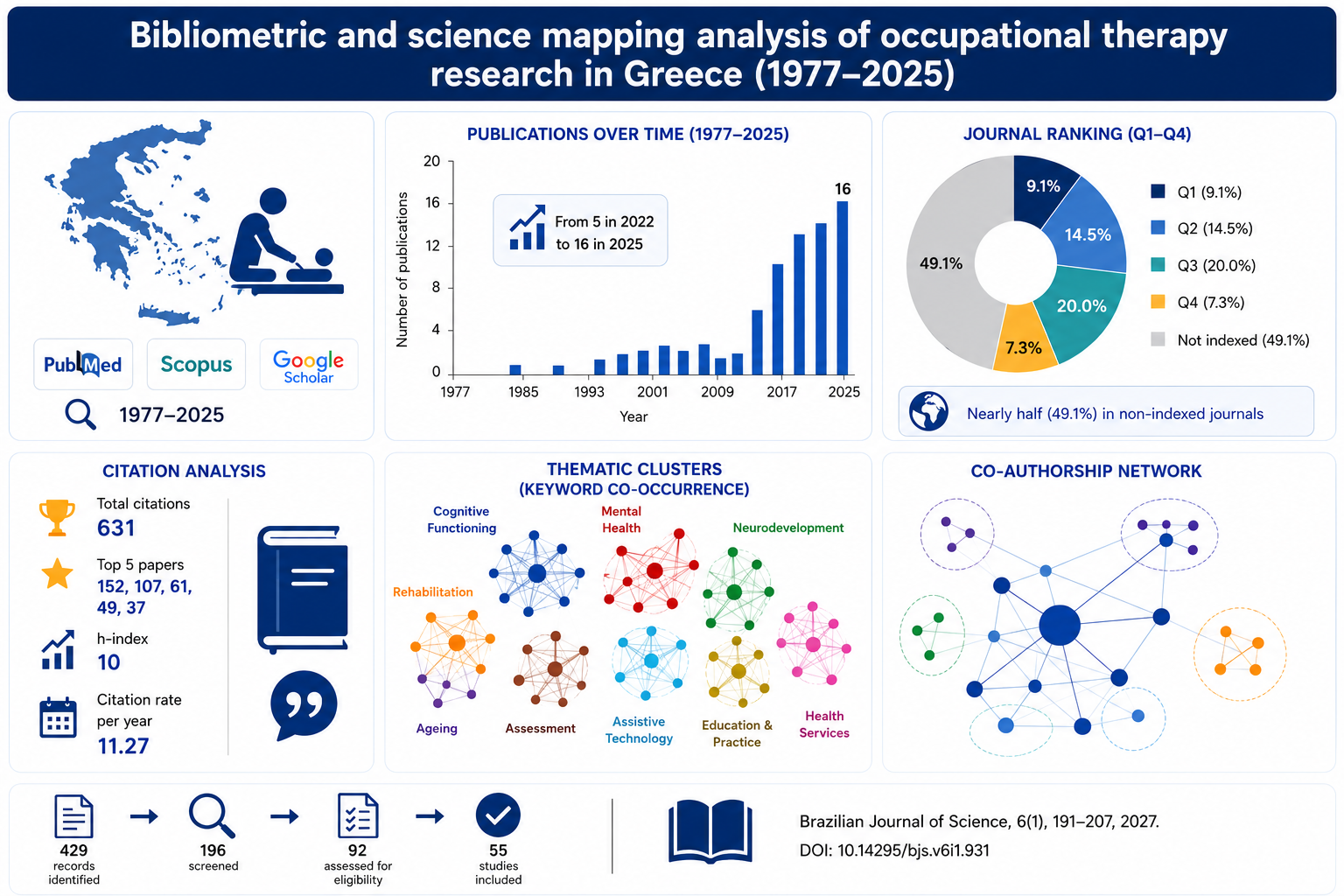
Occupational therapy research in Greece has developed gradually, yet its scientific output, impact, collaboration patterns, and thematic orientation have not previously been examined systematically. This study aimed to provide the first comprehensive bibliometric analysis and science mapping of occupational therapy research produced by academic staff affiliated with Greek higher education institutions. A bibliometric and science-mapping analysis was conducted, with the identification and selection of publications reported in accordance with the PRISMA 2020 framework. PubMed, Scopus, and Google Scholar were searched for peer-reviewed publications produced between 1977 and 2025 by academic staff affiliated with the three Greek university departments offering undergraduate occupational therapy programmes. Study selection was managed through Covidence, while publication trends, journal rankings, citation performance, keyword co-occurrence, thematic clusters, and co-authorship networks were examined. VOSviewer was used for science mapping and network visualization. Of the 429 records identified, 55 peer-reviewed articles met the eligibility criteria. Research output remained limited until 2021 but increased considerably thereafter, rising from five publications in 2022 to sixteen in 2025. Nearly half of the articles were published in non-indexed journals, while relatively few appeared in Q1 and Q2 journals. Citation impact was concentrated in a limited number of highly cited publications. Keyword analysis revealed nine thematic clusters covering cognitive functioning, mental health, neurodevelopment, rehabilitation, ageing, and emerging technologies. Co-authorship mapping indicated a centralized and fragmented collaboration structure. This study establishes the first bibliometric baseline for occupational therapy research associated with Greek higher education institutions. By identifying patterns of productivity, visibility, thematic development, and scientific collaboration, the findings provide evidence that may support institutional research planning, stronger interinstitutional collaboration, advanced research training, and the strategic development of occupational therapy research in Greece.
References
Alkattan, A., Albokhadaim, I., Almofti, A. Y., Alrasheed, M., & Kandeel, M. (2025). Evolution and emerging directions in occupational therapy for autism: A bibliometric evaluation of global literature. International Journal of Innovative Research and Scientific Studies, 8(3), 3431-3445. https://doi.org/10.53894/ijirss.v8i3.4567
Brown, T. (2011). Journal quality metrics: Options to consider other than impact factors. American Journal of Occupational Therapy, 65(3), 346-350. https://doi.org/10.5014/ajot.2011.001396
Brown, T., Gutman, S. A., Ho, Y. S., & Fong, K. N. K. (2017). Highly cited occupational therapy articles in the science citation index expanded and social sciences citation index: A bibliometric analysis. The American Journal of Occupational Therapy, 71(6), 7106300010p1-7106300010p11. https://doi.org/10.5014/ajot.2017.025346
Brown, T., Gutman, S. A., Ho, Y. S., & Fong, K. N. K. (2018). A bibliometric analysis of occupational therapy publications. Scandinavian Journal of Occupational Therapy, 25(1), 1-14. https://doi.org/10.1080/11038128.2017.1329344
Cantorani, J. R. H., & Oliveira, M. R. (2025). Forty-five years of disability and rehabilitation research: Review of the journal Disability and Rehabilitation through bibliometric analysis. Disability and Rehabilitation, 47(11), 2960-2974. https://doi.org/10.1080/09638288.2024.2403731
Cobo, M. J., López-Herrera, A. G., Herrera-Viedma, E., & Herrera, F. (2011). Science mapping software tools: Review, analysis, and cooperative study among tools. Journal of the American Society for Information Science and Technology, 62(7), 1382-1402. https://doi.org/10.1002/asi.21525
Donthu, N., Kumar, S., Mukherjee, D., Pandey, N., & Lim, W. M. (2021). How to conduct a bibliometric analysis: An overview and guidelines. Journal of Business Research, 133, 285-296. https://doi.org/10.1016/j.jbusres.2021.04.070
Ellegaard, O., & Wallin, J. A. (2015). The bibliometric analysis of scholarly production: How great is the impact? Scientometrics, 105(3), 1809-1831. https://doi.org/10.1007/s11192-015-1645-z
Espinosa-Sempere, M. C., Pérez-Jover, V., Quesada, J. A., López-Pineda, A., & Carratalá-Munuera, C. (2021). Evolutionary analysis of international scientific output in occupational therapy from 1917 to 2020. International Journal of Environmental Research and Public Health, 18(23), 12740. https://doi.org/10.3390/ijerph182312740
Man, D. W. K., Tsang, W. S. F., Lu, E. Y., & Tsang, H. W. H. (2019). Bibliometric study of research productivity in occupational therapy and physical therapy/physiotherapy in four Western countries and five Asian countries/regions. Australian Occupational Therapy Journal, 66(6), 690-699. https://doi.org/10.1111/1440-1630.12608
Man, D. W. K., Xu, G., & Wong, M. S. (2019). Rehabilitation research productivity: A comparative study across Western and Asian countries. Disability and Rehabilitation, 41(7), 835-842. https://doi.org/10.1080/09638288.2017.1408775
Márquez-Álvarez, L.-J., Talavera-Valverde, M.-Á., & Souto-Gómez, A.-I. (2026). Methodological and historical evolution of indexed publications in occupational therapy. British Journal of Occupational Therapy, 89(4), 217-234. https://doi.org/10.1177/03080226251363729
Mazaro, L. M., Depole, B. F., Gasparini, D. A., Colato, E. R. O., Gomes, L. D., Souza, M. B. C. A., Souza, T. T., Matsukura, T. S., & Lussi, I. A. O. (2021). Overview of scientific production on occupational therapy and mental health (1990-2018): A bibliometric study. Cadernos Brasileiros de Terapia Ocupacional, 29, e2855. https://doi.org/10.1590/2526-8910.ctoAR2159
Pamboris, G. M., Plakias, S., Tsiakiri, A., Karakitsiou, G., Bebeletsi, P., Vadikolias, K., Aggelousis, N., Tsiptsios, D., & Christidi, F. (2024). Physical therapy in neurorehabilitation with an emphasis on sports: A bibliometric analysis and narrative review. Sports, 12(10), 276. https://doi.org/10.3390/sports12100276
Passas, I. (2024). Bibliometric analysis: The main steps. Encyclopedia, 4(2), 1014-1025. https://doi.org/10.3390/encyclopedia4020065
Pendlebury, D. A. (2008). Using bibliometrics: A guide to evaluating research performance with citation data (Whitepaper). Thomson Reuters.
Pritchard, A. (1969). Statistical bibliography or bibliometrics? Journal of Documentation, 25(4), 348-349.
Wei, Y., Chen, Y., Ma, R., Qiu, Y., Su, W., Zhang, L., & Gao, Q. (2025). Research hotspots and trends of virtual reality intervention for stroke: Bibliometric analysis. JMIR Serious Games, 13, e65993. https://doi.org/10.2196/65993
World Federation of Occupational Therapists. (2025). About occupational therapy. https://wfot.org/about/about-occupational-therapyYildiz, M. (2025). Bibliometric analysis of studies on the rehabilitation of disabled athletes through visual mapping. Journal of Sport Rehabilitation, 34(4), 387-395. https://doi.org/10.1123/jsr.2024-0112
Yoo, M., & Jang, C. W. (2025). Prehabilitation research: A bibliometric analysis of past trends and future directions. American Journal of Physical Medicine & Rehabilitation, 104(4), 357-363. https://doi.org/10.1097/PHM.0000000000002611
Downloads
Published
How to Cite
Issue
Section
License
Copyright (c) 2027 Anastasia Onoufriou, Ioanna Kargaki, Panagiota Sfintsioti, Konstantinos Georgiou, Georgios Kalogirou, Pantelis Pergantis

This work is licensed under a Creative Commons Attribution 4.0 International License.
Authors who publish with this journal agree to the following terms:
1) Authors retain copyright and grant the journal right of first publication with the work simultaneously licensed under a Creative Commons Attribution License that allows others to share the work with an acknowledgement of the work's authorship and initial publication in this journal.
2) Authors are able to enter into separate, additional contractual arrangements for the non-exclusive distribution of the journal's published version of the work (e.g., post it to an institutional repository or publish it in a book), with an acknowledgement of its initial publication in this journal.
3) Authors are permitted and encouraged to post their work online (e.g., in institutional repositories or on their website) prior to and during the submission process, as it can lead to productive exchanges, as well as earlier and greater citation of published work.