Sustainable water management for irrigated agriculture in Rwanda: systematic narrative review
DOI:
https://doi.org/10.14295/bjs.v5i3.823Keywords:
sustainable water management, irrigated agriculture, integrated water resources management (IWRM), RwandaAbstract
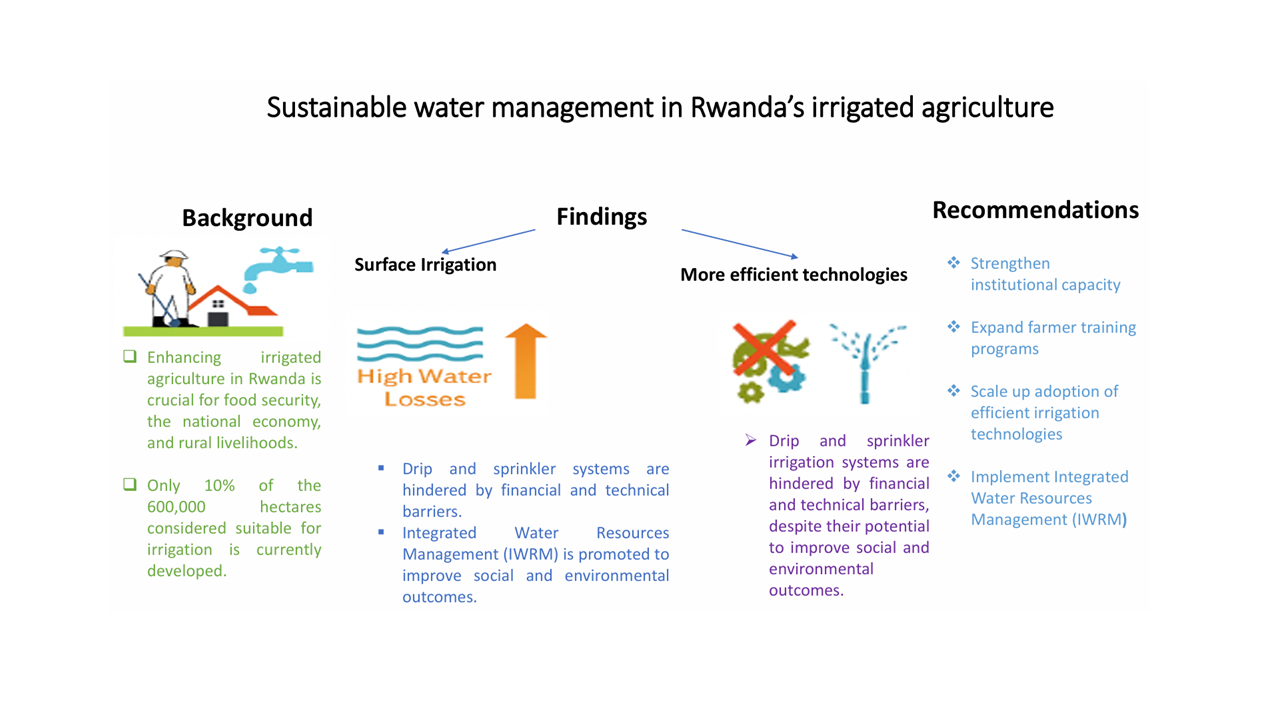
Sustainable water management is fundamental to the performance of irrigated agriculture in Rwanda, where irrigation plays a critical role in food security, rural livelihoods, and national economic development. Over the past two decades, the Government of Rwanda has made substantial investments in irrigation infrastructure and policy initiatives, notably the Rwanda Irrigation Master Plan (RIMP) and the Strategic Plan for the Transformation of Agriculture (PSTA). Despite these efforts, irrigation coverage and water use efficiency remain below their estimated potential. Of the approximately 600,000 hectares considered suitable for irrigation, only about 10% is currently developed. This systematic narrative review synthesizes peer-reviewed and grey literature published between 2010 and 2025 to assess the status of irrigation systems, water management practices, institutional arrangements, environmental challenges, and emerging technological options in Rwanda. The review shows that around 148 irrigation schemes have been established across marshlands, hillsides, and valley bottoms; however, many schemes are constrained by underutilized infrastructure, sedimentation, high energy costs, limited farmer technical capacity, and weak operation and maintenance mechanisms. Surface irrigation remains the dominant practice, often associated with substantial water losses, while more efficient technologies such as drip and sprinkler systems demonstrate better performance but face low adoption due to financial and technical barriers. Integrated Water Resources Management (IWRM) is increasingly promoted as a guiding framework, emphasizing coordinated water allocation, social equity, and environmental sustainability. Nonetheless, persistent issues such as soil degradation, waterlogging, and inefficient resource use indicate gaps in governance, monitoring, and enforcement. Overall, the review highlights that achieving sustainable water management in Rwanda’s irrigated agriculture will require strengthening institutional capacity, expanding farmer training, scaling up efficient irrigation technologies, and reinforcing IWRM implementation at catchment and scheme levels. These measures are essential for improving productivity, enhancing resilience to climate variability, and safeguarding long-term environmental sustainability.
References
Ali, A., Hussain, T., & Zahid, A. (2025). Smart irrigation technologies and prospects for enhancing water use efficiency for sustainable agriculture. AgriEngineering, 7(4), 106. DOI: https://doi.org/10.3390/agriengineering7040106
AllAfrica. (2025). Rwandan farms go high tech to fight drought. https://allafrica.com/stories/202509160204.html allAfrica.com
Bamurigire, P., Vodacek, A., Valko, A., & Rutabayiro Ngoga, S. (2020). Simulation of internet of things water management for efficient rice irrigation in Rwanda. Agriculture, 10(10), 431. DOI: https://doi.org/10.3390/agriculture10100431
Bird, K., Chabé-Ferret, B., & Simons, A. (2022). Linking human capabilities with livelihood strategies to speed poverty reduction: Evidence from Rwanda. World Development, 151, 105728. DOI: https://doi.org/10.1016/j.worlddev.2021.105728
Bizimana, C., Usengumukiza, F., Kalisa, J., & Rwirahira, J. (2012). Trends in key agricultural and rural development indicators in Rwanda. Rwanda Strateg Anal Knowl Support Syst SAKSS Minist Agric Anim Resour MINAGRI Kigali.
Bizoza, A. R. (2021). Investigating the effectiveness of land use consolidation–a component of the crop intensification programme in Rwanda. Journal of Rural Studies, 87, 213-225. DOI: https://doi.org/10.1016/j.jrurstud.2021.09.018
Booth, D., & Golooba‐Mutebi, F. (2014). Policy for agriculture and horticulture in Rwanda: A different political economy?. Development Policy Review, 32(s2), s173-s196.
Booth, D., & Golooba‐Mutebi, F. (2014). Policy for agriculture and horticulture in Rwanda: A different political economy?. Development Policy Review, 32(s2), s173-s196. DOI: https://doi.org/10.1111/dpr.12081
Celestin, H., Rukangantambara, H., & Pande, M. S. K. (2023). Performance Evaluation of Drip Irrigation System Under Onion Crop in Semi-Arid Region of Eastern Rwanda. Performance Evaluation, 41(2), 461-480. DOI: https://doi.org/10.52155/ijpsat.v41.2.3443
CIFOR-ICRAF. (2020). Rwanda Irrigation Master Plan. Nairobi: CIFOR-ICRAF Knowledge Platform
Energy 4 Impact (2025)—Mercy Corps report on the solar irrigation market in Rwanda, including barriers and benefits.
Environmental Impact Assessment Report for Gatsibo 8 site. (2013). Updated environmental impact assessment for hillsides irrigation infrastructure in Gatsibo 8. Retrieved from https://www.scribd.com/document/483696174/updated-environmental-impact-assesment-for-hillsides-irrigation-infrastructure-in-gatsibo-8
Food and Agriculture Organization of the United Nations (FAO). (2017). Irrigation in Africa in figures: AQUASTAT survey – 2016 (FAO Water Reports No. 43). FAO.
Food and Agriculture Organization of the United Nations (FAO). (2021). Rwanda: Irrigation and drainage country profile. FAO AQUASTAT Programme.
Food and Agriculture Organization of the United Nations (FAO). (2021). FAO delivers Rulindo’s first solar powered irrigation system in Rwanda. UN Rwanda. https://rwanda.un.org/en/110350 fao delivers rulindos first solar powered irrigation system
Gaspard, N., Félicien, N., Noel, M. J. C., Claude, T. J., Claude, M. J., & Mburu, D. M. (2023). Impact of irrigation systems use in agriculture farming in Rwanda: a case study of kagitumba, nasho and Muyanza schemes.
Gebremedhin, T., Haile, G. G., Gebremicael, T. G., Libsekal, H., & Reda, K. W. (2023). Balancing crop water requirements through supplemental irrigation under rainfed agriculture in a semi-arid environment. Heliyon, 9(8). DOI: https://doi.org/10.1016/j.heliyon.2023.e18727
Hakıruwızera, E., Topçu, E., & Uçar, Y. (2022). Water Resources and Irrigation in Rwanda. Turkish Journal of Science and Engineering, 4(1), 42-49. DOI: https://doi.org/10.55979/tjse.1054181
Heinen, S. (2022). Rwanda’s agricultural transformation revisited: Stagnating food production, systematic overestimation, and a flawed performance contract system. The Journal of Development Studies, 58(10), 2044-2064. DOI: https://doi.org/10.1080/00220388.2022.2069494
Iradukunda, E., Kayibanda, V., & Ndagijimana, E. (2022, August). Use of solar powered auto irrigation system as solution of reduction of carbon dioxide (CO 2) emissions in Rwanda. In: 2022, IEEE PES/IAS PowerAfrica, 1-5. IEEE. DOI: https://doi.org/10.1109/PowerAfrica53997.2022.9905340
Izar-Tenorio, J. L., Jaramillo, P., & Williams, N. (2021). Techno-economic feasibility of small-scale pressurized irrigation in Ethiopia, Rwanda, and Uganda through an integrated modeling approach. Environmental Research Letters, 16(10), 104048. DOI: https://doi.org/10.1088/1748-9326/ac2d69
Jones, M., Kondylis, F., Loeser, J., & Magruder, J. (2022). Factor market failures and the adoption of irrigation in Rwanda. American Economic Review, 112(7), 2316-2352. DOI: https://doi.org/10.1257/aer.20210059
Levidow, L., Zaccaria, D., Maia, R., Vivas, E., Todorovic, M., & Scardigno, A. (2014). Improving water-efficient irrigation: Prospects and difficulties of innovative practices. Agricultural Water Management, 146, 84-94. DOI: https://doi.org/10.1016/j.agwat.2014.07.012
Lydie, M., & Lydie, M. (2022). Droughts and Floodings Implications in Agriculture Sector in Rwanda: Consequences of Global Warming. The Nature, Causes, Effects and Mitigation of Climate Change on the Environment. https://doi.org/10.5772/INTECHOPEN.98922 DOI: https://doi.org/10.5772/intechopen.98922
Mabhaudhi, T., Dirwai, T. L., Taguta, C., Kanda, E. K., Nhamo, L., & Cofie, O. (2025). Irrigation development and agricultural water management in Rwanda: A systematic review. In T. Mabhaudhi, V. G. P. Chimonyo, A. Senzanje, & P. P. Chivenge (Eds.), Enhancing water and food security through improved agricultural water productivity: New knowledge, innovations and applications, 361-384. Springer. https://doi.org/10.1007/978 981 96 1848 4_16 DOI: https://doi.org/10.1007/978-981-96-1848-4_16
Mercy Corps / Energy 4 Impact (solar irrigation challenges and opportunities)
Energy 4 Impact. (2025). Driving growth in Rwanda’s solar irrigation market. Mercy Corps / Energy 4 Impact. https://www.energy4impact.org/resources/rwanda solar irrigation market growth
Ministry of Agriculture and Animal Resources (MINAGRI). (2010). Rwanda irrigation master plan (RIMP). Government of Rwanda.
Ministry of Agriculture and Animal Resources (MINAGRI). (2018). Strategic plan for the transformation of agriculture—Phase IV (PSTA 4), 2018-2024. Government of Rwanda.
Ministry of Agriculture and Animal Resources (MINAGRI). (2020). National irrigation policy and strategy. Government of Rwanda.
Ministry of Agriculture and Animal Resources (MINAGRI). (2024). Environmental and Social Impact Assessment report for Giseke hillside site — LWH project. Government of Rwanda. (EIA document, unpublished)
Mukanyandwi, V., Nahayo, L., Hakorimana, E., Gasirabo, A., & Otgon, S. (2018). Review on water resources management and key threats in Rwanda, East Africa. Journal of Water Security, 4. DOI: https://doi.org/10.15544/jws.2018.003
Musabanganji, E., Karangwa, A., & Lebailly, P. (2016). Intensification of smallholder agriculture in Rwanda: scenarios and challenges towards a sustainable transformation. In 5th African Association of Agricultural Economists (AAAE) conference" Transforming smallholder agriculture in Africa: The role of policy and governance".
National Institute of Statistics of Rwanda (NISR). (2021). Seasonal Agricultural Survey 2021: Annual report. Government of Rwanda.
National Institute of Statistics of Rwanda (NISR). (2023). Seasonal agricultural survey: Season A 2023 report. Government of Rwanda.
Ngango, J., & Hong, S. (2021). Adoption of small scale irrigation technologies and its impact on land productivity: Evidence from Rwanda. Journal of Integrative Agriculture, 20(8), 2302-2312. https://doi.org/10.1016/S2095 3119(20)63417 7 DOI: https://doi.org/10.1016/S2095-3119(20)63417-7
Nzeyimana, I. (2021). Farmer-Led irrigation development in Rwanda. DOI: https://doi.org/10.1596/35798
Perez-Guzman, K., Imanirareba, D., Jones, S. K., Neubauer, R., Niyitanga, F., & Naramabuye, F. X. (2023). Sustainability implications of Rwanda’s Vision 2050 long-term development strategy. Sustainability Science, 18(1), 485-499. DOI: https://doi.org/10.1007/s11625-022-01266-0
Rengasamy, P. (2018). Irrigation Water Quality and Soil Structural Stability: A Perspective with Some New Insights. Agronomy, 8(5), 72. https://doi.org/10.3390/AGRONOMY8050072 DOI: https://doi.org/10.3390/agronomy8050072
Research Letters article (modern irrigation technologies and smallholders) Recent Developments in Water Smart Irrigation Technologies for Smallholder Farmers. (2024). Journal of e Science Letters, 16(1). https://scienceletters.researchfloor.org/recent developments in water smart irrigation technologies for smallholder farmers
Rwanda Agriculture and Animal Resources Development Board (RAB). (2020). Rwanda irrigation master plan. Government of Rwanda.
Rwanda Water Resources Board (RWB). (2022). The state of soil erosion control in Rwanda, 2022. Government of Rwanda.
Rwanda Water Resources Board (RWB). (n.d.). Rwanda water portal: National water resources and irrigation potential. Government of Rwanda. https://waterportal.rwb.rw
Smith, P., Gregory, P. J., Van Vuuren, D., Obersteiner, M., Havlík, P., Rounsevell, M., Woods, J., Stehfest, E., & Bellarby, J. (2010). Competition for land. Philosophical Transactions of the Royal Society B: Biological Sciences, 365(1554), 2941-2957. https://doi.org/10.1098/RSTB.2010.0127 DOI: https://doi.org/10.1098/rstb.2010.0127
Tesfaye, M. Z., Balana, B. B., & Bizimana, J. C. (2021). Assessment of smallholder farmers’ demand for and adoption constraints to small-scale irrigation technologies: Evidence from Ethiopia. Agricultural Water Management, 250, 106855. DOI: https://doi.org/10.1016/j.agwat.2021.106855
Tuyisabe, J. B., Silungwe, F. R., & Mahoo, H. F. (2024). Assessment of physical status of the irrigation structures in Nyarubogo irrigation scheme, Rwanda. African Journal of Empirical Research, 5(4), 1561-1575. https://doi.org/10.51867/AJERNET.5.4.130 DOI: https://doi.org/10.51867/ajernet.5.4.130
World Bank. (2013). Safeguard policy issues: Land Husbandry, Water Harvesting, and Hillside Irrigation Project. World Bank Group.
World Bank. (2021). Rwanda agricultural transformation and irrigation development: Opportunities and challenges for sustainable water management. World Bank Group.
Downloads
Published
How to Cite
Issue
Section
License
Copyright (c) 2026 Sonia Ikundabayo, Jean de Dieu Bazimenyera, Romuald Bagaragaza, Jean Bosco Ngarukiyimana

This work is licensed under a Creative Commons Attribution 4.0 International License.
Authors who publish with this journal agree to the following terms:
1) Authors retain copyright and grant the journal right of first publication with the work simultaneously licensed under a Creative Commons Attribution License that allows others to share the work with an acknowledgement of the work's authorship and initial publication in this journal.
2) Authors are able to enter into separate, additional contractual arrangements for the non-exclusive distribution of the journal's published version of the work (e.g., post it to an institutional repository or publish it in a book), with an acknowledgement of its initial publication in this journal.
3) Authors are permitted and encouraged to post their work online (e.g., in institutional repositories or on their website) prior to and during the submission process, as it can lead to productive exchanges, as well as earlier and greater citation of published work.