Co-design and development of an occupational therapy conversational AI system for neurodevelopmental care in Greece: A mixed-methods protocol
DOI:
https://doi.org/10.14295/bjs.v6i2.943Keywords:
artificial intelligence, conversational AI, chatbot, occupational therapy, neurodevelopmental disordersAbstract
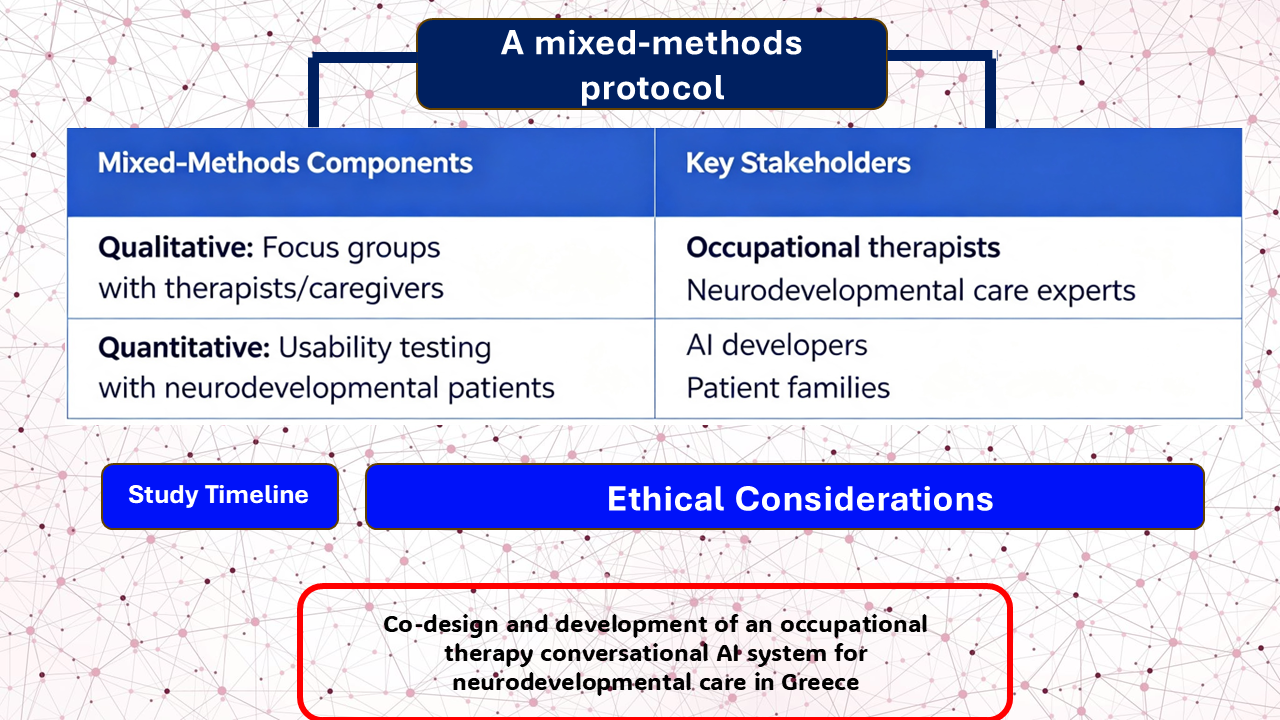
Conversational artificial intelligence (AI) has shown potential to support knowledge translation, personalized education, and access to health-related information. However, applications in neurodevelopmental care remain largely focused on screening and assessment, while conversational systems tailored to occupational therapy are scarce. Moreover, general-purpose generative AI may produce inaccurate, insufficiently contextualized, or clinically inappropriate responses, highlighting the need for evidence-based, domain-specific systems with robust safety mechanisms. This study describes the protocol for the co-design, development, and preliminary evaluation of a conversational AI system designed to support occupational therapists and parents of children aged 5–12 years with neurodevelopmental disorders in Greece. The system is intended as an educational and decision-support resource and will not replace diagnosis, clinical judgment, or individualized intervention. A co-designed, multi-phase, mixed-methods proof-of-concept design will be adopted, informed by the Medical Research Council framework, Design Science Research, user-centered design principles, and the CeHRes Roadmap 2.0. Development will include evidence synthesis, stakeholder needs assessment, knowledge base construction, iterative prototype development, and expert, technical, safety, and user evaluation. The system will integrate a curated occupational therapy knowledge base, retrieval-augmented generation, role-specific prompting, source verification, and layered safety guardrails. Expected outputs include a stakeholder-informed Greek-language minimum viable product and a transparent framework linking evidence, user requirements, technical design, and evaluation criteria. Preliminary evaluation will assess factual accuracy, evidence concordance, occupational therapy relevance, clinical appropriateness, safety, usability, acceptability, and perceived usefulness. This protocol provides a reproducible foundation for developing clinically relevant conversational AI in occupational therapy and for future feasibility and effectiveness studies.
References
Bui, T. A., Pohl, M., Rosenfelt, C., Ogourtsova, T., Yousef, M., Whitlock, K., Majnemer, A., Nicholas, D., Demmans Epp, C., Zaiane, O., & Bolduc, F. V. (2022). Identifying potential gamification elements for a new chatbot for families with neurodevelopmental disorders: User-centered design approach. JMIR Human Factors, 9(3), e31991. https://doi.org/10.2196/31991
Bulan, P. M. P., Kuizon, D. A. Y., Casaña, R. S. E., Fuentes, C. G., Pestaño, N. Y., & Suerte, J. R. O. (2025). A scoping review on artificial intelligence in occupational therapy. OTJR: Occupation, Participation and Health. Advance Online Publication. https://doi.org/10.1177/15394492251379332
Busch, F., Hoffmann, L., Rueger, C., van Dijk, E. H. C., Kader, R., Ortiz-Prado, E., Makowski, M. R., Saba, L., Hadamitzky, M., Kather, J. N., Truhn, D., Cuocolo, R., Adams, L. C., & Bressem, K. K. (2025). Current applications and challenges in large language models for patient care: A systematic review. Communications Medicine, 5. https://doi.org/10.1038/s43856-024-00717-2
Değerli, Y., Özata Değerli, M. N., & Kars, S. (2026). Artificial intelligence in occupational therapy: Comparing ChatGPT and occupational therapist approaches in assessment and intervention. British Journal of Occupational Therapy, 89(1), 6-18. https://doi.org/10.1177/03080226251368231
Feng, F., Yang, Y., Cer, D., Arivazhagan, N., & Wang, W. (2022). Language-agnostic BERT sentence embedding. In: Proceedings of the 60th Annual Meeting of the Association for Computational Linguistics: Volume 1, Long Papers, 878-891 p. Association for Computational Linguistics. https://doi.org/10.18653/v1/2022.acl-long.62
Gale, N. K., Heath, G., Cameron, E., Rashid, S., & Redwood, S. (2013). Using the Framework Method for the analysis of qualitative data in multi-disciplinary health research. BMC Medical Research Methodology, 13. https://doi.org/10.1186/1471-2288-13-117
Haltaufderheide, J., & Ranisch, R. (2024). The ethics of ChatGPT in medicine and healthcare: A systematic review on large language models. NPJ Digital Medicine, 7. https://doi.org/10.1038/s41746-024-01157-x
Kaelin, V. C., Valizadeh, M., Salgado, Z., Parde, N., Khetani, M. A., & Foster, E. R. (2021). Artificial intelligence in rehabilitation targeting the participation of children and youth with disabilities: Scoping review. Journal of Medical Internet Research, 23(11), e25745. https://doi.org/10.2196/25745
Kip, H., Beerlage-de Jong, N., van Gemert-Pijnen, L. J. E. W. C., & Kelders, S. M. (2025). The CeHRes Roadmap 2.0: Update of a holistic framework for development, implementation, and evaluation of eHealth technologies. Journal of Medical Internet Research, 27, e59601. https://doi.org/10.2196/59601
Koo, T. K., & Li, M. Y. (2016). A guideline of selecting and reporting intraclass correlation coefficients for reliability research. Journal of Chiropractic Medicine, 15(2), 155-163. https://doi.org/10.1016/j.jcm.2016.02.012
Lewis, J. R. (2018). The System Usability Scale: Past, present, and future. International Journal of Human–Computer Interaction, 34(7), 577-590. https://doi.org/10.1080/10447318.2018.1455307
Lewis, P., Perez, E., Piktus, A., Petroni, F., Karpukhin, V., Goyal, N., Küttler, H., Lewis, M., Yih, W.-T., Rocktäschel, T., Riedel, S., & Kiela, D. (2020). Retrieval-augmented generation for knowledge-intensive NLP tasks. Advances in Neural Information Processing Systems, 33, 9459-9474.
Livermore, P., Kupiec, K., Wedderburn, L. R., Knight, A., Solebo, A. L., Shafran, R., Robert, G., Sebire, N. J., Gibson, F., & IMPACT Steering Group. (2024). Designing, developing, and testing a chatbot for parents and caregivers of children and young people with rheumatological conditions (the IMPACT study): Protocol for a co-designed proof-of-concept study. JMIR Research Protocols, 13, e57238. https://doi.org/10.2196/57238
Milne-Ives, M., de Cock, C., Lim, E., Harper Shehadeh, M., de Pennington, N., Mole, G., Normando, E., & Meinert, E. (2020). The effectiveness of artificial intelligence conversational agents in health care: Systematic review. Journal of Medical Internet Research, 22(10), e20346. https://doi.org/10.2196/20346
Onoufriou, A., Kargaki, I., Sfintsioti, P., Georgiou, K., Kalogirou, G., & Pergantis, P. (2027). Bibliometric and science mapping analysis of occupational therapy research in Greece (1977–2025). Brazilian Journal of Science, 6(1), 191-207. https://doi.org/10.14295/bjs.v6i1.931
Orfanou, K., Tselios, N., & Katsanos, C. (2015). Perceived usability evaluation of learning management systems: Empirical evaluation of the System Usability Scale. The International Review of Research in Open and Distributed Learning, 16(2), 227-246. https://doi.org/10.19173/irrodl.v16i2.1955
Peffers, K., Tuunanen, T., Rothenberger, M. A., & Chatterjee, S. (2007). A design science research methodology for information systems research. Journal of Management Information Systems, 24(3), 45-77. https://doi.org/10.2753/MIS0742-1222240302
Pergantis, P., Bamicha, V., Skianis, C., & Drigas, A. (2025a). AI chatbots and cognitive control: Enhancing executive functions through chatbot interactions: A systematic review. Brain Sciences, 15(1). https://doi.org/10.3390/brainsci15010047
Pergantis, P., Bamicha, V., Doulou, A., Christou, A. I., Bardis, N., Skianis, C., & Drigas, A. (2025b). Assistive and emerging technologies to detect and reduce neurophysiological stress and anxiety in children and adolescents with autism and sensory processing disorders: A systematic review. Technologies, 13(4). https://doi.org/10.3390/technologies13040144
Pergantis, P., Georgiou, K., Bardis, N., Skianis, C., & Drigas, A. (2026). Artificial intelligence in the evaluation and intervention of Developmental Coordination Disorder: A scoping review of methods, clinical purposes, and future directions. Children, 13(2). https://doi.org/10.3390/children13020161
Reimers, N., & Gurevych, I. (2019). Sentence-BERT: Sentence embeddings using Siamese BERT-networks. In Proceedings of the 2019 Conference on Empirical Methods in Natural Language Processing and the 9th International Joint Conference on Natural Language Processing, 3982-3992 p., Association for Computational Linguistics. https://doi.org/10.18653/v1/D19-1410
Singla, A., Khanna, R., Kaur, M., Kelm, K., Zaiane, O., Rosenfelt, C. S., Bui, T. A., Rezaei, N., Nicholas, D., Reformat, M. Z., Majnemer, A., Ogourtsova, T., & Bolduc, F. (2024). Developing a chatbot to support individuals with neurodevelopmental disorders: Tutorial. Journal of Medical Internet Research, 26, e50182. https://doi.org/10.2196/50182
Skivington, K., Matthews, L., Simpson, S. A., Craig, P., Baird, J., Blazeby, J. M., Boyd, K. A., Craig, N., French, D. P., McIntosh, E., Petticrew, M., Rycroft-Malone, J., White, M., & Moore, L. (2021). A new framework for developing and evaluating complex interventions: Update of Medical Research Council guidance. BMJ, 374. https://doi.org/10.1136/bmj.n2061
The CHART Collaborative. (2025). Reporting guideline for chatbot health advice studies: The CHART statement. JAMA Network Open, 8(8), e2530220. https://doi.org/10.1001/jamanetworkopen.2025.30220
Zhang, W., Leung, R. Y. F., Mak, K. K., Ge, H., Kwok, T. T. O., Tso, R. V. Y., Wang, A., Ma, H., & Wong, J. Y. H. (2026). GPT-powered chatbot-based positive psychology intervention for well-being among parents of children with autism spectrum disorder: Single-arm mixed methods study. JMIR Formative Research, 10, e85060. https://doi.org/10.2196/85060
Downloads
Published
How to Cite
Issue
Section
License
Copyright (c) 2027 Pantelis Pergantis, Nikolaos Bardis, Charalabos Skianis, Athanasios Drigas

This work is licensed under a Creative Commons Attribution 4.0 International License.
Authors who publish with this journal agree to the following terms:
1) Authors retain copyright and grant the journal right of first publication with the work simultaneously licensed under a Creative Commons Attribution License that allows others to share the work with an acknowledgement of the work's authorship and initial publication in this journal.
2) Authors are able to enter into separate, additional contractual arrangements for the non-exclusive distribution of the journal's published version of the work (e.g., post it to an institutional repository or publish it in a book), with an acknowledgement of its initial publication in this journal.
3) Authors are permitted and encouraged to post their work online (e.g., in institutional repositories or on their website) prior to and during the submission process, as it can lead to productive exchanges, as well as earlier and greater citation of published work.