Occupational participation and occupational therapy care in Myotonic Dystrophy: A narrative literature review
DOI:
https://doi.org/10.14295/bjs.v6i1.930Keywords:
myotonic dystrophy, occupational participation, occupational therapy, assistive technology, caregiversAbstract
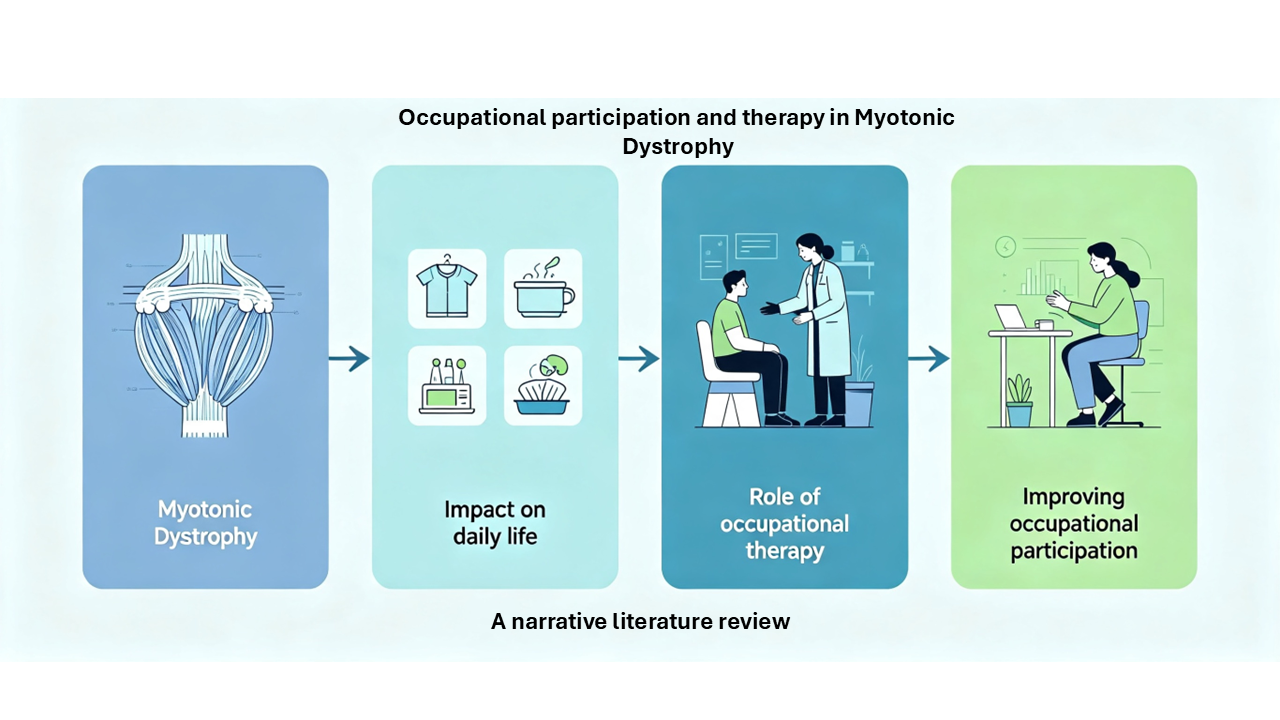
Myotonic dystrophy, the most prevalent adult-onset muscular dystrophy, is multisystemic, linking progressive neuromuscular impairment and occupational restriction. Both types share myotonia, chronic fatigue, and executive dysfunction with apathy, but differ in weakness distribution and facial involvement. Over 9 years, participation declines in nutrition, fitness, personal care, mobility, community life, and recreation; 47% of DM1 patients do not work, 23% rate daily activities as affected, and 35% and 22% identify fatigue and muscle-locking as important. This review synthesises evidence within the Occupational Therapy Practice Framework: Domain and Process, Fourth Edition (PubMed, Scopus, Google Scholar; English, 2016–2026). Four participation-restriction drivers emerge: distal-to-proximal muscle weakness with grip myotonia; frontotemporal executive dysfunction and apathy; accelerating fatigue and daytime sleepiness; and progressive restrictions in community life, employment, and psychological functioning. 80% of disabled persons live in low- and middle-income countries, where high-income settings report 22 occupational therapists per 10,000. At the same time, 54 World Federation of Occupational Therapists member nations have fewer than one, and ratios as low as 0.001. OT rests on four pillars: COPM-based top-down evaluation; contextual adaptations (wearable ADL effect sizes 1.06 and 1.38; tailored smart-home solutions: 89% ADL improvement, 91% readiness for change at US$567 per participant; powered-wheelchair intervention transitioning 74.8% of 127 tasks to independent completion); energy conservation through pacing, planning, prioritising, and positioning; caregiver coaching anchored in the OPTIMISTIC trial's DM1-Activ-c endpoint. The disease trajectory is irreversible, but participation restrictions are modifiable; three priorities follow: longitudinal DM-specific outcome studies, DM-specific participation measures more sensitive than impairment tools, and scalable low-cost technology for resource-limited settings.
References
Abebe, S. M., Nuri, R. P., Montagnese, J. A., Lysaght, R., Krupa, T., Mieras, C., Yehuala, Y. S., Ghahari, S., Kessler, D., Kolomitro, K., Batorowicz, B., Mzinganjira, A., Demissie, S. F., Mesfin, N., & Aldersey, H. M. (2024). Lessons learned from an occupational therapy programme needs assessment. https://doi.org/10.4102/aej.v12i1.699
Aldehag, A., Jonsson, H., Lindblad, J., Kottorp, A., Ansved, T., & Kierkegaard, M. (2013). Effects of hand-training in persons with myotonic dystrophy type 1 – a randomised controlled cross-over pilot study. Disability and Rehabilitation, 35(21), 1798-1807. https://doi.org/10.3109/09638288.2012.754952
Association, A. O. T. (2021). Standards of Practice for Occupational Therapy. American Journal of Occupational Therapy, 75. https://doi.org/10.5014/ajot.2021.75s3004
Bharati, B., & Sahu, K. S. (2021). Post-COVID-19 Chronic Fatigue and the Role of Energy Conservation and work Simplification Techniques: An Occupational Therapy Approach. https://doi.org/10.37506/ijpot.v16i1.17740
Bhattacharjya, S., Curtis, S., Kueakomoldej, S., Zweck, C. von, Russo, G., Mani, K., Kamalakannan, S., Ledgerd, R., & Jesus, T. S. (2023). Developing a Global Strategy for strengthening the occupational therapy workforce: A two-phased mixed methods consultation of country representatives shows the need for clarifying task-sharing strategies. In Research Square. https://doi.org/10.21203/rs.3.rs-3367762/v1
Bright, T., Wallace, S. J., & Kuper, H. (2018). A Systematic Review of Access to Rehabilitation for People with Disabilities in Low- and Middle-Income Countries. https://doi.org/10.3390/ijerph15102165
Bulea, T. C., Guth, A., Sarkar, N., Gravunder, A., Hodsdon, B., Farrell, K., Comis, L. E., Parks, R., Shimellis, H., Ndege, V., Ho, P., & Mankodi, A. (2022). Simple and economical HandClench Relaxometer device for reliable and sensitive measurement of grip myotonia in myotonic dystrophy. https://doi.org/10.1016/j.nmd.2022.02.005
Carlo, M. M. R. do P. D., Gomes-Ferraz, C. A., Rezende, G., Buin, L., Moreira, D., Souza, K. L. de, Sacramento, A. M., Santos, W. de A., Mendes, P. V. B., & Vendrúsculo-Fangel, L. M. (2020). Diretrizes para a assistência da terapia ocupacional na pandemia da COVID-19 e perspectivas pós-pandemia. https://doi.org/10.11606/issn.2176-7262.v53i3p332-369
Dancza, K., & Rodger, S. (2018). Occupation-Centred Practice and Reasoning, 11-27 p. https://doi.org/10.4324/9781315297415-2
Desmond, D., Layton, N., Bentley, J. A., Boot, F. H., Borg, J., Dhungana, B. M., Gallagher, P., Gitlow, L., Gowran, R. J., Groce, N., Mavrou, K., Mackeogh, T., McDonald, R., Pettersson, C., & Scherer, M. J. (2018). Assistive technology and people: a position paper from the first global research, innovation and education on assistive technology (GREAT) summit. Disability and Rehabilitation Assistive Technology, 13(5), 437-444. https://doi.org/10.1080/17483107.2018.1471169
Ding, D., Morris, L., Novario, G., Fairman, A. D., Roehrich, K., Walko, P. F., & Boateng, J. (2025). Mainstream Smart Home Technology–Based Intervention to Enhance Functional Independence in Individuals With Complex Physical Disabilities: Single-Group Pre-Post Feasibility Study (Preprint). https://doi.org/10.2196/preprints.70855
Domaradzki, J., & Walkowiak, D. (2024). Quality of life and caregiving burden associated with parenting a person with Duchenne/Becker muscular dystrophy in Poland. https://doi.org/10.1186/s13023-024-03481-7
Drummond, A., Nouri, F., Ablewhite, J., Condon, L., Nair, R. das, Jones, A., Jones, F., Sprigg, N., & Thomas, S. (2021). Managing post-stroke fatigue: A qualitative study to explore multifaceted clinical perspectives. https://doi.org/10.1177/03080226211042269
Engelen, B. G. M. van. (2015). Cognitive behaviour therapy plus aerobic exercise training to increase activity in patients with myotonic dystrophy type 1 (DM1) compared to usual care (OPTIMISTIC): study protocol for randomised controlled trial. Trials, 16(1), 224-224. https://doi.org/10.1186/s13063-015-0737-7
Eyssen, I. C. J. M., Steultjens, M., Oud, T., Bolt, E. M., Maasdam, A., & Dekker, J. (2011). Responsiveness of the Canadian Occupational Performance Measure. The Journal of Rehabilitation Research and Development, 48(5), 517-517. https://doi.org/10.1682/jrrd.2010.06.0110
Fateh, H. R., Askary-Kachoosangy, R., Shirzad, N., Akbarzadeh-Baghban, A., & Fatehi, F. (2022). The effect of energy conservation strategies on fatigue, function, and quality of life in adults with motor neuron disease: Randomized controlled trial. Current Journal of Neurology, 21(2), 83-90. https://doi.org/10.18502/cjn.v21i2.10491
Fried, J., Hughes, M. H., Singh, P., & Toto, P. (2025). Home Safe and Smart: A Pilot Program Integrating Smart Technology and Home Modifications for Aging in Place. https://doi.org/10.1093/geroni/igaf122.1883
Gagnon, C., Noreau, L., Moxley, R. T., Laberge, L., Jean, S., Richer, L., Perron, M., Veillette, S., & Mathieu, J. (2007). Towards an integrative approach to the management of myotonic dystrophy type 1. Journal of Neurology Neurosurgery & Psychiatry, 78(8), 800-806. https://doi.org/10.1136/jnnp.2006.107185
Gallais, B., Montreuil, M., Gargiulo, M., Eymard, B., Gagnon, C., & Laberge, L. (2015). Prevalence and correlates of apathy in myotonic dystrophy type 1. BMC Neurology, 15(1), 148-148. https://doi.org/10.1186/s12883-015-0401-6
Gandolla, M., Antonietti, A., Longatelli, V., & Pedrocchi, A. (2020). The Effectiveness of Wearable Upper Limb Assistive Devices in Degenerative Neuromuscular Diseases: A Systematic Review and Meta-Analysis. https://doi.org/10.3389/fbioe.2019.00450
Garmendia, J., Labayru, G., Aliri, J., Munaín, A. L. de, & Sistiaga, A. (2023). Executive functions and daily functioning in myotonic dystrophy type 1 ecological assessment with virtual reality. Neuromuscular Disorders, 33(12), 917-922. https://doi.org/10.1016/j.nmd.2023.10.006
Gaul, C., Schmidt, T. P., Windisch, G., Wieser, T., Müller, T., Vielhaber, S., Zierz, S., & Leplow, B. (2006). Subtle cognitive dysfunction in adult onset myotonic dystrophy type 1 (DM1) and type 2 (DM2). Neurology, 67(2), 350-352. https://doi.org/10.1212/01.wnl.0000225180.27833.c1
Ghali, A., Lacombe, V., Ravaiau, C., Delattre, E., Ghali, M., Urbanski, G., & Lavigne, C. (2023). The relevance of pacing strategies in managing symptoms of post-COVID-19 syndrome. Journal of Translational Medicine, 21(1), 375-375. https://doi.org/10.1186/s12967-023-04229-w
Gourdon, G., & Meola, G. (2017). Myotonic Dystrophies: State of the Art of New Therapeutic Developments for the CNS. Frontiers in Cellular Neuroscience, 11, 101–101. https://doi.org/10.3389/fncel.2017.00101
Group, the F. M. D. S., Antonio, M. D., Dogan, C., Daidj, F., Eymard, B., Puymirat, J., Mathieu, J., Gagnon, C., Katsahian, S., Hamroun, D., & Bassez, G. (2019). The DM-scope registry: a rare disease innovative framework bridging the gap between research and medical care. https://doi.org/10.1186/s13023-019-1088-3
Hayes, K., Santos, V. dos, Costigan, M., & Morante, D. (2022). Profile of occupational therapy services in non‐urban settings: A global scoping review. https://doi.org/10.1111/1440-1630.12835
Heugten, C. van, Meuleman, S., Hellebrekers, D. M. J., Reenen, E. K., & Visser‐Meily, J. M. A. (2018). Participation and the Role of Neuropsychological Functioning in Myotonic Dystrophy Type 1. https://doi.org/10.3233/jnd-170246
Jesus, T. S., Zweck, C. von, Larson, S., Bhattacharjya, S., Kamalakannan, S., Mani, K., & Ledgerd, R. (2024). Refining the first global strategy for the occupational therapy workforce: results from a mixed-methods survey and multimodal expert feedback. In: Research Square. https://doi.org/10.21203/rs.3.rs-4462309/v1
Kierkegaard, M., Petitclerc, Hébert, L. J., Mathieu, J., & Gagnon, C. (2017). Responsiveness of performance-based outcome measures for mobility, balance, muscle strength and manual dexterity in adults with myotonic dystrophy type 1. https://doi.org/10.2340/16501977-2304
Kurauchi, G., Endo, M., Odaira, K., Ono, R., Koseki, A., Goto, M., Sato, Y., Kon, S., Watanabe, N., Sugawara, N., Kimura, E., & Takada, H. (2019). Caregiver burden and related factors among caregivers of patients with myotonic dystrophy type 1. Journal of Neuromuscular Diseases, 6(4), 527-536. https://doi.org/10.3233/jnd-190386
Laberge, L. (2020). Correlates of daytime sleepiness and fatigue in a prospectively followed cohort of patientswith myotonic dystrophy type 1. Available in: https://www.imedpub.com/articles/correlates-of-daytime-sleepiness-and-fatigue-in-a-prospectively-followed-cohort-of-patientswith-myotonic-dystrophy-type-1.pdf. Accessed on: March 11, 2026.
Lambdin-Pattavina, C., & Pyatak, E. A. (2022). Occupational therapy’s role in chronic conditions. https://doi.org/10.5014/ajot.2022.76s3003
Landfeldt, E., Lindgren, P., Bell, C. F., Guglieri, M., Straub, V., Lochmüller, H., & Bushby, K. (2016). Quantifying the burden of caregiving in Duchenne muscular dystrophy. Journal of Neurology, 263(5), 906-915. https://doi.org/10.1007/s00415-016-8080-9
Landfeldt, E., Nikolenko, N., Jimenez‐Moreno, C., Cumming, S. A., Monckton, D. G., Gorman, G. S., Turner, C., & Lochmüller, H. (2019). Disease burden of myotonic dystrophy type 1. https://doi.org/10.1007/s00415-019-09228-w
Law, M. (2002). Participation in the Occupations of Everyday Life. American Journal of Occupational Therapy, 56(6), 640-649. https://doi.org/10.5014/ajot.56.6.640
LoRusso, S., Weiner, B., & Arnold, W. D. (2018). Myotonic Dystrophies: Targeting Therapies for Multisystem Disease. Neurotherapeutics, 15(4), 872–884. https://doi.org/10.1007/s13311-018-00679-z
Maass, R., Bonsaksen, T., Gramstad, A., Sveen, U., Stigen, L., Arntzen, C., & Horghagen, S. (2021). Factors associated with the establishment of new occupational therapist positions in Norwegian municipalities after the coordination reform. https://doi.org/10.1177/1178632921994908
McColl, M. A., Paterson, M., Davies, D., Doubt, L., & Law, M. (2000). Validity and community utility of the Canadian Occupational Performance Measure. Canadian Journal of Occupational Therapy, 67(1), 22-30. https://doi.org/10.1177/000841740006700105
Mun, K. (2025). Providing tailored smart home solutions as assistive technology for people with physical disabilities. https://doi.org/10.5014/ajot.2025.051120
Ned, L., Tiwari, R., Buchanan, H., Niekerk, L. van, Sherry, K., & Chikte, U. (2020). Changing demographic trends among South African occupational therapists: 2002 to 2018. https://doi.org/10.1186/s12960-020-0464-3
O’Connell, C., Guo, M., Soucy, B., Calder, M., Sparks, J., & Plamondon, S. (2024). All hands on deck: The multidisciplinary rehabilitation assessment and management of hand function in persons with neuromuscular disorders. Muscle & Nerve, 71(5), 869-888. https://doi.org/10.1002/mus.28167
Okkersen, K., Jimenez‐Moreno, C., Wenninger, S., Daidj, F., Glennon, J., Cumming, S. A., Littleford, R., Monckton, D. G., Lochmüller, H., Catt, M., Faber, C. G., Hapca, A., Donnan, P. T., Gorman, G. S., Bassez, G., Schoser, B., Knoop, H., Treweek, S., Engelen, B. G. M. van, & Dittrich, J. (2018). Cognitive behavioural therapy with optional graded exercise therapy in patients with severe fatigue with myotonic dystrophy type 1: a multicentre, single-blind, randomised trial. The Lancet Neurology, 17(8), 671-680. https://doi.org/10.1016/s1474-4422(18)30203-5
Pangalila, R., Bos, G. A. M. van den, Stam, H. J., Exel, J. van, Brouwer, W., & Roebroeck, M. E. (2011). Subjective caregiver burden of parents of adults with Duchenne muscular dystrophy. https://doi.org/10.3109/09638288.2011.628738
Pontes, T. B., & Polatajko, H. J. (2016). Habilitando ocupações: prática baseada na ocupação e centrada no cliente na terapia ocupacional. Cadernos de Terapia Ocupacional da UFSCar, 24(2), 403-412. https://doi.org/10.4322/0104-4931.ctoarf0709
Pousada, T., Pereira, J., Groba, B., & Nieto-Rivero, L. (2019). Assistive technology based on client-centered for occupational performance in neuromuscular conditions. LA Referencia (Red Federada de Repositorios Institucionales de Publicaciones Científicas), 98(25). https://doi.org/10.1097/md.0000000000015983
Raymond, K., Levasseur, M., Gallais, B., Richer, L., Laberge, L., Petitclerc, É., Mathieu, J., & Gagnon, C. (2020). Predictors of participation restriction over a 9-year period in adults with myotonic dystrophy type 1 [Data set]. In: Figshare. Figshare (United Kingdom). https://doi.org/10.6084/m9.figshare.13176900
Raymond, K., Levasseur, M., Mathieu, J., Desrosiers, J., & Gagnon, C. (2017). A 9-year follow-up study of the natural progression of upper limb performance in myotonic dystrophy type 1: A similar decline for phenotypes but not for gender. https://doi.org/10.1016/j.nmd.2017.04.007
Raymond, K., Levasseur, M., Mathieu, J., & Gagnon, C. (2019). Progressive decline in daily and social activities: A 9-year longitudinal study of participation in myotonic dystrophy type 1. https://doi.org/10.1016/j.apmr.2019.01.022
Renna, M. D., Berardi, A., Panuccio, F., Galeoto, G., & Simeon, R. (2025). Occupational therapy intervention in people with muscular dystrophy: A systematic review. Occupational Therapy In Health Care, 1-18. https://doi.org/10.1080/07380577.2025.2525101
Wenninger, S., Montagnese, F., & Schoser, B. (2018). Core clinical phenotypes in myotonic dystrophies. https://doi.org/10.3389/fneur.2018.00303
Winblad, S., & Lindberg, C. (2019). Perceived fatigue in myotonic dystrophy type 1: a case-control study. https://doi.org/10.1186/s12883-019-1280-z
Wolf, T., Polatajko, H. J., Baum, C., Rios, J., Cirone, D., Doherty, M., & McEwen, S. (2016). Combined cognitive-strategy and task-specific training affects cognition and upper-extremity function in subacute stroke: An exploratory randomized controlled trial. American Journal of Occupational Therapy, 70(2). https://doi.org/10.5014/ajot.2016.017293
Wu, Y., Wei, Q., Lin, J., Shang, H., & Ou, R. (2024). Cognitive impairment, neuroimaging abnormalities, and their correlations in myotonic dystrophy: a comprehensive review. Frontiers in Cellular Neuroscience, 18, 1369332-1369332. https://doi.org/10.3389/fncel.2024.1369332
Yum, K., Wang, E. T., & Kalsotra, A. (2017). Myotonic dystrophy: disease repeat range, penetrance, age of onset, and relationship between repeat size and phenotypes. https://doi.org/10.1016/j.gde.2017.01.007
Downloads
Published
How to Cite
Issue
Section
License
Copyright (c) 2027 Zisis Lazogkas, Pinelopi Vlotinou

This work is licensed under a Creative Commons Attribution 4.0 International License.
Authors who publish with this journal agree to the following terms:
1) Authors retain copyright and grant the journal right of first publication with the work simultaneously licensed under a Creative Commons Attribution License that allows others to share the work with an acknowledgement of the work's authorship and initial publication in this journal.
2) Authors are able to enter into separate, additional contractual arrangements for the non-exclusive distribution of the journal's published version of the work (e.g., post it to an institutional repository or publish it in a book), with an acknowledgement of its initial publication in this journal.
3) Authors are permitted and encouraged to post their work online (e.g., in institutional repositories or on their website) prior to and during the submission process, as it can lead to productive exchanges, as well as earlier and greater citation of published work.