Cross-cultural perspectives on traditional healing: A qualitative study of Harari, Oromo, and Somali medical systems in East Hararghe, Ethiopia
DOI:
https://doi.org/10.14295/bjs.v6i1.928Keywords:
traditional medicinal knowledge, Harari, Oromo, Somali, ethnomedicineAbstract
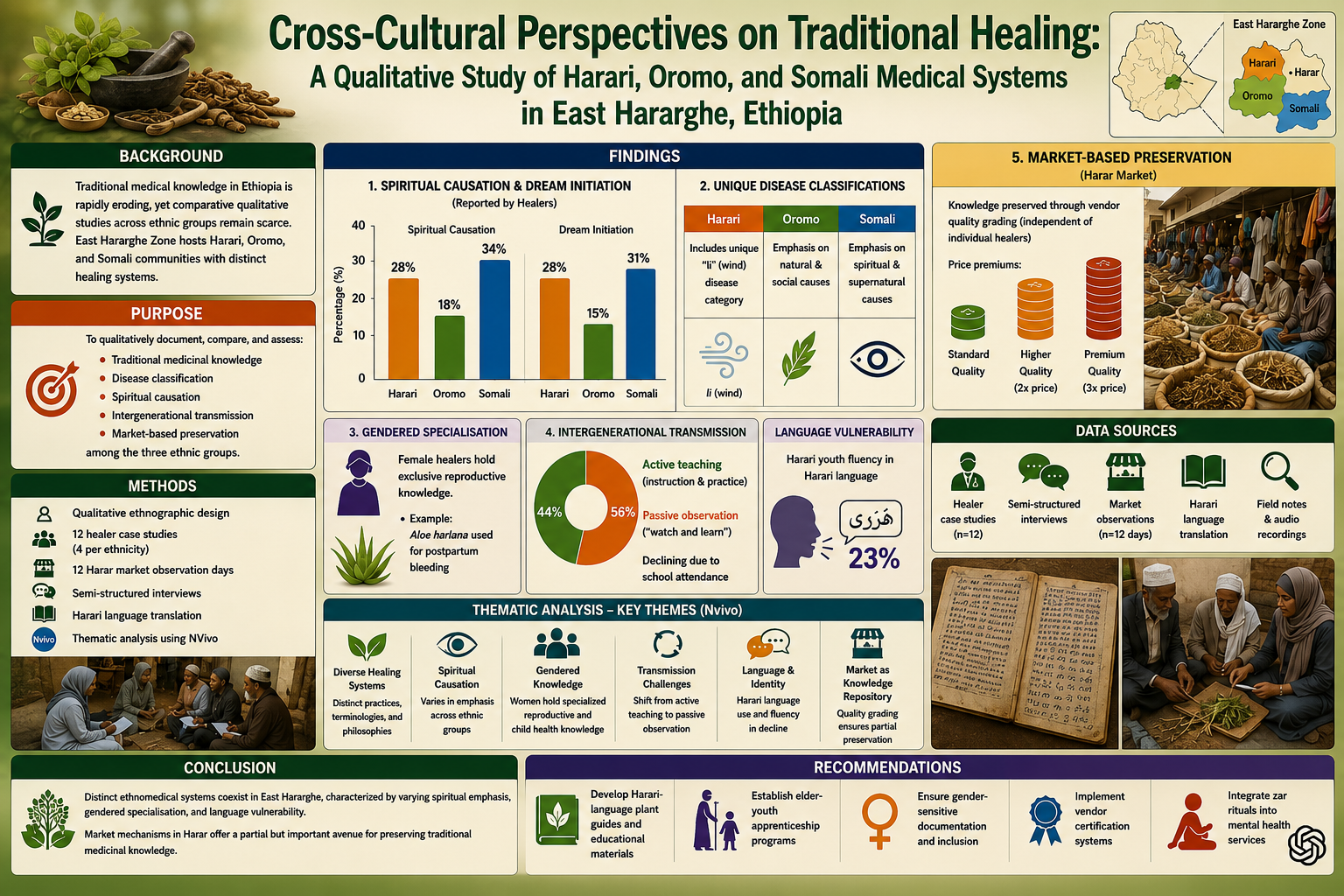
Background: Traditional medicinal knowledge in Ethiopia is rapidly eroding, yet comparative qualitative studies across ethnic groups remain scarce. East Hararghe Zone hosts Harari, Oromo, and Somali communities with distinct healing systems. Purpose: This study aimed to qualitatively document, compare, and assess the traditional medicinal knowledge, disease classification, spiritual causation, intergenerational transmission, and market-based preservation among the three ethnic groups. Methods: A qualitative ethnographic design was employed. Data collection included 12 healer case studies (four per ethnicity), 12 Harar market observation days, semi-structured interviews, and Harari language translation. Thematic analysis was conducted using NVivo. Findings: Somali healers reported the highest spiritual causation (34%) and dream initiation (31%), followed by Harari (28% each), then Oromo (18% and 15%). Harari uniquely incorporated the lil (wind) disease category. Female healers held exclusive reproductive knowledge (e.g., Aloe harlana for postpartum bleeding). Active teaching occurred in only 44% of families; 56% relied on passive observation, declining due to school attendance. Harari youth fluency was 23%. The Harar market preserved knowledge through vendor quality grading (price premiums 2–3×) independent of individual healers. Conclusion: Distinct ethnomedical systems coexist with varying spiritual emphasis, gendered specialisation, and language vulnerability. Market mechanisms offer partial preservation. Recommendation: Implement Harari-language plant guides, elder‑youth apprenticeships, gender‑sensitive documentation, vendor certification, and integration of zar rituals into mental health services.
References
Albuquerque, U. P., Ramos, M. A., de Lucena, R. F. P., & Alencar, N. L. (2014). Methods and techniques in ethnobiology and ethnoecology. Springer. https://doi.org/10.1007/978-1-4614-8636-7
Ayalew, H., Tewelde, E., & Awas, T. (2022). Endemic medicinal plants of Ethiopia: Ethnomedicinal uses, biological activities and chemical constituents. Journal of Ethnopharmacology, 293, 115307. https://doi.org/10.1016/j.jep.2022.115307
Ayenew, G. M., Tassew, W. C., Sewagegn, N., Dahnaw, M., Gurmu, A. E., Weldeab, A. N., & Beyene, B. B. (2026). Integrating traditional medicine into the healthcare system in Ethiopia: A systematic review of poly frameworks and implementation challenges. Clinical Traditional Medicine and Pharmacology, 7(2), 200281. https://doi.org/10.1016/j.ctmp.2026.200281
Belayneh, A., & Bussa, N. F. (2020). Ethnomedicinal plants used to treat human ailments in the prehistoric place of Harla and Dengego valleys, eastern Ethiopia. Journal of Ayurvedic and Herbal Medicine, 6(3), 154-172. https://doi.org/10.31254/jahm.2020.6305
Belay, M., Edwards, S., & Gebeyehu, F. (2005). Culture as an expression of ecological diversity: Integrating awareness of cultural heritage in Ethiopian schools. Mountain Research and Development, 25(1), 10-14.
Bernard, H. R. (2017). Research methods in anthropology: Qualitative and quantitative approaches. 6th ed., Rowman & Littlefield.
Berhan, Y., Ali, M., Tassew, A., & Nonogaki, A. (2022). Universal health coverage policy and progress towards the attainment of universal sexual and reproductive health and rights services in Ethiopia. Ethiopian Journal of Health Science, 32(1), 181-200. https://doi.org/10.4314/ejhs.v32i1.19
Bogale, M., Sasikumar, J. M., & Egigu, M. C. (2023). An ethnomedicinal study in Tulo District, West Hararghe Zone, Oromia Region, Ethiopia. Heliyon, 9(4), e15061. https://doi.org/10.1016/j.heliyon.2023.e15061
Braun, V., & Clarke, V. (2006). Using thematic analysis in psychology. Qualitative Research in Psychology, 3(2), 77-101. https://doi.org/10.1191/1478088706qp063oa
Brahmi, F., Mujinga, F. K., Guendouze, N., Madani, K., Boulekbache, L., & Duez, P. (2025). Benefits of traditional medicinal plants to african women’s health: An overview of the literature. Diseases, 13(5), 160. https://doi.org/10.3390/diseases13050160
Central Statistical Agency (CSA). (2007). Population and housing census of Ethiopia. https://doi.org/10.13140/RG.2.2.21688.52487
Chama, E. (2017). The study on medicinal plants and their uses to treat human ailments in Damot Gale District, Wolaita Zone, South Ethiopia. Journal of Agricultural and Applied Sciences, 13(2), 1-33. https://doi.org/10.7176/JAAS/13-2-01
Creswell, J. W., & Poth, C. N. (2018). Qualitative inquiry and research design: Choosing among five approaches (4th ed.). SAGE Publications.
de Boer, H. J., & Cotingting, C. (2014). Medicinal plants for women’s healthcare in southeast Asia: A meta-analysis of their traditional use, chemical constituents, and pharmacology. Journal of Ethnopharmacology, 151(2), 747-767. https://doi.org/10.1016/j.jep.2013.11.030
Duguma, M. (n.d.). Factors that have made traditional medicine almost into disappearance in Qellam Wallagga province. FUB Hagen. Retrieved from https://fub hagen.digibib.net
Cunningham, A. B. (2001). Applied ethnobotany: People, wild plant use and conservation. Earthscan Publications. https://doi.org/10.4324/9781849776073
Ethiopian Public Health Institute. (2023). EPHI’s IRB recognition. EPHI. https://ephi.gov.et/ephis-irb-recognition-has-been-renewed/
Fenta, M. (2025). Indigenous medicinal knowledge and therapeutic practices of the endangered Ongota/Birale of Southwest Ethiopia. Journal of Ethnobiology and Ethnomedicine, 21. https://doi.org/10.1186/s13002-025-00786-0
Fenetahun, Y., Eshetu, G., Worku, A., & Abdella, T. (2017). A survey on medicinal plants used by traditional healers in Harari regional State, East Ethiopia. Journal of Medicinal Plants Studies, 5(4), 85–90. https://doi.org/10.22271/plants.2017.v5.i4b.02
Fonseca-Kruel, V. S., Coimbra Jr., C. E. A., Silva, L. A. E., Oliveira, F. A., Mesquita, M. P. V., Taniguchi, M., & Forzza, R. C. (2026). Connecting tradition and thenology: The digitalization of the ethnobocanical collection at the Rio de Janeiro Botanical Garden. Plants People Planet, 8(4), 1104-1115. https://doi.org/10.1002/ppp3.70105
Gedlu, M., Bizuayehu, T., Melese, A., & Sewnet, A. (2024). A comprehensive review on traditional medicinal plants in Ethiopia and their application for treatment of different diseases. Advances in Pharmacological and Pharmaceutical Sciences, 2024. https://doi.org/10.1155/2024/5542990
Gitima, G., Gebre, A., Berhanu, Y., & Wato, T. (2025). Exploring indigenous wisdom: Ethnobotanical documentation and conservation of medicinal plants in Goba District, Southwest Ethiopia. Scientific African, 27, e02571. https://doi.org/10.1016/j.sciaf.2025.e02571
Grokipedia. (2025). East Hararghe Zone. Grokipedia. https://grokipedia.com/page/East_Hararghe_Zone
Hart, R., Fonseca-Kruel, V., Dalcin, E., Alexandre, E. S. L., Pace, M., Schmull, M., Beltran-Rodríguez, L., & Murguía-Romero, M. (2026). Repositories of biocultural diversity: Toward best practices for empowering ethnobotany in digital herbaria. Plants People Planet, 8(4), 1095-1103. https://doi.org/10.1002/ppp3.70052
Khadim, S., Malik, K., Kazmi, A., Sultana, T., Ali, A., Mehmood, K., Ul Hassan, R., Nashir, M. N., & Ali, M. M. (2024). Folklore use of medicinal plants for the treatment of gynecological diseases in Pakistan-a review. Heliyon, 10(15), e34869. https://doi.org/10.1016/j.heliyon.2024.e34869
Kandari, L. S., Negi, T., Thakur, A. K., & Yilma, E. (2015). Ethnobotanical and indigenous knowledge of important plants in East Hararghe, Eastern Ethiopia. Journal of Mountain Science, 12(6), 1521–1533. https://doi.org/10.1007/s11629-014-3137-7
Lewis, I. M., Al Safi, A., & Hurreiz, S. H. (Eds.). (1991). Women’s medicine: The zar bori cult in Africa and beyond. Edinburgh University Press for the International African Institute.
Lincoln, Y. S., & Guba, E. G. (1985). Naturalistic inquiry. SAGE Publications. https://doi.org/10.1016/0147-1767(85)90062-8
Magare, D. A., & Patil, M. B. (2025). Ethnobotany in the digital age: Opportunities and challenges of traditional knowledge digitalization. World Journal of Biology Pharmacy and Health Sciences, 21(01), 235-242. https://doi.org/10.30574/wjbphs.2025.21.1.0043
Martin, G. J. (2004). Ethnobotany: A methods manual. Earthscan Publications. https://doi.org/10.4324/9781849776073-12
Mbelebele, Z., Mdoda, L., Ntlanga, S. S., Nontu, Y., & Gidi, L. S. (2024). Harmonizing traditional knowledge with environmental preservation: Sustainable strategies for the conservation of indigenous medicinal plants (IMPs) and their implications for economic well-being. Sustainability, 16(14), 5841. https://doi.org/10.3390/su16145841
Mekonnen, N., & Abebe, E. (2017). Ethnobotanical knowledge and practices of traditional healers in Harar, Haramaya, Bati and Garamuleta, Eastern Ethiopia. Ethiopian Veterinary Journal, 21(2), 1-18. https://doi.org/10.4314/evj.v21i2.1
McDougall, A. R. A., Goldstein, M., Tuttle, A., Ammerdorffer, A., Rushwan, S., Hastie, R., Gülmezoglu, A. M., & Vogel, J. P. (2022). Innovations in the prevention and treatment of postpartum hemorrhage: Analysis of a novel medicines development pipeline database. International Journal of Gynecology & Obstetrics, 158(S1), 31-39. https://doi.org/10.1002/ijgo.14200
Mengistu, T. S., Endalamaw, A., Zewdie, A., Wolka, E., & Assefa, Y. (2025). Strengthening primary health care in Ethiopia: A scoping review of successes, challenges, and pathways towards universal health coverage using the WHO monitoring framework. PLOS Global Public Health, 5(4), e0004470. https://doi.org/10.1371/journal.pgph.0004470
Nigussie, S., Godana, A., Birhanu, A., Abdeta, T., Demeke, F., Lami, M., Gemechu, K., Eyeberu, A., Bogale, K., Dechasa, D. B., Getachew, T., Negash, A., Aliyi, S., Meseret, F., Kibret, H., Nigatu, B. B., Dirirsa, G., Gebremariam, T. B., Bayu, K., & Dessie, Y. (2022). Practice of traditional medicine and associated factors among residents in eastern Ethiopia: A community based cross sectional study. Frontiers in Public Health, 10, 915722. https://doi.org/10.3389/fpubh.2022.915722
Nuro, G., Tolossa, K., Arage, M., & Giday, M. (2024). Medicinal plants diversity among the oromo community in herban-arsi district of Ethiopia used to manage human and livestock ailments. Frontiers in Pharmacology, 15. https://doi.org/10.3389/fphar.2024.1455126
Patton, M. Q. (2015). Qualitative research and evaluation methods. 4th ed., SAGE Publications.
Saensouk, P., Saensouk, S., Hein, K. Z., Appamaraka, S., Maknoi, C., Souladeth, P., Koompoot, K., Sonthonongphithak, P., Boonma, T., & Jutpromma, T. (2025). Diverity, ethnobotany, and horticultural potential of local vegetables in Chai Chumphol Temple community market, Maha Sarakham Province, Thailand. Horticulturae, 11(3), 243. https://doi.org/10.3390/horticulturae11030243
Tafazoli, V., Tavakoli, A., Mosaffa-Jahromi, M., Cooley, K., & Pasalar, M. (2022). Approach of Persian medicine to health and disease. Advances in Integrative Medicine, 9(1), 3-8. https://doi.org/10.1016/j.aimed.2021.07.007
Tarekegn, S. M., Tadesse, D., Argaw, M. D., Semahegn, A., Taddesse, L., Abate, B., Tamire, A., & Makonnen, M. (2025). Capacity and performance of primary health care in Ethiopia: a novel mixed methods measurement in low-income country. BMC Primary Care, 26. https://doi.org/10.1186/s12875-025-02988-7
Tuasha, N., Fekadu, S., & Deyno, S. (2023). Prevalence of herbal and traditional medicine in Ethiopia: A systematic review and meta analysis of 20 year studies. Systematic Reviews, 12. https://doi.org/10.1186/s13643-023-02412-y
Usure, R. E., Kebebe, D., Mekasha, Y. T., Hasen, G., Dubale, S., & Suleman, S. (2024). Traditional herbal medicine regulatory implementation in Ethiopia: a qualitative study. Frontiers in Pharmacology, 15. https://doi.org/10.3389/fphar.2024.1392330
Wendimu, A., Tekalign, W., Bojago, E., & Abrham, Y. (2024). Traditional ethnobotanical knowledge and ethnomedicinal use of plants in the tropical Rift Valley of Ethiopia. Heliyon, 10(6), e27528. https://doi.org/10.1016/j.heliyon.2024.e27528
World Health Organization. (2025). WHO global traditional medicine strategy 2025 2034. World Health Organization. Available in: https://www.who.int/publications/i/item/9789240098046. Accessed on: June 11, 2026.
World Health Organization. (2025). Global traditional medicine strategy 2025-2034. Available in: https://www.who.int/publications/i/item/9789240113176. Accessed on: July 16, 2026.
Woldeamanueal, M. M., Goshu, B. S., Mushike, G. N., Ahmed, S. D., & Tasew, M. F. (2027). Integrating qualitative and quantitative ethnomedicinal knowledge: A comprehensive assessment of traditional medicine in West Hararghe Zone, Oromia, Ethiopia, Brazilian Journal of Science, 6(1), 54-93.
Yifru, M., Tilahun, A., Awoke, A., & Kassa, Z. (2025). Traditional medicinal plant based remedies for common ailments in Menz Keya Gebreal district, North Shewa Zone, Ethiopia. BMC Complementary Medicine and Therapies, 25. https://doi.org/10.1186/s12906-025-05158-5
Yinger, H., Yemane, G., Tesfaye, G. (2015). Ethnobotanical and indigenous knowledge of important plants in East Hafaghe, Eastern Ethiopia. Journal of Mountain Science, 12(6), 1521-1533. https://doi.org/10.1007/s11629-014-3137-7
Yineger, H., Yewhalaw, D., & Teketay, D. (2008). Ethnomedicinal plant knowledge and practice of the Oromo ethnic group in southwestern Ethiopia. Journal of Ethnobiology and Ethnomedicine, 4. https://doi.org/10.1186/1746-4269-4-11
Downloads
Published
How to Cite
Issue
Section
License
Copyright (c) 2027 Melaku Masresha Woldeamanueal, Belay Sitotaw Goshu, Feven Tigistu Ayele, Beyene Dereje Degefa, Dawit Daniel Dando

This work is licensed under a Creative Commons Attribution 4.0 International License.
Authors who publish with this journal agree to the following terms:
1) Authors retain copyright and grant the journal right of first publication with the work simultaneously licensed under a Creative Commons Attribution License that allows others to share the work with an acknowledgement of the work's authorship and initial publication in this journal.
2) Authors are able to enter into separate, additional contractual arrangements for the non-exclusive distribution of the journal's published version of the work (e.g., post it to an institutional repository or publish it in a book), with an acknowledgement of its initial publication in this journal.
3) Authors are permitted and encouraged to post their work online (e.g., in institutional repositories or on their website) prior to and during the submission process, as it can lead to productive exchanges, as well as earlier and greater citation of published work.