Heat wave events in the capitals of Northern Brazil
DOI:
https://doi.org/10.14295/bjs.v5i11.912Keywords:
Amazon, climate variability, extreme weather events, heat waves, urban heat islandAbstract
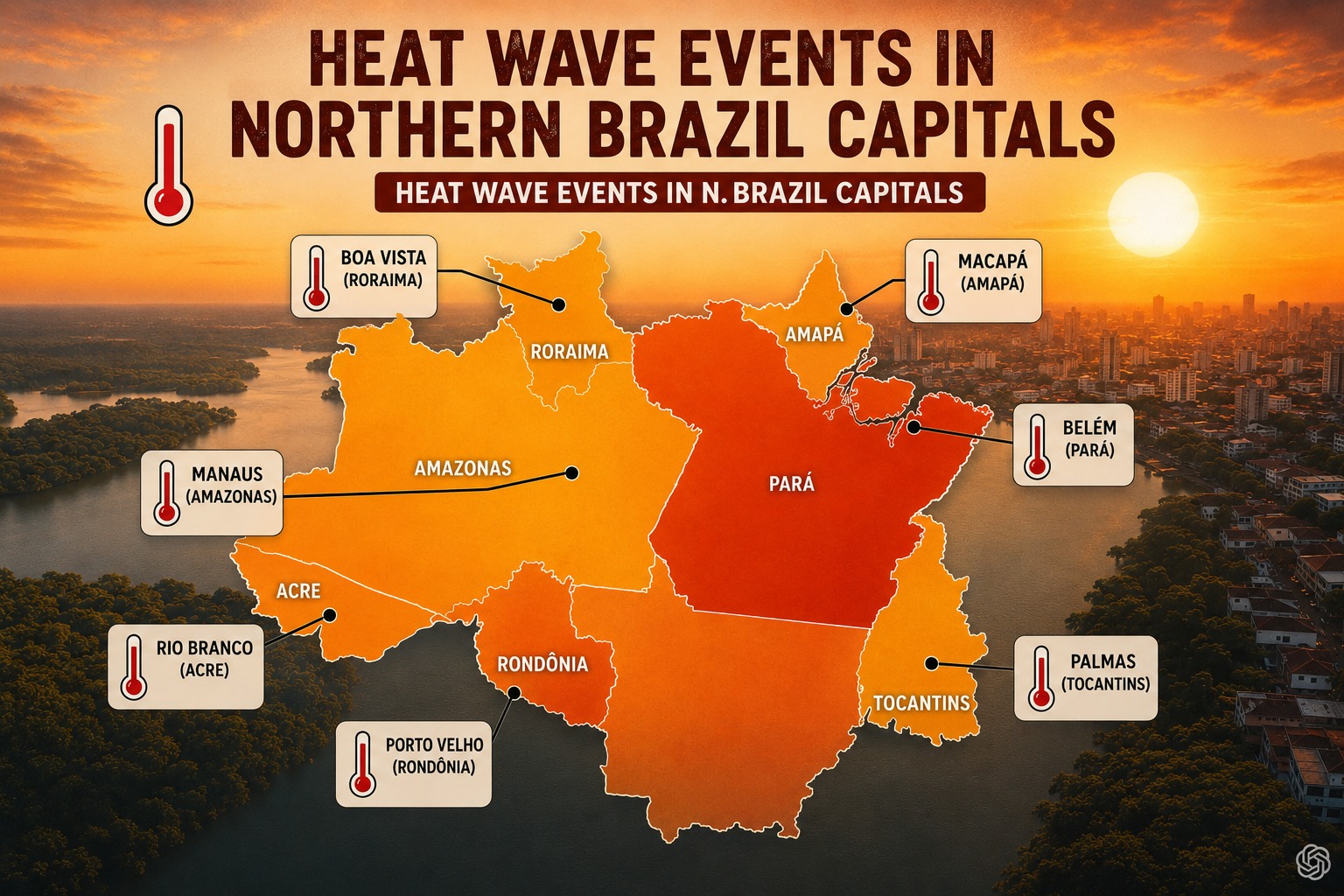
Extreme weather events are atypical atmospheric conditions that can affect multiple sectors of society. Among them, heat waves are persistent episodes of elevated air temperature with significant environmental, social, and public health implications. This study evaluated the occurrence, frequency, duration, and intensity of heat waves in the capitals of Northern Brazil from 1980 to 2018. Daily maximum and minimum air temperature records from conventional weather stations of the Brazilian National Institute of Meteorology and the Brazilian Air Force Meteorology Network underwent consistency checks, and missing data were filled in using multiple imputation. Heat waves were identified with the CTX90pct and CTN90pct indices, based on the calendar-day 90th percentile for the 1980-2010 reference period, using a 15-day moving window and a minimum duration of three consecutive days. Intensity was assessed using Exceedance Degree-Days. A total of 825 heat-wave events were identified with CTX90pct and 806 with CTN90pct. Belém and Manaus concentrated the highest numbers of events. Frequency followed the annual behavior observed for occurrence, with some years exceeding 40% of days under heat-wave conditions in most capitals. Mean duration was approximately 4.4 days, whereas annual mean intensity ranged from 8.0 °C to 14.0 °C. The results show marked spatial and interannual variability and indicate an increase in heat-wave occurrence since the beginning of the 21st century, reinforcing the need for regionalized climate-risk studies and adaptation policies in Northern Brazil.
References
Ballarin, A. S., Oliveira, P. T. S., Uchôa, J. G. S. M., Lima, C. H. R., Zaerpour, M., Godoy, M. R. V., Meira Neto, A. A., Papalexiou, S. M., & Wendland, E. (2024). Escalating threat of human-perceived heatwaves in Brazil. Environmental Research Communications, 6, 111004. https://doi.org/10.1088/2515-7620/ad9140
Bitencourt, D. P., Fuentes, M. V., Franke, A. E., Silveira, R. B., & Alves, M. P. A. (2020). The climatology of cold and heat waves in Brazil from 1961 to 2016. International Journal of Climatology, 40(4), 2464-2478. https://doi.org/10.1002/joc.6345
Díaz, J., García-Herrera, R., Trigo, R. M., Linares, C., Valente, M. A., De Miguel, J. M., & Hernández, E. (2006). The impact of the summer 2003 heat wave in Iberia: How should we measure it? International Journal of Biometeorology, 50(3), 159-166. https://doi.org/10.1007/s00484-005-0005-8
Feron, S., Cordero, R. R., Damiani, A., Llanillo, P. J., Jorquera, J., Sepulveda, E., Asencio, V., Laroze, D., Labbe, F., Carrasco, J., & Torres, G. (2019). Observations and projections of heat waves in South America. Scientific Reports, 9, 8173. https://doi.org/10.1038/s41598-019-44614-4
Geirinhas, J. L., Trigo, R. M., Libonati, R., Coelho, C. A. S., & Palmeira, A. C. (2018). Climatic and synoptic characterization of heat waves in Brazil. International Journal of Climatology, 38(4), 1760-1776. https://doi.org/10.1002/joc.5294
Instituto Brasileiro de Geografia e Estatística - IBGE. (2020). Cidades e estados: Região Norte do Brasil. Available in: <https://www.ibge.gov.br/>. Access on: June 29, 2026.
Instituto de Pesquisa Econômica Aplicada - IPEA. (2019). Atlas do desenvolvimento humano no Brasil. Available in: <https://www.ipea.gov.br/>. Access on: June 29, 2026.
Jiménez-Muñoz, J. C., Mattar, C., Barichivich, J., Santamaría-Artigas, A., Takahashi, K., Malhi, Y., Sobrino, J. A., & van der Schrier, G. (2016). Record-breaking warming and extreme drought in the Amazon rainforest during the course of El Niño 2015-2016. Scientific Reports, 6, 33130. https://doi.org/10.1038/srep33130
Lewis, S. L., Brando, P. M., Phillips, O. L., van der Heijden, G. M. F., & Nepstad, D. (2011). The 2010 Amazon drought. Science, 331(6017), 554. https://doi.org/10.1126/science.1200807
Libonati, R., Geirinhas, J. L., Silva, P. S., Russo, A., Rodrigues, J. A., Belém, L. B. C., Nogueira, J., Roque, F. O., & Trigo, R. M. (2022). Drought-heatwave nexus in Brazil and related impacts on health and fires: A comprehensive review. Annals of the New York Academy of Sciences, 1517(1), 44-62. https://doi.org/10.1111/nyas.14887
Ministério do Meio Ambiente. (2010). Mapa de cobertura vegetal dos biomas brasileiros. Available in: <https://www.gov.br/mma/>. Access on: June 29, 2026.
Mora, C., Dousset, B., Caldwell, I. R., Powell, F. E., Geronimo, R. C., Bielecki, C. R., Counsell, C. W. W., Dietrich, B. S., Johnston, E. T., Louis, L. V., Lucas, M. P., McKenzie, M. M., Shea, A. G., Tseng, H., Giambelluca, T. W., Leon, L. R., Hawkins, E., & Trauernicht, C. (2017). Global risk of deadly heat. Nature Climate Change, 7, 501-506. https://doi.org/10.1038/nclimate3322
Oleson, K. W., Monaghan, A., Wilhelmi, O., Barlage, M., Brunsell, N., Feddema, J., Hu, L., & Steinhoff, D. F. (2015). Interactions between urbanization, heat stress, and climate change. Climatic Change, 129, 525-541. https://doi.org/10.1007/s10584-013-0936-8
Oliveira, D. S., Costa, P. D. P., Bezerra, L. M., & Pezzopane, J. E. M. (2021). Hotter, longer and more frequent heatwaves: An observational study for the Brazilian city of Campinas, SP. Revista Brasileira de Meteorologia, 36(2), 305-316. https://doi.org/10.1590/0102-77863620119
Perkins, S. E. (2015). A review on the scientific understanding of heatwaves - Their measurement, driving mechanisms, and changes at the global scale. Atmospheric Research, 164-165, 242-267. https://doi.org/10.1016/j.atmosres.2015.05.014
Perkins, S. E., & Alexander, L. V. (2013). On the measurement of heat waves. Journal of Climate, 26(13), 4500-4517. https://doi.org/10.1175/JCLI-D-12-00383.1
Perkins, S. E., Alexander, L. V., & Nairn, J. R. (2012). Increasing frequency, intensity and duration of observed global heatwaves and warm spells. Geophysical Research Letters, 39, L20714. https://doi.org/10.1029/2012GL053361
Russo, S., Sillmann, J., & Fischer, E. M. (2015). Top ten European heatwaves since 1950 and their occurrence in the coming decades. Environmental Research Letters, 10(12), 124003. https://doi.org/10.1088/1748-9326/10/12/124003
Seneviratne, S. I., Nicholls, N., Easterling, D., Goodess, C. M., Kanae, S., Kossin, J., Luo, Y., Marengo, J. A., McInnes, K., Rahimi, M., Reichstein, M., Sorteberg, A., Vera, C., & Zhang, X. (2012). Changes in climate extremes and their impacts on the natural physical environment. In: Field, C. B., Barros, V., Stocker, T. F., et al. (Eds.). Managing the risks of extreme events and disasters to advance climate change adaptation. Cambridge: Cambridge University Press.
Silva Junior, C. H. L., Anderson, L. O., Aragão, L. E. O. C., & Rodrigues, B. D. (2019). Fire responses to the 2010 and 2015/2016 Amazonian droughts. Frontiers in Earth Science, 7, 97. https://doi.org/10.3389/feart.2019.00097
van Buuren, S., & Groothuis-Oudshoorn, K. (2011). MICE: Multivariate imputation by chained equations in R. Journal of Statistical Software, 45(3), 1-67. https://doi.org/10.18637/jss.v045.i03
Wilks, D. S. (2011). Statistical methods in the atmospheric sciences. Oxford: Academic Press.
World Meteorological Organization - WMO. (2008). Guide to meteorological instruments and methods of observation. WMO-No. 8. Geneva: World Meteorological Organization.
Wouters, H., De Ridder, K., Poelmans, L., Willems, P., Brouwers, J., Hosseinzadehtalaei, P., Tabari, H., Vanden Broucke, S., van Lipzig, N. P. M., & Demuzere, M. (2017). Heat stress increase under climate change twice as large in cities as in rural areas: A study for a densely populated midlatitude maritime region. Geophysical Research Letters, 44(17), 8997-9007. https://doi.org/10.1002/2017GL074889
Downloads
Published
How to Cite
Issue
Section
License
Copyright (c) 2026 Tiago Bentes Mandú, Márcia Sabrina Lima Aguiar, Eduardo Almeida da Silva, Ana Carla dos Santos Gomes

This work is licensed under a Creative Commons Attribution 4.0 International License.
Authors who publish with this journal agree to the following terms:
1) Authors retain copyright and grant the journal right of first publication with the work simultaneously licensed under a Creative Commons Attribution License that allows others to share the work with an acknowledgement of the work's authorship and initial publication in this journal.
2) Authors are able to enter into separate, additional contractual arrangements for the non-exclusive distribution of the journal's published version of the work (e.g., post it to an institutional repository or publish it in a book), with an acknowledgement of its initial publication in this journal.
3) Authors are permitted and encouraged to post their work online (e.g., in institutional repositories or on their website) prior to and during the submission process, as it can lead to productive exchanges, as well as earlier and greater citation of published work.