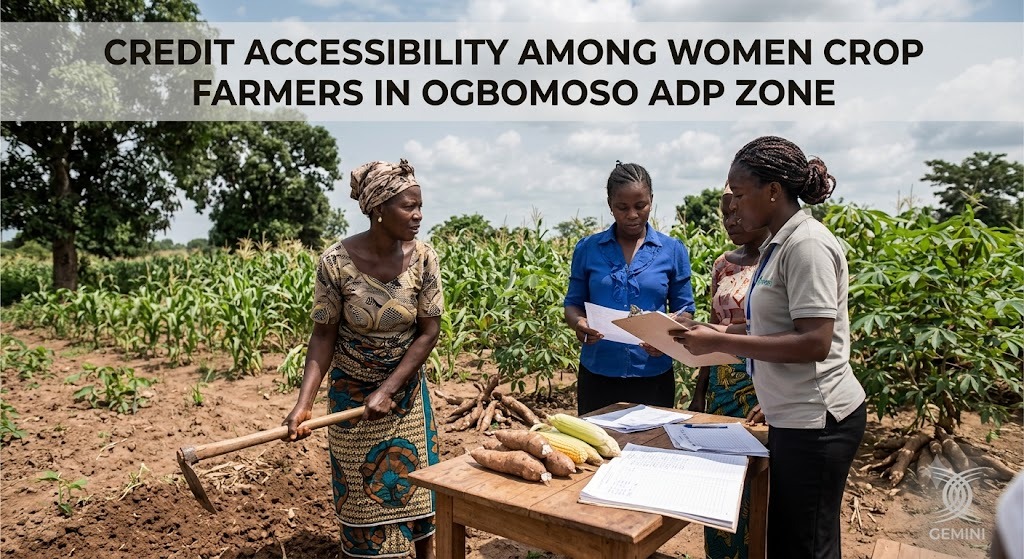
Factors determining credit accessibility among women crop farmers in Ogbomoso Agricultural Development Programme (ADP) Zone of Oyo State, Nigeria
DOI:
https://doi.org/10.14295/bjs.v5i12.863Keywords:
credit, credit accessibility, women crop farmersAbstract
Agricultural credit is an important tool for agricultural transformation and growth in an economy. This study examined the factors determining credit accessibility among women crop farmers in the Ogbomoso Agricultural Development Programme zone of Oyo State, Nigeria. Women crop farmers were randomly selected for the study using a multistage sampling technique. The data obtained for the study were analyzed using descriptive statistics and a binary logistic regression model. The result indicated that 76.7% of the women crop farmers were married, with an average household size of 6 persons and an average farming experience of 17 years. The result revealed that women crop farmers in the study area sourced credit from cooperatives, community savings, and commercial banks, among others. The result further showed that age, being a member of a cooperative society, and the number of times visited by the extension agent were significant factors determining credit accessibility among women crop farmers in the study area. The result indicated that distance to financial institutions, high interest rate charges, short loan repayment period, inadequate credit information, and awareness among others were significant constraints to credit access among women crop farmers.
References
Adebayo, J. A., & Worth, S. H. (2024). Profile of women in African agriculture and access to extension services. Social Sciences & Humanities Open, 9, 100790. https://doi.org/10.1016/j.ssaho.2023.100790
Adeomi, D. T., Jubreel, O. K., & Fadoju, D. T. (2023). Analysis of Factors Influencing Credit Accessibility among Farmers in Ogbomoso Agricultural Zone, Oyo State. Malaysian Animal Husbandry Journal, 3(2), 86-90. https://doi.org/10.26480/mahj.02.2023.93.97
Adigun G. T. (2022) Determinants of Credit Access among Smallholder Women Farmers in Kwara State. Nigerian Agricultural Journal, 53(2), 121-128.
Agbo, F.U., Iroh, I.I & Ihemezie, E.J (2015) Access to Credit by Vegetable Farmers in Nigeria: A Case Study of Owerri Agricultural Zone of Imo State, Nigeria Asian Journal of Agricultural Research 9 (4): 155-165,
Ajah, E. A., Igiri, J. A., & Ekpenyong, H. B. (2018). Determinants of access to credit among rice farmers in biase local government area of cross River State, Nigeria. Global Journal of Agricultural Sciences, 16, 43-51. https://doi.org/10.4314/gjass.v16i1.6
Akinbami, C. A. O., Oladele, O. I., & Fadeyi, O. (2019). Constraints to women farmers’ access to agricultural credit in nigeria. Journal of Agricultural Extension, 23(2), 12-21.
Akpan, S. B., Nkanta, V. S., & Essien, U. A. (2013a). A double-hurdle model of fertilizer adoption and optimum use among farmers in southern Nigeria. Tropicultura, 31(4), 243-251
Akpan, S. B., Inimfon V. P., Samuel J. U., Edem A. O., & Uwemedimo E. O. (2013b). Determinants of credit access and demand among poultry farmers in Akwa Ibom state, Nigeria. American Journal of Experimental Agriculture, 3(2), 293-307 https://doi.org/10.9734/ajea/2013/2810
David, P., Roemer, C., Anibaldi, R., & Rundle-Thiele, S. (2022). Factors enabling and preventing farming practice change: An evidence review. Journal of Environmental Management, 322, 115789. https://doi.org/10.1016/j.jenvman.2022.115789
FAO. (2011). The State of Food and Agriculture 2010-2011: Women in Agriculture—Closing the Gender Gap for Development. Rome: Food and Agriculture Organization of the United Nations.
FAO. (2019). Women’s access to rural finance: challenges and opportunities. Rome, License: CC BY-NC-SA 3.0 IGO
Falola, A., Mukaila, R., & Abdulhamid, K. O. (2022). Informal finance: its drivers and contributions to farm investment among rural farmers in Northcentral Nigerial. Agricultural Finances Review, 82(5), 942-959. https://doi.org/10.1108/AFR-08-2021-0116
Kassegn, A., & Endris, E. (2021). Factors affecting loan repayment rate among smallholder farmers got leans from the Amhara credit and saving institution: In the case of Habru district, Amhara regional state, Ethiopia. International Area Studies Review, 25(1). https://doi.org/10.1177/22338659211040993
Ndzaruwa, J. V, Shuaibu, I. M, Amurtiya, M., & Bitrus, H.W. (2022). Analysis of women crop farmers’ access and utilization of agricultural credit in Yola south local government area of Adamawa state, Nigeria. Journal of Agriculture and Applied Biotechnology, 1(1), 1-6. https://doi.org/10.52493/j.jaab.2022.1.21
Nwankwo, O., Ezeh, C. I., & Nwankwo, C. (2020). Accessibility of rural women farmers to agricultural credit in Nigeria. Journal of Economics and Sustainable Development, 11(1), 45-52.
Nweze, N. J. (2011). The role of women's traditional savings and credit cooperative in small farm development. Winrock International Institute for Agricultural Development, 234-253.
Oboh, V. U., & Ekpebu, I. D. (2011). Determinants of formal agricultural credit allocation to the farm sector by arable crop farmers in Benue state, Nigeria. African Journal of Agricultural Research, 6(1), 181-185.
Odoemenen, I. U., & Obinne, C. P. O. (2010). Assessing the factors influencing the utilization of improved cereal crop production technologies by small scale farmers in Nigeria. Indian Journal of Science and Technology, 3(1), 180-183. https://doi.org/10.17485/ijst/2010/v3i2.23
Okodua, H. (2018). Assessing in impact of rice sector policy reforms on the income mobility of rural households in Nigeria. The Open Agriculture Journal, 12, 174-184. https://doi.org/10.2174/1874331501812010174
Okunola, S. O. (2019) Determinants of access to credit by farming households in rural and peri-urban of Akinyele local government Area, Oyo state. International Journal of Research and Scientific Innovation, 5(9), 217-220.
Olaoye, O., Ashaolu, O., Idowu, A., Akintayo, I., & Talabi, J. (2012). Determinants of demand for Ogun state agricultural and multipurpose credit agency (0SAMCA) loans among fish farmers in Ogun State, Nigeria. Journal of Sustainable Development in Africa, 13(4), 15-25.
Olawuyi, S. O., & Adetunji, M. O. (2013). Assessment of rural women’s access to agricultural credit in Oyo state, Nigeria. International Journal of Agricultural Economics and Rural Development, 6(1), 14-20.
Olomola, A. S., & Yaro, M. (2015). Commercial banks’ response to government’s financial stimulus for improved agricultural financing in Nigeria. NSSP Working, 28 p. Washington, DC: International Food Policy Research Institute, 1-24 p.
Simonyan, J.B., Akpan, A.J., & Amusa, T.A (2019) Factors influencing access to credit among smallholder farmers of selected agricultural commodities in Akwa Ibom state, Nigeria. Journal of Agriculture and Food Environment, 6(4), 61-75.
Uduji, J. I., & Okolo-Obasi, E. N. (2018). Corporate social responsibility initiatives in Nigeria and rural women livestock keepers in oil host communities. Social Responsibility Journal, 15(8), 1008-1032. https://doi.org/10.1108/SRJ-01-2018-0025
Vasavi, S., Anandaraja, N., Murugan, P. P., Latha, M. R., & Pangayar Selvi, R. (2025). Challenges and strategies of resource poor farmers in adoption of innovative farming technologies: A comprehensive review. Agricultural Systems, 227, 104355. https://doi.org/10.1016/j.agsy.2025.104355
Vicent, K. (2022). A review of gender in agricultural and pastoral livelihoods based on selected countries in west and east Africa. Frontiers in Sustainable Food Systems, 6. https://doi.org/10.3389/fsufs.2022.908018
Wamboye, E. F. (2024). The parodox of women ownership of land and gender equality in sub-saharan Africa: Channels and obstacles. Journal of African Development, 25(1), 22-45. https://doi.org/10.5325/jafrideve.25.1.0022
World Bank. (2020). Nigeria Economic Update: Resilience through Reforms. World Bank Group.
Downloads
Published
How to Cite
Issue
Section
License
Copyright (c) 2026 Damilola Toluse Adeomi, Deborah Tosin Fajobi, Olasunbo Kafilat Jubreel, Temitope Janet Ojediran, Gbohunmi Damisola Ajibesin

This work is licensed under a Creative Commons Attribution 4.0 International License.
Authors who publish with this journal agree to the following terms:
1) Authors retain copyright and grant the journal right of first publication with the work simultaneously licensed under a Creative Commons Attribution License that allows others to share the work with an acknowledgement of the work's authorship and initial publication in this journal.
2) Authors are able to enter into separate, additional contractual arrangements for the non-exclusive distribution of the journal's published version of the work (e.g., post it to an institutional repository or publish it in a book), with an acknowledgement of its initial publication in this journal.
3) Authors are permitted and encouraged to post their work online (e.g., in institutional repositories or on their website) prior to and during the submission process, as it can lead to productive exchanges, as well as earlier and greater citation of published work.