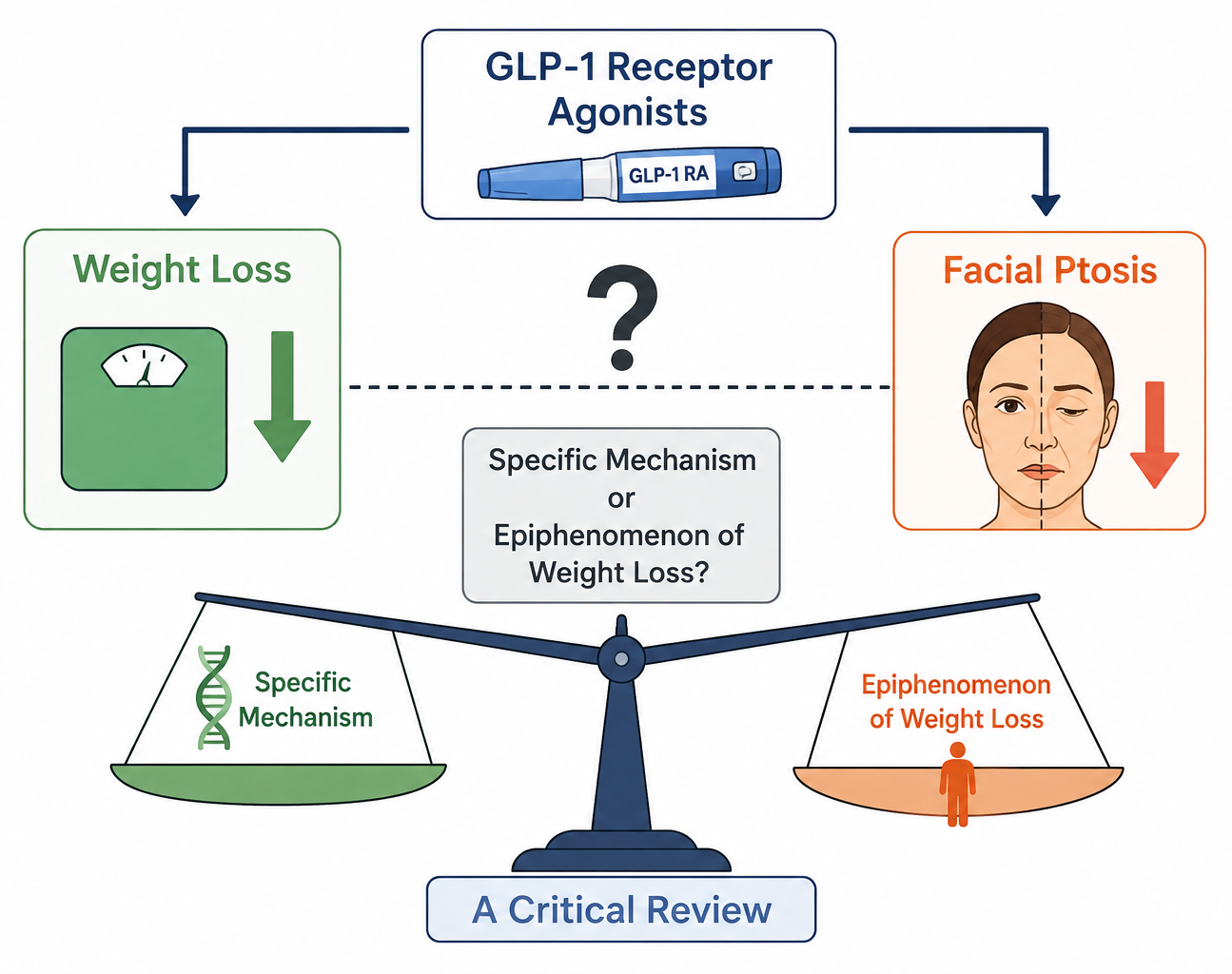
Weight loss from GLP-1 receptor agonists and facial ptosis: Specific mechanism or epiphenomenon of weight loss? A critical review
DOI:
https://doi.org/10.14295/bjs.v6i3.948Keywords:
GLP-1 receptor agonists, semaglutide, facial aging, ptosis, Ozempic faceAbstract
The expanding use of glucagon-like peptide-1 receptor agonists (GLP-1RA) for the treatment of type 2 diabetes mellitus and obesity has made a set of facial aesthetic changes popularly known as “Ozempic face” clinically common, characterized by volume loss, deepening of folds, and soft-tissue ptosis. A central controversy persists regarding causality, however: do these changes result from a specific pharmacological effect of the GLP-1 pathway on dermal cells, or are they merely an epiphenomenon of the magnitude and speed of weight loss, independent of the drug class? This narrative critical review synthesizes the available evidence on epidemiology, clinical presentation, molecular and tissue mechanisms, and aesthetic management options, with emphasis on the methodological gaps that prevent a definitive causal attribution. We conclude that the association between GLP-1RA and accelerated facial ptosis is robust and reproducible, but the existence of a receptor-specific mechanism remains a biologically plausible, still-unproven hypothesis, given the absence of studies that control for the rate of weight loss as a confounding variable.
References
American Academy of Facial Plastic and Reconstructive Surgery. (2024). Annual Trends Survey.
American Academy of Ophthalmology. (2025). GLP-1s and rapid facial aging: aesthetic solutions. EyeNet Magazine. Available at: https://www.aao.org/eyenet/article/cosmetic-surgery-for-GLP-1-weight-loss. Accessed on: August 24, 2026.
Anastasiou, I. A., Tentolouris, A., Sarantis, P., Katsaouni, A., Rebelos, E., Mourouzis, I., Pantos, C., & Tentolouris, N. (2025). Semaglutide enhances cellular regeneration in skin and retinal cells in vitro. Pharmaceutics, 17(9), 1115. https://doi.org/10.3390/pharmaceutics17091115
Avelar, L. E. T., Sarlos, P., Guarnieri, C., Alvarez, P. P., Rojas, G. A., Rossiere, N., Toro, V. A., Kamamoto, C., Gomes, R. T., Nogueira, A., & Miot, H. A. (2026). Aesthetic use of poly-L-lactic acid and hyaluronic acid fillers in medication-driven weight loss due to GLP-1 receptor agonists: real-world case series from Latin America. Clinical, Cosmetic and Investigational Dermatology, 19, 620566. https://doi.org/10.2147/CCID.S620566
Baggett, A., Saadi, C., Saadi, R., & Patel, V. (2025). Cosmetic considerations of semaglutide. Cosmetics, 12(5), 221. https://doi.org/10.3390/cosmetics12050221
Carboni, A., Woessner, S., Martini, O., Marroquin, N. A., & Waller, J. (2024). Natural weight loss or “Ozempic face”: demystifying a social media phenomenon. Journal of Drugs in Dermatology, 23(1), 1367-1368. https://doi.org/10.36849/JDD.7613
Catalfamo, L., De Ponte, F. S., & De Rinaldis, D. (2025). “Ozempic face”: an emerging drug-related aesthetic concern and its treatment with endotissutal bipolar radiofrequency (RF) – our experience. Journal of Clinical Medicine, 14(15), 5269. https://doi.org/10.3390/jcm14155269
Cedirian, S., Donati, M., Rapparini, L., Pampaloni, F., La Placa, M., Sgarzani, R., Negosanti, L., Raschi, E., & Starace, M. (2025). Benefit-risk assessment of GLP-1 receptor agonists: implications for dermatologists and plastic surgeons. Dermatology and Therapy, 15(11), 3173-3193. https://doi.org/10.1007/s13555-025-01537-5
Chen, T. H., Li, J., Hellbusch, D., & Tao, J. P. (2026). Effects of glucagon-like peptide-1 receptor agonist on facial landmarks. Ophthalmic Plastic and Reconstructive Surgery, 42(3), 277-280. https://doi.org/10.1097/IOP.0000000000003070
Contini, M., Hollander, M. H. J., Vissink, A., Schepers, R. H., Jansma, J., & Schortinghuis, J. (2023). A systematic review of the efficacy of microfocused ultrasound for facial skin tightening. International Journal of Environmental Research and Public Health, 20(2), 1522. https://doi.org/10.3390/ijerph20021522
Daneshgaran, G., Shauly, O., & Gould, D. J. (2025). “Ozempic face” in plastic surgery: a systematic review of the literature on GLP-1 receptor agonist mediated weight loss and analysis of public perceptions. Aesthetic Surgery Journal Open Forum, 7, ojaf056. https://doi:10.1093/asjof/ojaf056
Drucker, D. J. (2018). Mechanisms of action and therapeutic application of glucagon-like peptide-1. Cell Metabolism, 27(4), 740-756. https://doi.org/10.1016/j.cmet.2018.03.001
Durairaj, K. K., McCarthy, A. D., Yambao, M., & Linnemann-Heath, J. (2025). Hyperdilute Radiesse preserves facial volume in glucagon-like peptide-1 receptor agonist users undergoing rapid weight loss. Aesthetic Surgery Journal Open Forum, 7, ojaf088. https://doi.org/10.1093/asjof/ojaf088
Haq, S. (2025). Aesthetic restoration following GLP-1 agonist-induced facial volume loss: a multimodal case report. PMFA Journal, 13(1). Available at: https://www.thepmfajournal.com/media/42585/pmfaon25-cr-haq-online-final.pdf. Accessed on: July 11, 2026.
Haykal, D., Hersant, B., Cartier, H., & Meningaud, J. P. (2025). The role of GLP-1 agonists in esthetic medicine: exploring the impact of semaglutide on body contouring and skin health. Journal of Cosmetic Dermatology, 24(2), e16716. https://doi.org/10.1111/jocd.16716
Humphrey, C. D., Lawrence, A. C. (2023). Implications of Ozempic and other GLP-1 receptor agonists for facial plastic surgeons. Facial Plastic Surgery, 39(6), 719-721. https://doi.org/10.1055/a-2148-6321
Jastreboff ,A. M., Aronne, L. J., Ahmad, N. N., Wharton, S., Connery, L., Alves, B., Kiyosue, A., Zhang, S., Liu, B., Bunck, M. C., & Stefanski, A. (2022). Tirzepatide once weekly for the treatment of obesity (SURMOUNT-1). New England Journal of Medicine, 387(3), 205-216. https://doi.org/10.1056/nejmoa2206038
Kapantais, D., Tsoutsanis, P. (2025). Functional and aesthetic periorbital, ocular adnexal and ocular surface changes linked to GLP-1 receptor agonists. Journal of Clinical Medicine, 14(24), 8792. https://doi.org/10.3390/jcm14248792
Kılıç, S. (2025). Facial aging after GLP-1 receptor agonist-induced weight loss: the emerging Ozempic face phenomenon. Journal of Diabetes and Metabolic Disorders, 24, 261. https://doi.org/10.1007/s40200-025-01778-3
Kirsanova, L. V., Gintovt, E. A., Araviiskaia, E. R., Sokolovskiy, E. V., & Bogatenkov, A. I. (2025). Ozempic face: role of cosmetologists in preventing and treating skin and soft tissue changes. Russian Journal of Skin and Venereal Diseases, 28(5), 615-625. https://doi.org/10.17816/dv678367
Krajewski, P. K., Złotowska, A., Szepietowski, J. C. (2024). The therapeutic potential of GLP-1 receptor agonists in the management of hidradenitis suppurativa: a systematic review of anti-inflammatory and metabolic effects. Journal of Clinical Medicine, 13(21), 6292. https://doi.org/10.3390/jcm13216292
Lorenc, Z. P., Somenek, M., Nguyen, T. Q., Garimella, S., Hicks, J., Le, J. H. T. D., Meckfessel, M. H. (2026). A multicenter, open-label study of combined poly-L-lactic acid and hyaluronic midface filler regimen enhances facial harmony and skin quality in GLP-1 medication users. Aesthetic Surgery Journal, 46(5), 509-519. https://doi.org/10.1093/asj/sjaf240
Lv, Q., Li, X., Qi, Y., Gu, Y., Liu, Z., Ma, G. E. (2021). Volume retention after facial fat grafting and relevant factors: a systematic review and meta-analysis. Aesthetic Plastic Surgery, 45(2), 506-520. https://doi.org/10.1007/s00266-020-01612-6
Mansour, M. R., Hannawa, O. M., Yaldo, M. M., Nageeb, E. M., Chaiyasate, K. (2024). The rise of “Ozempic face”: analyzing trends and treatment challenges associated with rapid facial weight loss induced by GLP-1 agonists. Journal of Plastic, Reconstructive & Aesthetic Surgery, 96, 225-227. https://doi.org/10.1007/s13555-025-01537-5
Martins, J. A., Lach, A. A., Morris, H. L., Carr, A. J., & Maouthuy, P-A. (2019). Polydioxanone implants: a systematic review on safety and performance in patients. Journal of Biomaterials Applications, 34(7), 902-916. https://doi.org/10.1177/0885328219888841
Mnajjed, L., & Mims, M. M. (2025). Interest in facial volume restorative procedures with the rise in “Ozempic face”: a Google Trends analysis. Plastic and Reconstructive Surgery Global Open, 13(11), e7282. https://doi.org/10.1097/GOX.0000000000007282
Montecinos, K., Kania, B., Goldberg, D. J. (2024). Semaglutide “Ozempic” face and implications in cosmetic dermatology. Dermatological Reviews, 5, e70003. https://doi.org/10.1002/der2.70003
Moradi, A., Denkova, R., Holcomb, K., Rossi, A., Ashourian, N. (2026). Nonsurgical aesthetic treatment of the face and neck in GLP-1 receptor agonist weight loss patients: experience-based considerations. Aesthetic Surgery Journal Open Forum, 8, ojag011. https://doi.org/10.1093/asjof/ojag011
Morzhanaeva, M. A., Svechnikova, E. V., Gorskaya, A. A., & Artemyeva, N. O. (2025). Complex protocols for correction of age-related changes caused by drug-induced loss of subcutaneous fat tissue of the face and body using a PLA-based preparation. Meditsinskiy Sovet, (14), 202-211. https://doi.org/10.21518/ms2025-365
Nguyen, N., Aguilar, A., Afzal, N., Lee, A., Akram, W., Duong, M. N., Sivamani, R. K. (2026). Topical volumizing cream improves facial volume and skin health in adults with rapid weight loss from pharmacologic (GLP-1/GIP agonists), surgical, or behavioral interventions. Journal of Cosmetic Dermatology, 25(1), e70681. https://doi.org/10.1111/jocd.70681
O'Neill, E. S., Wiegmann, A. L., Parrella, N., Pittman, T., Hood, K., & Kurlander, D. (2024). Injectable weight loss medications in plastic surgery: what we know, perioperative considerations, and recommendations for the future. Plastic and Reconstructive Surgery Global Open, 12(1), e5516. https://doi.org/10.1097/gox.0000000000005516
Parkinson, H. (2026). A topical approach to GLP-1/GIP agonist-induced tissue changes in the face, neck and décolletage: a case series evaluation. Journal of Aesthetic Nursing, 15(1), 6-16. https://doi.org/10.12968/joan.2025.0058
Paschou, I. A., Sali, E., Paschou, S. A., Tsamis, K. I., Peppa, M., Psaltopoulou, T., Nicolaidou, E., & Stratigos, A. J. (2025). GLP-1RA and the possible skin aging. Endocrine, 89(3), 680-685. https://doi.org/10.1007/s12020-025-04293-w
Patino, W., Thomas, A., Jain, S., Del Rosso, J. Q., Issa, N. T. (2025). A review of glucagon-like peptide-1 in dermatology. Journal of Clinical and Aesthetic Dermatology, 18(3), 42-50.
Persson, C., Eaton, A., & Mayrovitz, H. N. (2025). A closer look at the dermatological profile of GLP-1 agonists. Diseases, 13(5), 127. https://doi.org/10.3390/diseases13050127
Ridha, Z., Fabi, S. G., Zubar, R., & Dayan, S. H. (2024). Decoding the implications of glucagon-like peptide-1 receptor agonists on accelerated facial and skin aging. Aesthetic Surgery Journal, 44(11), NP809-NP818. https://doi.org/10.1093/asj/sjae132
Saffari, P. S., Davila, N., Pradeep, T., Wong, B., & Lee, W. W. (2026). Periorbital changes following glucagon-like peptide-1 receptor agonist use: a retrospective cohort study of oculofacial complications and interventions. Ophthalmic Plastic and Reconstructive Surgery, 42(4), 414-419. https://doi.org/10.1097/IOP.0000000000003129
Sataray-Rodriguez, A., Pham, D., Severini, C., Oladinni, D., Hunter, C., Marsh, S., Sataray-Arriaga, L., Frasier, K. (2025). Investigating the impact of GLP-1 receptor agonist-mediated fat loss on collagen synthesis and skin elasticity. Journal of Biomedical Science and Engineering, 18(3), 45-59. https://doi.org/10.4236/jbise.2025.183003
Sciscent, B. Y., Goldrich, D., Eberly, H. W., & Walen, S. (2024). Semaglutide, popularly known as Ozempic – what the facial plastic surgeon needs to know. Facial Plastic Surgery & Aesthetic Medicine, 27(2), 127-128. https://doi.org/10.1089/fpsam.2024.0083
Seidel, D. U., & Bode, S. (2025). Rapider Gewichtsverlust durch GLP-1-Rezeptor-Agonisten als Lifestylephänomen und Implikationen für die plastisch-ästhetische Medizin. HNO, 73(11), 765-770. https://doi.org/10.1007/s00106-025-01653-w
Sharma, R. K., Vittetoe, K. L., Barna, A. J., Takkouche, S., Varelas, A. N., Yang, S. F., Stephan, S. J., Patel, P. N. (2025). Radiographic midfacial volume changes in patients on GLP-1 agonists. Otolaryngology–Head and Neck Surgery, 173(2), 360-366. https://doi.org/10.1002/ohn.1209
Sharp, G. (2026). Response by Sharp to “‘Ozempic face’: construct, consequence, or clinical entity?” by Daneshgaran et al. Aesthetic Surgery Journal Open Forum, 8, ojag080. https://doi.org/10.1093/asjof/ojag080
Signori R., Barbosa A. P., Cezar-Dos-Santos F., Carbone A. C., Ventura S., Nobre B. B. S., Neves M. L. B. B., Câmara-Souza M. B., Poluha R. L., & De la Torre Canales G. (2024). Efficacy and safety of poly-L-lactic acid in facial aesthetics: a systematic review. Polymers, 16(18), 2564. https://doi.org/10.3390/polym16182564
Strong, A. L., Rohrich, R. J., Tonnard, P. L., Vargo, J. D., & Cederna, P. S. (2024). Technical precision with autologous fat grafting for facial rejuvenation: a review of the evolving science. Plastic and Reconstructive Surgery, 153(2), 360-377. https://doi.org/10.1097/prs.0000000000010643
Vilarrasa, E., Nicolau, J., de la Cueva, P., Goday, A., Gallardo, F., Martorell-Calatayud, A., & Varrascosa, J. M. (2024). Glucagon-like peptide-1 agonists for treating obesity in patients with immune-mediated skin diseases. Actas Dermo-Sifiliográficas, 115(1), T56-T65. https://doi.org/10.1016/j.ad.2023.10.019
Wilding, J. P. H., Batterham, R. L., Calanna, S., Davies, M., Van Gaal, L. F., Lingvay, I., McGowan, B. M., & Study Group, S. T. E. P. (2021). Once-weekly semaglutide in adults with overweight or obesity (STEP 1). The New England Journal of Medicine, 384(11), 989-1002. https://doi.org/10.1056/NEJMoa2032183
Jodat, Z., Shahzad, K., Younas, M., Afridi, H., & Mahato, R. K. (2026). Emergence of “Ozempic face”: addressing unintended consequences of rapid weight loss. Annals of Medicine and Surgery, 88(2), 2087-2088. https://doi.org/10.1097/MS9.0000000000004254
Downloads
Published
How to Cite
Issue
Section
License
Copyright (c) 2027 Ana Beatriz Neves Felix, Camila de Oliveira Zendram, Isabela Cristina de Pinho Rosa, Amir Horiquini Barbosa, Érica Ferrari Calissi

This work is licensed under a Creative Commons Attribution 4.0 International License.
Authors who publish with this journal agree to the following terms:
1) Authors retain copyright and grant the journal right of first publication with the work simultaneously licensed under a Creative Commons Attribution License that allows others to share the work with an acknowledgement of the work's authorship and initial publication in this journal.
2) Authors are able to enter into separate, additional contractual arrangements for the non-exclusive distribution of the journal's published version of the work (e.g., post it to an institutional repository or publish it in a book), with an acknowledgement of its initial publication in this journal.
3) Authors are permitted and encouraged to post their work online (e.g., in institutional repositories or on their website) prior to and during the submission process, as it can lead to productive exchanges, as well as earlier and greater citation of published work.