Physicochemical and structural properties of native starch from Matayba guianensis Aubl. seeds (Sapindaceae)
DOI:
https://doi.org/10.14295/bjs.v5i7.888Keywords:
proteins, minerals, Sapindaceae, color, microbiological analysis, digestibilityAbstract
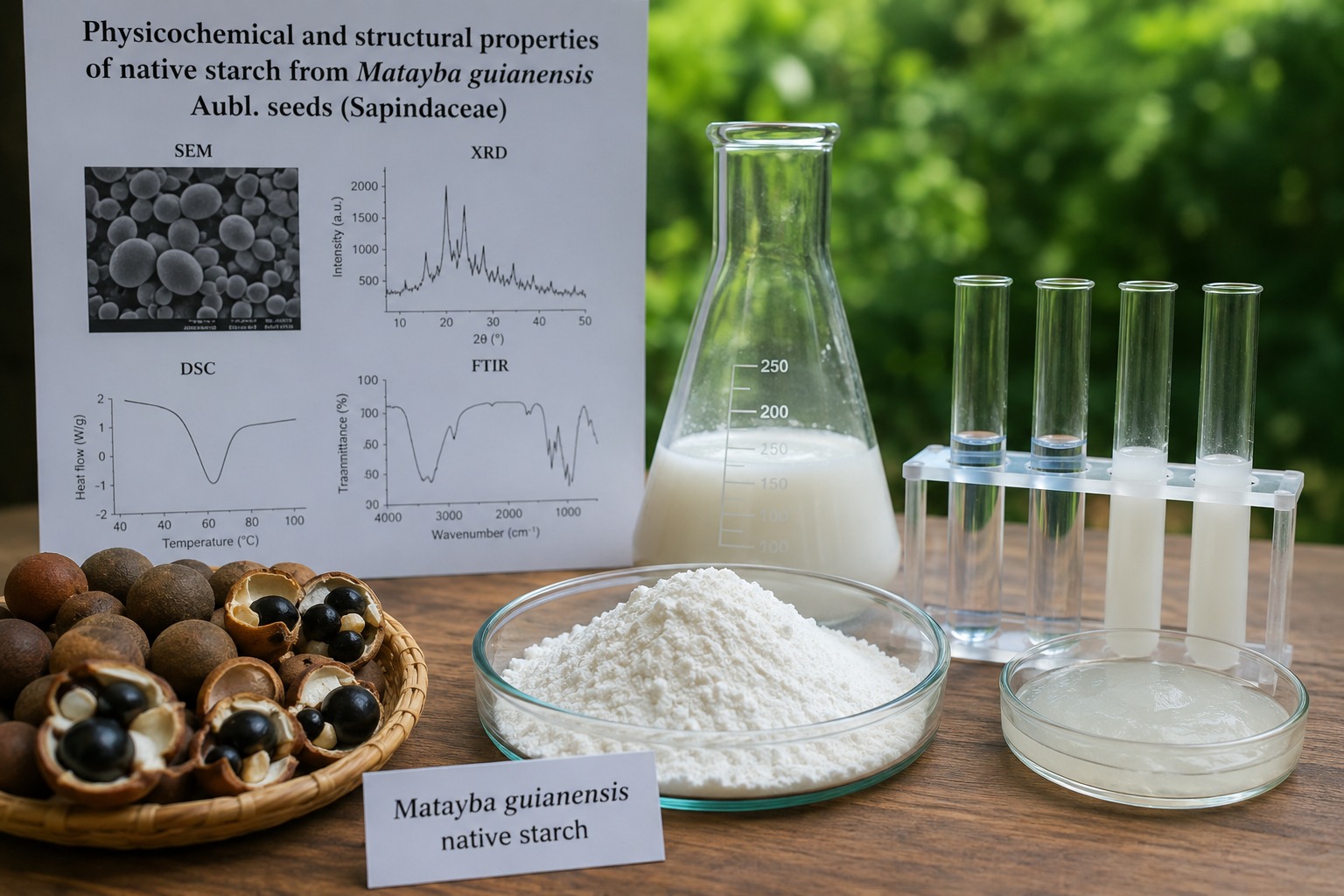
This study aimed to characterize the physicochemical, crystalline, morphological, biological, in vitro digestibility, and microbiological properties of starch extracted from Matayba guianensis seeds. Chemical composition analysis revealed a starch yield of 85% and a total protein content of 12%. The starch exhibited good paste clarity (66%), high lightness (L* > 70%), and relevant mineral contents, particularly nitrogen, iron, copper, and zinc. Morphological evaluation indicated typical native starch patterns, while biological assays demonstrated notable in vitro digestibility and low cytotoxicity, with 94.56% cell viability. In addition, the material complied with microbiological standards required for food-grade biopolymers. Overall, these findings highlight the technological potential of Matayba guianensis seed starch, supporting its exploitation as a novel and promising starch source and as a functional ingredient for food industry applications.
References
Altieri, M., & Nicholls, C. (2018). Biodiversity and pest management in agroecosystems. Boca Raton: CRC Press. DOI: https://doi.org/10.1201/9781482277937
Acevedo-Rodríguez, P.; Van Welzen, P. C.; Adema, F.; Ham, R. W. J. M. (2011). Sapindaceae. In: Flowering plants. Eudicots: Sapindales, Cucurbitales, Myrtaceae. The families and genera of vascular plants. Springer, Berlin, 357-407. DOI: https://doi.org/10.1007/978-3-642-14397-7_17
Adbowale, K. O., Afolabi, T. A., & Lawal, O. (2002). Isolation, chemical modification and physicochemical characterization of bambarra groundnut (Voandzeia subterranean) starch and flour. Food Chemistry, 78(3),305-311. https://doi.org/10.1016/S0308-8146(02)00100-0 DOI: https://doi.org/10.1016/S0308-8146(02)00100-0
Ajala, A., Kaur, L., Lee, S. J., & Singh, J. (2023). Native and processed legume seed microstructure and its influence on starch digestion and glycaemic features: A review. Trends in Food Science & Technology, 133, 65-74. https://doi.org/10.1016/j.tifs.2023.01.011 DOI: https://doi.org/10.1016/j.tifs.2023.01.011
Akhila, P. P., Sunooj, K. V., Aaliya, B., Navaf, M., Sudheesh, C., Yadav, D. N., Khan, M. A., Mir, S. A., & George, J. (2022). Morphological, physicochemical, functional, pasting, thermal properties and digestibility of house potato (Plectranthis rotundifolius) flour and starch. Applied Food Research, 2. https://doi.org/10.1016/j.afres.2022.100193 DOI: https://doi.org/10.1016/j.afres.2022.100193
Almeida, E. C., Bora, P. S., & Zárate, N. A. H. (2013). Amido nativo e modificado de taro (Colocasia esculenta L. Schott): Caracterização química, morfológica e propriedades de pasta. Boletim Ceppa, 31(1), 67-82. DOI: https://doi.org/10.5380/cep.v31i1.32703
AOAC. (2016). Official Methods of Analysis of AOAC International. 20th ed. Gaithersburg, MD: AOAC International.
Batista, R. D., Mendes, D. C. S., Morais, C. C., Thomaz, D. V., Ascheri, D. P. R., Damiani, C., & Asquieri, E. R. (2020). Physicochemical, functional and rheological properties of fermented and non-fermented starch from canary seed (Phalaris canariensis). Food Hydrocolloids, 99, 105346. https://doi.org/10.1016/j.foodhyd.2019.105346 DOI: https://doi.org/10.1016/j.foodhyd.2019.105346
Bergel, B. F., Araujo, L. L., & Santana, R. M. C. (2022). Evaluation of toxicity and biodegradation of thermoplastics starch foams with modified starch. Food Packaging and Shelf Life, 31, 100798. https://doi.org/10.1016/j.fpsl.2021.100798 DOI: https://doi.org/10.1016/j.fpsl.2021.100798
Carbalho, L. M. C., Martins, A. L. L., Lealzimmer, F. M. A., Pinedo, A. A., & Santos, C. C. A. A. (2025). Characterization of Solanum lycocarpum starch and its application as edible coating in minimally processed baby carrots. ACS Food Science & Technology, 5(9), 3271-3281. DOI: https://doi.org/10.1021/acsfoodscitech.5c00182
Chacon, W. D. C., Gaviria, Y. A. R., Melo, A. P. Z., Verruck, S., Monteiro, A. R., & Valencia, G. A. (2024). Physicochemical properties and potential food applications of starches isolated from unconventional seeds: A review. Starch, 76(12). https://doi.org/10.1002/star.202200228 DOI: https://doi.org/10.1002/star.202200228
Coelho, R. L. G., Souza, V. C., Ferrucci, M. S., & Flores, T. B. (2017). Revisão taxonômica de Matayba sect. Matayba (Sapindaceae, Cupanieae). Rodriguésia, 68(2), 411-443. https://doi.org/10.1590/2175-7860201768209 DOI: https://doi.org/10.1590/2175-7860201768209
Costa, B. P., Carpiné, D., Ikeda, M., Pazzini, I. A. E., Alves, F. E. S. B., Melo, A. M., & Ribani, R. H. (2023). Bioactive coatings from non-conventional loquat (Eribotrya japônica Lindl.) seed starch to extend strawberries shelf-life: An antioxidant packaging. Progress in Organic Coatings, 175, 107320. https://doi.org/10.1016/j.porgcoat.2022.107320 DOI: https://doi.org/10.1016/j.porgcoat.2022.107320
Dhull, S. B., Chandak, A., Collins, M. N., Bangar, S. P., Chawla, P., & Singh, A. (2022). Lotus seed starch: A novel functional ingredient with promising properties and applications in food – A review. Starch, 74(9-10), 2200064. https://doi.org/10.1002/star.202200064 DOI: https://doi.org/10.1002/star.202200064
Englyst, H. N., Kingman, S. M., & Cummings, J. H. (1992). Classification and measurement of nutritionally important starch fractions. European Journal of Clinical Nutrition, 46, S33-S50. 10.1016/S0271-5317(97)00010-9
Falade, K.O., & Ayetigbo, O. E. (2017). Effects of tempering (annealing), acid hydrolysis, low-citric acid substitution on chemical and physicochemical properties of starches of four yam (Dioscorea spp.) cultivars. Journal of Food Science and Technology, 54(6), 1455-1466. DOI: https://doi.org/10.1007/s13197-017-2568-x
Freitas, M. C. J., & Tavares, D. Q. (2005). Caracterização do grânulo de amido de bananas (Musa AAA-Nanicão e Musa AAB-Terra). Revista de Tecnologia de Alimentos, 25(2), 217-222. https://doi.org/10.1590/S0101-20612005000200005 DOI: https://doi.org/10.1590/S0101-20612005000200005
Gonçalves, P. H. P., Rezende, U. C., Bomfim, P. M., Maia, V. C., & Oliveira, D. C. (2021). Sexually dimorphic galls induced on leaflets of Matayba guianensis (Sapindaceae): a rare phenomenon occurring in Diptera (Decidomyiidae). The Science of Nature, 109. https://doi.org/10.1007/s00114-021-01777-3 DOI: https://doi.org/10.1007/s00114-021-01777-3
Goñi, I., Garcia-Alonso, A., & Saura-Calixto, F. A. (1997). Starch hydrolysis procedure to estimate glycemic index. Nutrition Research, 17(3), 427-437. https://doi.org/10.1016/S0271-5317(97)00010-9 DOI: https://doi.org/10.1016/S0271-5317(97)00010-9
Gurunathan, M. K., Navaşingh, R. J. H., Selvam, J. D. R., & Čep, R. (2025). Development and characterization os starch bioplastics as a sustainable alternative for packaging. Scientific Reports, 15, 15264. https://doi.org/10.1038/s41598-025-00221-0 DOI: https://doi.org/10.1038/s41598-025-00221-0
Instituto Adolfo Lutz. (2008). Normas Analíticas do Instituto Adolfo Lutz: Métodos químicos e físicos para análise de alimentos. 4ª ed., São Paulo, IMESP.
Jiménez-Sánchez, A., Hernández-Gil, L., García, M. A., & Rodríguez-Larraburu, E. (2024). Development of corn starch biodegradable films reinforced by nanocellulose for food packaging. Nativa, 12(4), 612-620. https://doi.org/10.31413/nat.v12i4.17718 DOI: https://doi.org/10.31413/nat.v12i4.17718
Kushwaha, R., Singh, V., Kaur, S., Wani, A. A., & Kaur, D. (2023). Elucidating the impact of chemical modifications on the structure, and properties of jackfruit seed starch. Food Bioscience, 56, 103097. https://doi.org/10.1016/j.fbio.2023.103097 DOI: https://doi.org/10.1016/j.fbio.2023.103097
Malumba, P., Delatte, S., Doran, L., & Blecker, C. (2022). The effect of annealing under acid or alkaline environment on the physicochemical and functional properties of wheat starch. Food Hydrocolloids, 125, 107452. https://doi.org/10.1016/j.foodhyd.2021.107452
Leonel, M., Sarmento, S. B. S., Cereda, M. P., & Câmara, F. L. A. (2003). Extração e caracterização de amido de jacatupé (Pachyrhizus ahipa)1. Ciência e Tecnologia de Alimentos, 23(3), 362-365. https://doi.org/10.1590/S0101-20612003000300011 DOI: https://doi.org/10.1590/S0101-20612003000300011
Lima, N. B. F., Silva, L. B., Borges, M. V., Neves, R. R., Vera, R., & Ferreira, G. A. (2019). Caracterização do amido de araruta orgânica e potencial para aplicação tecnológica em alimentos. Revista Desafios, 6, 118-126. http://dx.doi.org/10.20873/uft.2359365220196Especialp118 DOI: https://doi.org/10.20873/uft.2359365220196Especialp118
Malumba, P., Delatte, S., Doran, L., & Blecker, C. (2022). The effect of annealing under acid or alkaline environment on the physicochemical and functional properties of wheat starch. Food Hydrocolloids, 125, 107452. https://doi.org/10.1016/j.foodhyd.2021.107452 DOI: https://doi.org/10.1016/j.foodhyd.2021.107452
Martins, S. H. F., Pontes, K. V., Fialho, R. L., & Fakhouri, F. M. (2022). Extraction and characterization of the starch present in the avocado seed (Persea americana mill) for future applications. Journal of Agriculture and Food Research, 8, 100303. https://doi.org/10.1016/j.jafr.2022.100303 DOI: https://doi.org/10.1016/j.jafr.2022.100303
Nemţanu, M. R., & Braşoveanu, M. (2026). Sustainable modification of starch color via dual cold plasma and electron beam irradiation. Radiation Physics and Chemistry, 240. https://doi.org/10.1016/j.radphyschem.2025.113477 DOI: https://doi.org/10.1016/j.radphyschem.2025.113477
Peng, M., Yin, L., Dong, J., Shen, R., & Zhu, Y. (2022). Physicochemical characteristics and in vitro digestibility of starches from colored quinoa (Chenopodium quinoa) varieties. Journal of Food Science, 87(5), 2147-2158. https://doi.org/10.1111/1750-3841.16126 DOI: https://doi.org/10.1111/1750-3841.16126
Radlkofer, L. (1879). Sapindaceae. Sitzungsberichte der Mathematisch-Physikalischen Klasse der K.B. 5. Akademie der Wissenschaften su München, Munique, 630-637.
Radlkofer, L. (1895). Sapindaceae. In: Engler, A., & Prantl, K. Die Natürlichen Pflazenfamilien, 3, 277-366.
Radlkofer, L. (1892-1900). Sapindaceae. In: Martius, C.F.P. Flora brasiliensis. Leipzig, Munchen, Wien, 13, pars 3, 225-658.
Radlkofer, L. (1934). Sapindaceae. In: Engler, A., & Diel, L. Das Pflanzenreich Regni Vegetabilis Conspectus, 4, 1019-1109.
Rashwan, A. K., Younis, H. A., Abdelshafy, A. M., Osman, A. I., Eletmany, M. R., Hafouda, M. A., & Chen, W. (2024). Plant starch extraction, modification, and green applications: a review. Environmental Chemistry Letters, 22, 2483-2530. https://doi.org/10.1007/s10311-024-01753-z DOI: https://doi.org/10.1007/s10311-024-01753-z
Rengsutthi, K., & Charoenrein, S. (2011). Physico-chemical properties of jackfruit seed starch (Artocarpus heterophyllus) and its application as a thickener and stabilizer in chilli sauce. LWT – Food Science and Technology, 44(5), 1309-1313. https://doi.org/10.1016/j.lwt.2010.12.019 DOI: https://doi.org/10.1016/j.lwt.2010.12.019
Rickard, J. E., & Behn, K. R. (1987). Evaluation of acid and enzyme hydrolytic methods for determination of cassava starch. Journal of the Science of Food and Agriculture, 41(4), 373-379. https://doi.org/10.1002/jsfa.2740410409 DOI: https://doi.org/10.1002/jsfa.2740410409
Roldán-San Antonio, J. E., & Martín, M. (2025). Optimal design of a supply chain for the production of starch-based biopolymers by waste revalorization. Journal of Cleaner Production, 493. https://doi.org/10.1016/j.jclepro.2025.144875 DOI: https://doi.org/10.1016/j.jclepro.2025.144875
Santos, L. S., Bonomo, R. C. F., Fontam, R. C. I., Bonomo, P., Leite, C. X. S., & Santos, D. O. (2013). Efeito dos métodos de extração na composição, rendimento e propriedades da pasta do amido obtido da semente de jaca. Revista Brasileira de Produtos Agroindustriais, 15(3), 255-261. DOI: https://doi.org/10.15871/1517-8595/rbpa.v15n3p255-261
Shahrim, N. A., Sarifuddin, N., & Ismail, H. (2018). Extraction and characterization of starch from mango seeds. Journal of Physics: Conference Series, 1082. DOI: 10.1088/1742-6596/1082/1/012019 DOI: https://doi.org/10.1088/1742-6596/1082/1/012019
Silva, N., Junqueira, V. C. A., Silveira, N. F. A., Taniwaki, M. H., Gomes, R. A. R., & Okazaki, M. M. (2010). Manual de métodos de análise microbiológica de alimentos: 1-624. Blucher, São Paulo, 2010.
Silva-Neto, L. A., Raímerz-Rueda, R. Y., Salvador, M. J., & Nascimento, A. M. (2025). Chemical composition and evaluation of antimicrobial and antioxidant activities of essential oils from Lippia hermannioides and Matayba marginata, two plants on ironstone outcrops: an endangered Brazilian ecosystem. Brazilian Journal of Biology, 85, e289902. https://doi.org/10.1590/1519-6984.289902 DOI: https://doi.org/10.1590/1519-6984.289902
Silva, L. S. C., Martim, S. R., Souza, R. A. T., Machado, A. R. G., Teixeira, L. S., Sousa, L. B., Vasconselos, M. C., & Teixeira, M. F. S. (2019). Extração e caracterização de amido de espécies de Dioscorea cultivadas na Amazônia. Boletim do Museu Paraense Emílio Goeldi Ciências Naturais, 14(3), 439-452. https://doi.org/10.46357/bcnaturais.v14i3.230 DOI: https://doi.org/10.46357/bcnaturais.v14i3.230
Souza, M. E., Leonel, S., Martins, & Segtowick, E. C. S. (2013). Caracterização físico-química e avaliação sensorial dos frutos de bananeira. Nativa, 01(01), 13-17. https://doi.org/10.31413/nativa.v1i1.1330 DOI: https://doi.org/10.14583/2318-7670.v01n01a03
Souza, R. C. R., & Andrade, C. T. (2000). Investigação dos processos de gelatinização e extrusão de amido de milho. Polímeros: Ciência e Tecnologia, 10(1), 24-30. DOI: https://doi.org/10.1590/S0104-14282000000100006
Vrancheva, R., Krystev, L., Popova, A., & Mihaylova, D. (2019). Proximate nutritional composition and heat-induced changes of starch in selected grains and seeds. Emirates Journal of Food and Agriculture, 31(9), 718-724. DOI: 10.9755/ejfa.2019.v31.i9.2011 DOI: https://doi.org/10.9755/ejfa.2019.v31.i9.2011
Wang, L., & Tong, L. (2024). Production and properties of starch: Current research. Molecules, 29(3), 646. https://doi.org/10.3390/molecules29030646 DOI: https://doi.org/10.3390/molecules29030646
Wang, B., Dong, Y., Fang, Y., Gao, W., Kang, X., Liu, P., Yan, S., Cui, B., & El-Aty, A. M. (2022). Effects of different moisture contents on the structure and properties of corn starch during extrusion. Food Chemistry, 368, 120804. https://doi.org/10.1016/j.foodchem.2021.130804 DOI: https://doi.org/10.1016/j.foodchem.2021.130804
Williams, P. C., Kuzina, F. D., & Hlynka, I. (1970). A rapid colorimetric method for estimating the amylose content of starch and flours. Cereal Chemistry, 47(4).
Wolter, A., Hager, A. S., Zannini, E., & Arendt, E. K. (2014). Influence of sourdough on in vitro starch digestibility and predictedglycemic indices of gluten-free breads. Food & Function, 5(3), 564-572. https://doi.org/10.1039/c3fo60505a DOI: https://doi.org/10.1039/c3fo60505a
Downloads
Published
How to Cite
Issue
Section
License
Copyright (c) 2026 João Batista Casemiro, Júlio Cesar Fernandes dos Santos, Aurélio Ferreira Melo, Hellen Regina Fernandes Batista Ventura, Osvaldo Resende, Antonio Carlos Pereira de Menezes Filho

This work is licensed under a Creative Commons Attribution 4.0 International License.
Authors who publish with this journal agree to the following terms:
1) Authors retain copyright and grant the journal right of first publication with the work simultaneously licensed under a Creative Commons Attribution License that allows others to share the work with an acknowledgement of the work's authorship and initial publication in this journal.
2) Authors are able to enter into separate, additional contractual arrangements for the non-exclusive distribution of the journal's published version of the work (e.g., post it to an institutional repository or publish it in a book), with an acknowledgement of its initial publication in this journal.
3) Authors are permitted and encouraged to post their work online (e.g., in institutional repositories or on their website) prior to and during the submission process, as it can lead to productive exchanges, as well as earlier and greater citation of published work.