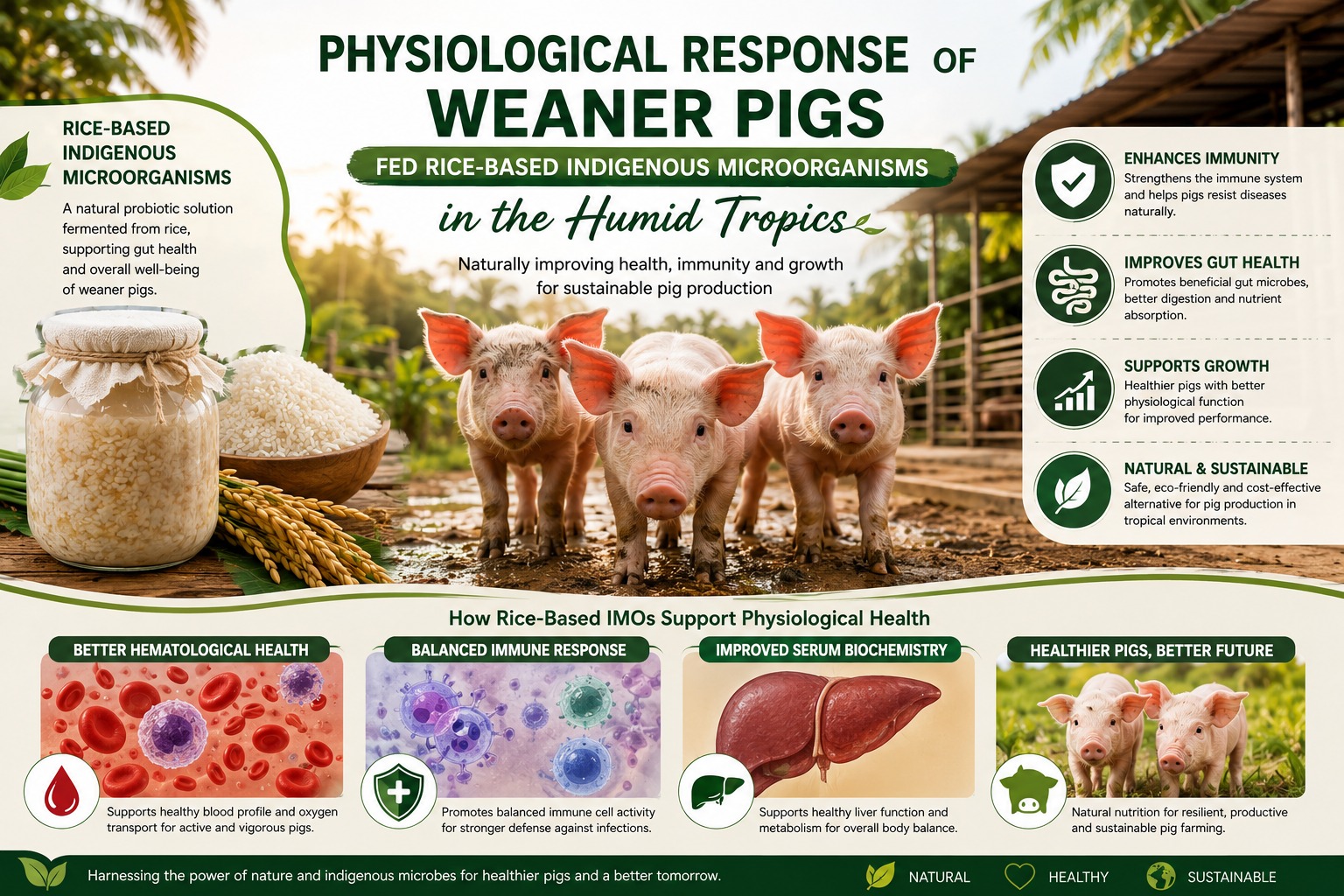
Physiological response of weaner pigs fed rice-based indigenous microorganisms in the humid tropics
DOI:
https://doi.org/10.14295/bjs.v5i6.880Keywords:
haematology, indigenous microorganisms, probiotics, serum biochemistryAbstract
Pig production has strong potential to bridge the protein deficiency gap in the humid tropics. Quality nutrition is essential for increased growth and productivity in any pig farming enterprise. This research examined the effect of rice-based indigenous microorganisms (IMOs) solution on the haematological and serum biochemical indices of weaner pigs in the humid tropics. A total of 24 weaner pigs (Aged 12-weeks) with an average body weight of 10.21 ± 0.4 kg were randomly assigned to three treatments (T) group and four replications each in a completely randomized design (CRD). The treatments comprised three levels of rice IMOs in water: T1 (0 mL/L-1), T2 (5 mL/L), and T3 (10 mL/L-1). The weaner pigs were exposed to the rice IMOs for a period of 20 weeks. Data were collected on haematology and serum biochemical parameters. The results showed that rice IMOs significantly (p < 0.05) increased haemoglobin (16.59 ± 0.05 g/dL), packed cell volume (41.80 ± 0.12%), red blood cells (14.50 ± 0.16 x 10⁶/µL), and white blood cells (19.80 ± 0.18 x 10³/µL) concentrations of pigs in T3. Neutrophil (28.00 ± 0.08 %), eosinophil (8.00 ± 0.26 %), and monocyte (6.00 ± 0.10 %) blood concentrations were higher (p < 0.05) at T2, with lowered lymphocyte compared to other treatments. Compared with IMOs-treated pigs, total protein, globulin, alanine aminotransferase, aspartate aminotransferase, and total cholesterol were higher in the control group (T1). Alkaline phosphate (37.12 ± 0.18 µL/L) and urea (45.00 ± 0.18 mg/dL) concentrations were equally higher (p < 0.05) for T3 pigs. However, albumin concentration showed a non-significant effect (p > 0.05) on the pigs. Based on these findings, the study concluded that rice-based IMOs fed at 10 mL/L improved the physiological health status of weaner pigs in the humid tropics.
References
Adegun, W. O., Njoku, C. P., Ekunseitan, D. A., & Agbaje, M. (2023). Evaluation of herbal leaf meal as an alternative to in-feed antibiotics on haematological parameter and serum biochemical indices of growing sexed pigs. Indian Journal of Animal Sciences, 93(3), 298-302. https://doi.org/10.56093/ijans.v93i3.124411 DOI: https://doi.org/10.56093/ijans.v93i3.124411
Agregán-Pérez, R., Alonso-González, E., Mejuto, J. C., & Pérez-Guerra, N. (2021). Production of a potentially probiotic product for animal feed and evaluation of some of its probiotic properties. International Journal of Molecular Sciences, 22(18), 10004. https://doi.org/10.3390/ijms221810004 DOI: https://doi.org/10.3390/ijms221810004
Ahmad, R. S., Imran, A., & Hussain, M. B. (2018). Nutritional composition of meat. Meat Science and Nutrition, 61, 61-75. https://doi.org/10.5772/intechopen.77045 DOI: https://doi.org/10.5772/intechopen.77045
Ali, L. C., Ikeh, N. E., Nwoga, C. C., Uberu, N. P., & Machebe, N. S. (2022). Reproductive performance of rabbit does subjected to discarded cocoa seed meal (Theobroma cacao) based diet. Himalayan Journal of Agriculture, 3(1), 1-5. https://doi.org/10.47310/Hja.2022.v03i01.001 DOI: https://doi.org/10.47310/hja.2022.v03i01.001
Aminlari, L., Shekarforoush, S.S., Hosseinzadeh, S., Nazifi, S., Sajedianfard, J., & Eskandari, M. H. (2019). Effect of probiotics Bacillus coagulans and Lactobacillus plantarum on lipid profile and feces bacteria of rats fed cholesterol-enriched diet. Probiotics and Antimicrobial Proteins, 11, 1163-1171. https://doi.org/10.1007/s12602-018-9480-1 DOI: https://doi.org/10.1007/s12602-018-9480-1
Bushby, E. V., Friel, M., Goold, C., Gray, H., Smith, L., & Collins, L. M. (2018). Factors influencing individual variation in farm animal cognition and how to account for these statistically. Frontiers in Veterinary Science, 5, 193. https://doi.org/10.3389/fvets.2018.00193 DOI: https://doi.org/10.3389/fvets.2018.00193
Cantalapiedra-Hijar, G., Abo-Ismail, M., Carstens, G. E., Guan, L. L., Hegarty, R., Kenny, D. A., McGee, M., Plastow, G., Relling, A., & Ortigues-Marty, I. (2018). Biological determinants of between-animal variation in feed efficiency of growing beef cattle. Animal, 12(s2), 321-335. https://doi.org/10.1017/S1751731118001489 DOI: https://doi.org/10.1017/S1751731118001489
Cao, G., Tao, F., Hu, Y., Li, Z., Zhang, Y., & Deng, B. (2019). Positive effects of a Clostridium butyricum-based compound probiotic on growth performance, immune responses, intestinal morphology, hypothalamic neurotransmitters, and colonic microbiota in weaned piglets. Food and Function, 10(5), 2926-2934. https://doi.org/10.1039/c8fo02370k DOI: https://doi.org/10.1039/C8FO02370K
Cardelle-Cobas, A., Coy-Girón, L., Cepeda, A., & Nebot, C. (2022). Swine production: Probiotics as an alternative to the use of antibiotics. In: Antibiotics and Probiotics in Animal Food—Impact and Regulation [Working Title]; Veterinary medicine and science; IntechOpen: London, UK. https://doi.org/10.5772/intechopen.108308 DOI: https://doi.org/10.5772/intechopen.108308
Caroline, C. V. (2019). Improving feed efficiency and gut integrity in Escherichia coli challenged weaned pigs. International Pig Topics, 36(3), 7-8. http://www.positiveaction.info/pdfs/articles/pt_36.3_p7.pdf
Chen, H., & Luo, D. (2023). Application of haematology parameters for health management in fish farms. Reviews in Aquaculture, 15(2), 704-737. https://doi.org/10.1111/raq.12753 DOI: https://doi.org/10.1111/raq.12753
Czech, A., Klebaniuk, R., Grela, E.R., Samolinska, W., & Ognik, K. (2017). Polish crossbred pigs’ blood haematological parameters depending on their age and physiological state. Annals of Warsaw University of Life Sciences – SGGW – Animal Sciences, 56(2), 185-195. https://doi.org/10.22630/AAS.2017.56.2.20 DOI: https://doi.org/10.22630/AAS.2017.56.2.20
Dong, X., Zhang, N., Zhou, M., Tu, Y., Deng, K., & Diao, Q. (2013). Effects of dietary probiotics on growth performance, faecal microbiota and serum profiles in weaned piglets. Animal Production Science, 54(5), 616-621. http://dx.doi.org/10.1071/AN12372 DOI: https://doi.org/10.1071/AN12372
Duncan, D. B. (1955). Multiple range and multiple F-test. Biometrics, 11(1), 1-42. https://doi.org/10.2307/3001478 DOI: https://doi.org/10.2307/3001478
Fanta, Y., Kechero, Y., & Yemane, N. (2024). Hematological parameters of sheep and goats fed diets containing various amounts of water hyacinth (Eichhornia crassipes). Frontiers in Veterinary Science, 11, 1286563. https://doi.org/10.3389/fvets.2024.1286563 DOI: https://doi.org/10.3389/fvets.2024.1286563
Food and Agriculture Organization. (2012). Pig sector in Burkina Faso. National Livestock Reviews of the Animal Production and Health Division of the Food and Agriculture Organization of the United Nations, 2012, Number 1, Rome. https://www.fao.org/3/i2567f/i2567f.pdf
Frimpong, Y. O., Boateng, M., Amoah, K. O., Atuahene, P. Y., Okungbowa, S. O., Baah, J., & Okai, D. B. (2021). Response of large white gilts to diets containing differing probiotic products. Scientific African, 13, e00878. https://doi.org/10.1016/j.sciaf.2021.e00878 DOI: https://doi.org/10.1016/j.sciaf.2021.e00878
Gaggia, F., Mattarelli, P., & Biavati, B. (2010). Probiotics and prebiotics in animal feeding for safe food production. International Journal of Food Microbiology, 141(Suppl 1), 15-28. https://doi.org/10.1016/j.ijfoodmicro.2010.02.031 DOI: https://doi.org/10.1016/j.ijfoodmicro.2010.02.031
Ghavami, A., Roshanravan, N., Alipour, S., Barati, M., Mansoori, B., Ghalichi, F., Nattagh-Eshtivan, E., & Ostadrahimi, A. (2018). Assessing the effect of high performance inulin supplementation via KLF5 mRNA expression in adults with type 2 diabetes: a randomized placebo controlled clinical trail. Advanced Pharmaceutical Bulletin, 8, 39-47. https://doi.org/10.15171/apb.2018.005 DOI: https://doi.org/10.15171/apb.2018.005
Gresse, R., Chaucheyras-Durand, F., Fleury, M.A., Van de Wiele, T., Forano, E., & Blanquet-Diot, S. (2017). Gut microbiota dysbiosis in post-weaning piglets: Understanding the keys to health. Trends in Microbiology, 25(10), 851-873. https://doi.org/10.1016/j.tim.2017.05.004 DOI: https://doi.org/10.1016/j.tim.2017.05.004
Hagan, J. K., Hagan, B. A., Ofori, S. A., & Etim, N. N. (2022). Haematological and serum biochemical profiles of two broiler strains fed rations with varying levels of palm kernel oil residue. Ghanaian Journal of Animal Science, 13(2), 30-41. https://www.ajol.info/index.php/gjansci/article/view/246060/232783
Harikrishnan, R., Kim, M.C., Kim, J. S., Balasundaram, C., & Heo, M. S. (2011). Protective effect of herbal and probiotics enriched diet on haematological and immunity status of Oplegnathus fasciatus (Temminck and Schlegel) against Edwardsiella tarda. Fish & Shellfish Immunology, 30(3), 886-893. https://doi.org/10.1016/j.fsi.2011.01.013 DOI: https://doi.org/10.1016/j.fsi.2011.01.013
Haroun, B. M., Refaat, B. M., El-Waseif, A. A., El-Menoufy, H. A., & Amin, H. A. (2013). Hypolipidemic activity of the probiotic Lactobacillus plantarum NRRL B-4496 and their prebiotic exopolysaccharide in vitro and in vivo. Journal of Applied Sciences Research, 9(1), 1015-1020. https://doi.org/10.5555/20133189939
Hossein-Ali, A., Alireza, M., Esmaeil, M., & Rezaeian, M.M. (2014). Effects of Bacillus subtilis and Bacillus licheniformis-Based probiotic on performance, hematological parameters and blood metabolites in lambs. International Journal of Food and Nutritional Sciences, 3(4), 8-15. https://www.ijfans.com/Volume%203%20Issue%204/2.%20IJFANS%20A0286-14.pdf
Huff, T., Boyd, B., & Jialal, I. (2023). Physiology, cholesterol. In: StatPearls. Treasure Island (FL): StatPearls Publishing. Retrieved from https://www.ncbi.nlm.nih.gov/books/NBK470561/
Ikeh, N. E., Amaefule, B. C., Odo, O. J., Ali, L. C., Obinna, A. L., Umeugokwe, P. I., & Machebe, N. S. (2025). The effect of different sources and levels of inclusion of indigenous microorganisms on the growth performance, days-to-first-oestrus and haematological profile in crossbred pigs. Xi'an Shiyou Daxue Xuebao (Ziran Kexue Ban)/Journal of Xi'an Shiyou University, Natural Sciences Edition, 68(6), 1-16. https://doi.org/10.5281/zenodo.15687263
John, A. O. (2024). Novel phytogenics’ impact on weaned pigs’ growth performance, haematology and serum biochemical indicators. Black Sea Journal of Agriculture, 7(2), 82-89. https://doi.org/0.47115/bsagriculture.1328386 DOI: https://doi.org/10.47115/bsagriculture.1328386
Kim, D., Min, Y., Yang, J., Heo, Y., Kim, M., Hur, C. G., Lee, S. C., Lee, H. K., Song, K. D., Heo, J., Som, Y. O., & Lee, D. S. (2021). Multi-Probiotic Lactobacillus supplementation improves liver function and reduces cholesterol levels in jeju native pigs. Animals, 11, 2309. https://doi.org/10.3390/ani11082309 DOI: https://doi.org/10.3390/ani11082309
Kumar, B. L., & Gopal, D. S. (2015). Effective role of indigenous microorganisms for sustainable environment. 3 Biotech, 5, 867-876. https://doi.org/10.1007/s13205-015-0293-6 DOI: https://doi.org/10.1007/s13205-015-0293-6
Lala, V., Zubair, M., & Minter, D. (2023). Liver function tests. StatPearls. Retrieved from https://www.statpearls.com/point-of-care/20995/
Lee, K. W., & Lillehoj, H. S. (2017). An update on direct-fed microbials in broiler chickens in post-antibiotic era. Animal Production Science, 57(8), 1575-1581. https://doi.org/10.1071/AN15666 DOI: https://doi.org/10.1071/AN15666
Liu, J., Cao, S., Liu, J., Xie, Y., & Zhang, H. F. (2018). Effect of probiotics and xylo-oligosaccharide supplementation on nutrient digestibility, intestinal health and noxious gas emission in weanling pigs. Asian-Australasian Journal of Animal Science, 31, 1660-1669. https://doi.org/10.5713/ajas.17.0908 DOI: https://doi.org/10.5713/ajas.17.0908
Machebe, N. S., Ezekwe, A. G., Okeke, G. C., & Banik, S. (2016). Path analysis of body weight in grower and finisher pigs. Indian Journal of Animal Research, 50(5), 794-798. https://doi.org/10.18805/ijar.11319 DOI: https://doi.org/10.18805/ijar.11319
Manzhalii, E., Virchenko, O., Falalyeyeva, T., Beregova, T., & Stremmel, W. (2017). Treatment efficacy of a probiotic preparation for non-alcoholic steatohepatitis: a pilot trial. Journal of Digestive Diseases, 18, 698-703. https://doi.org/10.1111/1751-2980.12561 DOI: https://doi.org/10.1111/1751-2980.12561
Mashayekhi, H., Mazhari, M., & Esmaeilipour, O. (2018). Eucalyptus leaves powder, antibiotic and probiotic addition to broiler diets: effect on growth performance, immune response, blood components and carcass traits. Animal, 12(10), 2049-2055. https://doi.org/10.1017/S1751731117003731 DOI: https://doi.org/10.1017/S1751731117003731
Min, Y., Choi, Y., Choe, J., Kim, Y., Jeong, Y., Kim, D., Kim, J., Jung, H., & Song, M. (2019). Effects of dietary mixture of protease and probiotics on growth performance, blood constituents, and carcass characteristics of growing-finishing pigs. Journal of Animal Science and Technology, 61(5), 272-277. https://doi.org/10.5187/jast.2019.61.5.272 DOI: https://doi.org/10.5187/jast.2019.61.5.272
Mohamed, A. S. D., & Omer, A. A. (2010). Hemostatic profile, platelets, and blood constituents of the Arabian oryx (Oryx leucoryx). Comparative Clinical Pathology, 19(6), 585-591. https://doi.org/10.1007/s00580-009-0928-2 DOI: https://doi.org/10.1007/s00580-009-0928-2
Moreira, M. R., & Ponce, A. G. (2024). Bioactive compounds in functional fruits and vegetables: A strategy for promoting wellness and preventing diseases. Studies in Natural Products Chemistry, 82, 315-345. https://doi.org/10.1016/B978-0-443-15756-1.00012-4 DOI: https://doi.org/10.1016/B978-0-443-15756-1.00012-4
Okosun, S. E., Eguaoje, A. S., & Obasoyo, D. O. (2019). The performance characteristics and economic evaluation of weaner rabbits fed varying levels of sundried false yam (Icacina tricantha) meal. International Journal of Applied Science, 2(1), 1. https://doi.org/10.30560/ijas.v2n1p1 DOI: https://doi.org/10.30560/ijas.v2n1p1
Parthasarathy, R., & Ravi, D. (2011). Probiotic bacteria as growth promoter and biocontrol agent against Aeromonas hydrophila in Catla catla (Hamilton, 1822). Indian Journal of Fisheries, 58(3) 87-93. https://epubs.icar.org.in/index.php/IJF/article/view/11098
Pawlak, K., & Kołodziejczak, M. (2020). The role of agriculture in ensuring food security in developing countries: Considerations in the context of the problem of sustainable food production. Sustainability, 12(13), 5488. https://doi.org/10.3390/su12135488 DOI: https://doi.org/10.3390/su12135488
Phillips, C. J. (2016). Nutrition and the welfare of farm animals. Springer Nature Publishing. https://doi.org/10.1007/978-3-319-27356-3 DOI: https://doi.org/10.1007/978-3-319-27356-3
Rusu, I. G., Suharoschi, R., Vodnar, D. C., Pop, C. R., Socaci, S. A., Vulturar, R., Istrati, M., Moroșan, I., Farcaș, A. C., Kerezsi, A. D., & Mureșan, C. I. (2020). Iron supplementation influence on the gut microbiota and probiotic intake effect in iron deficiency—A literature-based review. Nutrients, 12(7), 1993. https://doi.org/10.3390/nu12071993 DOI: https://doi.org/10.3390/nu12071993
Sanap, D. S., Garje, M. A., & Godge, G. R. (2019). Probiotics, their health benefits and applications for development of human health: a review. Journal of Drug Delivery and Therapeutics, 9(4-s), 631-640. https://doi.org/10.22270/jddt.v9i4-s.3231
Sanchez, N. B., Carroll, J. A., Broadway, P. R., Bass, B. E., & Frank, J. W. (2019). Supplementation of a Lactobacillus acidophilus fermentation product can attenuate the acute phase response following a lipopolysaccharide challenge in weaned pigs. Animal, 13(1), 144-152. https://doi.org/10.1017/S1751731118001222 DOI: https://doi.org/10.1017/S1751731118001222
Sanubi, J. O., Ade, S., Obakanurhe, O., Irikefe-Ekeke, E. P., Ighobesuo, O. B., Onwumelu, I. J., & Osuzoka, N. E. (2023). Haematology and Serum Biochemistry of grower pigs fed dietary sweet potato leaf meal (Ipomoea batatas) as replacement for soybean meal. In: Proceedings of 28th annual conference of ASAN, 257-260 p. https://www.researchgate.net/publication/377224025_Haematology_and_Serum_Biochemistry_of_grower_pigs_fed_dietary_Sweet_Potato_Leaf_Meal_Ipomoea_batatas_as_replacement_for_Soya_Bean_Meal
Schaefer, D. M., Videla, R., Smith, J. S., Mulon, P. Y., Flatland, B., & Zhu, X. (2025). Hematology and clinical biochemistry reference intervals for companion pigs using the ADVIA 2120 and Cobas c501. PeerJ, 13, e18968. https://doi.org/10.7717/peerj.18968 DOI: https://doi.org/10.7717/peerj.18968
Sjofjan, O., Adli, D. N., Harahap, R. P., Jayanegara, A., Utama, D. T., & Seruni, A. P. (2021). The effects of lactic acid bacteria and yeasts as probiotics on the growth performance, relative organ weight, blood parameters, and immune responses of broiler: A meta-analysis. F1000Research, 10. https://doi.org/10.12688/f1000research.51219.3 DOI: https://doi.org/10.12688/f1000research.51219.3
Sol, C., Castillejos, L., López-Vergé, S., Muns, R., & Gasa, J. (2019). Effects of the feed: Water mixing proportion on diet digestibility of growing pigs. Animals, 9, 791. https://doi.org/10.3390/ani9100791 DOI: https://doi.org/10.3390/ani9100791
Tall, A. R., & Yvan-Charvet, L. (2015). Cholesterol, inflammation and innate immunity. Nature Reviews Immunology, 15(2), 104-116. https://doi.org/10.1038/nri3793 DOI: https://doi.org/10.1038/nri3793
Torres-Maravilla, E., Parra, M., Maisey, K., Vargas, R. A., Cabezas-Cruz, A., Gonzalez, A., Tello, M., & Bermúdez-Humarán, L. G. (2024). Importance of probiotics in fish aquaculture: Towards the identification and design of novel probiotics. Microorganisms, 12(3), 626. https://doi.org/10.3390/microorganisms12030626 DOI: https://doi.org/10.3390/microorganisms12030626
Uguru, M. I., Baiyeri, P. K., & Aba, S.C. (2011). Indicators of climate change in the derived savannah niche of Nsukka, South-eastern Nigeria. Agro-Science, 10(1), 17-26. https://doi.org/10.4314/as.v10i1.68718 DOI: https://doi.org/10.4314/as.v10i1.68718
Walter, J., Britton, R. A., & Roos, S. (2010). Host-microbial symbiosis in the vertebrate gastrointestinal tract and the Lactobacillus reuteri paradigm. Proceedings of the National Academy of Sciences, 108(Supplement 1), 4645-4652. https://doi.org/10.1073/pnas.1000099107 DOI: https://doi.org/10.1073/pnas.1000099107
Zaitsev, S. Y., Bogolyubov, N. V., Zhang, X., & Brenig, B. (2020). Biochemical parameters, dynamic tensiometry, and circulating nucleic acids for cattle blood analysis. PeerJ, 8, 8997. https://doi.org/10.7717/peerj.8997 DOI: https://doi.org/10.7717/peerj.8997
Zhang, Y., Zhang, Y., Liu, F., Mao, Y., Zhang, Y., Zeng, H., Ren, S., Guo, L., Chen, Z., Hrabchenko, N., & Wu, J. (2023). Mechanisms and applications of probiotics in prevention and treatment of swine diseases. Porcine Health Management, 9, 5. https://doi.org/10.1186/s40813-022-00295-6 DOI: https://doi.org/10.1186/s40813-022-00295-6
Downloads
Published
How to Cite
Issue
Section
License
Copyright (c) 2026 Ndubuisi Samuel Machebe, Luke Chukwudi Ali, Bright Chigozie Amaefule, Nnanna Ephraim Ikeh, Cynthia Ifechukwu Emmanuel, Amarachi Linda Obinna, Paulinus Ikenna Umeugokwe, Onwuamaeze Gabriel Ugwu

This work is licensed under a Creative Commons Attribution 4.0 International License.
Authors who publish with this journal agree to the following terms:
1) Authors retain copyright and grant the journal right of first publication with the work simultaneously licensed under a Creative Commons Attribution License that allows others to share the work with an acknowledgement of the work's authorship and initial publication in this journal.
2) Authors are able to enter into separate, additional contractual arrangements for the non-exclusive distribution of the journal's published version of the work (e.g., post it to an institutional repository or publish it in a book), with an acknowledgement of its initial publication in this journal.
3) Authors are permitted and encouraged to post their work online (e.g., in institutional repositories or on their website) prior to and during the submission process, as it can lead to productive exchanges, as well as earlier and greater citation of published work.