Treatment of effluent from the coconut (Cocos nucifera) processing industry via dissolved air flotation
DOI:
https://doi.org/10.14295/bjs.v5i6.879Keywords:
flotation, coconut, effluent treatment, oil and grease, coagulation, factorial designAbstract
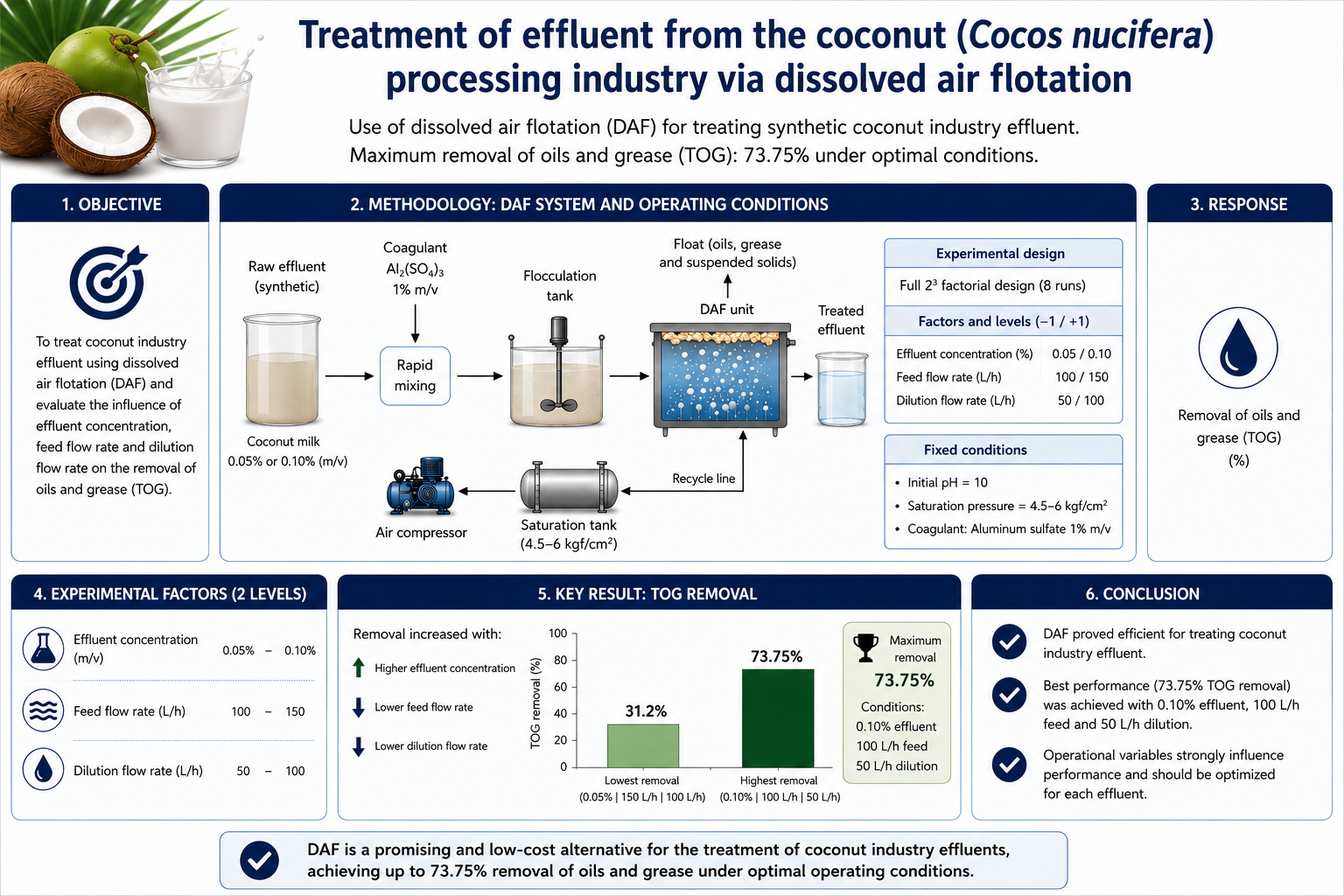
The coconut palm (Cocos nucifera L) is one of the most widespread fruit species worldwide and plays a key role in Brazilian agribusiness, especially in the Northeast, which accounts for over 90% of national production. However, coconut processing generates large volumes of liquid effluents, composed of coconut milk, oil, and mainly washing water, which require proper treatment before disposal. Among the available techniques, dissolved air flotation (DAF) stands out for its efficiency and low operating cost in contaminant removal. This study focused on treating coconut industry effluents using DAF, applying a full 23 experimental design. The evaluated factors were effluent concentration (0.05% and 0.1%), feed flow rate (100 L/h and 150 L/h), and dilution flow rate (50 L/h and 100 L/h), with initial pH fixed at 10 and saturation pressure between 4.5 and 6 kgf/cm². Aluminum sulfate 1% m/v was used as the coagulant. Results showed that oil and grease reduction increased with higher effluent concentration and lower dilution flow rates, reaching up to 73.75% removal under conditions of 0.1% concentration, 150 L/h feed, and 50 L/h dilution.
References
Abuhasel, K., Kchaou, M., Alquraish, M., Munusamy, Y., & Jeng, Y. T. (2021). Oily wastewater treatment: Overview of conventional and modern methods, challenges, and future opportunities. Water, 13(7), 980. https://doi.org/10.3390/w13070980 DOI: https://doi.org/10.3390/w13070980
Adetunji, A. I., & Olaniran, A. O. (2021). Treatment of industrial oily wastewater by advanced technologies: A review. Applied Water Science, 11, 98. https://doi.org/10.1007/s13201-021-01430-4 DOI: https://doi.org/10.1007/s13201-021-01430-4
CBI – Centre for the Promotion of Imports from Developing Countries. (2025). Entering the European market for coconut water. Retrieved May 4, 2026, from https://www.cbi.eu/market-information/processed-fruit-vegetables-edible-nuts/coconut-water/market-entry.
Crespilho, F. N., Santana, C. G., & Rezende, M. O. O. (2004). Tratamento de efluente da indústria de processamento de coco utilizando eletroflotação. Química Nova, 27(3), 387-392. DOI: https://doi.org/10.1590/S0100-40422004000300005
DebMandal, M., & Mandal, S. (2011). Coconut (Cocos nucifera L.: Arecaceae): In health promotion and disease prevention. Asian Pacific Journal of Tropical Medicine, 4(3), 241-247. https://doi.org/10.1016/S1995-7645(11)60078-3 DOI: https://doi.org/10.1016/S1995-7645(11)60078-3
Food and Agriculture Organization of the United Nations (FAO). (2024). FAOSTAT statistical database. Food and Agriculture Organization of the United Nations. https://www.fao.org/faostat/en/#data.
Grand View Research. (2026). Brazil coconut water market size & outlook, 2026–2033. Retrieved May 2, 2026, from https://www.grandviewresearch.com/horizon/outlook/coconut-water-market/brazil.
Musa, M. A., & Idrus, S. (2024). Industrial wastewater treatment technologies: A comprehensive review. Environmental Science and Pollution Research, 31, 34584-34612. https://doi.org/10.1007/s11356-024-34584-0 DOI: https://doi.org/10.1007/s11356-024-34584-0
Muñoz-Alegría, J. A., Muñoz-España, E., & Flórez-Marulanda, J. F. (2021). Dissolved air flotation: A review from the perspective of system parameters and uses in wastewater treatment. Tecnológicas, 24(52), e2111. https://doi.org/10.22430/22565337.2111 DOI: https://doi.org/10.22430/22565337.2111
Plumier, B. M., Garcia, R. A., Renye, J. A., Miller, A. L., & McAnulty, M. J. (2026). Wastewater treatment techniques for application in fat recovery from waste ice cream. Journal of Dairy Science, 109(4), 3544-3555. https://doi.org/10.3168/jds.2025-27619 DOI: https://doi.org/10.3168/jds.2025-27619
Santos, A. M., Gonzaga, D. R. G., Santos, R. B., Soletti, J. I., & Carvalho, S. H. V. (2010). Avaliação de variáveis que influenciam no processo de flotação por ar dissolvido, aplicado ao tratamento de efluente da indústria de laticínios. In: XVIII Congresso Brasileiro de Engenharia Química, 1-8 p, Foz do Iguaçu, PR, Brazil.
Santos, P. R., Sacchi, G. D., Daniel, L. A., & Reali, M. A. P. (2025). Treatment of secondary effluent using dissolved air flotation on a pilot-scale: Assessing operating conditions. Journal of Water Process Engineering, 70, 107033. https://doi.org/10.1016/j.jwpe.2025.107033 DOI: https://doi.org/10.1016/j.jwpe.2025.107033
Silva, S. R. (2009). Tratamento de efluentes de indústria de beneficiamento de coco (Master’s dissertation). Universidade Federal de Alagoas, Maceió, AL, Brazil.
Soletti, J. I., Carvalho, S. H. V., & Fonseca, V. F. (2004). Separação petróleo-água utilizando flotação com ar dissolvido. In: XV Congresso Brasileiro de Engenharia Química, Curitiba, PR, Brazil.
Viana, J. D. R., Alves Filho, E. G., Silva, L. M. A., Ribeiro, P. R. V., Taniguchi, C. A. K., Souza, A. C. R., Abreu, F. A. P., Petrus, J. C. C., & Canuto, K. M. (2026). Evaluation of ceramic and polymeric membranes for crossflow microfiltration of coconut water: Filtration performance and composition of the clarified coconut water. Journal of Food Engineering, 414, 113027. https://doi.org/10.1016/j.jfoodeng.2026.113027 DOI: https://doi.org/10.1016/j.jfoodeng.2026.113027
Downloads
Published
How to Cite
Issue
Section
License
Copyright (c) 2026 Victor Cesar Pugliesi de Sousa, Amanda Santana Peiter, Tiago Marques da Silva, Tiago Lima Alves, José Harlisson de Araújo Ferro, Júlio Inácio Holanda Tavares Neto, Sandra Helena Vieira de Carvalho, João Inácio Soletti

This work is licensed under a Creative Commons Attribution 4.0 International License.
Authors who publish with this journal agree to the following terms:
1) Authors retain copyright and grant the journal right of first publication with the work simultaneously licensed under a Creative Commons Attribution License that allows others to share the work with an acknowledgement of the work's authorship and initial publication in this journal.
2) Authors are able to enter into separate, additional contractual arrangements for the non-exclusive distribution of the journal's published version of the work (e.g., post it to an institutional repository or publish it in a book), with an acknowledgement of its initial publication in this journal.
3) Authors are permitted and encouraged to post their work online (e.g., in institutional repositories or on their website) prior to and during the submission process, as it can lead to productive exchanges, as well as earlier and greater citation of published work.