Integrated application of a commercial biostimulant improves growth, root development, and biomass accumulation in Coffea arabica seedlings
DOI:
https://doi.org/10.14295/bjs.v5i6.872Keywords:
plant growth regulators, inthernursery production, seed treatment, foliar fertilization, root architectureAbstract
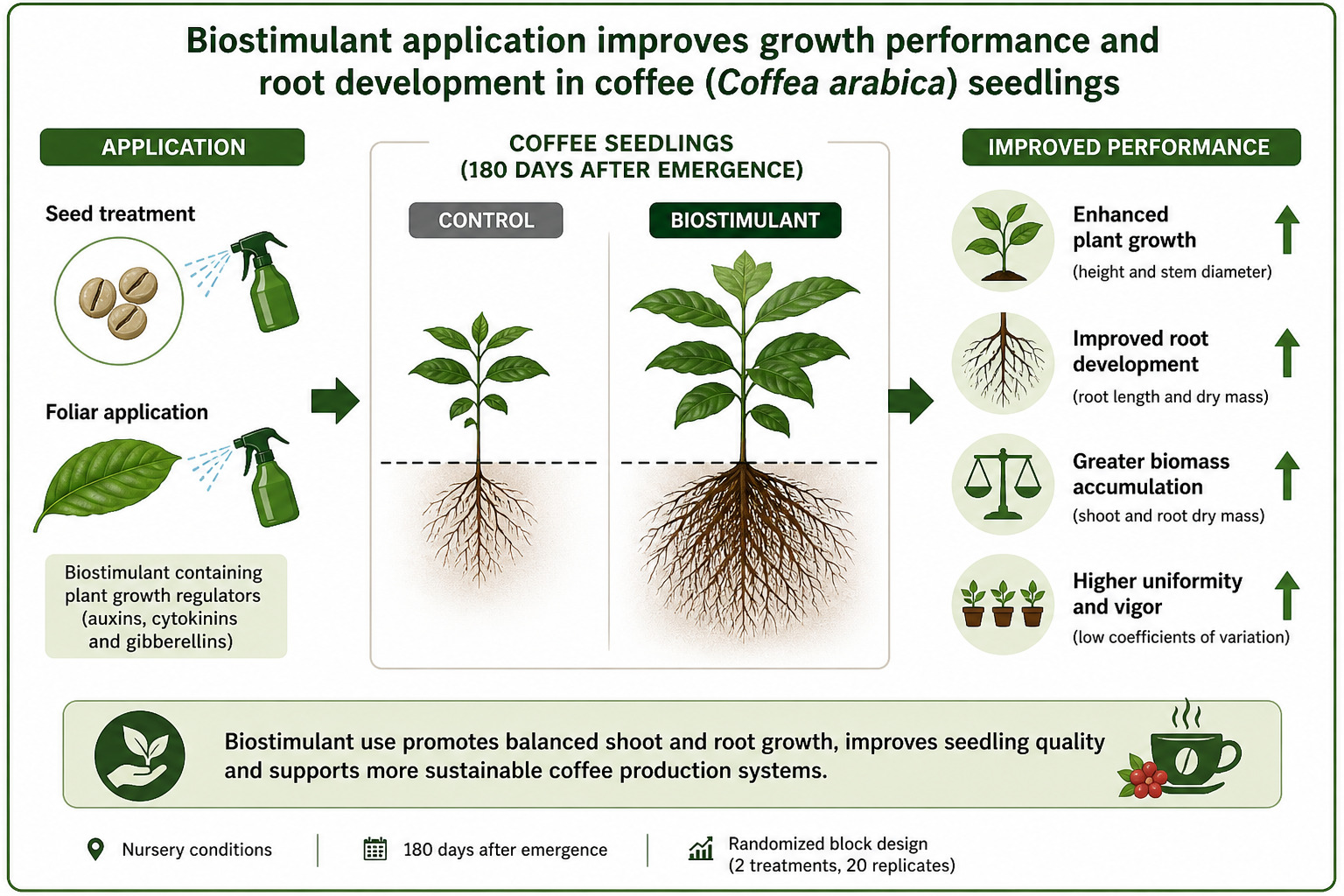
The use of plant biostimulants has emerged as a promising strategy to improve seedling quality and sustainability in coffee production systems. This study evaluated the effects of the integrated application of a commercial biostimulant on the growth and biomass accumulation of Coffea arabica seedlings under nursery conditions. The experiment was conducted in a randomized complete block design with two treatments, control and biostimulant application, and twenty replications. The commercial product Enervig Leg® was applied during seed treatment (6 mL kg-1 of seeds) and by foliar spraying (150 mL per 200 L of water) during the early vegetative stage. Growth and biomass variables were evaluated at 180 days after emergence. Biostimulant-treated seedlings showed significant increases in plant height, stem diameter, shoot dry mass, and root dry mass compared to the control treatment. Shoot dry mass increased by 37.7%, while root dry mass increased by 104.5% in treated plants. The treatment also promoted greater root system development and more balanced biomass allocation between shoot and root components. The low coefficients of variation observed for all variables indicated high experimental precision and uniformity of responses under nursery conditions. The results demonstrate that the integrated use of plant biostimulants can improve seedling vigor and structural development in Coffea arabica, representing a promising strategy to optimize nursery management and support sustainable coffee production systems.
References
Backer, R., Rokem, J. S., Ilangumaran, G., Lamont, J., Praslickova, D., Ricci, E., Subramanian, S., & Smith, D. L. (2018). Plant growth-promoting rhizobacteria: Context, mechanisms of action, and roadmap to commercialization of biostimulants for sustainable agriculture. Frontiers in Plant Science, 9, 1473. https://doi.org/10.3389/fpls.2018.01473 DOI: https://doi.org/10.3389/fpls.2018.01473
Bergo, C. L., Sá, C. P., & Sales, F. (2002). Produção de mudas de cafeeiros por sementes e estacas. Rio Branco: Embrapa Acre.
DaMatta, F. M., Ronchi, C. P., Maestri, M., & Barros, R. S. (2007). Ecophysiology of coffee growth and production. Brazilian Journal of Plant Physiology, 19(4), 485-510. https://doi.org/10.1590/S1677-04202007000400014 DOI: https://doi.org/10.1590/S1677-04202007000400014
Davies, P. J. (2010). Plant hormones: Biosynthesis, signal transduction, action! (3rd ed.). Dordrecht: Springer. https://doi.org/10.1007/978-1-4020-2686-7 DOI: https://doi.org/10.1007/978-1-4020-2686-7
Davis, A. P., Gole, T. W., Baena, S., & Moat, J. (2012). The impact of climate change on indigenous Arabica coffee (Coffea arabica): Predicting future trends and identifying priorities. PLoS ONE, 7(11), e47981. https://doi.org/10.1371/journal.pone.0047981 DOI: https://doi.org/10.1371/journal.pone.0047981
du Jardin, P. (2015). Plant biostimulants: Definition, concept, main categories and regulation. Scientia Horticulturae, 196, 3-14. https://doi.org/10.1016/j.scienta.2015.09.021 DOI: https://doi.org/10.1016/j.scienta.2015.09.021
Ferreira, D. F. (2011). Sisvar: A computer statistical analysis system. Ciência e Agrotecnologia, 35(6), 1039–1042. https://doi.org/10.1590/S1413-70542011000600001 DOI: https://doi.org/10.1590/S1413-70542011000600001
Klahold, C. A., Guimarães, V. F., Echer, M. M., Klahold, A., Robinson, L. C., & Becker, A. (2006). Resposta da soja (Glycine max L. Merrill) à ação de bioestimulante. Acta Scientiarum Agronomy, 28(2), 179-185. DOI: https://doi.org/10.4025/actasciagron.v28i2.1032
Marschner, P. (2012). Marschner’s mineral nutrition of higher plants (3rd ed.). London: Academic Press. https://doi.org/10.1016/C2009-0-63043-9 DOI: https://doi.org/10.1016/C2009-0-63043-9
Medina, A. D., González, A. C., & Pérez, C. S. (2023). Effect of bioproducts on the development of coffee seedlings in the inthenursery. Revista Mexicana de Ciencias Agrícolas, 14(4), 495-507. https://doi.org/10.29312/remexca.v14i4.3303 DOI: https://doi.org/10.29312/remexca.v14i4.3303
Nephali, L., Piater, L., Dubery, I., & Tugizimana, F. (2024). Next generation plant biostimulants & genome sequencing strategies for sustainable agriculture. Frontiers in Microbiology, 15, 1439561. https://doi.org/10.3389/fmicb.2024.1439561 DOI: https://doi.org/10.3389/fmicb.2024.1439561
Rouphael, Y., & Colla, G. (2020). Biostimulants in agriculture. Frontiers in Plant Science, 11, 40. https://doi.org/10.3389/fpls.2020.00040 DOI: https://doi.org/10.3389/fpls.2020.00040
Souza, L. A., Andrade, F. M., Penido, E. S., & Peñaflor, M. F. G. V. (2025). Humic substance-based formulation in coffee seedlings: Enhanced plant growth and resistance to coffee leaf miner. International Journal of Tropical Insect Science, 45, 2707-2714. https://doi.org/10.1007/s42690-025-01618-0 DOI: https://doi.org/10.1007/s42690-025-01618-0
Taiz, L., Zeiger, E., Møller, I. M., & Murphy, A. (2017). Plant physiology and development (6th ed.). Sunderland: Sinauer Associates.
Wazeer, H., Gaonkar, S. S., Doria, E., Pagano, A., Balestrazzi, A., & Macovei, A. (2024). Plant-based biostimulants for seeds in the context of circular economy and sustainability. Plants, 13(7), 1004. https://doi.org/10.3390/plants13071004 DOI: https://doi.org/10.3390/plants13071004
Downloads
Published
How to Cite
Issue
Section
License
Copyright (c) 2026 Elias Rodrigues Cunha, Edimar Agnaldo Moreira

This work is licensed under a Creative Commons Attribution 4.0 International License.
Authors who publish with this journal agree to the following terms:
1) Authors retain copyright and grant the journal right of first publication with the work simultaneously licensed under a Creative Commons Attribution License that allows others to share the work with an acknowledgement of the work's authorship and initial publication in this journal.
2) Authors are able to enter into separate, additional contractual arrangements for the non-exclusive distribution of the journal's published version of the work (e.g., post it to an institutional repository or publish it in a book), with an acknowledgement of its initial publication in this journal.
3) Authors are permitted and encouraged to post their work online (e.g., in institutional repositories or on their website) prior to and during the submission process, as it can lead to productive exchanges, as well as earlier and greater citation of published work.