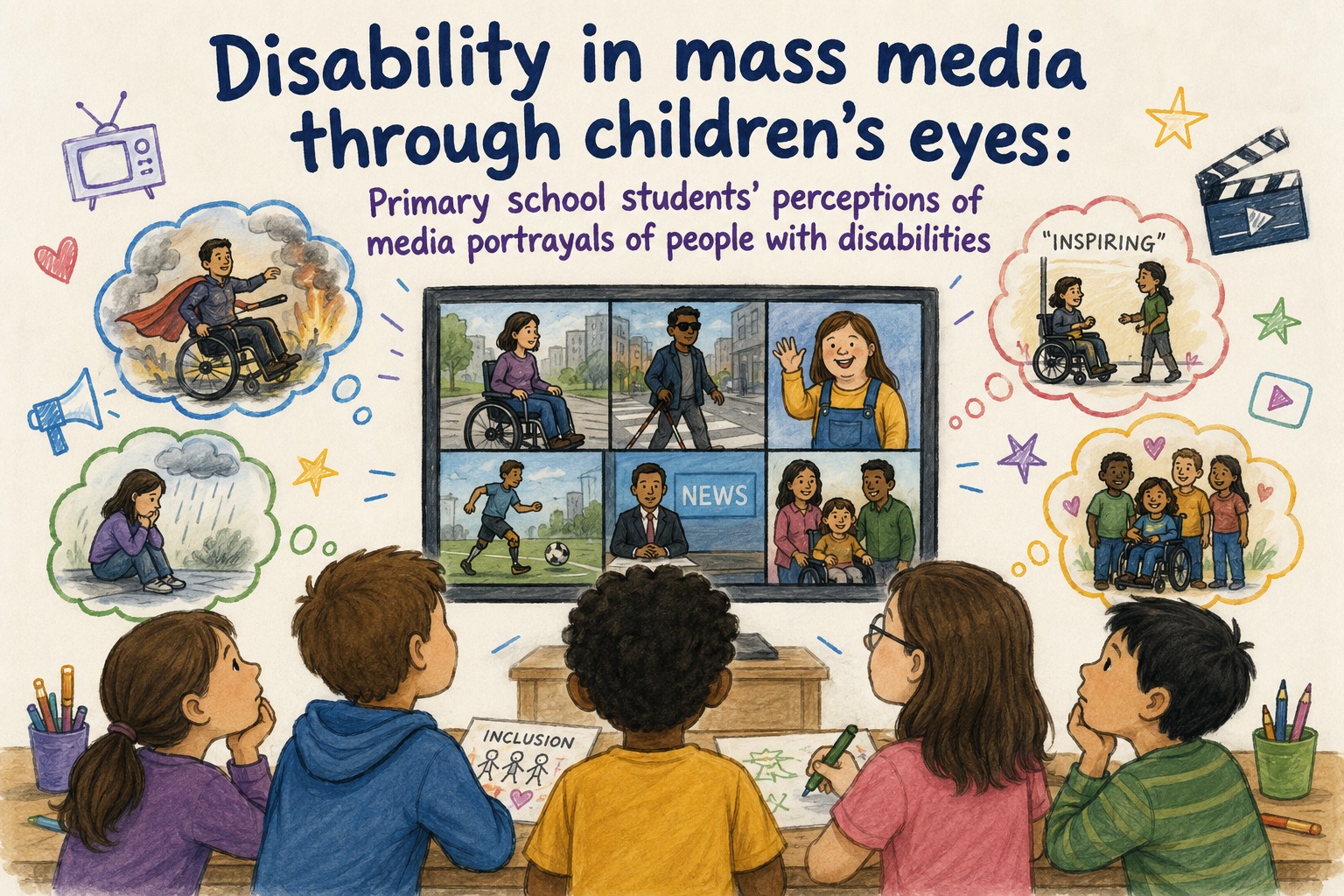
Disability in mass media through children’s eyes: Primary school students’ perceptions of media portrayals of people with disabilities
DOI:
https://doi.org/10.14295/bjs.v5i6.869Keywords:
disability, media, children, representation, media literacyAbstract
Media representations of people with disabilities often rely on simplified or stereotypical narratives that do not reflect everyday social realities. Such portrayals may reinforce pity-based or charitable perspectives and contribute to the persistence of social distance and misunderstanding. Against this background, the present study explores how primary school students perceive the way disability is presented in mass media. A pilot study was conducted between October and December 2025 with 154 sixth-grade students attending primary schools in the region of Attica, Greece. Data were collected through a structured questionnaire adapted for children aged 11–12 years. The study examined students’ interest in disability-related information, the media sources through which they are informed, their emotional responses to disability-related media content, and their evaluation of media attitudes toward people with disabilities. Findings indicate that the majority of students express a clear interest in being informed about disability-related issues. Television remains the primary source of information, while digital media and social networking platforms are also frequently reported. Students largely perceive media portrayals of people with disabilities as characterized by pity, yet they strongly believe that accurate and objective media coverage could substantially improve their own attitudes and behaviors toward people with disabilities.
References
Barton, L. (1996). Sociology and disability: Emerging issues. Longman.
Carmel, J.-M., Chapman, S., & Wright, P. (2024). Seeing disability in children’s made for television programmes: An Australian case study. Children & Society, 38(6), 2036-2051. https://doi.org/10.1111/chso.12866 DOI: https://doi.org/10.1111/chso.12866
Cocq, C., & Ljuslinder, K. (2020). Self-representations on social media: Reproducing and challenging discourses on disability. Alter, 14(2), 71-84. https://doi.org/10.1016/j.alter.2020.02.001 DOI: https://doi.org/10.1016/j.alter.2020.02.001
Ellis, K., & Kent, M. (2017). Disability and social media: Global perspectives. Routledge. DOI: https://doi.org/10.4324/9781315577357
Goffman, E. (2001). Stigma: Notes on the management of spoiled identity. Alexandria.
Goodley, D. (2017). Disability studies: An interdisciplinary introduction (2nd ed.). Sage.
Krämer, B., & Conrad, J. (2017). Social ontologies online: The representation of social structures on the Internet. Social Media + Society, 3(1), 1-11. https://doi.org/10.1177/2056305117693648 DOI: https://doi.org/10.1177/2056305117693648
Lemish, D. (2009). Children and television: A global perspective. Topos.
McNally, A., Jackson, J., & Ellis, K. (2024). Disability expertise on TikTok: Platformed visibility and self-representation in digital culture. Social Media + Society, 10(3). https://doi.org/10.1177/20563051241279549 DOI: https://doi.org/10.1177/20563051241279549
Shakespeare, T., & Watson, N. (1997). Defending the social model. Disability & Society, 12(2), 293-300. https://doi.org/10.1080/09687599727380 DOI: https://doi.org/10.1080/09687599727380
Sousa, C. (2022). Mapping the inclusion of children and youth with disabilities in media literacy research. Media and Communication, 10(4), 400-410. https://doi.org/10.17645/mac.v10i4.5769 DOI: https://doi.org/10.17645/mac.v10i4.5769
Tregaskis, C. (2002). Social model theory: The story so far. Disability & Society, 17(4), 457-470. https://doi.org/10.1080/09687590220140377 DOI: https://doi.org/10.1080/09687590220140377
World Health Organization. (2022). Global report on health equity for persons with disabilities. WHO.
Downloads
Published
How to Cite
Issue
Section
License
Copyright (c) 2026 Stefanos Loukeris

This work is licensed under a Creative Commons Attribution 4.0 International License.
Authors who publish with this journal agree to the following terms:
1) Authors retain copyright and grant the journal right of first publication with the work simultaneously licensed under a Creative Commons Attribution License that allows others to share the work with an acknowledgement of the work's authorship and initial publication in this journal.
2) Authors are able to enter into separate, additional contractual arrangements for the non-exclusive distribution of the journal's published version of the work (e.g., post it to an institutional repository or publish it in a book), with an acknowledgement of its initial publication in this journal.
3) Authors are permitted and encouraged to post their work online (e.g., in institutional repositories or on their website) prior to and during the submission process, as it can lead to productive exchanges, as well as earlier and greater citation of published work.