The effect of WhatsApp-based leadership communication on neighborhood security
DOI:
https://doi.org/10.14295/bjs.v5i6.865Keywords:
leadership communication, perceived neighborhood security, WhatsApp, digital communication, local leadershipAbstract
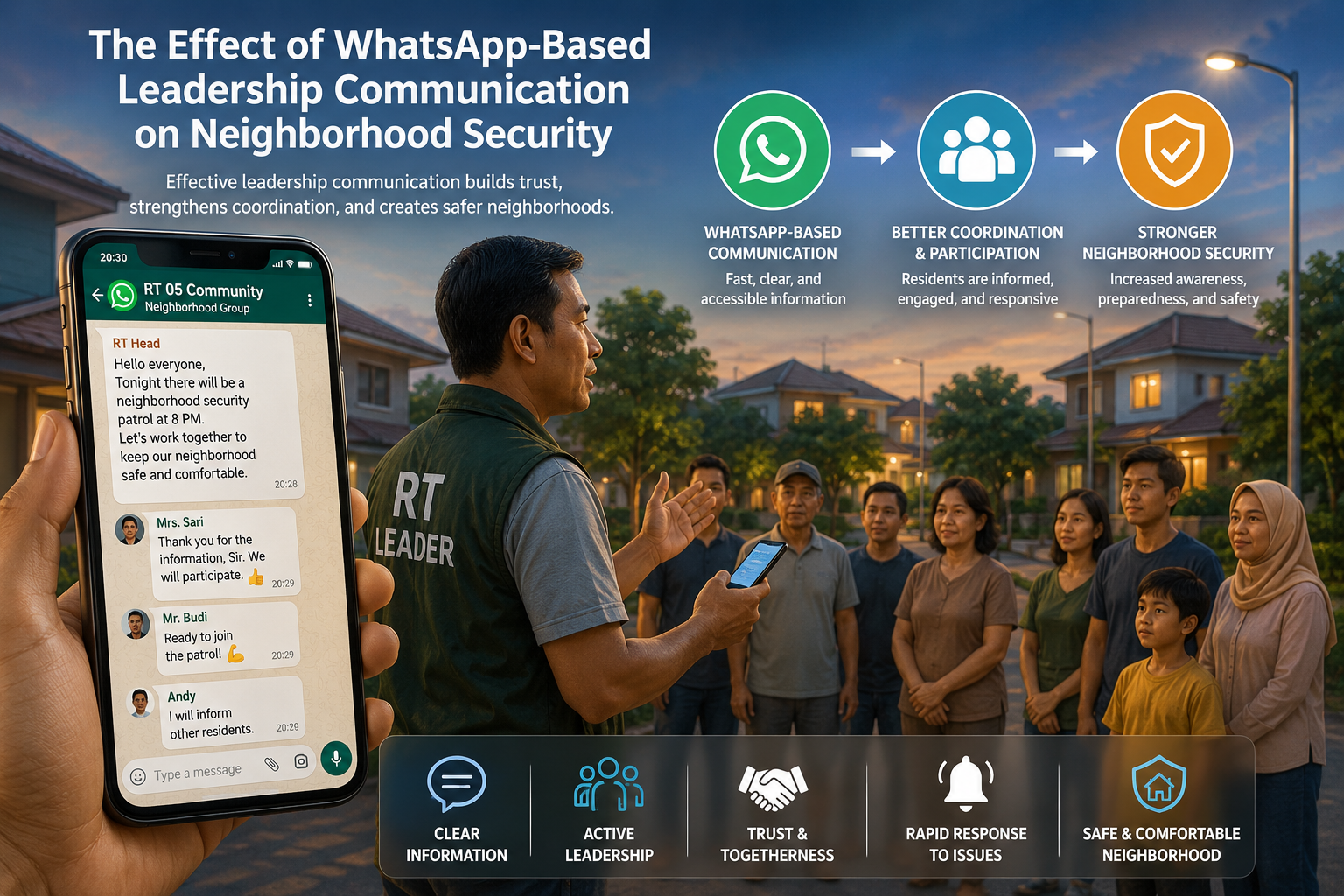
This study examines the relationship between WhatsApp-based leadership communication and perceptions of neighborhood safety. This study used a cross-sectoral exploratory quantitative survey of 92 residents of Bojong Lio Village, Cilodong District, Depok City, Indonesia, who are members of a neighborhood WhatsApp group. Respondents were selected using purposive sampling based on their participation in neighborhood-level WhatsApp communication. Data were collected through a structured questionnaire using a five-point Likert scale and analyzed using descriptive statistics and simple linear regression. The results showed a positive and statistically significant relationship between leadership communication and perceptions of neighborhood safety. A correlation coefficient of 0.750 indicates a strong relationship, while a coefficient of determination of 0.562 indicates that 56.2% of the variation in neighborhood safety perceptions can be statistically explained by leadership communication. The regression equation is Y = 11.192 + 0.354X, indicating that higher-quality leadership communication is associated with higher perceptions of neighborhood safety. Descriptive findings also revealed that clarity of information, leader activeness, understandable language, coordination skills, and clear directions were the most prominent aspects of communication. In terms of security, the highest-ranking indicators included residents' response to disturbances, sense of security, rapid dissemination of security information, and cooperation among residents. These findings suggest that WhatsApp-based leadership communication can support neighborhood coordination and perceived preparedness, although the cross-sectional study design limits causal conclusions.
References
Abuowda, A., Iwidat, H., & Alawnah, M. (2024). Impact of e-leadership on organizational citizenship behaviour of faculty members in higher education: Information and communication technology as a mediator. Discover Education, 3, 48. https://doi.org/10.1007/s44217-024-00133-7 DOI: https://doi.org/10.1007/s44217-024-00133-7
Ahmed, S. K. (2024). How to choose a sampling technique and determine sample size for research: A simplified guide for researchers. Oral Oncology Reports, 12, 100662. https://doi.org/10.1016/j.oor.2024.100662 DOI: https://doi.org/10.1016/j.oor.2024.100662
Alkhayyal, S., & Bajaba, S. (2023). The impact of e-leadership competencies on workplace well-being and job performance: The mediating role of e-work self-efficacy. Sustainability, 15(6), 4724. https://doi.org/10.3390/su15064724 DOI: https://doi.org/10.3390/su15064724
Alvarado Vazquez, S., Madureira, A. M., Ostermann, F. O., & Pfeffer, K. (2023). The use of ICTs to support social participation in the planning, design and maintenance of public spaces in Latin America. ISPRS International Journal of Geo-Information, 12(6), 237. https://doi.org/10.3390/ijgi12060237 DOI: https://doi.org/10.3390/ijgi12060237
Badrinarayanan, V. (2024). Trust building strategies for virtual leaders in the post pandemic era. Project Leadership and Society, 5, 100126. https://doi.org/10.1016/j.plas.2024.100126 DOI: https://doi.org/10.1016/j.plas.2024.100126
Bellis, P., Cunial, M., & Trabucchi, D. (2024). Mastering hybrid worlds through digital leadership: The role of agility in fostering innovation. Business Horizons, 67(4), 369-380. https://doi.org/10.1016/j.bushor.2024.04.002 DOI: https://doi.org/10.1016/j.bushor.2024.04.002
Berg, S., & Hofmann, J. (2021). Digital democracy. Internet Policy Review, 10(4), 1-23. https://doi.org/10.14763/2021.4.1612 DOI: https://doi.org/10.14763/2021.4.1612
Bonati, S., Nardini, O., Boersma, K., & Clark, N. (2023). Unravelling dynamics of vulnerability and social media use on displaced minors in the aftermath of Italian earthquakes. International Journal of Disaster Risk Reduction, 89, 103632. https://doi.org/10.1016/j.ijdrr.2023.103632 DOI: https://doi.org/10.1016/j.ijdrr.2023.103632
Bulat, B. (2025). Governance dynamics in online communities: Autonomy, control, and sense of virtual community. New Media & Society. Advance online publication. https://doi.org/10.1177/14614448251336440 DOI: https://doi.org/10.1177/14614448251336440
Cardullo, P., & Kitchin, R. (2025). Provincialising platform citizenship: Citizen participation in and through civic platforms. Digital Geography and Society, 8, 100123. https://doi.org/10.1016/j.diggeo.2025.100123 DOI: https://doi.org/10.1016/j.diggeo.2025.100123
Dzordzormenyoh, M. K. (2025). Residential types, neighborhood security and public trust in Ghana police service: A comprehensive analysis. Policing: An International Journal, 48(2), 284-302. https://doi.org/10.1108/PIJPSM-08-2024-0139 DOI: https://doi.org/10.1108/PIJPSM-08-2024-0139
Ferrando, P. J., Morales-Vives, F., Casas, J. M., & Muñiz, J. (2025). Likert scales: A practical guide to design, construction and use. Psicothema, 37(4), 1-15. https://doi.org/10.70478/psicothema.2025.37.24 DOI: https://doi.org/10.70478/psicothema.2025.37.24
Frischlich, L., Klapproth, J., Frank, S., Heckmann, M., Kunze, S. E., & Murgas, T. (2024). Fighting fakes on WhatsApp—Audience perspectives on fact bots as countermeasures. Digital Journalism, 12(5), 700-720. https://doi.org/10.1080/21670811.2024.2341299 DOI: https://doi.org/10.1080/21670811.2024.2341299
Gershon-Coneal, O., Eizenberg, E., & Jabareen, Y. (2024). The digital power of the tower: Digital communication technologies and dwelling experience in residential large urban developments. Journal of Housing and the Built Environment, 39(2), 1-18. https://doi.org/10.1007/s10901-024-10113-w DOI: https://doi.org/10.1007/s10901-024-10113-w
Hatuka, T., & Elhanan, G. (2026). Digitization processes at the neighborhood scale: Infrastructure, governance, community, and practices. Planning Theory, 25(1), 75-97. https://doi.org/10.1177/14730952241263863 DOI: https://doi.org/10.1177/14730952241263863
Heywood, E., Ivey, B., & Meuter, S. (2024). Reaching hard-to-reach communities: Using WhatsApp to give conflict-affected audiences a voice. International Journal of Social Research Methodology, 27(1), 107-121. https://doi.org/10.1080/13645579.2022.2117451 DOI: https://doi.org/10.1080/13645579.2022.2117451
Huang, H., & Wang, Q. (2024). Within digital collaborative teams, how can leaders promote productive knowledge sharing among members with diverse settings? Digital Economy and Sustainable Development, 2(1), 2. https://doi.org/10.1007/s44265-023-00027-w DOI: https://doi.org/10.1007/s44265-023-00027-w
Jailobaev, T., Jailobaeva, K., Baialieva, M., Baialieva, G., & Asilbekova, G. (2021). WhatsApp groups in social research: New opportunities for fieldwork communication and management. Bulletin of Sociological Methodology/Bulletin de Méthodologie Sociologique, 149(1), 60-82. https://doi.org/10.1177/0759106320978337 DOI: https://doi.org/10.1177/0759106320978337
Kim, S., Lee, J., & Cho, W. (2022). Do transparency and ICT improve citizens’ trust in local governments? Evidence from South Korean municipalities. Public Performance & Management Review, 45(6), 1397-1423. https://doi.org/10.1080/15309576.2021.2010423
Kummitha, R. K. R. (2025). Smart city governance: Assessing modes of active citizen engagement. Regional Studies, 59(1), 1-15. https://doi.org/10.1080/00343404.2024.2399262 DOI: https://doi.org/10.1080/00343404.2024.2399262
Lam, N. S. N., Meyer, M., Reams, M., Li, K., Yang, X., Liu, S. B., Mickelson, K., Scheuer, M., New, A., & Maldonado, A. (2023). Improving social media use for disaster resilience: Challenges and strategies. International Journal of Digital Earth, 16(1), 3023-3044. https://doi.org/10.1080/17538947.2023.2239768 DOI: https://doi.org/10.1080/17538947.2023.2239768
Lee-Geiller, S. (2024). The moderating effect of digital literacy on the link between e-government effectiveness and trust in government. Journal of Policy Studies, 39(4), 77-101. https://doi.org/10.52372/jps.e672 DOI: https://doi.org/10.52372/jps.e672
López-Figueroa, J. C., Ochoa-Jiménez, S., Palafox-Soto, M. O., & Hernández-Muñoz, D. S. (2025). Digital leadership: A systematic literature review. Administrative Sciences, 15(4), 129. https://doi.org/10.3390/admsci15040129 DOI: https://doi.org/10.3390/admsci15040129
Lu, H., Lin, Y., Liu, Z., & Kleinhans, R. (2025). To participate online or onsite? Public preferences for participating in neighborhood regeneration planning in China. Planning Practice & Research. Advance Online Publication. https://doi.org/10.1080/02697459.2025.2589895 DOI: https://doi.org/10.1080/02697459.2025.2589895
McDermott, R., Sagala, S., Susetyo, N. A., Insan, A., Harahap, W. D. P., Indrarini, A., & Azhari, D. (2025). The role of digital participation platforms in risk-informed development: A case study of Surabaya, Indonesia. Progress in Disaster Science, 26, 100430. https://doi.org/10.1016/j.pdisas.2025.100430 DOI: https://doi.org/10.1016/j.pdisas.2025.100430
Neiroukh, N., Ansari, A. A., Dalu, R. A., Khlaif, E., Barahmaeh, D., Zubeidi, J., Shtayeh, B., & Daher, W. (2024). Organizational communication competence of public secondary school principals through utilizing WhatsApp. Frontiers in Education, 9, 1374279. https://doi.org/10.3389/feduc.2024.1374279 DOI: https://doi.org/10.3389/feduc.2024.1374279
Ooko, G. A. (2023). In pursuit of a “safe” space for political participation: A study of selected WhatsApp communities in Kenya. Journalism and Media, 4(2), 506-529. https://doi.org/10.3390/journalmedia4020032 DOI: https://doi.org/10.3390/journalmedia4020032
Pimmer, C., Brühlmann, F., Odetola, T. D., Dipeolu, O., Oluwasola, D. O., Jäger, J., & Ajuwon, A. J. (2021). WhatsApp for mobile learning. Effects on knowledge, resilience and isolation in the school-to-work transition. The Internet and Higher Education, 49, 100809. https://doi.org/10.1016/j.iheduc.2021.100809 DOI: https://doi.org/10.1016/j.iheduc.2021.100809
Rizal, E., Winoto, Y., Sugito, T., Nugroho, C., & Septian, F. I. (2025). Disaster communication in the digital age: A community-based case study of media, education, and local knowledge in Pangandaran, Indonesia. Frontiers in Communication, 10, 1632436. https://doi.org/10.3389/fcomm.2025.1632436 DOI: https://doi.org/10.3389/fcomm.2025.1632436
Robaeyst, B., Baccarne, B., De Meulenaere, J., & Mechant, P. (2022). Online neighborhood networks: The relationship between online communication practices and neighborhood dynamics. Media and Communication, 10(2), 108-118. https://doi.org/10.17645/mac.v10i2.5129 DOI: https://doi.org/10.17645/mac.v10i2.5129
Samiee, M., Heggart, K., Birch, P., & Wallace, H. (2025). Digital neighbourhood moderation: Online community safety and the role of Facebook group moderators in Queensland, Australia. Journal of Criminological Research, Policy and Practice, 11(4), 377-399. https://doi.org/10.1108/JCRPP-05-2025-0034 DOI: https://doi.org/10.1108/JCRPP-05-2025-0034
Shin, B., Floch, J., Rask, M., Bæck, P., Edgar, C., Berditchevskaia, A., Mesure, P., & Branlat, M. (2024). A systematic analysis of digital tools for citizen participation. Government Information Quarterly, 41(3), 101954. https://doi.org/10.1016/j.giq.2024.101954 DOI: https://doi.org/10.1016/j.giq.2024.101954
Tigre, F. B., Henriques, P. L., & Curado, C. (2025). The digital leadership emerging construct: A multi-method approach. Management Review Quarterly, 75(1), 789-836. https://doi.org/10.1007/s11301-023-00395-9 DOI: https://doi.org/10.1007/s11301-023-00395-9
Townley, C., & Koop, C. (2024). Exploring the potential and limits of digital tools for inclusive regulatory engagement with citizens. Government Information Quarterly, 41(1), 101901. https://doi.org/10.1016/j.giq.2023.101901 DOI: https://doi.org/10.1016/j.giq.2023.101901
Traeger-Soudry, S., Rosenberg, H., Sabag-Ben Porat, C., & Lowenstein-Barkai, H. (2025). Navigating parental engagement in WhatsApp groups: A study of parent-teacher experiences. Teaching and Teacher Education, 162, 105074. https://doi.org/10.1016/j.tate.2025.105074 DOI: https://doi.org/10.1016/j.tate.2025.105074
Xu, X., & Dai, M. (2024). Evaluation of local government digital governance ability and sustainable development: A case study of Hunan Province. Sustainability, 16(14), 6084. https://doi.org/10.3390/su16146084 DOI: https://doi.org/10.3390/su16146084
Zhao, B., Cheng, S., Schiff, K. J., & Kim, Y. (2023). Digital transparency and citizen participation: Evidence from the online crowdsourcing platform of the City of Sacramento. Government Information Quarterly, 40(4), 101868. https://doi.org/10.1016/j.giq.2023.101868 DOI: https://doi.org/10.1016/j.giq.2023.101868
Zhao, G., Zhao, F., Hui, X., Wu, Y., & Zhao, X. (2025). How digital leadership impacts community resilience: A moderated mediation model. Frontiers in Public Health, 13, 1524985. https://doi.org/10.3389/fpubh.2025.1524985 DOI: https://doi.org/10.3389/fpubh.2025.1524985
Zhao, S. Z., Luk, T. T., Guo, N., Wang, M. P., Lai, A. Y. K., Wong, B. Y. M., Fong, D. Y. T., Chan, S. S. C., & Lam, T. H. (2021). Association of mobile instant messaging chat group participation with family functioning and well-being: Population-based cross-sectional study. Journal of Medical Internet Research, 23(3), e18876. https://doi.org/10.2196/18876 DOI: https://doi.org/10.2196/18876
Downloads
Published
How to Cite
Issue
Section
License
Copyright (c) 2026 Nelson Avdisius Nengo, Mustofa Abdul Azis, Veranus Sidharta, Anisti

This work is licensed under a Creative Commons Attribution 4.0 International License.
Authors who publish with this journal agree to the following terms:
1) Authors retain copyright and grant the journal right of first publication with the work simultaneously licensed under a Creative Commons Attribution License that allows others to share the work with an acknowledgement of the work's authorship and initial publication in this journal.
2) Authors are able to enter into separate, additional contractual arrangements for the non-exclusive distribution of the journal's published version of the work (e.g., post it to an institutional repository or publish it in a book), with an acknowledgement of its initial publication in this journal.
3) Authors are permitted and encouraged to post their work online (e.g., in institutional repositories or on their website) prior to and during the submission process, as it can lead to productive exchanges, as well as earlier and greater citation of published work.