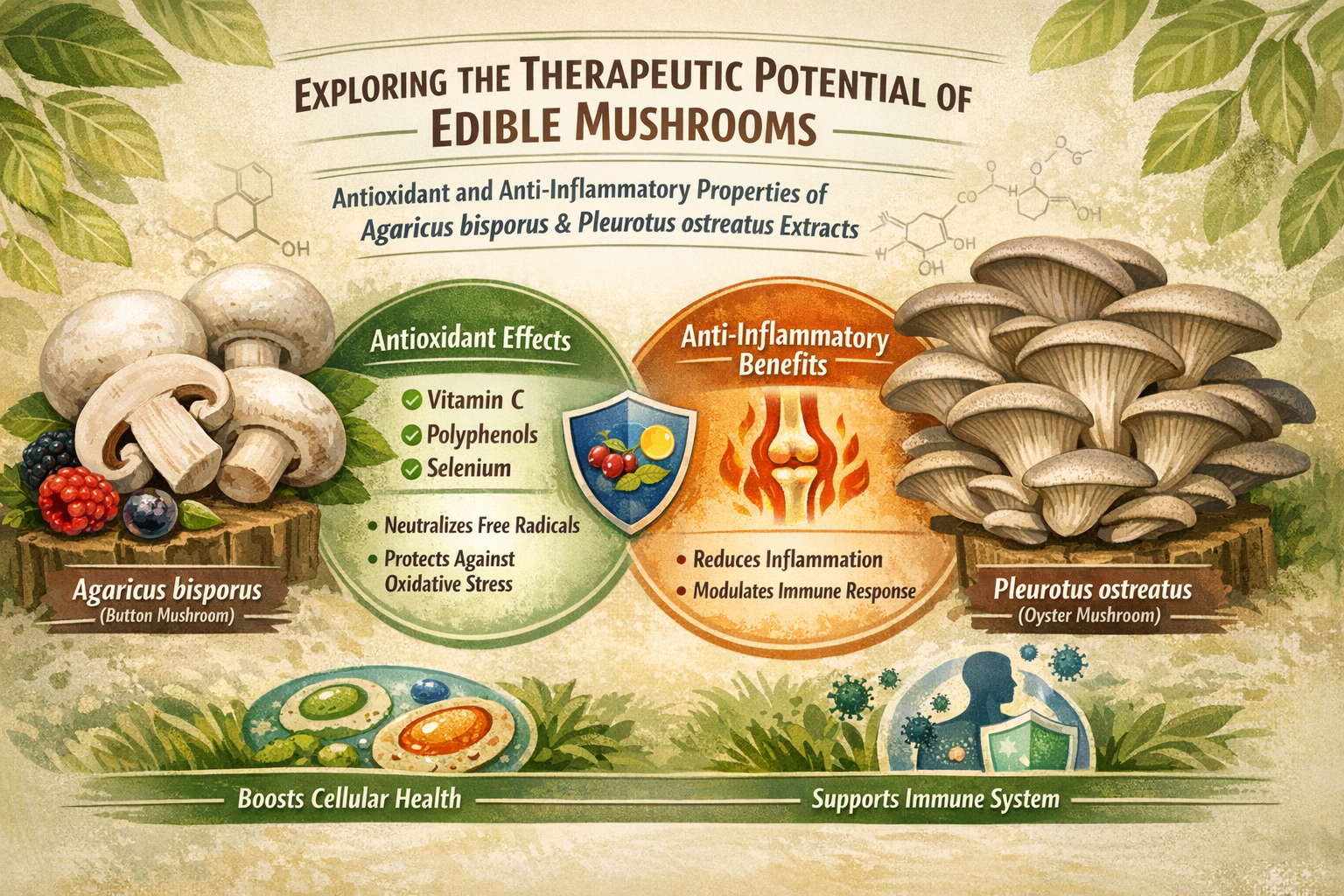
Exploring the therapeutic potential of edible mushrooms: antioxidant and anti-inflammatory properties of Agaricus bisporus and Pleurotus ostreatus extracts
DOI:
https://doi.org/10.14295/bjs.v5i1.826Keywords:
Agaricus genus, button mushroom, edible mushrooms, Pleurotus genus, protein extractionAbstract
This study comparatively analyzed the protein profiles, antioxidant potential, and anti-inflammatory activities of Agaricus bisporus (button mushroom) and Pleurotus ostreatus (oyster mushroom). Proteins were extracted, purified via ammonium sulfate precipitation and dialysis, and quantified using the Lowry assay. SDS-PAGE analysis revealed distinct protein bands, particularly in the 11-17 kDa range, within fractions exhibiting the most promising bioactivities. Both mushroom species demonstrated significant total antioxidant capacity (TAC) via the phosphomolybdate assay, with notably high values observed in the P. ostreatus 30% (1.52 mg mL AAE-1), P. ostreatus 70% (0.85 mg mL AAE), and A. bisporus 70% (1.6 mg mL AAE-1) precipitation fractions, as well as crude extracts. For anti-inflammatory activity, evaluated by red blood cell (RBC) hemolysis inhibition, all extracts and fractions showed anti-hemolytic effects. The P. ostreatus 70% (72.15% inhibition), P. ostreatus 30% (69.62% inhibition), and A. bisporus 70% (68.35% inhibition) precipitation fractions displayed the highest efficacy. While oyster mushroom crude extract yielded a higher protein concentration (9.516 mg mL-1) than A. bisporus mushroom (6.516 mg mL-1), the study's focus remained on the functional activities of specific fractions. This research underscores the significant potential of both A. bisporus and P. ostreatus as natural sources of antioxidants and anti-inflammatory agents. The strong correlation between these high bioactivities and the presence of specific protein bands, particularly in the 11-17 kDa range within the most active fractions, emphasizes the crucial role of their protein components. Further investigation is warranted to isolate, characterize, and elucidate the mechanisms of action of these specific bioactive proteins for potential applications in functional foods, nutraceuticals, and pharmaceuticals.
References
Andrew, S. M., Titus, J. A., & Zumstein, L. (2001). Dialysis and concentration of protein solutions. Current Protocols in Toxicology, 10, A-3H. https://doi.org/10.1002/0471140856.txa03hs10 DOI: https://doi.org/10.1002/0471140856.txa03hs10
Araújo, P. L., Araújo, E. S., Barreto, E. M. A., Alves, J. L. B., Souza, K. M., Freire, M. P. L., & Souza, R. M. P. (2025). Pleurotus mushrooms in nutrition and health: Clinical and preclinical insights for nutraceutical development. Comprehensive Reviews in Food Science and Food Safety, 24(5), e70279. https://doi.org/10.1111/1541-4337.70279 DOI: https://doi.org/10.1111/1541-4337.70279
Assemie, A., & Abaya, G. (2022). The effect of edible mushroom on health and their biochemistry. International Journal of Microbiology, 1. https://doi.org/10.1155/2022/8744788 DOI: https://doi.org/10.1155/2022/8744788
Bai, Y., Liang, F., Yang, Y., Guan, L., & Ma, H. (2025). Polysaccharides from edible fungi spent mushroom substrates: A review of their extraction, purification, structural characteristics, and biological activities. International Journal of Biological Macromolecules, 330(1), 147925. https://doi.org/10.1016/j.ijbiomac.2025.147925 DOI: https://doi.org/10.1016/j.ijbiomac.2025.147925
Cheung, P. C. K. (2008). Mushrooms as Functional Foods. Wiley, A John Wiley & Sons, INC., Publication, 227 p. DOI: https://doi.org/10.1002/9780470367285
Deepalakshmi, K., & Sankaran, M. (2014). Pleurotus ostreatus: an oyster mushroom with nutritional and medicinal properties. Journal of Biochemical Technology, 5(2), 718-726.
El-Maradny, Y. A., Abouakkada, A. S., Abbass, A. A. G., Abaza, A. F., & El-Fakharany, E. M. (2025). Prebiotic properties and antioxidant effect of crude extracts and polysaccharides from Agaricus bisporus and Pleurotus ostreatus mushrooms. Scientific Reports, 15. https://doi.org/10.1038/s41598-025-16152-9 DOI: https://doi.org/10.1038/s41598-025-16152-9
Goyal, R. K., & Grewal, R. B. (2024). Effect of feeding Agaricus bisporus (white button) mushroom on serum and liver cholesterol and excretion of cholesterol and bile acids in rats. Journal of Scientific Research, 16(2), 579-587. https://doi.org/10.3329/jsr.v16i2.70098 DOI: https://doi.org/10.3329/jsr.v16i2.70098
Ionescu, M., Dincă, M-N., Ferdes, M., Zăbavă, B-Ș., Paraschiv, G., & Moiceanu, G. (2025). Proteins from edible mushrooms: Nutritional role and contribution to well-being. Foods, 14(18), 3201. https://doi.org/10.3390/foods14183201 DOI: https://doi.org/10.3390/foods14183201
Irfan, F. H., Shafiq, S. A., Afroz, S., Saleem, A., & Ammar, M. (2022). Medicinal importance of Pleurotus species (Oyster Mushroom): A review. Interdisciplinary Journal and Hummanity, 1(5), 29-34. DOI: https://doi.org/10.58631/injurity.v1i1.6
Jiang, N., Xu, S., & Li, C. (2025). Research progress on pharmacological activity of Agaricus bisporus: A review. Foods Bioscience, 73, 107763. https://doi.org/10.1016/j.fbio.2025.107763 DOI: https://doi.org/10.1016/j.fbio.2025.107763
Kumar, K., Mehra, R., Guiné, R. P. F., Lima, M. J., Kumar, N., Kaushik, R., Ahmed, N., Yadav, A. N., & Kumar, H. (2021). Edible mushrooms: A comprehensive review on bioactive compounds with health benefits and processing aspects. Foods, 10(12), 2996. https://doi.org/10.3390/foods10122996 DOI: https://doi.org/10.3390/foods10122996
Kumari, M., Poonia, M. K., & Pawariya, V. (2025). Button (Agaricus bisporus) and oyster mushrooms (Pleurotus ostreatus): Cultivation and its value addition: A overview. International Journal of Horticulture and Food Science, 7(5), 38-43. https://www.doi.org/10.33545/26631067.2025.v7.i5a.294 DOI: https://doi.org/10.33545/26631067.2025.v7.i5a.294
Laemmli, U. K. (1970). Cleavage of structural proteins during the assembly of the head of bacteriophage T4. Nature, 227, 680-685. https://doi.org/10.1038/227680a0 DOI: https://doi.org/10.1038/227680a0
Lindequist, U., Niedermeger, T. H. J., & Jülich, W-D. (2005). The pharmacological potential of mushrooms. Evidence-Based Complementary and Alternative Medicine, 2, 285-299. https://doi.org/10.1093/ecam/neh107 DOI: https://doi.org/10.1093/ecam/neh107
Losoya-Sifuentes, C., Cruz, M., Rocha-Pizaña, M. del R., Loredo-Treviño, A., & Belmares, R. (2025). Edible mushrooms: a nutrient-rich ingredient for healthier food products – A review. Current Nutrition Reports, 14. https://doi.org/10.1007/s13668-024-00605-0 DOI: https://doi.org/10.1007/s13668-024-00605-0
Ma, G., Li, X., Tao, Q., Ma, S., Du, H., Hu, Q., & Xiao, H. (2025). Impacts of preparation technologies on biological activities of edible mushroom polycaccharides – novel insights for personalized nutrition achievement. Critical Reviews in Food Science and Nutrition, 65(15), 2898-2920. https://doi.org/10.1080/10408398.2024.2352796 DOI: https://doi.org/10.1080/10408398.2024.2352796
Masri, H. J., Maftoun, P., Malek, R. A., Boumehira, A. Z., Pareek, A., Hanapi, S. Z., Ling, O. M., & El Enshasy, H. A. (2017). The edible mushroom Pleurotus spp.: II. Medicinal Values. International Journal of Biotechnology for Wellness Industries 6(1), 1-11. https://doi.org/10.6000/1927-3037.2017.06.01.1 DOI: https://doi.org/10.6000/1927-3037.2017.06.01.1
Mattila, P., Könkö, K., Eurola, M., Pihlava, J-M., Astola, J., Vahteristo, L., Hietaniemi, V., Kumpulainen, J., Valtonen, M., & Piironen, V. (2001). Contents of vitamins, mineral elements, and some phenolic compounds in cultivated mushrooms. Journal of Agricultural and Food Chemistry, 49(5), 2343-2348. https://doi.org/10.1021/jf001525d DOI: https://doi.org/10.1021/jf001525d
Michalska, A., Sierocka, M., Drzewiecka, B., & Świeca, M. (2025). Antioxidant and anti-inflammatory properties of mushroom-based food additives and food fortified with them-current status and future perspectives. Antioxidants, 14(5), 519. https://doi.org/10.3390/antiox14050519 DOI: https://doi.org/10.3390/antiox14050519
Patel, S., Dey, R., Verma, K., Deshbhratar, R., Maru, K. K., Sharma, P., Limaye, R., & Puri, P. (2023). Comparative analysis of antioxidant and anti-inflammatory activities of red, blue, and black tea for health benefits. Brazilian Journal of Science, 2(4), 76-89. https://doi.org/10.14295/bjs.v2i4.299 DOI: https://doi.org/10.14295/bjs.v2i4.299
Patel, S., Sharma, P., Supat, M., Mali, S., Bafna, A., Rangwala, T., Limaye, R., & Puri, P. (2024). Investigation of antioxidant potential of black beans due to phytochemical and globulin content for nutraceutical application. Defence Life Science Journal, 9, 326-334. DOI: https://doi.org/10.14429/dlsj.9.19920
Petrovska, B. B., Panov, S., Zafirovska, D. R., & Kulevanova, S. (2004). Electrophoretic study of mushroom proteins. Journal of Food Agriculture and Environment, 2, 148-152.
Rocha, E. M., Ávila, S., Lima, J. J., Silva, R. S. A., Mathias, Á. L., Bacila, D. M., & Jorge, R. M. M. (2025). Nutritional value and antioxidant activity of Agaricus bisporus, Lentinula edodes and Pleurotus ostreatus mushrooms. Anais da Academia Brasileira de Ciências, 97(4), e20241454. https://doi.org/10.1590/0001-3765202520241454 DOI: https://doi.org/10.1590/0001-3765202520241454
Santos-Buelga, M. T., Cruz, T., Baptista, P., Estevinho, L. M., & Ferreira, I. C. F. R. (2008). Wild and commercial mushrooms as source of nutrients and nutraceuticals. Food and Chemistry Toxicology, 46(8), 2742-2747. https://doi.org/10.1016/j.fct.2008.04.030 DOI: https://doi.org/10.1016/j.fct.2008.04.030
Singh, A., Saini, R. K., Kumar, A., Chawla, P., & Kaushik, R. (2025). Mushrooms as nutritional powerhouses: A review of their bioactive compounds, health benefits, and value-added products. Foods, 14(5), 741. https://doi.org/10.3390/foods14050741 DOI: https://doi.org/10.3390/foods14050741
Waktola, G, & Temesgen, T. (2020). Pharmacological activities of oyster mushroom (Pleurotus ostreatus). Novel Research in Microbiology Journal, 4, 688-695. DOI: https://doi.org/10.21608/nrmj.2020.84017
Wingfield, P. (1998). Protein precipitation using ammonium sulfate. Current Protocols in Protein Science, 13, A-3F. https://doi.org/10.1002/0471140864.psa03fs13 DOI: https://doi.org/10.1002/0471140864.psa03fs13
Zhang, S., Gantumur, M-A., He, Y., Bilawal, A., Jiang, Z., & Yang, Y. (2025). Characterization and comparison of chemical compositions and biological activities of an edible mushroom (Lactarius volemus) of three different sizes. Food Chemistry, 464(2), 141690. https://doi.org/10.1016/j.foodchem.2024.141690 DOI: https://doi.org/10.1016/j.foodchem.2024.141690
Zhang, M., Zhao, L., Tang, F., Gao, J., & Qi, J. (2024). Chemical structures, biological activities, and biosynthetic analysis of secondary metabolites from Agaricus mushrooms: A review. Journal of Agricultural and Food Chemistry, 72(22), 12387-12397. https://doi.org/10.1021/acs.jafc.4c01861 DOI: https://doi.org/10.1021/acs.jafc.4c01861
Downloads
Published
How to Cite
Issue
Section
License
Copyright (c) 2026 Preeti Shrivastava, Nirali Ali, Sanjana Patel, Rashmi Limaye, Payal Puri

This work is licensed under a Creative Commons Attribution 4.0 International License.
Authors who publish with this journal agree to the following terms:
1) Authors retain copyright and grant the journal right of first publication with the work simultaneously licensed under a Creative Commons Attribution License that allows others to share the work with an acknowledgement of the work's authorship and initial publication in this journal.
2) Authors are able to enter into separate, additional contractual arrangements for the non-exclusive distribution of the journal's published version of the work (e.g., post it to an institutional repository or publish it in a book), with an acknowledgement of its initial publication in this journal.
3) Authors are permitted and encouraged to post their work online (e.g., in institutional repositories or on their website) prior to and during the submission process, as it can lead to productive exchanges, as well as earlier and greater citation of published work.